
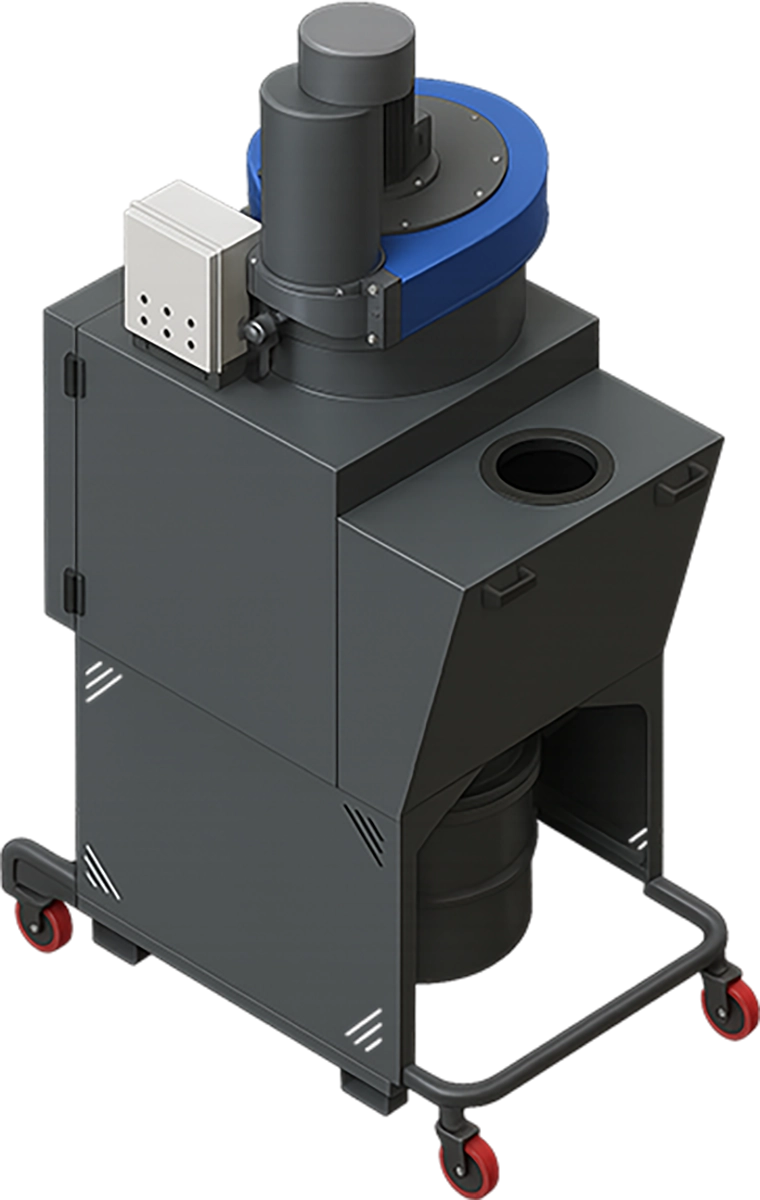
Delfin CUBE 20 K2 PN ACD
Stationary ACD deduster in the CUBE chassis -- 2.2 kW centrifugal fan, 2,500 m³/h, 2 cartridge filters with automatic pulse-jet cleaning, 90 L container, forklift-liftable
- Central suction for combustible wood dust in furniture factories outside ATEX zone classification
- Medium-sized bakeries and flour industries where flour dust is combustible but the area is not ATEX
- Powder coating halls with continuous spray cycles and demanding filter cleaning
- Feed plants with grain, oil-cake or protein powder in non-classified zones
- MDF, OSB and chipboard processing where dust is combustible but ATEX is not required
- IEC 60335-2-69 Annex AA (ACD)
- Low Voltage Directive 2014/35/EU
- EMC Directive 2014/30/EU
Delfin CUBE 20 K2 PN ACD
The Delfin CUBE 20 K2 PN ACD is a stationary ACD deduster in Delfin's CUBE chassis -- an industrial particle collector for combustible dust in non-ATEX classified areas (IEC 60335-2-69 Annex AA). At its core is a 2.2 kW centrifugal fan (three-phase 400 V, IE3, IP65) delivering 2,500 m³/h airflow at 210 mmH²O (21 mbar) static vacuum. What sets the CUBE range apart is the filter system: 2 large cartridge filters (combined 200,000 cm² -- 4 times the filter surface of the ZFR EV's star filter) with automatic pulse-jet cleaning (PN). Compressed air is pulsed through the filter cartridges in an alternating pattern during operation, keeping filter surfaces clean without operator intervention -- built for continuous 8-24 hour operation without shutdown. The 90 L detachable container with internal plastic liner is on wheels for easy emptying. Forklift lifting points in the chassis make moving and positioning straightforward. Ideal for central dust collection systems, bakeries, feed plants and coating halls where dust is combustible but the area is not ATEX classified.
Applications
- Central suction for combustible wood dust in furniture factories outside ATEX zone classification
- Medium-sized bakeries and flour industries where flour dust is combustible but the area is not ATEX
- Powder coating halls with continuous spray cycles and demanding filter cleaning
- Feed plants with grain, oil-cake or protein powder in non-classified zones
- MDF, OSB and chipboard processing where dust is combustible but ATEX is not required
Technical specifications
| ATEX marking | ACD VERSION FOR COMBUSTIBLE DUST IN ORDINARY LOCATION (IEC 60335-2-69 Annex AA -- internal construction equivalent to Zone 20, external non-ATEX) |
|---|---|
| Internal / external zone | 20 / non-ATEX |
| Motor type | IE3 centrifugal fan (2.2 kW, three-phase 400 V), ACD construction for combustible dust in non-ATEX areas (IEC 60335-2-69 Annex AA) |
| Duty cycle | Continuous |
| Airflow | 2500 m³/h |
| Vacuum | 21 mbar (210 mmH₂O) |
| Container | 90 L |
| Sound pressure | 72 dB(A) |
| Filter class | H class |
| Filter type | HEPA H14 (EN 1822-5), 99.995 % MPPS, final filter -- included as standard |
| Primary filter | 2 polyester cartridge filters with PTFE-coated surface, class M antistatic (ANT M), 200,000 cm² total filter area |
| Cleaning system | Automatic pulse-jet cleaning (PN -- pneumatic reverse flushing with compressed air), alternating between cartridges during operation |
| Collection system | Plastic bag |
| Material | Painted steel construction with forklift lifting points in the base (AISI 304 as option) |
| IP class | IP65 |
| Power | 2.2 kW |
| Voltage | 400 V / 50 Hz / 3~ |
| Inlet | Ø 200 mm |
| Dimensions (L × W × H) | 1350 x 880 x 2550 mm |
| Weight | 250 kg |
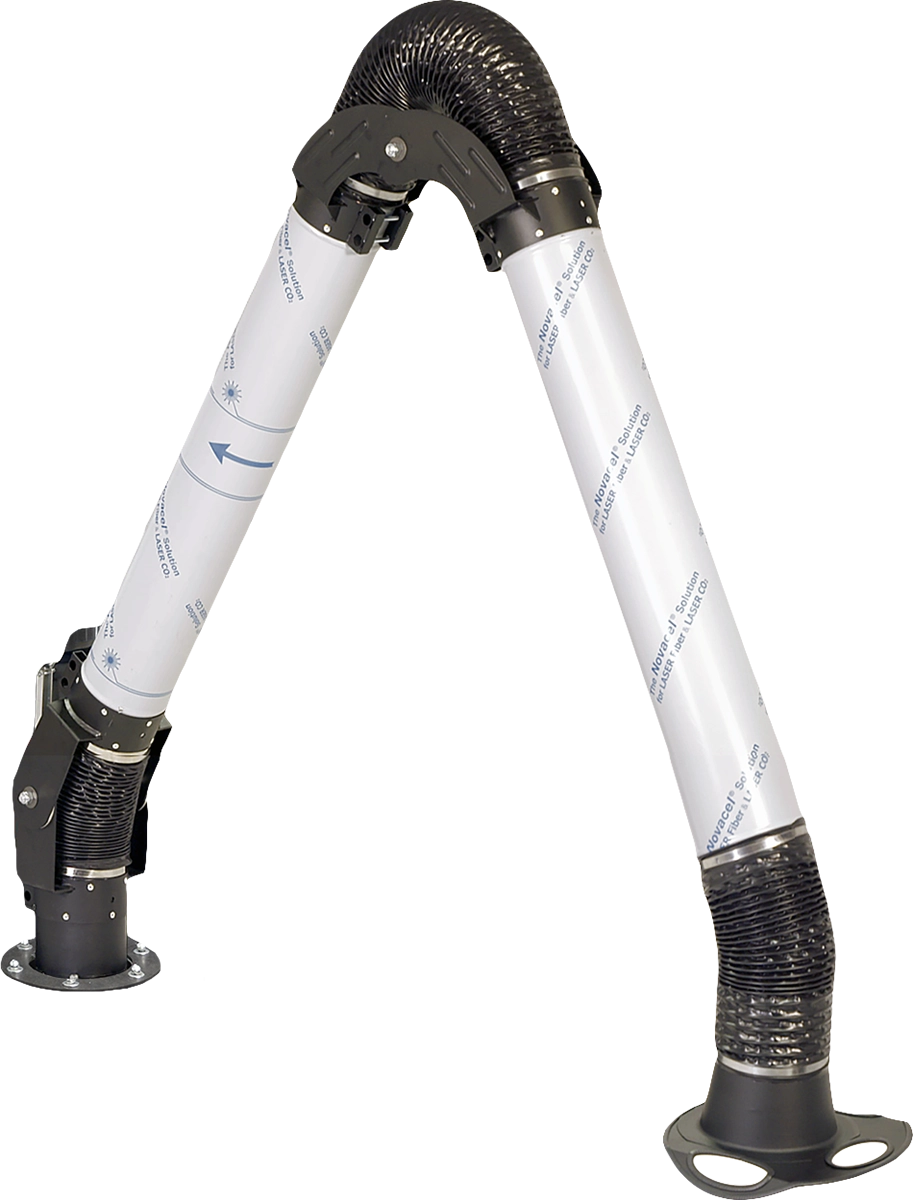
EXTRACTION ARM & SOURCE CAPTURE — CENTRAL DUST COLLECTION
Extraction arm for source capture on central dedusters
An articulated extraction arm is a free-standing, balanced arm that places the deduster's suction point directly at the particle source — welding, grinding, solder fume, bag emptying, mixing stations or quality-control booths. The difference from a fixed hose run is that the operator can adjust the arm's height, reach and angle during operation without tools and without stopping the suction. This delivers far more effective source capture than a general room-extraction system, because the contamination is collected before it reaches the operator's breathing zone.
Why a deduster + extraction arm work so well together
The deduster is a centrifugal-fan based particle collector built for high airflow at low static vacuum — exactly the characteristic an extraction arm needs. The arm's flexible run has low pressure drop per metre, and the wide trumpet-shaped hood at the end loses a small additional amount of vacuum. A centrifugal fan (1,000-3,500 m³/h) supplies the required volume, whereas a side-channel blower (typically 200-400 m³/h at high vacuum) would concentrate the suction on far too small a capture area.
Available dimensions and accessories
Three standard arm configurations are available as accessories, all 3000 mm reach and with earth grounding (MT) included for ESD control: TA.0177.0000 (oe150 arm to oe150 filter chamber inlet), TA.1256.0000 (oe150 arm to oe200 filter chamber inlet — reducing from the deduster's larger inlet to a smaller arm) and TA.0511.0000 (oe200 arm to oe200 filter chamber inlet — maximum airflow). Tubo-flex reductions (SL.2632.0200, SL.6882.0200, SL.3775.0200, SL.6883.0200) allow connection of other hose dimensions, and Y-branches (SL.2775.0200, SL.2692.0200, SL.3022.0200) enable two extraction arms on the same deduster.
Typical industrial scenarios
Arm-equipped dedusters are used for welding fume extraction (MAG, MIG, TIG, arc welding), grinding dust from metal and polymer processing, solder fume and brazing vapours in electronics manufacturing, bag emptying and powder handling in food, pharmaceutical and chemical production, and quality-control booths where particles must be captured but not dispersed. On the ATEX Zone 22 models the arm installation requires ESD earthing throughout the system, and the MT function delivers exactly that. On ACD models (non-ATEX areas with combustible dust) earthing is likewise recommended, because static build-up on the inner wall of the arm can generate ignition sources even without ATEX classification.
Questions and answers
What is ACD, and how does it differ from ATEX?
ACD (Approved for Combustible Dust) is a certification category in IEC 60335-2-69 Annex AA -- a standard for vacuum cleaners handling combustible dust in non-ATEX classified areas. The difference from ATEX is that the ACD area is NOT classified as an explosion-hazardous zone (Zone 20/21/22), but the dust itself is so combustible that it still requires constructive safety measures: earth grounding, antistatic filters, internal temperature limitation and closed enclosure. ACD is the correct certification when your risk analysis demonstrates combustible dust but no explosive atmosphere -- typically because the concentration never reaches LEL (Lower Explosive Limit). If the area IS classified as Zone 22, an ATEX version should be chosen (CUBE 20 K2 PN Z22).
How does the pulse-jet (PN) cleaning work on the cartridge filters?
Pulse-jet (PN -- pneumatic counter-flow cleaning) is an automatic filter cleaning system using short compressed-air pulses to clean the cartridge filters while the deduster operates. The principle is simple: a valve opens for a fraction of a second and sends a short compressed-air pulse (typically 5-7 bar) into the cartridge interior, causing the filter cloth to flex outward and shake the dust layer off the outer surface. Dust falls into the collection container. The pulses alternate between the two cartridges with 10-30 second intervals, so only one cartridge is out of service at a time while the other continues to filter. The result is stable suction-point vacuum over time without manual cleaning -- crucial for continuous operation.
How much compressed air does the pulse-jet cleaning require?
Consumption is modest because the pulses are short. Typical consumption is 50-150 nl/min at 5-7 bar -- in contrast to pneumatic venturi vacuums which draw 500-2,500 nl/min continuously. A standard industrial compressed-air installation at 6-8 bar with a 100-200 L buffer tank can easily supply it. Pulses are fired typically every 10-30 seconds depending on dust load -- the controller adjusts the interval automatically based on filter pressure drop. Important: compressed air must be clean (filter, water separator, cooler) to extend cartridge life -- oil and water in compressed air wear the cartridge coating and can permanently clog the filter cloth.
What does the dual suction inlet mean -- 1 x 200 mm or 2 x 150 mm?
The CUBE 20 has two inlet options. Standard is a single 200 mm inlet (oe200) used when the deduster serves one suction circuit or one extraction arm at full flow. Alternatively, 2 x 150 mm (oe150) can be configured -- two separate inlets each accepting an extraction arm or suction circuit. Total airflow remains 2,500 m³/h, but is now distributed across two points at ca. 1,250 m³/h each. The difference is that the dual configuration allows two operators to work independently without one's start-up disturbing the other's suction-point vacuum -- good for parallel work at welding booths or grinding stations. Choose configuration based on installation architecture.
Why does the CUBE 20 K2 PN ACD weigh 250 kg -- nearly double that of the ZFR EV K2?
The CUBE chassis is built more heavily than the ZFR EV chassis for three reasons. (1) The cartridge filter housing is larger and requires thicker steel walls to be airtight under the pulse-jet cleaning's pressure variations. (2) The built-in forklift lifting points and frame-like sub-chassis require stronger steel beams. (3) The entire unit is built for continuous operation over many years without maintenance, which demands robust components. The higher weight is a feature, not a weakness -- the CUBE is built to operate uninterrupted for 10-15 years. If weight is an issue (low-ceiling installation, upper floors with limited load capacity), consider the ZFR EV range which is 50 % the CUBE's weight with the same airflow.
What type of ACD area typically fits the CUBE 20 K2 PN ACD?
Classic ACD applications in Denmark include (1) the wood sector -- furniture factories, joinery workshops, MDF/OSB production -- where dust is combustible but normal-operation concentrations do not reach zone classification limits, (2) the bakery industry -- flour handling, sieve stations, rye-bread production -- where flour dust is combustible but the plant is ventilated enough to avoid zones, (3) coating and powder coating without gas zones -- where the powder is combustible but spraying happens in extraction booths, (4) feed plants with grain and oily powder -- typically classified as non-Zone in Denmark when the process is ventilated, and (5) lighter chemical industries with organic powders without categorised substances. The prerequisite is always a risk analysis demonstrating that LEL is not reached in normal operation -- if in doubt, the Zone 22 version should be chosen.