
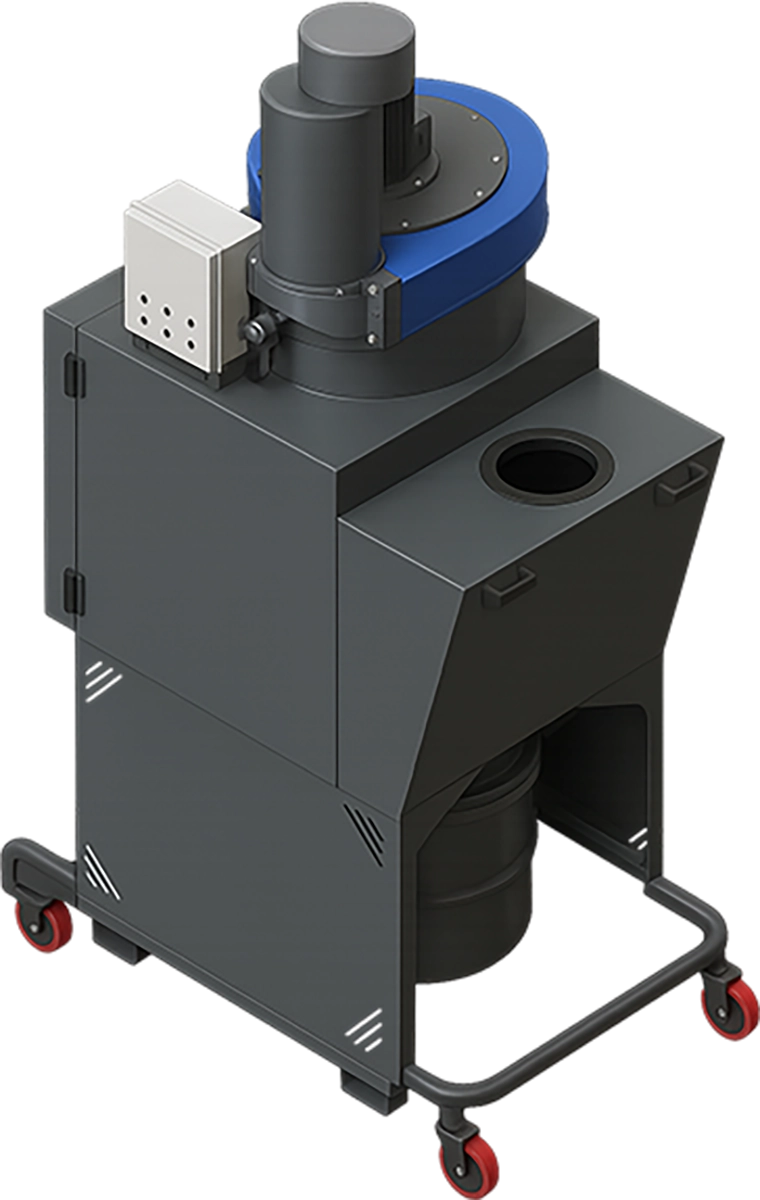
Delfin CUBE 20 K4 PN ACD
Top-model ACD deduster in the CUBE chassis -- 4 kW centrifugal fan, 3,500 m³/h, 36 mbar vacuum, 2 cartridge filters with pulse-jet cleaning, 90 L container, for large central suction systems in non-ATEX zones
- Larger central suction systems with combustible wood dust in MDF and OSB production outside ATEX classification
- Multi-collection-point installations at bakeries and flour mills with multiple simultaneous collection points
- Continuous 24/7 operation in powder coating halls with high dust volume
- Feed plants with multiple machine lines under the same central suction -- grain, soy, oily powders
- MDF milling and chipboard processing with long suction piping and 4-6 simultaneous collection points
- IEC 60335-2-69 Annex AA (ACD)
- Low Voltage Directive 2014/35/EU
- EMC Directive 2014/30/EU
Delfin CUBE 20 K4 PN ACD
The Delfin CUBE 20 K4 PN ACD is the top model in the CUBE ACD range -- a stationary ACD deduster with a 4 kW centrifugal fan and 3,500 m³/h airflow at 370 mmH²O (36 mbar) static vacuum. It is the most powerful combination of automatic pulse-jet cleaning and ACD design in Delfin's portfolio and the correct choice for large central suction systems where dust is combustible but the area is not ATEX classified. With 70 % higher vacuum and 40 % greater airflow than the K2 variant, the K4 can handle 4-6 simultaneous collection points, long central-suction piping, or particularly sticky dust. The 2 cartridge filters (200,000 cm² combined, PTFE-coated polyester ANT M) are cleaned automatically with compressed-air pulses while the unit operates -- stable suction-point vacuum without operator intervention, built for continuous operation. IP65 enclosure, 400 V three-phase, 250 kg robust steel construction with forklift lifting points. Complies with IEC 60335-2-69 Annex AA (ACD).
Applications
- Larger central suction systems with combustible wood dust in MDF and OSB production outside ATEX classification
- Multi-collection-point installations at bakeries and flour mills with multiple simultaneous collection points
- Continuous 24/7 operation in powder coating halls with high dust volume
- Feed plants with multiple machine lines under the same central suction -- grain, soy, oily powders
- MDF milling and chipboard processing with long suction piping and 4-6 simultaneous collection points
Technical specifications
| ATEX marking | ACD VERSION FOR COMBUSTIBLE DUST IN ORDINARY LOCATION (IEC 60335-2-69 Annex AA -- internal construction equivalent to Zone 20, external non-ATEX) |
|---|---|
| Internal / external zone | 20 / non-ATEX |
| Motor type | IE3 centrifugal fan (4 kW, three-phase 400 V), ACD construction for combustible dust in non-ATEX areas (IEC 60335-2-69 Annex AA) |
| Duty cycle | Continuous |
| Airflow | 3500 m³/h |
| Vacuum | 36 mbar (370 mmH₂O) |
| Container | 90 L |
| Sound pressure | 72 dB(A) |
| Filter class | H class |
| Filter type | HEPA H14 (EN 1822-5), 99.995 % MPPS, final filter -- included as standard |
| Primary filter | 2 polyester cartridge filters with PTFE-coated surface, class M antistatic (ANT M), 200,000 cm² total filter area |
| Cleaning system | Automatic pulse-jet cleaning (PN -- pneumatic reverse flushing with compressed air), alternating between cartridges during operation |
| Collection system | Plastic bag |
| Material | Painted steel construction with forklift lifting points in the base (AISI 304 as option) |
| IP class | IP65 |
| Power | 4.0 kW |
| Voltage | 400 V / 50 Hz / 3~ |
| Inlet | Ø 200 mm |
| Dimensions (L × W × H) | 1350 x 880 x 2550 mm |
| Weight | 250 kg |
EXTRACTION ARM & SOURCE CAPTURE — CENTRAL DUST COLLECTION
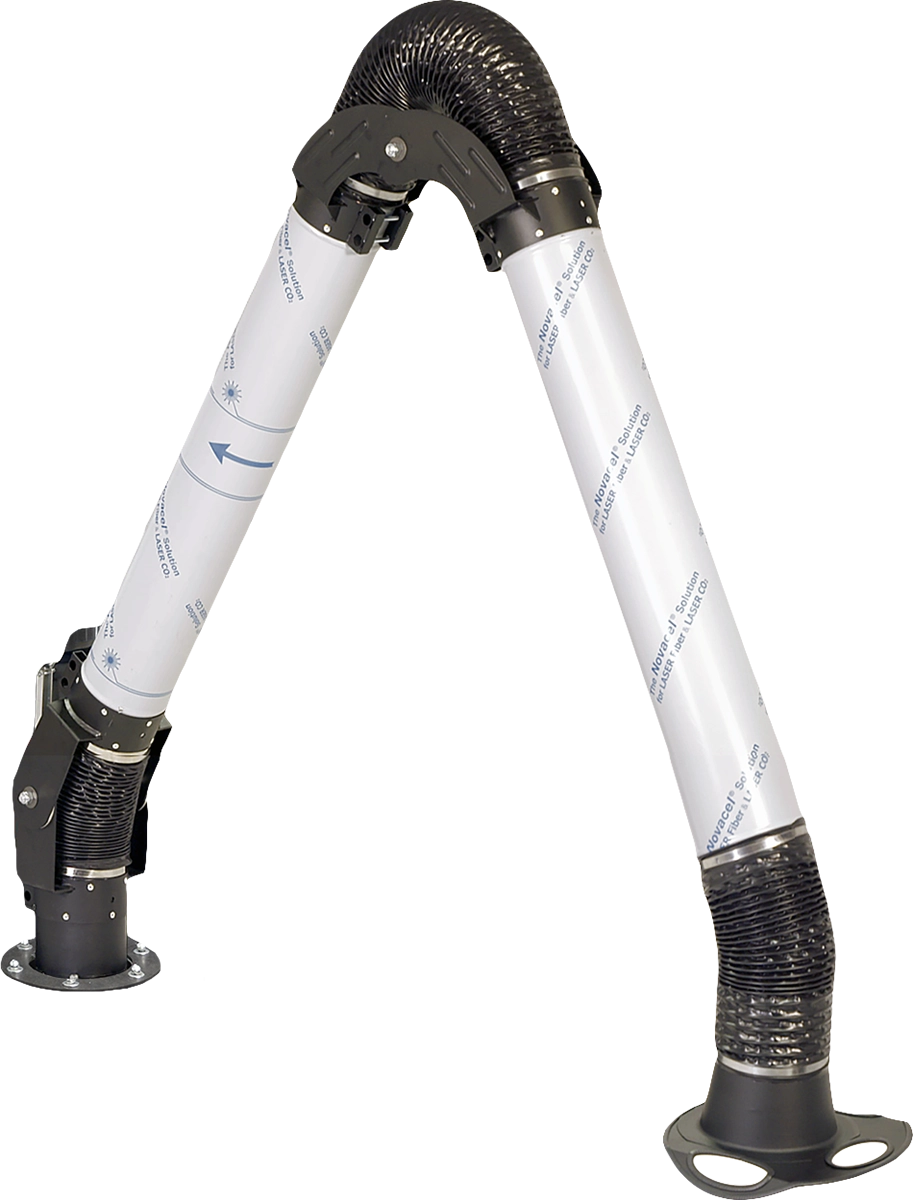
Extraction arm for source capture on central dedusters
An articulated extraction arm is a free-standing, balanced arm that places the deduster's suction point directly at the particle source — welding, grinding, solder fume, bag emptying, mixing stations or quality-control booths. The difference from a fixed hose run is that the operator can adjust the arm's height, reach and angle during operation without tools and without stopping the suction. This delivers far more effective source capture than a general room-extraction system, because the contamination is collected before it reaches the operator's breathing zone.
Why a deduster + extraction arm work so well together
The deduster is a centrifugal-fan based particle collector built for high airflow at low static vacuum — exactly the characteristic an extraction arm needs. The arm's flexible run has low pressure drop per metre, and the wide trumpet-shaped hood at the end loses a small additional amount of vacuum. A centrifugal fan (1,000-3,500 m³/h) supplies the required volume, whereas a side-channel blower (typically 200-400 m³/h at high vacuum) would concentrate the suction on far too small a capture area.
Available dimensions and accessories
Three standard arm configurations are available as accessories, all 3000 mm reach and with earth grounding (MT) included for ESD control: TA.0177.0000 (oe150 arm to oe150 filter chamber inlet), TA.1256.0000 (oe150 arm to oe200 filter chamber inlet — reducing from the deduster's larger inlet to a smaller arm) and TA.0511.0000 (oe200 arm to oe200 filter chamber inlet — maximum airflow). Tubo-flex reductions (SL.2632.0200, SL.6882.0200, SL.3775.0200, SL.6883.0200) allow connection of other hose dimensions, and Y-branches (SL.2775.0200, SL.2692.0200, SL.3022.0200) enable two extraction arms on the same deduster.
Typical industrial scenarios
Arm-equipped dedusters are used for welding fume extraction (MAG, MIG, TIG, arc welding), grinding dust from metal and polymer processing, solder fume and brazing vapours in electronics manufacturing, bag emptying and powder handling in food, pharmaceutical and chemical production, and quality-control booths where particles must be captured but not dispersed. On the ATEX Zone 22 models the arm installation requires ESD earthing throughout the system, and the MT function delivers exactly that. On ACD models (non-ATEX areas with combustible dust) earthing is likewise recommended, because static build-up on the inner wall of the arm can generate ignition sources even without ATEX classification.
Questions and answers
When is the K4 necessary over the K2 on the CUBE chassis?
Same logic as on the ZFR EV: the K4 is the right choice when (1) total piping length exceeds 15-20 metres, (2) the number of simultaneous collection points is 4 or above, or (3) the dust is particularly sticky, heavy or hygroscopic (moist metal dust, moist concrete dust, polymer process with adhesive binder). For ACD installations a fourth reason is added: continuous 24/7 operation over many years requires the extra motor headroom of the K4 to avoid running the motor at its limit under demanding load. The K2 is sufficient for 8-12 hours daily operation with 2-3 points; the K4 is the choice for continuous operation on central-suction architecture.
Can the CUBE 20 K4 PN ACD be used in a Zone 22 installation?
No -- the ACD version is intended for areas that are not ATEX classified (IEC 60335-2-69 Annex AA). If your area is classified as Zone 22 (a place where an explosive atmosphere of combustible dust is not likely to occur in normal operation but, if it does occur, will persist for a short period only), you must choose the CUBE 20 K4 PN Z22 -- the identically-equipped ATEX version. The difference is constructive and certification-wise: the Z22 version has Ex h IIIC T80°C internal / T135°C external marking, a nameplate with ATEX mark and CE documentation per the ATEX directive 2014/34/EU, plus additional tightening of cable seals and dust-tight testing. The ACD version lacks these -- and using an ACD model in a Zone 22 zone is a violation of ATEX regulations regardless of how safe the model might be in practice.
What is the expected cartridge filter life under continuous operation?
Cartridge filter life depends on three factors: dust type, dust loading and pulse-jet cleaning quality. Under typical ACD conditions (wood dust, flour dust, powder coating) and 8-hour daily operation a cartridge life of ca. 3,500-7,000 operating hours is expected -- roughly 2-4 years. Sticky dust (glue, resin, moist flour dust) reduces life to 1-2 years because pulse-jet pulses cannot shake the layer fully off. Continuous 24/7 operation reduces calendar life but not operating-hour life -- cleaning cycles wear less than static loading. Indication of filter replacement: falling suction-point vacuum even after pulse-jet cleaning (typically below 15 mbar at nominal operation) and visible dust pass-through to the HEPA H14 final filter. Filter replacement takes 30-60 min and requires no special tools.
How is the HEPA H14 final filter maintained -- does it also require cleaning?
The HEPA H14 final filter is NOT cleaned during operation, because the filter medium is too fine and fragile for pulse-jet flushing. It captures the small residual fraction that passes the cartridge filters and is replaced according to its condition, the pressure drop and the manufacturer's recommendations; its service life depends on the dust collected. A differential pressure sensor across the HEPA cell is not fitted as standard. Replacement requires access to the filter housing.
Are the forklift lifting points built to move the unit with contents?
The forklift lifting points are designed to move the empty unit (250 kg) or the unit with an empty container. They are NOT dimensioned to carry a fully loaded container of up to 180-200 kg (with heavy metal dust) on top of the 250 kg chassis. If you need to move the unit during operation, the container must be emptied first. Forklift specification: 2 forklift lifting points in the chassis bottom with standard 600 mm forklift tine entry; lifting points are welded to the chassis frame and can carry the unit's full weight. In practice the lifting points are used mostly for (1) initial installation from delivery truck to final position, (2) moving to a technical service area for major renovation, and (3) scrapping at end of life. For continuous use the unit is built to stand fixed.
What is the annual operating cost of the CUBE 20 K4 PN ACD under continuous operation?
Calculate with three main items at 8 hours x 220 days/year = 1,760 operating hours. (1) Electricity: 4 kW nominal, ca. 3.2 kWh/h average (80 % load) = 5,632 kWh/year, at ca. 0.20 EUR/kWh = ca. 1,130 EUR/year. (2) Compressed air for pulse-jet: ca. 100 Nl/min average = 10,560 m³/year, at a typical industrial cost of 0.02 EUR/m³ = ca. 210 EUR/year. (3) Maintenance: cartridge filters (ca. 535 EUR/set, replaced every 2-4 years) ca. 135-270 EUR/year; HEPA final filter (ca. 400 EUR, assuming replacement every 1-2 years depending on the dust) ca. 200-400 EUR/year; misc. (gaskets, valve service) ca. 70 EUR/year. Total ca. 1,750-2,100 EUR/year excluding container emptying and service labour. Under 24/7 operation (8,760 hours) electricity alone rises to ca. 5,600 EUR/year and compressed air to ca. 1,050 EUR/year; filters are replaced correspondingly more often. Amounts are indicative (converted at the exchange rate of 23.09.2026).