
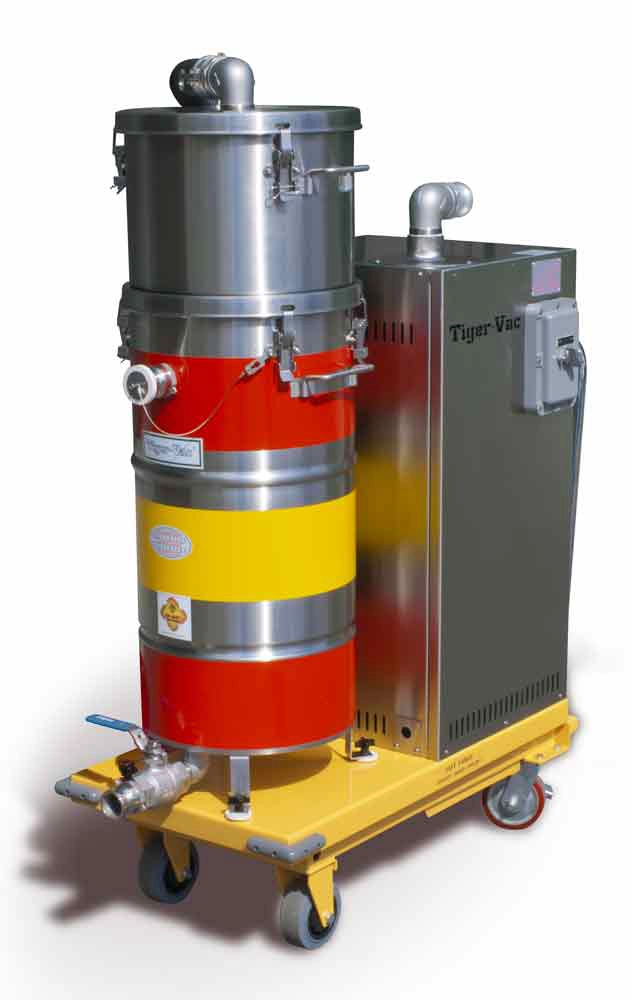
Tiger-Vac CD-25 EX MRAC (HY-C)
TEFC ATEX II 1/2GD flagship with hydraulic lift cart -- Zone 20 internal, Zone 1 + 21 external, 56.8 L dry / 64.4 L liquid, 400V three-phase (2.2 kW) or 230V single-phase (1.5 kW), MRAC filter cleaning, EN 17348 LC
- Defueling and depuddling of military aircraft (F-35, legacy fighters) in hangars
- Recovery of JP-8, Jet A-1 and diesel spills around refueling stations
- Depot work with fuel residues in defense logistics (NSN/NATO)
- Civilian aviation MRO -- wing-tank emptying during service checks
- Chemical industry with flammable solvents (toluene, acetone, alcohols) in Zone 1/21
- ATEX Directive 2014/34/EU -- II 1/2GD External Ex db h IIB T4 Gb / Ex h tb IIIC T135°C Db IP65 -- Internal Ex h IIC T6 Ga / Ex h IIIC T50°C Da -- LCIE 03 ATEX 6295 X -- IECEx LCI 10.0040X -- EN 17348 LC
- EN 17348:2022 (harmonized March 2023)
- IEC 60335-2-69 (industrial vacuums)
Tiger-Vac CD-25 EX MRAC (HY-C)
The Tiger-Vac CD-25 EX MRAC (HY-C) is the TE series' highest certification level: ATEX II 1/2GD -- internal Zone 20/0 (Ga/Da) and external Zone 1/21 (Gb/Db). Internal T6 (Tmax 50 °C), external T4 (Tmax 135 °C). Dual-certified under ATEX (LCIE 03 ATEX 6295 X) and IECEx (LCI 10.0040X). Hydro Cart (HY-C) is a hydraulic lift cart that can raise the 56.8 L tank to working height -- critical when a full 64 L liquid tank weighs 70+ kg and must be lifted to a waste container. MRAC = Manual Reverse Airflow Cleaning for cartridge cleaning without opening the unit. Available in two electric variants: 400V three-phase TEFC (2.2 kW / 4.8 A, part 112600B1) and 230V single-phase TEFC (1.5 kW / 12.3 A, part 112600B3). Both deliver 212 m3/h and 2540 mmH2O.
Applications
- Defueling and depuddling of military aircraft (F-35, legacy fighters) in hangars
- Recovery of JP-8, Jet A-1 and diesel spills around refueling stations
- Depot work with fuel residues in defense logistics (NSN/NATO)
- Civilian aviation MRO -- wing-tank emptying during service checks
- Chemical industry with flammable solvents (toluene, acetone, alcohols) in Zone 1/21
Technical specifications
| ATEX marking | II 1/2GD External Ex db h IIB T4 Gb / Ex h tb IIIC T135°C Db IP65 -- Internal Ex h IIC T6 Ga / Ex h IIIC T50°C Da -- LCIE 03 ATEX 6295 X -- IECEx LCI 10.0040X -- EN 17348 LC |
|---|---|
| Internal / external zone | -- / 21 |
| Motor type | Three-phase TEFC motor (standard), explosion-proof (External Ex db h IIB T4 Gb / Ex h tb IIIC T135°C Db), 2.2 kW / 4.8 A, 400 V / 50 Hz |
| Duty cycle | |
| Airflow | 212 m³/h |
| Vacuum | 249 mbar (2540 mmH₂O) |
| Container | 56.8 L |
| Sound pressure | 72 dB(A) |
| Filter class | Stainless steel mesh filter (not HEPA-classified, for liquid recovery) |
| Filter type | Stainless steel mesh filter (213433) + activated carbon filter included -- inline in stainless steel housing |
| Primary filter | Stainless steel mesh (213433) + activated carbon filter cartridge (211045) included + strainer basket. |
| Cleaning system | MRAC (Manual Reverse Airflow Cleaning) -- cartridge cleaning without opening the unit |
| Collection system | Detachable container |
| Material | AISI 304 stainless steel |
| IP class | IP65 |
| Power | 2.2 kW |
| Current | 4.8 A |
| Voltage | 400 V / 50 Hz / 3~ (standard) -- 230 V / 50 Hz / 1~ option |
| Inlet | Ø 38 mm |
| Dimensions (L × W × H) | 1350 x 510 x 1520 mm |
| Weight | 203 kg |
Questions and answers
What does II 1/2GD mean and why does it matter over II 2GD?
II 1/2GD is a higher ATEX class than II 2GD. The first digit is the INTERNAL category (the part of the unit in contact with fuel/dust), the second is the EXTERNAL category (the unit seen from outside): 1 = Zone 0/20 (permanent risk), 2 = Zone 1/21 (periodic risk). The CD-25 therefore has internal '1' (Zone 20 construction -- dust may be present more than 1000 h/year) and external '2' (Zone 1/21). The rest of the TE series has '2' internally. The difference matters during emptying and maintenance where the operator may contact the unit's interior: on II 2GD, the unit must cool down and zone classification be checked each time; on II 1/2GD, the internal zone classification is inherently certified.
Why a hydraulic lift cart (Hydro Cart)?
A 64 L liquid tank with 1.0 kg/L fuel weighs 64 kg -- plus the tank's own weight, a full unit reaches about 70-80 kg just for the tank. Lifting that manually to a 90 cm waste container is not realistic. The Hydro Cart uses a hydraulic pump (not electric, for ATEX reasons) to raise the entire tank to working height. This eliminates manual lifting, reduces spill risk, and makes emptying possible for a single operator. In defense contexts where the same unit is used by multiple operators over a 24-hour rotation, ergonomics is a real operational factor.
400V or 230V -- which variant should I choose?
Both deliver the same performance (212 m3/h, 2540 mmH2O). The choice depends on your electrical infrastructure: 400V three-phase (112600B1) is standard industrial mains in Europe with typically lower current (4.8 A) and more stable operation; 230V single-phase (112600B3) is wall-outlet level and suited to mobile operations where three-phase is unavailable, but requires 12.3 A which can be problematic on weak circuits. Defense procurements typically choose 400V three-phase for their hangars. Field work and mobile operations choose 230V single-phase.