
Tiger-Vac SS-25 (TC) TE
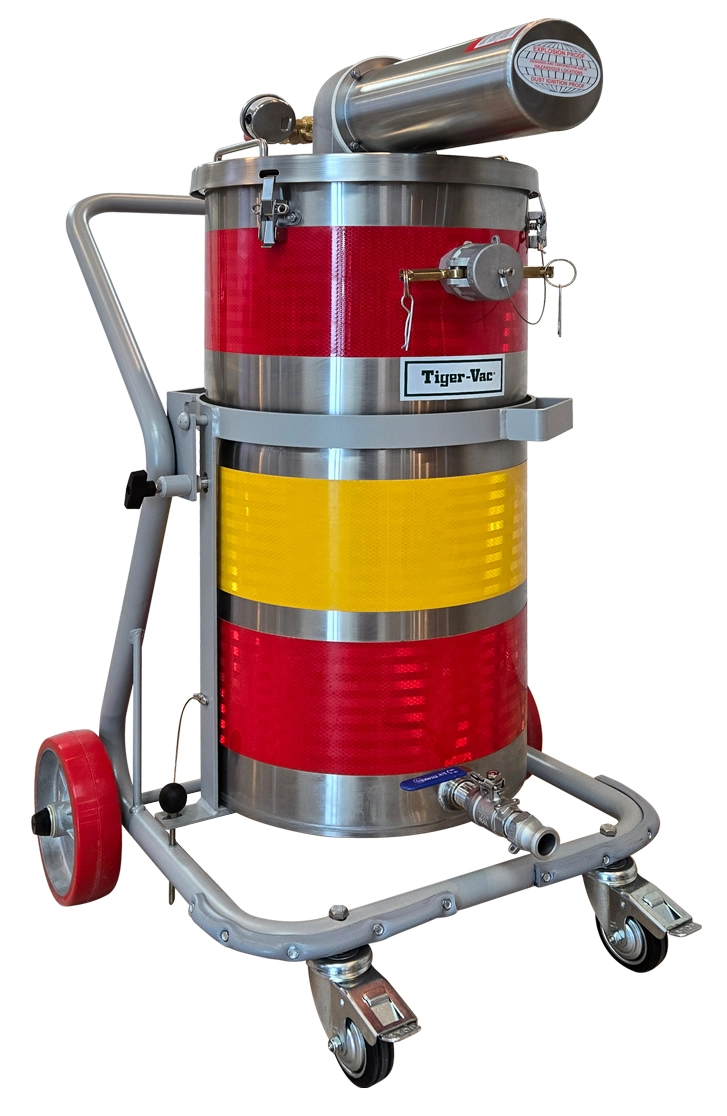
Pneumatic venturi ATEX T6 vacuum for Zone 1 gas + Zone 21 dust -- 56.8 L dry / 64.4 L liquid, Tilt Cart (TC) for fuel recovery, EN 17348 LC for flammable liquids -- 56.8 L dry / 64.4 L liquid, 75 dB(A), EN 17348-certified variant available
- Defueling and depuddling of military aircraft (F-35, legacy fighters) in hangars -- zero electrical ignition risk
- Depot work and field operations where compressed air is more readily available than 230V
- Recovery of JP-8 and Jet A-1 in areas with high vapour concentration
- Continuous process extraction without motor overheating (24/7 operation possible)
- Chemical industry with flammable solvents (toluene, acetone, MEK) in Zone 1/21 where T6 rating is required
- ATEX Directive 2014/34/EU -- II 2GD Ex h IIC T6 Gb / Ex h IIIC T85°C Db -- LCIE 03 ATEX 6310 X -- IECEx LCIE 17.0076 X -- EN 17348 LC
- EN 17348:2022 (harmonized March 2023)
- IEC 60335-2-69 (industrial vacuums)
Tiger-Vac SS-25 (TC) TE
The Tiger-Vac SS-25 (TC) TE is the mid-size in pneumatic explosion-proof vacuum for the recovery of fuel and flammable liquids in ATEX Zone 1 (gas) and Zone 21 (dust). Driven exclusively by compressed air through a single venturi unit -- no electrical components, no ignition risk, and ATEX T6 class (max 85 °C surface temperature). Certified to EN 17348 LC (flammable + non-flammable liquids) and dual-certified under ATEX (LCIE 03 ATEX 6310 X) and IECEx (LCIE 17.0076 X) for international defense procurement. The Tilt Cart (TC) construction tips the entire tank for emptying without lifting, a real ergonomic and safety advantage for a 64.4 litre full liquid tank. 204 m3/h airflow, 5080 mmH2O vacuum at 5.5 bar supply pressure. AISI 304 stainless construction, activated carbon filter optional for VOC vapours, only 75 dB(A) sound level. Requires a 15 HP compressor with 21.2 L/s capacity.
Applications
- Defueling and depuddling of military aircraft (F-35, legacy fighters) in hangars -- zero electrical ignition risk
- Depot work and field operations where compressed air is more readily available than 230V
- Recovery of JP-8 and Jet A-1 in areas with high vapour concentration
- Continuous process extraction without motor overheating (24/7 operation possible)
- Chemical industry with flammable solvents (toluene, acetone, MEK) in Zone 1/21 where T6 rating is required
Technical specifications
| ATEX marking | II 2GD Ex h IIC T6 Gb / Ex h IIIC T85°C Db -- LCIE 03 ATEX 6310 X -- IECEx LCIE 17.0076 X -- EN 17348 LC |
|---|---|
| Internal / external zone | -- / 21 |
| Motor type | Pneumatic venturi unit (single venturi, 6 mm), no electrical components -- ATEX T6 class (Tmax 85 °C) |
| Duty cycle | Continuous |
| Airflow | 204 m³/h |
| Vacuum | 498 mbar (5080 mmH₂O) |
| Container | 56.8 L |
| Sound pressure | 75 dB(A) |
| Filter class | Stainless steel mesh filter (not HEPA-classified, for liquid recovery) |
| Filter type | Stainless steel mesh filter with clamp (part 213433) -- activated carbon filter (211045) optional for VOC/vapours |
| Primary filter | Stainless steel mesh filter (213433). Strainer basket included. Static conductive construction (< 10 ohm resistivity). |
| Cleaning system | None (manual) -- mesh filter is removed and rinsed clean |
| Collection system | Detachable container |
| Material | AISI 304 stainless steel (except cart) |
| Air consumption | 1272 nl/min |
| Supply pressure | 5.5 bar |
| Air supply hose | Ø 12.7 mm |
| Venturi units | 1 pcs |
| Inlet | Ø 38 mm |
| Dimensions (L × W × H) | ? x 690 x 1090 mm |
| Weight | 45 kg |
Questions and answers
What's the advantage of pneumatic venturi over an electric TEFC motor?
Zero electrical ignition risk. A pneumatic vacuum is driven exclusively by compressed air passing through a venturi nozzle system that creates negative pressure by aerodynamic effect. No motor, no sparks, no hot electrical component -- only mechanical airflow. This qualifies the unit for T6 class (max 85 °C surface temperature), while an electric TEFC motor can only achieve T3 (200 °C). T6 is required in certain high-risk applications such as F-35 fuel tanks or hydrogen areas where even a 100 °C surface can ignite flammable vapours. The downside is the compressor requirement (minimum 15 HP + 21.2 L/s air at 5.5 bar) -- in the field, compressed air can be the limiting factor.
What compressor do I need?
Minimum 15 HP (11 kW) compressor delivering 21.2 L/s (1272 NL/min) at 5.5 bar continuously. This corresponds to a mid-scale industrial compressor -- e.g. Atlas Copco GA11, Kaeser AirTower 11 or equivalent. You also need a 1/2" (12.7 mm) hose from the compressor to the unit, and the unit can be operated continuously as long as the compressor maintains pressure. For field work, a mobile compressor (e.g. Atlas Copco XAS 97) can be used -- be aware of the compressor's own fuel; a diesel compressor can become an ignition source inside an ATEX zone and should be placed outside the zone with the air hose run in.
Why T6 instead of T3 -- what does it mean in practice?
T6 is ATEX's strictest temperature class: maximum surface temperature 85 °C. T3 is 200 °C. For most fuels such as diesel or Jet A-1, T3 is sufficient because auto-ignition temperature is 210-230 °C. But for hydrogen, acetylene, and certain aerosolised aromatics (such as benzene vapours at high concentration), even 90-120 °C surface temperature can trigger ignition. T6 is also required in many newer defense specifications (NATO STANAG, US Air Force TO-0 series) where a single worst-case class is chosen for all tasks. SS-TE models are built to T6 because the pneumatic construction makes it physically impossible to exceed 85 °C.
What's the difference between the SS (pneumatic) and EXP1 (electric) TE series?
Same chassis family, same Tilt Cart, same filtration (stainless mesh + activated carbon optional), same EN 17348 LC certification. But the motor is fundamentally different: EXP1 is single-phase TEFC electric (230V), SS is pneumatic venturi (compressed air). Choice depends on available energy and risk level: When you have 230V and T3 is sufficient -- choose EXP1 (lighter, no compressor requirement, longer hose reach via cable). When you have compressed air and T6 is required, or you work in ultra-high-risk areas (hydrogen, F-35, rocket fuel) -- choose SS. In practice, many defense units choose SS models because NATO/US Air Force specifications typically require T6.
What's the difference between SS-25 (TC) TE and SS-25 (TC) TE EN17348 VERSION?
Technical specifications are identical (same motor, same flow, same tank, same filter). The only difference is certification documentation: EN17348 VERSION (part number 110274-17348) is supplied with an explicit EN 17348 LC certificate and can be used in procurements where the standard must appear verbatim in tender documents. For defense procurement after March 2023 (when EN 17348 was harmonised), EN17348 VERSION is the normal choice. For existing customers with ongoing contracts referencing the older specification, the 110274 standard version can still be supplied. Talk to us if you are unsure which version your tender requires. Note: the PDF does not provide the length dimension for this model -- we will supplement as soon as Tiger-Vac delivers the data.