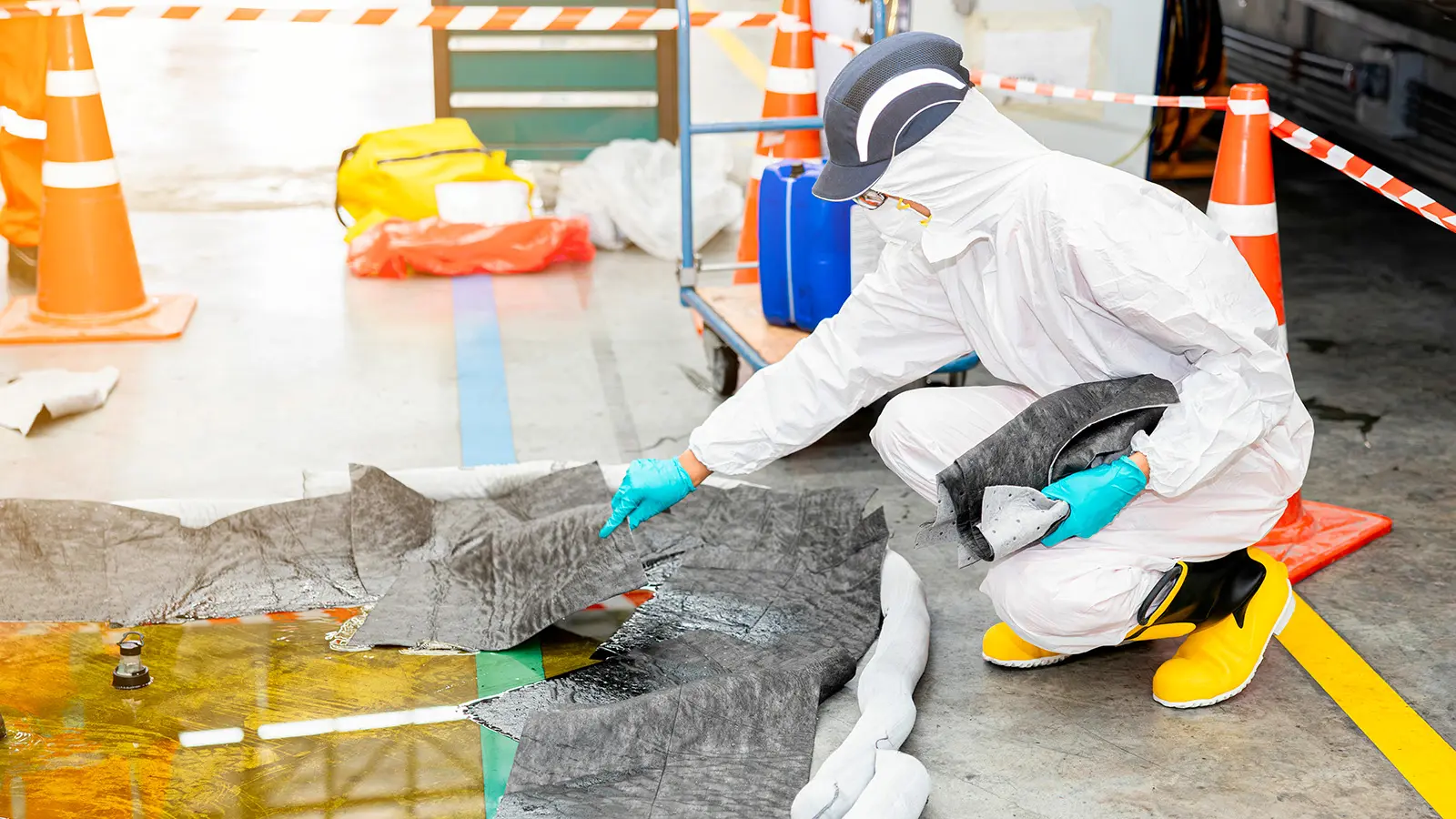
In many industries, the focus on PPE, CE marking and ATEX classification is firmly in place. But when a spill occurs, it is often practice — not equipment — that fails. Because what do you actually do when a small pool of base, acid or solvent ends up on the floor?
This article looks at the overlooked side of safety: the practical handling of spilled hazardous liquids — including corrosive, flammable and health-damaging substances. Perhaps this is precisely where your risk assessment falls short.
We document everything — until liquid hits the floor
Modern industrial production involves millions invested in safety and precision. We build ATEX zones, cleanrooms and closed systems where every gram of dust or millilitre of liquid can represent a risk. Sensors are validated. PPE is CE marked. Filter efficiency is documented.
But what happens when someone drops a bottle of base, or spills a little solvent during cleaning? How is it handled in practical terms? Is a cloth fetched? A mop? A neutralising dry powder? A collection vessel? Or is it a combination, depending on who discovers the spill and where it happens?
We know that some workplaces have detailed emergency plans and specialist equipment. But we also know that many minor spills are handled quietly. Informally. Without documentation. That is rarely malicious — it is more often routine. And that may be exactly the problem.
Inconsistencies in everyday practice
It is often the small situations that reveal the large inconsistencies. A few millilitres beneath a tank nozzle. Residual liquid in a CIP system. A bottle dripping slightly from the cap. Incidents that do not necessarily trigger an alarm, but that nonetheless carry a risk — particularly if the response is inconsistent, imprecise, undocumented or entirely informal.
In some ATEX installations, flammable liquids are wiped up with paper cloths that have no earthing connection. In cleanrooms, household buckets are sometimes used for acid waste. In process environments, steaming liquids are collected with equipment that has neither a carbon filter nor acid-resistant materials. And there are still workplaces where staff have no clear guidelines for whether the liquid in front of them is acidic, alkaline or flammable — and what that means for how it should be collected.
All of this is understandable. It is practical. It is well-intentioned. But it is rarely sufficient.
Many corrosive liquids are transparent, odourless and resemble water. Yet even in small quantities they can cause corrosion, vapour damage and personal injury — particularly if left unattended. Concentration is not the only factor that matters.
A “mild” acid can become dangerous if it evaporates, reacts with another material, or spreads into a sensitive area. In a cleanroom, a few millilitres can mean the rejection of an entire batch. In an ATEX zone, even a small droplet can become an ignition source if it evaporates to a flammable vapour under the right conditions.
The risk is determined not by how the liquid looks, but by what the liquid actually is. That requires knowing what you are dealing with — and choosing your equipment accordingly.
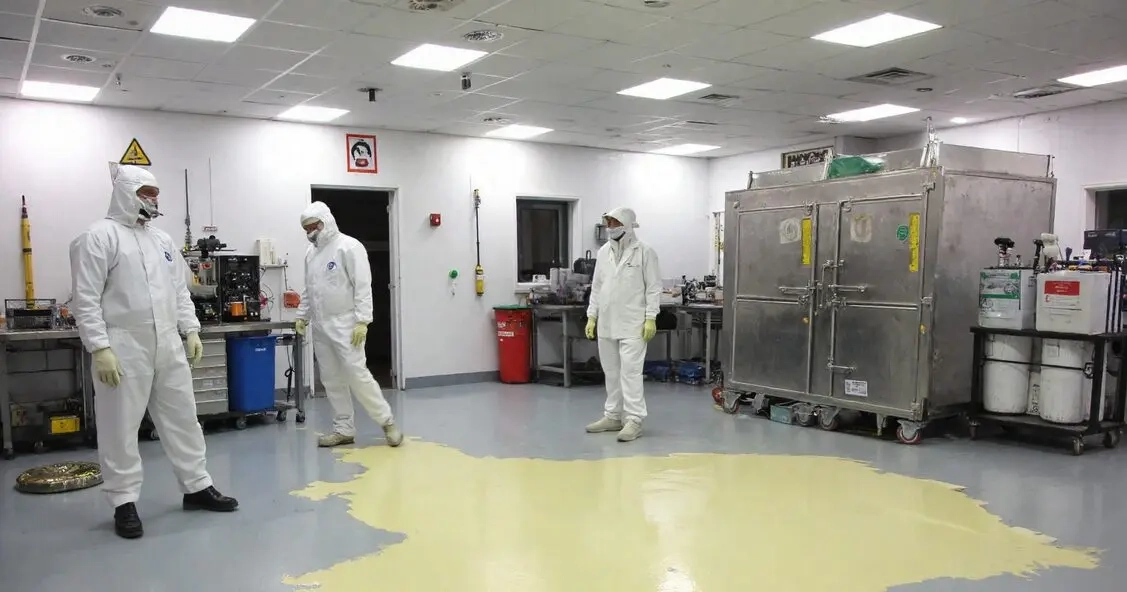
What is actually the problem?
The problem does not necessarily arise at the moment of the spill. It arises in how we respond — and what we choose to do afterwards. When minor incidents are handled with improvisation or informal routines, it sends a signal: This is not that important.
But liquids evaporate. Acids corrode. Solvents can be both flammable and harmful to health. And if they are handled incorrectly — or simply without attention — the consequences go beyond immediate injury: chemical contamination of indoor air, corrosion of equipment, strain on ventilation systems, or the gradual build-up of flammable vapours.
It is not about doing everything perfectly. It is about doing it deliberately. When collecting a liquid, we should know what it consists of, what risk it poses, how it affects equipment, materials, people and the environment — and which equipment is genuinely suitable. That may seem like overkill in the moment. But it is precisely when it feels unnecessary that consequences have a way of creeping in.
Why don’t we talk about this more?
Perhaps because it seems trivial. Because spills and cleaning are everyday tasks that no one wants to question. Because it almost feels embarrassing to raise concerns about something that happens quietly several times a day. Because it is not exciting enough to feature in the next safety review. Or perhaps because investment in appropriate equipment is deprioritised when no one takes a clear view of the risks and the scale.
But here lies a blind spot. When we discuss chemical handling, the conversation tends to focus on storage, dosing, extraction and protective equipment. But once something has been spilled — and needs to be removed — it falls outside many systems. It is neither a process nor a machine. It is simply… something someone does.
That is why ownership is often missing. No one is entirely sure whether it belongs to production, cleaning, the safety group or maintenance. And in that no-man’s-land, the lowest common denominator tends to prevail: we do what we have always done. That is where the conversation needs to start — not with equipment, but with awareness.
You may be spraying particles without knowing it
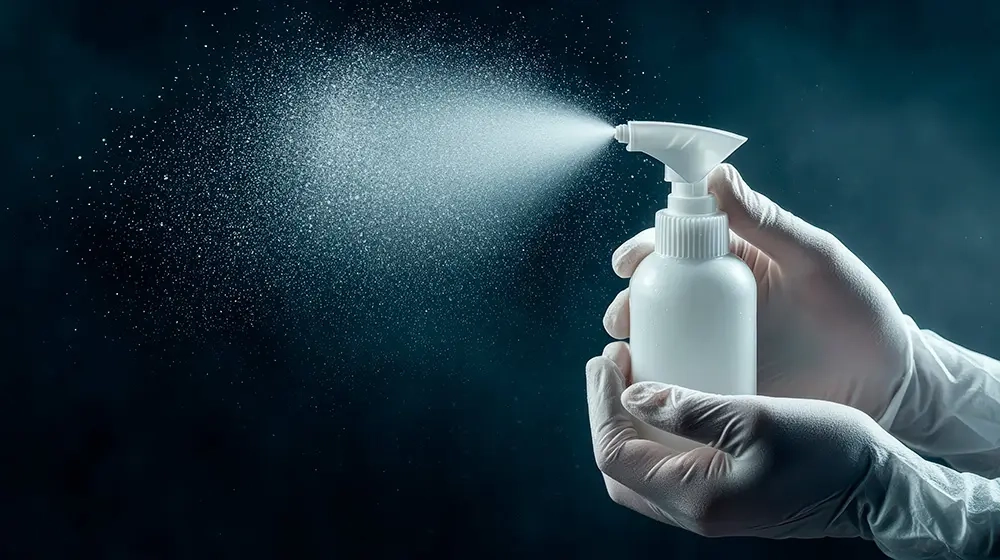
In sterile environments, the concern is not only what is on the floor — but what gets re-suspended into the air. When a conventional wet vacuum collects corrosive or volatile liquids, it risks redistributing harmful vapours and aerosols back into the room if it lacks both a proper particulate filter and an active carbon filter.
The effect is comparable to spraying chemical particles into a controlled environment — but without being able to see it happening. In a cleanroom, invisible particles are far more dangerous than visible contamination: they can settle on equipment and products, cause cross-contamination and in the worst case compromise the entire classification under ISO 14644-1.[1]
It is important to understand that particulate filters and active carbon filters address two fundamentally different problems — and cannot substitute for one another. HEPA and ULPA filters retain particles: solid or liquid fragments suspended in air. A HEPA H14 filter retains 99.995 % of particles at the most penetrating particle size, while a ULPA U15 filter reaches 99.9995 % — both classified to EN 1822.[2] However, both perform poorly against gaseous substances. The vapours from volatile liquids — alcohols, solvents, acids — consist of molecular compounds that pass freely through a particulate filter. This is not a deficiency of the filter; it simply was not designed for that task.
An active carbon filter operates on an entirely different principle: adsorption. Activated carbon has an extremely large internal surface area — typically around 1,000 m² per gram — and organic vapour molecules bind physically to the carbon structure as air passes through it.[3] In this way, vapour is removed from the airstream before it is returned to the room. Carbon filters are particularly effective against volatile organic compounds (VOCs), including many solvents and acid vapours. They are not universal, however: very light gases such as hydrogen are adsorbed less effectively, and the filter’s capacity is finite — its surface area gradually becomes saturated, requiring regular replacement.
The conclusion is straightforward: a particulate filter alone is insufficient when collecting volatile or corrosive liquids. The two filter types complement each other, and neither can be dispensed with in a controlled environment where the goal is to prevent both particles and vapours from being recirculated. This is not a luxury. It is a prerequisite.
Do you work with volatile chemicals in cleanrooms or ATEX zones?
At Particulair, we advise on the right equipment for your specific combination of requirements — cleanroom classification, chemical profile and ATEX category. We start not with products, but with questions.
Ask an expertIt starts with awareness, not equipment
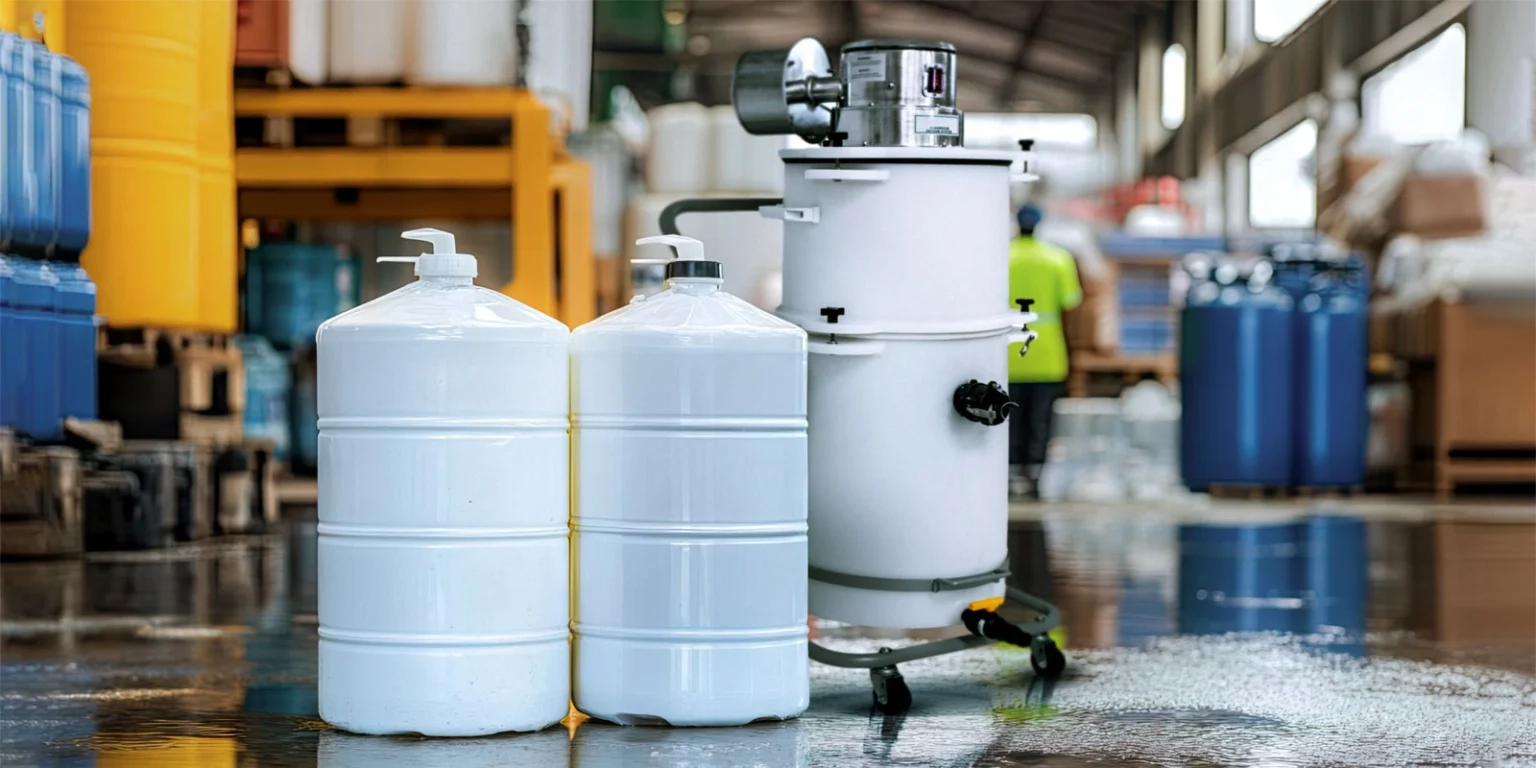
Equipment capable of handling aggressive liquids safely does exist. Filters, vessels, materials and solutions for ATEX, cleanroom and wet-chemical environments are all available. That is not what is missing.
What is missing is the willingness to take the situation seriously enough to ask: Are we doing this in a way we can defend? Because perhaps it is not the vacuum or the collection vessel that is the weakest link. Perhaps it is the fact that nobody has asked whether what is currently in use is actually appropriate. Or that someone once chose a solution in good faith — and since then, nothing has been revisited.
That is not an accusation. It is an invitation to look more closely at what we do when we are not thinking about it too carefully. Because that is precisely where the opportunity for improvement tends to hide.
What does correct collection mean?
Correct collection is not simply about removing liquid from the floor. It means containing vapours before they disperse, avoiding static electricity that could ignite flammable vapours, using materials that are chemically compatible with the liquid, filtering correctly with both a particulate filter and a carbon filter when a vacuum is used — and ensuring traceability where documentation requirements apply, such as in ISO-classified cleanrooms or ATEX zones.[4]
In many cases the problem is not the volume of liquid, but the equipment used to remove it. A poor choice can in the worst case amplify the risk rather than reduce it: a wet vacuum without earthing in an ATEX zone, a plastic acid container that gradually degrades under chemical attack, or a standard filter that recirculates vapours directly back into the working environment.
Improving practice does not necessarily require significant investment. What it requires, first and foremost, is that someone asks the question.
Is your liquid collection practice on a par with the rest of your safety system?
We are happy to review your current setup and assess whether equipment, materials and procedures are matched to the environments you work in.
Contact us- ISO 14644-1:2015 — Cleanrooms and associated controlled environments — Part 1: Classification of air cleanliness by particle concentration. iso.org
- EN 1822:2019 — High efficiency air filters (EPA, HEPA and ULPA). Defines filter classes E10–U17 and test methods at MPPS (Most Penetrating Particle Size). en-standard.eu
- Zhu, L.; Shen, D.; Luo, K.H. “A critical review on VOCs adsorption by different porous materials: species, mechanisms and modification methods.” Journal of Hazardous Materials 389 (2020): 122102. doi.org/10.1016/j.jhazmat.2020.122102
- ATEX Directive 2014/34/EU — Equipment and protective systems intended for use in potentially explosive atmospheres. eur-lex.europa.eu
- Seveso III Directive 2012/18/EU — Control of major-accident hazards involving dangerous substances. EUR-Lex (official text). eur-lex.europa.eu
- American Chemical Society (ACS). Guide for Chemical Spill Response Planning in Laboratories. acs.org
- U.S. OSHA. Chemical Hazards and Toxic Substances. osha.gov
- Canadian Centre for Occupational Health and Safety (CCOHS). Spill Response — Chemicals. ccohs.ca
- OECD. Chemical Accidents Involving Nanomaterials — Potential Risks and Review of Prevention, Preparedness and Response Measures (2022). doi.org/10.1787/6395f7ce-en
- IChemE. Risks of High Flash Point Liquids in Relation to the ATEX 137 Directive. icheme.org
- EU Joint Research Centre (MAHB). Prevention and Preparedness of Chemical Accidents — Bulletin 16. minerva.jrc.ec.europa.eu