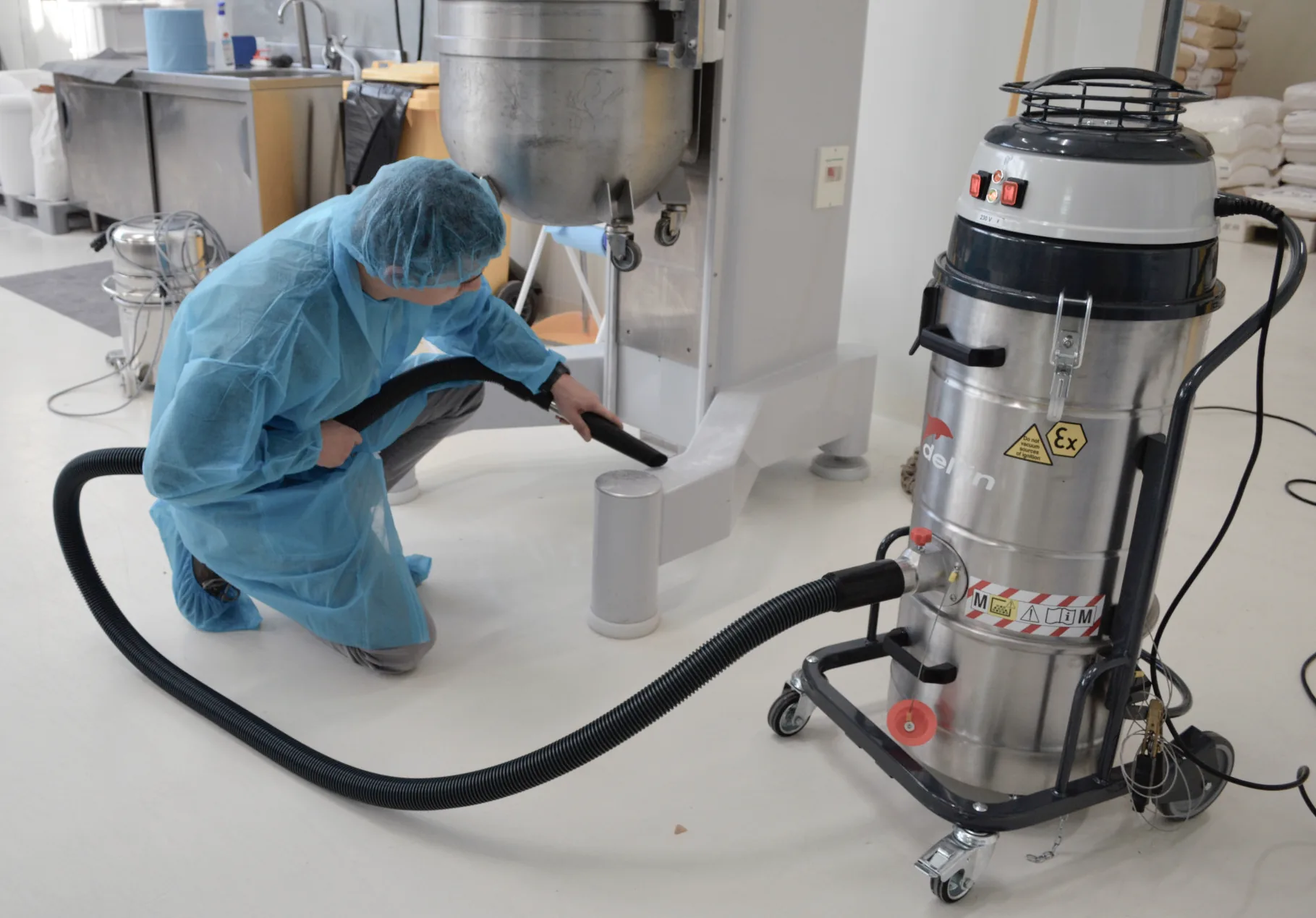
When people talk about ATEX and vacuum cleaners, the conversation typically turns immediately to explosion-proof motors, correct zone classification and major technical decisions. But one of the most important and most overlooked elements concerns something far more practical: hoses, nozzles and couplings. Because even a well-certified vacuum cleaner is only as safe as the accessories connected to it. If the hose is not continuously conductive, or if the earthing connection is broken at a loose coupling, the entire ATEX safety system has been compromised without anyone necessarily noticing.
What are the requirements for accessories in ATEX zones?
Are there requirements for accessories and hoses in ATEX zones? Yes. Clear, measurable and legally binding requirements. Accessories must comply with the ATEX Directive 2014/34/EU and meet the technical requirements of EN 17348:2022, EN 60079-32-1, EN ISO 80079-36/37 and EN 1127-1.[1]
But do not get lost in directives and standards just yet. This article is designed to equip you with an understanding of what the requirements actually mean in daily practice, not just on paper or in theory.
Every single day, hoses, couplings and nozzles are used in explosive areas that should not be there. Not because anyone wants to cause an explosion, but because many people are simply unaware that it is the accessories that fail most often. Not the vacuum cleaner itself.
The failures we see again and again
Many setups look correct at first glance. The accessories are connected, the hoses are black, and the nozzle looks professional. But on closer inspection, the failures that make equipment unsuitable for ATEX zones become apparent.
A classic example is galvanised steel pipes, which are often chosen to keep costs down. The actual risk of galvanised pipes in ATEX zones is not that the zinc coating becomes brittle over time, but that zinc under heavy impact or friction can react thermally with rust on adjacent metal surfaces. This thermite reaction, recognised as an ignition source under EN 1127-1 and well documented in IChemE research literature,[8] produces extremely energetic sparks sufficient to ignite flammable vapours, gases and dust clouds. This is not a hypothetical scenario. It occurs in practice when accessories strike other metal components, or when hard particles are conveyed at high velocity through the system.
We also see plastic nozzles with no dissipative properties. While these work perfectly well for ordinary dust, they are directly hazardous in explosive areas because they cannot drain static electricity.
Hoses without continuous electrical conductivity are another typical source of failure. This is particularly common in cheaper models where only the outer surface has been treated with an antistatic coating, but where the inner surface in direct contact with the dust stream has no conductive properties at all. The result is charge accumulation that cannot be earthed.
Finally, we far too often see couplings with no proper earthing conductor or measurement point. This means the earthing chain cannot be documented or measured, and in practice the connection is often broken at one or more points.
Antistatic is not the same as safe
It is not uncommon for someone with good intentions to point at a black hose and say: “Do not worry, it is antistatic.” But that is not the same as safe.
An antistatic surface reduces static build-up, but that does not necessarily mean the hose is conductive. And it is precisely conductivity that matters in ATEX zones: a continuous, electrically conductive chain that can effectively carry charges away all the way from the nozzle to the vacuum cleaner.
The distinction is not trivial. An antistatic hose is typically made from a material that limits charge build-up on the outer surface by having a surface resistance in the dissipative range, that is, somewhere between conductive and insulating. A conductive hose is something different entirely. It has a continuous, measurable electrical connection from one end to the other, typically via an embedded copper wire or spiral, and it can be verified with a multimeter. Only the latter meets the requirements for ATEX zones, because only the latter can function as a verifiable link in the earthing chain.
This is precisely where many collection systems fail. Not because anyone made a deliberate wrong choice, but because the market is full of products marketed as “antistatic” or “ATEX-suitable” without meeting the specific electrical conductivity requirements set by EN 17348:2022 and EN 60079-32-1.
Material selection and its consequences
When choosing hoses and nozzles for ATEX environments, the decision is not just about diameter and flexibility. It is fundamentally about materials and how they behave, both electrically and mechanically.
Hoses are available in many variants: PU (polyurethane), TPE, rubber, or composites with embedded copper wire. The most reliable solutions have a continuous conductive structure, either via an embedded spiral or through the hose material itself. What matters is that the hose can drain charges along its entire length, and that this can be documented.
When it comes to pipes and nozzles, many choices are made on the basis of weight or price. Aluminium is light, galvanised steel is cheap. But stainless steel is in most cases a strong choice for ATEX zones. It has a low risk of thermite reaction, high mechanical strength and maintains its properties over time. Conductive rubber can also be used, provided it has been tested and documented. Aluminium can in some circumstances initiate a thermite reaction when struck hard against rusted steel surfaces, because aluminium is the primary fuel in precisely this reaction type. Galvanised pipes carry a similar risk from the zinc-rich coating. Stainless steel avoids both of these scenarios and is for this reason the standard material in professional ATEX accessories.
Earthing in practice — what is required, and what do the numbers mean?
An ATEX-certified vacuum cleaner is not in itself a guarantee of safety. What matters is whether the complete installation, including hose, couplings and nozzle, functions as a single electrically connected system capable of effectively draining static electricity.
To understand the requirements it is helpful to distinguish between the two standards in the EN 60079-32 series. EN 60079-32-1 is the guidance standard, which establishes the principled requirements for controlling static electricity in explosive atmospheres, including specific advisory threshold values for earthing resistance.[6] EN 60079-32-2 is the test method standard, which describes how these properties are measured in practice.[7] The advisory resistance values therefore come from 32-1, while 32-2 tells you how to verify them.
EN 60079-32-1 gives as an advisory general requirement that metal components in ATEX zones should have a resistance to earth of no more than 1 MΩ, equivalent to 10⁶ Ω. This is the upper limit at which a metal component is considered safely earthed in most combustible dust applications.
EN 17348:2022 supplements this with product-specific requirements for vacuum cleaners and their accessories. The standard requires that the entire system from nozzle to chassis forms a continuous electrical chain. For parts in direct contact with the dust stream, including hoses and filters, the standard specifies a resistance of less than 10⁸ Ω measured in accordance with EN 60079-32-2.[3] It is important to understand these two values in context: they do not apply to the same thing and cannot be compared directly. 10⁶ Ω is an advisory limit for metal components to be considered effectively earthed, while 10⁸ Ω is an upper limit for the hose material to be classified as conductive enough to form part of the system without acting as an insulating barrier. Both requirements must be met, and together they ensure that the earthing chain is intact all the way from the outermost point of the nozzle to the chassis bolt of the vacuum.
In practice, it is the system’s overall ability to drain charges that counts. A hose that meets the EN 17348 requirement in isolation can, in combination with a coupling that does not close properly, render the entire system ineffective. And that is precisely the point most frequently overlooked.
To document the earthing chain, you must be able to measure the electrical resistance from the vacuum’s chassis bolt all the way out to the furthest point on the accessories. This requires a continuously conductive hose, mechanical contact in the couplings, and a visible measurement point, typically a chassis bolt, where you can connect a multimeter and read the resistance.
The problem is that the chain is often broken by apparently trivial factors: a coupling that does not close properly, a hose clamp that is not tightened correctly, or an earthing conductor that is not secured. We also see solutions where couplings have been glued to the hose, with no electrical contact between the hose’s conductive spiral core and the coupling itself. It feels stable, but in practice it is isolated.
This type of failure is invisible to the eye, but visible to the multimeter. And it should be measured before equipment is put into service in ATEX zones. Here is how to test the equipment yourself: measure the resistance from the chassis bolt to the nozzle, record the value and date in a log, and repeat the measurement after service, cleaning or replacement of hoses.
It does not help that hoses and accessories were perfect when delivered. Wear, deposits, vibration and temperature variation can all alter electrical properties over time. You should therefore have a written SOP specifying the frequency of checks and documenting the results. Measure, document and repeat, or replace accessories on a fixed schedule.
Antistatic means that the material slows the build-up of static electricity by having a surface resistance in the dissipative range, typically 10⁶ to 10⁹ Ω. It reduces the risk of charge accumulation, but it is not the same as a measurable, continuous electrical connection.
Conductive means that the material can serve as an active link in the earthing chain because it has a low, measurable resistance from one end to the other. This is what EN 17348:2022 and EN 60079-32-1 require of accessories in ATEX zones. Antistatic is a property. Conductive is a requirement.
Do you have control of your ATEX accessories?
When a new vacuum cleaner is delivered, everything can look correct. The hose is included, the nozzle fits, and the coupling is mounted. And this is rarely where failures arise. They show up later, after the equipment has been in service for weeks or months, and electrical conductivity has gradually deteriorated due to wear, deposits and loose connections.
The first thing you should do is confirm that the hose is actually conductive. Not just labelled “antistatic”, but measured and documented as conductive along its entire length. This requires a continuously conductive structure, typically with an embedded copper wire or conductive plastic. You must be able to measure a low resistance from the far end of the hose all the way to the vacuum chassis.
Next, you should verify that there is electrical contact between the coupling and the conductive element of the hose. Many couplings are glued in place, which can insulate rather than connect. What matters is that the contact is electrically conductive, either via a compression sleeve, a conductive collar, or metal-to-metal contact.
Nozzles and pipes also require attention. As described, stainless steel is normally a strong choice in ATEX zones, both in terms of spark safety and durability over time. Conductive rubber can also be used, provided it has been tested and documented.
Finally: do you have a measurement point? A location on the chassis where you can use a multimeter to check the resistance from the vacuum all the way out to the furthest accessory? If not, you are missing a fundamental tool for monitoring your own safety. And under the ATEX Workplace Directive 1999/92/EC, documenting explosion protection measures is not optional. It is a legal requirement that must be reflected in an Explosion Protection Document (EPD), and must be updated whenever changes are made to equipment or procedures.[2]
Are you unsure what “below 10⁶ ohms” actually means in practice?
At Particulair, we help you develop a concrete measurement plan, choose the right ATEX accessories, and build documentation that stands up to inspection.
Contact usA real-world example
Consider the following example. An operator uses a mobile ATEX vacuum cleaner for the collection of combustible plastic dust. The setup is correctly configured: the hose is conductive with an embedded copper wire, the couplings are clamped tight with metal contact to the hose, and the nozzle is manufactured from stainless steel. An earthing conductor runs from the vacuum chassis all the way to the nozzle, and a visible measurement point is available for routine verification.
At delivery, resistance is measured at below 10⁴ Ω. Six months later, the reading shows 7 × 10⁵ Ω, still within the requirement, but clearly higher. After one year, the connection in one coupling has failed entirely, and resistance can no longer be measured. The fault is discovered because the company has a written SOP requiring periodic checks, and because results are logged and compared over time.
Without that SOP and without the measurement point, the operator would have continued for months without realising the system was no longer ATEX-safe. The vacuum cleaner was the same. The certificate was the same. But the equipment was not secured. This is the type of failure that is invisible to the eye, but visible to the multimeter.
EN 17348:2022 — a turning point for ATEX vacuum cleaners
For many years, the ATEX Directive 2014/34/EU was the sole regulatory reference point for the certification of industrial vacuum cleaners for use in explosive atmospheres. The directive defined the basic health and safety requirements for equipment and protective systems in explosive environments, and it was the responsibility of manufacturers to determine how those requirements should be met in practice. In practice, this meant that two vacuum cleaners certified under the same directive could differ substantially in design and safety level without this being apparent from their certificates.
With EN 17348:2022, which entered into force as a harmonised standard under the ATEX Directive in March 2023, this changed fundamentally.[3] For the first time, a European standard exists that specifically and in detail governs how a vacuum cleaner for use in explosive atmospheres must be designed, constructed, tested and marked, including all its accessories. The standard is not a supplement to the ATEX Directive. It is the technical concretisation of it.
One of the standard’s most significant contributions is the concept of the internal ATEX zone, which classifies the explosion risk inside the vacuum cleaner’s own collection system in the same way that the surrounding workplace is classified. This represents a fundamentally new way of thinking: the vacuum cleaner is not merely a piece of equipment located in an ATEX zone, it potentially creates an internal explosive zone itself, and the standard requires manufacturers to address this and design accordingly. Category 2D vacuum cleaners must therefore manage an internal Zone 21, while the most demanding models for internal Zone 20 must be built and certified to a corresponding level.
EN 17348:2022 explicitly covers accessories. Hoses, couplings, nozzles and filters are an integrated part of the standard’s requirements, not an afterthought. This is particularly relevant to the problem this article describes: a product certified under the new standard cannot certify only the machine unit itself and leave the accessories unregulated.
In August 2024, the standard was also harmonised with the Machinery Directive, making it the primary technical reference point for both the ATEX Directive and the Machinery Directive where vacuum cleaners in explosive environments are concerned. It is the most coherent regulatory framework for this type of equipment ever adopted in the EU, and it creates for the first time a clear basis for comparison available to professional purchasers and safety managers.
Standards and directives — what do the rules actually say?
This article has deliberately focused on practice. But ATEX safety is rooted in specific rules and standards, and it is worth knowing them, not in order to be buried in paragraphs, but because they are the shared language you need when setting requirements for suppliers and documenting your decisions.
ATEX Directive 2014/34/EU governs all equipment for use in explosive atmospheres, including vacuum cleaners and accessories. It defines the basic health and safety requirements and conformity assessment procedures, and is the legal foundation for all ATEX equipment on the European market.[1]
ATEX Workplace Directive 1999/92/EC requires employers to classify explosive areas into zones, prepare an Explosion Protection Document, and ensure that correct equipment is used in the classified zones. The documentation obligation is a legal requirement, not an optional best practice.[2]
EN 17348:2022 is the harmonised product standard for vacuum cleaners in explosive atmospheres. As described, it is the most specific technical framework for this equipment ever published, and it explicitly covers accessories. Harmonised with the ATEX Directive since March 2023 and with the Machinery Directive since August 2024.[3]
EN 60079-32-1 is the guidance standard for electrostatic hazards in explosive atmospheres. It establishes the advisory requirements for controlling static electricity, including threshold values for earthing resistance. The advisory limit of no more than 10⁶ Ω for metal components originates here.[6]
EN 60079-32-2 is the test method standard paired with 32-1. It describes precisely how the electrical properties defined in 32-1 are measured and documented. When you use a multimeter to check the resistance in your earthing chain, it is the methods of 32-2 you are applying.[7]
EN ISO 80079-36 and 37 define requirements for non-electrical equipment in explosive atmospheres. These two standards are particularly relevant because they specify the requirements that apply to exactly the accessories most frequently overlooked: hoses, couplings and mechanical components.
EN 1127-1 is the fundamental standard for explosion prevention and protection. It classifies and describes ignition sources, including thermite reactions and static electricity, and serves as the technical foundation for risk assessments.[5]
What do you do when something is uncertain?
The hose is rarely the first thing to be checked. Attention usually goes to the machine, the filter or the motor type. But the reality is that accessories are what fail most often, and they represent the greatest risk.
Ask yourself: do I have a written procedure for checking conductivity and earthing? Do I measure the system regularly, or do I assume it still works because it worked when it was delivered?
If you are in doubt, measure. And if you are still in doubt, replace. Not because the equipment is necessarily defective, but because you can no longer say with confidence that it functions as it should. ATEX safety is not only about regulations. It is about awareness and about having a routine that keeps the system safe, not only at commissioning, but throughout its entire service life.
Conclusion and next steps
ATEX zones are not mysterious rooms. They are risk areas, and the risk does not disappear with a label or a CE marking. It is only eliminated when the entire chain from vacuum unit to nozzle has been thought through, verified and assembled with respect for materials, function and charge dissipation.
ATEX safety does not start in the manual. It starts in practice, when you select, use and check your equipment. And it starts with documentation: the SOP that ensures the checks actually happen, and the logbook that makes it possible to detect changes before they have consequences.
Whether you have a single unit or a full production line, we are happy to help you develop a measurement plan and select the right ATEX accessories. Contact us and let us have a practical conversation about your safety.
Should we review your ATEX setup?
We advise on accessories, measurement methods and documentation adapted to your zones and your equipment.
Ask an expert- ATEX Directive 2014/34/EU — Equipment and protective systems intended for use in potentially explosive atmospheres. eur-lex.europa.eu
- ATEX Workplace Directive 1999/92/EC — Minimum requirements for improving the safety and health protection of workers potentially at risk from explosive atmospheres. eur-lex.europa.eu
- EN 17348:2022 — Requirements for design and testing of vacuum cleaners for use in potentially explosive atmospheres. Harmonised with the ATEX Directive March 2023, Machinery Directive August 2024. en-standard.eu
- EN ISO 80079-36 and -37 — Non-electrical equipment for use in potentially explosive atmospheres. iso.org
- EN 1127-1 — Explosive atmospheres — Explosion prevention and protection — Part 1: Basic concepts and methodology. en-standard.eu
- IEC/TS 60079-32-1:2013+AMD1:2017 — Explosive atmospheres — Part 32-1: Electrostatic hazards, guidance. Guidance standard for electrostatic hazards; defines advisory threshold values for earthing resistance. webstore.iec.ch
- EN 60079-32-2:2015 — Explosive atmospheres — Part 32-2: Electrostatic hazards, tests. Test method standard describing measurement of the electrical properties defined in 32-1. en-standard.eu
- Gibson, N.; Lloyd, F.C.; Perry, G.R. “Fire Hazards in Chemical Plant from Friction Sparks Involving the Thermite Reaction.” IChemE Symposium Series No. 25 (1968). icheme.org
- Smallwood, J. “Electrostatic Hazards in Industrial Processes — Overview of IEC/TS 60079-32-1.” IChemE Hazards 25, Symposium Series No. 160 (2015). icheme.org