The Dust Collector
A dust collector is neither a traditional industrial vacuum cleaner nor a conventional ventilation system. It is a category of equipment in its own right, developed for production environments where dust is generated locally, continuously, and as a direct consequence of the manufacturing process itself.
In many companies, dust is still treated as a by-product—something to be dealt with once production has finished. When there is time. When things quiet down. When the “real work” is done.
The problem is that dust neither appears randomly nor disappears on its own. It is created by the process itself: movement, vibration, assembly, dosing, and the handling or machining of components. And when dust is generated at that point, it rarely makes sense to remove it afterwards. In practice, that is simply doing the same work twice.
It is far more effective to address the problem where and when it occurs—and to do so continuously. Not only to protect employees, but also to protect what is being produced and the equipment used to produce it.
This is where the dust collector clearly differs from other solutions. While an industrial vacuum cleaner is used to clean up afterwards and ventilation systems work by diluting airborne contaminants throughout a room, the role of a dust collector is to capture dust and particles directly at the source, before they spread into the working environment and the rest of the process.
This does not mean that a dust collector replaces either vacuum cleaning or ventilation. Quite the opposite. It makes both more effective. One could say that together they form a kind of dust-control trinity, where each has its own role—and where production only truly runs optimally when all three are properly integrated.
Local extraction outperforms general ventilation when dust is generated locally
Ventilation absolutely has its place. It provides fresh air, comfort, and a generally healthy indoor climate. But ventilation is rarely the right answer when dust is generated at a specific point in a process.
A dust collector does not work with the entire room. It works with local extraction. This means that dust is removed exactly where it is generated—before it has the chance to spread, settle on surfaces, or find its way into machines, installations, and products. In principle, it operates in a similar way to ventilation, using large air volumes—significantly higher than those of a vacuum cleaner. But because the airflow is concentrated at a single point, the effect is significantly greater.
In many processes, dust is released inside machines, enclosures, and cabinets. This may be dust that is already present on components before they enter the process, but which only becomes airborne once the process is running. If it is not removed at that point, it inevitably ends up everywhere inside the machine—and unfortunately also outside it. That is when cleaning, maintenance, and troubleshooting begin. Vacuum cleaners and ventilation systems are pushed into overdrive.
For this reason, local extraction is not just an advantage that everyone should consider. It is often the only solution that truly works—and, quite frankly, also the most economical one.
Process equipment – not cleaning equipment
It is important to be clear: a dust collector is not designed for manual cleaning. It is designed for process extraction.
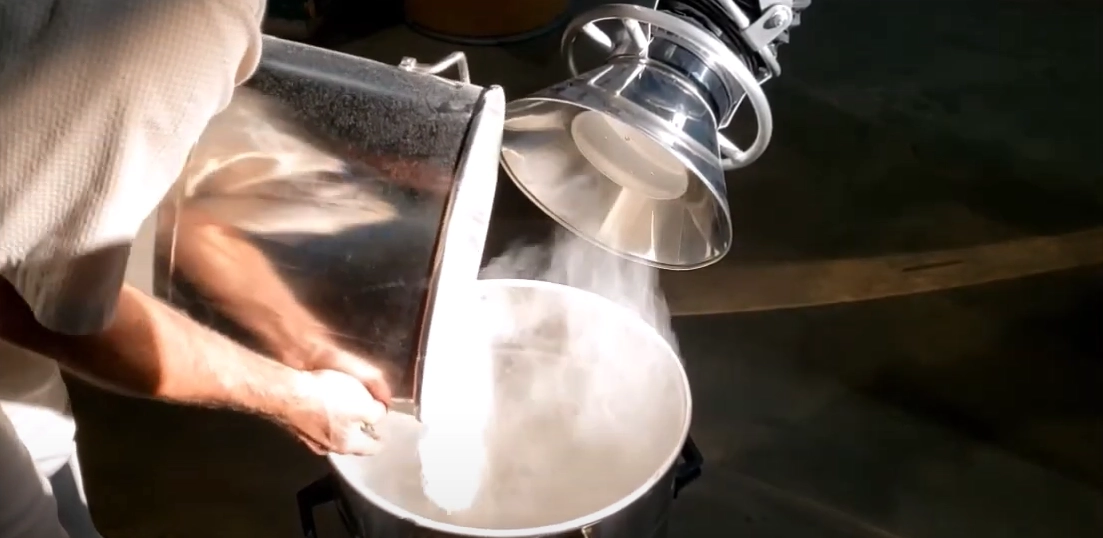
It is used where dust is generated as part of normal operation. This may be at open process points, during filling and dosing of powders and granulates, or inside machines and enclosures where movement, vibration, or assembly of components releases dust.
In many cases, the dust is already there. It is present on the components, in the material, or within the process itself. The task of the dust collector is to remove it while the process is running—and before it develops into a work environment issue, a quality issue, or a maintenance issue.
Once the principle of a dust collector is understood, everything starts to make sense—especially the fact that it can take many different forms depending on the application. Sometimes this is achieved through hoses or fixed ducting systems, other times via extraction arms or integrated capture points tailored to the task. And in many cases, it is precisely the combination that makes the difference.
Vacuum cleaner, dust collector, or ventilation – what is used for what?
Although the three solutions are often mentioned in the same breath, they serve fundamentally different purposes. This becomes clear when they are viewed side by side:
| Function & Application | Industrial Vacuum | Dust Collector | Ventilation |
|---|---|---|---|
| Manual cleaning | ✓ Primary function | ✗ Not designed for this | ✗ Not relevant |
| Process extraction | △ Temporary solution | ✓ Primary function | ✗ Not sufficient |
| Point-source extraction at the origin | ✗ Not designed for this | ✓ Yes, continuous | △ Only with special design |
| Internal extraction in machines and enclosures | ✗ Unsuitable | ✓ Ideal solution | ✗ Not effective |
| Room ventilation | ✗ Not relevant | ✗ Incorrect approach | ✓ Primary function |
| Continuous operation (24/7) | ✗ Not designed for this | ✓ Yes | ✓ Yes |
| Collection in a container | ✓ Yes | ✓ Yes | ✗ No (not typical) |
| Typical daily operating time | △ 1-2 hours | ✓ 8-24 hours | ✓ 24 hours |
In short: the dust collector minimises the problem. Vacuum cleaning and ventilation act as backstops, capturing the remaining dust on surfaces and in the air.
When dust is no longer just dust
In any production environment, dust is not merely a question of cleaning. When dust is not removed at the source, it spreads. It settles in machines, enclosures, on sensors, and in moving parts. It ends up on products, in packaging, and in areas where it simply does not belong.
Over time, this affects operational stability, quality, and maintenance requirements. In some cases, dust also becomes a safety issue—for example when it is combustible or hazardous to health. When that happens, companies are confronted with ATEX directives and standards such as EN 17348 and EN 60335-2-69. These exist because experience has shown what happens when dust is not controlled. At some point, it goes bang, and the day suddenly becomes very long.
In that context, a dust collector is not something you install to comply with “one thing or another”. It is a control tool. A piece of equipment that makes it possible to manage something that would otherwise quickly get out of hand.
The economic aspect – which should matter to everyone
Many organisations only become aware of the true cost of dust when they look at the time spent on cleaning and maintenance. If just one process area requires half an hour of cleaning per day, that quickly adds up to around 100 working hours per year—for a single location in production.
Add to that production downtime, additional quality control, increased maintenance, and accelerated wear on equipment, and the calculation starts to look very different.
In many cases, the investment in a dust collector pays for itself far faster than expected—often within the same financial year. Not because the equipment is inexpensive, but because it shifts resources away from constant clean-up and towards stable, controlled operation.
And then there are all the additional benefits. But if you have read this far, you already know what they are.
Thomas Lyngskjold
Januar 2026