
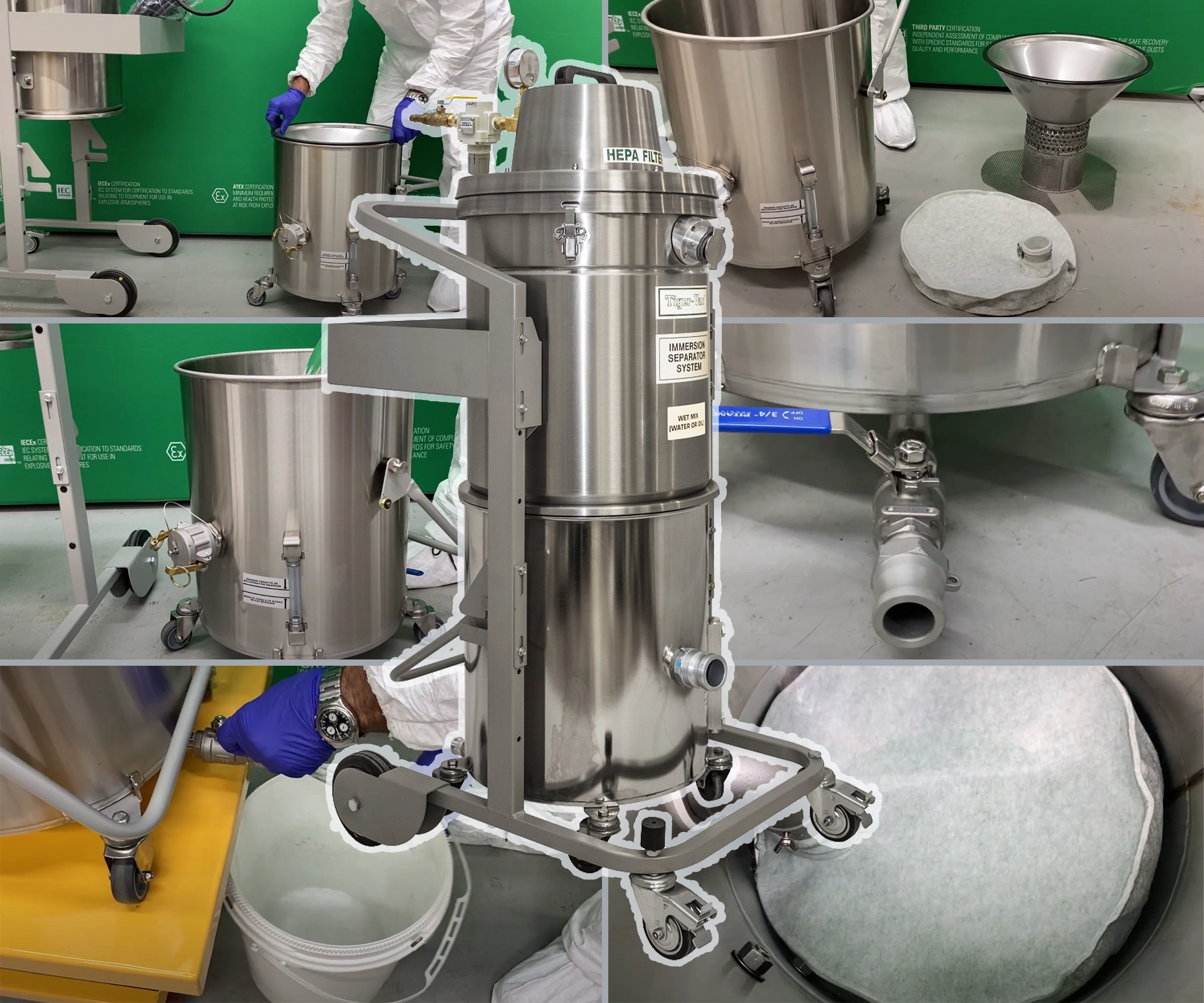
The difference between control and catastrophe
Are you working with conductive, combustible or self-igniting dust? Then a standard ATEX vacuum cleaner will in many cases not be sufficient to handle all the risks.
In many processes, in particular where reactive metal dust, propellant dust or lithium dust is handled, an inert vacuum cleaner will, after a conservative risk assessment, often be the only realistic way to neutralise the hazard and reduce the likelihood of an explosive atmosphere developing. Without inert technology, an ATEX certification can in practice become a false sense of security, where the dust can still develop into life-threatening events.
Read this article with belt and braces on. Let us look at the issue together.
Inert technology, the background
The word inert comes from the Latin “iners”, meaning “idle, sluggish”. In chemistry, inert means that a substance does not react chemically. And that is precisely what inert technology seeks to do with hazardous dust: make it inactive.
In an inert vacuum cleaner, dust and particles are led directly into a liquid bath, typically water or oil, where the dust is surrounded and neutralised so that it can no longer easily be ignited or explode. The difference from a standard industrial vacuum cleaner or ATEX vacuum cleaner is simple: in a standard vacuum cleaner the container is typically empty until you start vacuuming. In an inert vacuum cleaner the container is already filled with liquid before the work begins. All hazardous dust collected ends up in the liquid bath, where it is rendered inactive or neutralised.
The liquid does not function as an ordinary filter that simply retains the dust mechanically. Instead it surrounds and dampens the dust so it becomes harder for it to react or develop critical heat. Water is typically used for materials such as aluminium dust and magnesium dust. Oil is used where water could react unfavourably with the dust (as with lithium dust) or where there is a risk that evaporation could make the dust active again, as with propellant dust.
A technology rooted in the 1970s
The method is not new. Liquid baths for safe collection of reactive metals such as aluminium, magnesium, titanium and zirconium have been used in the metal and defence industries for decades. These materials have very low ignition energies and a high risk of self-ignition, precisely in cases where a traditional dry ATEX vacuum cleaner does not necessarily provide adequate safety.
The practice around “immersion separators” has for years been recognised as best practice in the United States and described in NFPA 484: Standard for Combustible Metals, which at the start of the new century brought together requirements and guidelines for handling combustible metals, including the use of liquid-based separators. Manufacturers such as Tiger-Vac and Delfin have for many years developed wet mix and inert separators, which today are standard equipment in high-risk industries working with combustible and self-igniting metal dust.
Now a European standard: EN 17348 and IEC 60335-2-69
What is new in Europe is that the EN 17348:2022 standard places liquid-based “wet type dust collectors” in an official European framework. The standard specifies requirements for design, construction, testing and marking of handheld, transportable and mobile vacuum cleaners for use in potentially explosive atmospheres (ATEX) and introduces, among other things, the division into dry type, wet type and liquid collectors. Inert technology typically sits under wet type, where liquid is added to the bath to reduce the risk.
For the first time inert vacuum cleaner solutions are therefore clearly described in a harmonised European standard, not as a niche but as a recognised method, which in practice is necessary in industries with reactive or self-igniting dust types if you want to meet current safety standards and a conservative risk assessment.
In addition to EN 17348, IEC 60335-2-69:2021 has been expanded with the ACD classification, which covers vacuum cleaners for collecting combustible dust in areas where the risk assessment does not give grounds for ATEX zone classification. ACD has been introduced to address the many applications where combustible dust is present in the process but no explosive atmosphere exists, and where clear requirements for vacuum cleaners have previously been missing.
EN 17348 and ACD therefore complement each other: EN 17348 describes the requirements for vacuum cleaners in explosive atmospheres, including wet type solutions, while ACD sets the requirements in non-ATEX areas with combustible dust. Taken together, ATEX, ACD and EN 17348 provide a complete framework for the risk picture, from explosive atmospheres to combustible dust that does not form an explosive atmosphere.
The conclusion can be summed up as follows: an ATEX vacuum cleaner protects primarily against ignition sources in an explosive atmosphere. An ACD-classified vacuum cleaner covers combustible dust in non-ATEX environments. And an inert vacuum cleaner addresses the material itself, when the dust is inherently reactive, self-igniting or electrically conductive, and the risk assessment therefore indicates that collection is not enough.
Which substances are we talking about?
Not all dust is equally dangerous. Some particles settle heavily and relatively harmlessly at the bottom of a container. Others can explode or self-ignite simply because they encounter a spark, a little moisture or contact with air. It is the latter category that inert technology has been developed for.
Aluminium dust and magnesium dust are classic examples. Two light metals that are indispensable in aviation and space industry. When they are machined, a fine, silver-grey dust is released, which can self-ignite at very low energies. That is why these metals have historically been the driving force behind the development of inert vacuum technology. The same applies to titanium and zirconium, which are used in high-tech processes but can become highly hazardous when present as fine metal powder.
But it does not stop with the metals. Other conductive materials can create problems. Graphite and carbon dust are easily stirred up and can form dust clouds that both conduct electricity and can create an explosive atmosphere if they encounter an ignition source. Such substances are found in particular in chemical and pharmaceutical production and in parts of the energy sector, where safety requirements are tightened.
And then there are the substances that go one step further, the self-igniting ones. Propellant dust is a well-known example, especially at shooting ranges where gunpowder residues can accumulate in cracks and crevices and later flare up. Lithium is another material: indispensable in the battery industry, but in dust form so reactive that water can cause more harm than good. In laboratories and pharmaceutical production, too, you meet substances that can ignite spontaneously simply because they come into contact with air or moisture.
Common to these materials is an extremely low Minimum Ignition Energy (MIE), the smallest amount of energy required to ignite the dust. To put it in perspective: walking across a carpet generates 10–25 mJ. That sounds harmless, but fine titanium dust can be ignited at under 10 mJ, and certain metal dust types have MIE values so low that even static electricity from a touch is enough. Several of these materials are directly pyrophoric and can ignite spontaneously on contact with air or moisture. That is why inert technology is not just an extra safety measure, but in many cases the most realistic way of neutralising the material.
When is an inert vacuum cleaner required, and when is ATEX or ACD enough?
Many people rightly ask when a “standard” ATEX vacuum cleaner is enough, when the ACD class is relevant, and when the process should have an inert vacuum cleaner. The most important difference lies in whether the risk primarily comes from the surroundings (explosive atmosphere) or from the material itself (reactive dust).
An explosive atmosphere occurs when combustible dust is present in the air in sufficient concentration to be ignited. Combustible dust lying still or present in low concentrations is not explosive, but can still represent a fire risk.
- the dust is self-igniting (propellant, lithium, certain reactive metals)
- the dust has a very low MIE and can be ignited by static electricity or low energies
- the dust is electrically conductive (e.g. aluminium, magnesium, titanium, graphite, carbon)
- the risk is not just from an explosive atmosphere but also substantially linked to the dust itself
In these cases neither ATEX nor ACD alone will normally be enough, because the risk assessment often shows that the dust should be neutralised in liquid to achieve an appropriate level of safety.
- combustible dust in the air can form an explosive atmosphere
- the dust has “normal” ignition energies
- the area is classified as ATEX zone 21 or 22 and the material has no particular reactive properties
Here safety primarily concerns eliminating ignition sources, not changing the chemistry of the dust.
- combustible dust is being handled but no explosive atmosphere is present
- the process is enclosed, or the dust is only to a limited extent airborne (e.g. certain 3D printers, laboratories, pharma)
- there is a need for documented safe collection without ATEX classification
Industries where an inert vacuum cleaner is particularly relevant
Looking at the materials, it quickly becomes clear which industries face the greatest risks, and therefore the greatest need for inert technology and inert vacuum cleaners.
The defence sector is an obvious example. Here propellant and pyroeffects are handled every day, and even small residues of propellant dust can constitute a serious risk. At shooting ranges, propellant dust can accumulate over time, and without neutralisation in liquid it can suddenly flare up long after the shooting is finished. An inert vacuum cleaner for propellant dust will typically be much safer than a standard dry ATEX vacuum cleaner.
In aviation and automotive we see another, equally serious challenge. Aluminium and magnesium are fundamental and indispensable materials when something has to be built light and strong. But when they are ground, cut or milled, fine metal dust is released, which can self-ignite at even small sparks. That is why an inert vacuum cleaner for metal dust will in many cases be the most robust solution, especially in or close to ATEX zone 20.
The battery industry is today one of the fastest-growing areas where inert vacuum cleaners are on the way to becoming the standard solution. Lithium is the foundation of modern batteries, but in dust form it is extremely reactive. Water can make lithium dust react violently, and oil-based inert baths are therefore almost always recommended in production and recycling plants.
3D printing has in recent years emerged as a high-risk industry. Metal powder is the core of additive processes, but it requires special handling both during and after printing. Inert vacuum cleaners often need to be part of the safety procedures here, especially when working with combustible metal powder with low ignition energy.
In the semiconductor industry you meet similar challenges. Production of wafers and advanced microchips involves fine, reactive powders such as lithium, tantalum or certain silicon compounds. Even small amounts of dust can create significant risks in cleanroom production. Inert technology and correctly dimensioned vacuum systems are used here to avoid the dust becoming an ignition source in an environment with very low error margins.
Finally, the same issues appear in the chemical and pharmaceutical industries. Small amounts of self-igniting reagents or conductive dust can be enough to create an explosive atmosphere. In such environments a correctly chosen ATEX vacuum cleaner will often be required for combustible dust, but for particularly reactive, conductive or self-igniting substances an inert vacuum cleaner will often be the solution that a prudent risk assessment points to, in order to avoid false comfort.
ATEX and the new standards, why inert has become more important
As mentioned, the United States was an early mover in this area. Already in the 1990s inert technology was described in NFPA 484: Standard for Combustible Metals, where “immersion separators” are described as one of the central solutions for handling reactive metal powders. That gave American manufacturers and authorities clear guidelines for when and how reactive metals should be neutralised in liquid.
Europe had to wait longer for the same degree of clarity. The ATEX directives did set the framework for equipment in explosive atmospheres, but without going into detail about inert collection. Companies could therefore be fully ATEX-certified and still carry a residual risk if they handled metals or substances that in practice require neutralisation in liquid to reach an appropriate level of safety.
With EN 17348:2022, harmonised under the Machinery Directive, inert collection solutions are now clearly anchored in a European standard. That gives companies a clearer basis for choosing equipment based on the specific material and the actual risk, not just on whether “ATEX” appears on the vacuum cleaner.
Regulatory safety and certification
When working with dust that can self-ignite or conduct electricity, certification is not just a formality, it is the documentation that the equipment has been assessed as suitable for the relevant risks.
It is not only the liquid bath that is certified, but the entire vacuum cleaner: container, separator, filters, motor and construction. For ATEX equipment for zone 20 or zone 21, the machine is tested and assessed by a notified body such as IMQ, LCIE or RINA. The result appears on the nameplate, for example the marking II 1/2D Ex h IIIC T80 °C Da/Db (which states that the vacuum cleaner is documented as suitable both internally (zone 20 conditions) and externally (zone 21/22)).
For zone 22 equipment, the manufacturer can carry out conformity assessments themselves via module A, internal production control. This does not require a notified body. The same applies to ACD-classified equipment, where the manufacturer documents compliance with IEC 60335-2-69.
So what really provides the best protection?
Legally, the manufacturer’s own assessment is sufficient for zone 22 and ACD. But there is a difference between what the law requires and what provides the greatest safety in practice.
When a notified body is involved, an independent third party has reviewed construction, documentation and test results. That does not mean that manufacturer-assessed equipment is unsafe, but it means the responsibility for the assessment lies elsewhere. Some manufacturers voluntarily involve a notified body, even when they are not required to, precisely because it provides external validation of their work.
For the user it is worth asking: is the equipment assessed by the manufacturer itself or by an independent party? And does the marking match the actual risk in my application, not just the zone, but also the material’s properties?
An Ex logo tells you the equipment meets certain requirements. But it does not tell you by itself whether those requirements match your risk. That is why the marking on the nameplate matters more than the logo on the brochure.
Product types and construction
The choice of inert vacuum cleaner depends on what is to be collected, how much and in which environment. There are several variants, and the difference is not just about size, but about drive, performance and which zones the equipment is suitable for.
The most widely used are the electric models. They are compact, mobile units in painted or stainless steel, typically with container capacity of 20–100 litres. They are used where ordinary mains electricity is available and where flexibility matters, for example in pharma, chemistry, laboratories and 3D printing.
For heavier tasks, air-driven models are often used. With double Venturi suction units they can deliver higher vacuum and airflow than many electric models and at the same time have fewer moving wear parts, qualities that make them well suited to demanding environments where operational reliability is critical, and where work often takes place in or near ATEX zone 20.
Common to both types is that they typically combine an antistatic primary filter with HEPA H14 filtration (around 99.995% efficiency) and a liquid capacity tailored to process requirements. When correctly documented and marked, they can be used for combustible metal dust, self-igniting dust and electrically conductive dust in both ATEX and ACD areas.
Safety designs in the liquid bath
Even though the basic principle is the same, neutralising dust in liquid, there are several safety designs depending on process, material and operating environment.
The simplest models use manual emptying, where liquid and sludge are replaced as needed. More advanced systems can be self-emptying and equipped with sludge filters that reduce the amount of particles in the liquid and extend service intervals.
In environments with large amounts of reactive dust, anti-overflow designs and level sensors are often used to prevent the liquid bath from overflowing or running too low. That contributes both to operational stability and to keeping the neutralisation effective.
A practical solution Tiger-Vac has developed for their Mini Immersion models is a statically conductive collection bag placed in the liquid tank and held in place by a metal bracket. The bag is connected directly to the suction pipe so the dust is led down into the bag while still being neutralised in the liquid bath around it. At emptying time the entire bag can be lifted out with its contents and liquid, a faster and cleaner process than emptying the tank manually. Because the bag is statically conductive, it does not build up charge, which is essential in explosive environments.
These features do not change the principle behind inert collection, but can be decisive in processes with heavy loading or continuous operation.
The path to inert technology
The path to inert technology rarely starts with choosing a product on a catalogue page. It typically starts with a realisation: “Our ATEX certification does not cover all the risks we actually have.”
The first step is therefore a technical review of the process: which dust types are generated, and in what quantities? Is the dust ordinarily combustible, or does it have reactive or self-igniting properties such as aluminium, magnesium, titanium, zirconium, lithium or propellant? Where in the process can the dust become airborne? And are we talking about an ATEX environment, an ACD environment or a material where an inert solution should be considered?
When material and risk profile have been clarified, the solution can be designed. This is not just about choosing “a vacuum cleaner”, but about ensuring that the entire collection system is integrated into the process: equipment placement, dimensioning of the liquid bath and filtration, choice of container material, correct bonding, hose selection, workflows, replacement routines and documentation. An inert system is only safe if every link, from the suction head to the container, follows the same principle.
Implementation typically requires specialists who understand ATEX, ACD and inert technology, including concepts such as MIE (ignition energy) and MIT (ignition temperature). Errors in construction can mean the dust is still active, even if you think it has been neutralised. Testing, validation and documentation review are therefore almost always part of the process, together with supplier and relevant internal or external parties.
When the system is operational, the next phase begins: operation and maintenance. An inert system requires correct topping up of liquid, level checks, cleaning of filter cartridges, checks of HEPA filters, and ongoing handling of sludge or liquid mix. Operational safety depends to a high degree on procedures and on the staff’s understanding of why inert collection is used.
From false comfort to real safety
Inert technology is not a niche. It is an important part of reality in industries where dust and materials are combustible, reactive, self-igniting or electrically conductive.
The ATEX Directive has for decades been fundamental to explosion protection, and it has worked well for many applications. But for certain materials, certification has only reduced part of the risk. An ATEX vacuum cleaner can be correctly approved and still unsuited to handling reactive metal powders, propellant dust or lithium dust safely without neutralisation.
With EN 17348 and the ACD classification, inert technology is now more clearly integrated into the European framework. This means that companies will need to reassess their existing solutions in the coming years. The question is no longer whether inert is a voluntary addition, but whether the processes and materials are of a type where an inert vacuum cleaner, after a prudent risk assessment and grounded in current standards, is the most responsible solution.
At Particulair we work daily to help customers assess their current equipment, replace machines that are no longer considered sufficient, and find the solutions that provide both safety and documentation. We work with an accredited laboratory that can analyse the explosion properties of dust, including MIE, MIT and Kst, in cases where the customer does not know the values or where the material supplier cannot provide sufficient documentation.
We also offer service agreements that ensure the equipment is maintained over time and continues to meet the requirements of the certification. Inert technology works only when the system is intact, and regular service is the precondition for safety to hold in practice, not just on paper.
Are you in doubt whether your process requires inert technology? The next step is a concrete risk assessment that links material properties, standard requirements and practical operating conditions, so certification and safety hang together both on paper and in reality.
FAQ — questions we often meet
What is an inert vacuum cleaner?
An inert vacuum cleaner is an industrial vacuum cleaner that collects reactive, conductive or self-igniting dust by leading it into a liquid bath (water or oil), where the dust is surrounded and significantly reduced in its tendency to ignite. An inert vacuum cleaner is typically used where a dry solution is considered insufficient given the properties of the material.
When is an ATEX vacuum cleaner not enough?
An ATEX vacuum cleaner can be insufficient when the dust itself is strongly reactive, self-igniting or electrically conductive, e.g. aluminium dust, magnesium dust, lithium dust or propellant dust. In these cases a risk assessment will often indicate that the dust should be neutralised in liquid rather than collected dry.
How do I choose a vacuum cleaner for metal dust?
The starting point is always the material: aluminium, magnesium, titanium, zirconium, etc., as well as the dust’s fineness and quantity. Next, whether work takes place in ATEX zone 20/21/22 or in an ACD area without zoning. On that basis an inert vacuum cleaner is chosen that is documented as suitable for the specific metal dust and environment.
When is water used, and when is oil used in the liquid bath?
Water is typically used for materials such as aluminium dust and magnesium dust, where it effectively dampens the dust. Oil is used where water could react dangerously with the material (as with lithium dust) or where evaporation could make the dust active again, as with propellant dust.
Can an inert vacuum cleaner be used for propellant dust and shooting ranges?
Yes, inert vacuum cleaners are often used for propellant dust in the defence sector and at shooting ranges because propellant is both combustible and can be self-igniting. Dry collection with ordinary industrial vacuum cleaners would typically be unacceptable, and even ATEX vacuum cleaners can involve residual risk if the dust is not neutralised in liquid.
Should lithium dust always be collected with an inert vacuum cleaner?
For lithium dust, inert collection with an oil-based liquid bath is generally recommended, because lithium is highly reactive and reacts violently with water. Dry collection with ordinary vacuum cleaners, and often also standard ATEX vacuum cleaners, will in many cases not be considered sufficiently safe.
Is there an ATEX zone inside metal 3D printers?
Normally the inside of a metal 3D printer is not considered an ATEX zone, because the process takes place in an enclosed chamber with inert gas and low oxygen levels. For 3D printers, any ATEX/ACD concerns are usually linked to powder handling outside the chamber.
When does low MIE matter more than ATEX in practice?
Low MIE becomes the driver when the material is so easily ignited that the risk primarily comes from the dust itself and not just from ignition sources in the surroundings. In those cases a dry ATEX vacuum cleaner only addresses part of the risk, while inert technology is often the solution deemed necessary after assessment.
Is an inert vacuum cleaner more expensive than an ATEX vacuum cleaner?
Yes, an inert vacuum cleaner is typically more expensive to purchase than a standard ATEX vacuum cleaner. In return, it can be the only solution that really covers the risk of reactive materials. The price should therefore be viewed in relation to what it would cost not to have adequate safety, both in human and economic terms.
Does an inert vacuum cleaner require more maintenance?
An inert vacuum cleaner requires ongoing control of liquid level, replacement and disposal of sludge, and cleaning of filters and cartridges. This is more than for a dry vacuum cleaner, but it is a precondition for the neutralisation to work. With a service agreement, maintenance can be planned so that the equipment is always ready for use.
How often should the liquid and sludge be changed?
It depends on dust type, quantity and operating intensity. In processes with large amounts of reactive dust, daily or weekly replacement may be necessary. In lighter applications the interval can be longer. Manufacturer instructions and a specific assessment of the process determine the frequency.
How do I dispose of the liquid and the sludge?
Liquid and sludge from an inert vacuum cleaner must be handled as hazardous waste if it contains reactive metals or other classified substances. Disposal typically takes place through an approved waste handler. It is important to make sure the sludge stays moist in storage so it does not dry out and become reactive again.
Can I upgrade my existing ATEX vacuum cleaner to inert?
No, an ATEX vacuum cleaner cannot be converted to inert. Inert technology requires a completely different construction with liquid bath, separator and adapted filtration. If a risk assessment shows that inert is required, equipment designed and certified for the purpose needs to be invested in.
What documentation comes with an inert vacuum cleaner?
A properly supplied inert vacuum cleaner is delivered with an EU declaration of conformity, a nameplate with Ex marking, user manual and, where applicable, certificates from a notified body. The documentation must be available for inspections and should be kept together with the company’s workplace risk assessment.
Glossary — key terms
- ACD (Applied to Combustible Dust)
- Classification in IEC 60335-2-69 for vacuum cleaners for combustible dust in areas where the risk assessment does not require ATEX zoning. ACD equipment is documented by the manufacturer itself, with no requirement for notified body certification.
- ATEX
- Common name for two EU directives on explosion protection: 2014/34/EU (equipment) and 1999/92/EC (workplaces). ATEX stands for “Atmosphères EXplosibles” and forms the basis for zone classification and equipment certification in Europe.
- ATEX zones (20, 21, 22)
- Classification of areas by how often an explosive atmosphere can occur. Zone 20: continuously or frequently present. Zone 21: can occur occasionally during normal operation. Zone 22: rare and short-lived. The zone determines the equipment category required.
- Explosive atmosphere
- A mixture of air and combustible dust (or gas/vapour) in a concentration where ignition can lead to explosion. An explosive atmosphere arises when the dust is sufficiently finely distributed and in sufficient quantity. Combustible dust lying still is not explosive, but can still present a fire risk.
- EN 17348:2022
- European standard for vacuum cleaners for use in potentially explosive atmospheres. The standard specifies requirements for design, construction, testing and marking and introduces the division into dry type, wet type and liquid collectors. Inert technology typically falls under wet type.
- Ex mark
- Marking on the nameplate showing that the equipment has been assessed for explosive areas. The marking indicates, among other things, category, zone, dust group and temperature class, e.g. “II 2D Ex h IIIC T85 °C”. The Ex mark is the visible evidence that the equipment meets ATEX requirements.
- IEC 60335-2-69
- International standard for safety requirements for vacuum cleaners and dust extractors, including classification of dust classes (L, M, H) and requirements for ACD equipment. The standard forms the basis for both ATEX and non-ATEX vacuum cleaners.
- Kst (dust explosion index)
- A measure of how quickly pressure rises during an explosion. Measured in bar m/s. Higher Kst means a more violent and faster explosion. Together with Pmax, Kst is used to classify the dust’s explosion hazard and to dimension safety measures.
- MIE (Minimum Ignition Energy)
- The smallest amount of energy required to ignite a dust cloud. Measured in millijoules (mJ). To put it in perspective: walking across a carpet generates 10–25 mJ, and fine titanium dust can be ignited below 10 mJ. MIE is therefore decisive for the choice of safety equipment.
- MIT (Minimum Ignition Temperature)
- The lowest temperature at which the dust can ignite without a spark or flame. Relevant for assessing hot surfaces, process temperatures and the risk of self-ignition in accumulated dust.
- NFPA 484
- American standard for handling combustible metals including aluminium, magnesium, titanium and zirconium. NFPA 484 has for decades described best practice for liquid-based collection (immersion separators) and is an important reference, also in European contexts.
- Notified body
- Independent third party (e.g. IMQ, LCIE, RINA) appointed by an EU member state to test and certify ATEX equipment. A notified body is mandatory for equipment for zone 20 and zone 21. For zone 22 equipment the manufacturer can carry out the assessment itself.
- Pmax (maximum explosion overpressure)
- The highest pressure a dust explosion can generate in a closed space. Measured in bar. Pmax is used to dimension explosion protection such as pressure relief valves and explosion-proof vessels.
- Bonding
- Electrical connection between all conductive parts in a system so they share the same electrical potential. Prevents sparks that can arise from contact between components with different charges. In inert systems, bonding must cover the entire chain from suction head to container.
- Pyrophoric
- Material that self-ignites on contact with air or moisture without an external ignition source. Pyrophoric substances require special handling, typically storage and collection under inert atmosphere or in liquid. Examples include certain finely divided metal powders and chemical compounds.
- Self-certification (module A)
- The manufacturer’s own conformity assessment, where the manufacturer declares that the equipment meets the relevant requirements without involvement of a notified body. Allowed for ATEX category 3 equipment (zone 22) and ACD-classified equipment. The documentation must still be in place.
- Statically conductive
- Material that conducts static electricity to earth and thereby prevents charge build-up. In explosive environments, statically conductive equipment, hoses, bags and tools are decisive in avoiding sparks from electrostatic discharge.
- Wet type / immersion separator
- Vacuum cleaner where the dust is collected in a liquid bath that neutralises reactive or self-igniting material. The liquid surrounds the particles and reduces their ability to react with oxygen or develop heat. The term “wet type” is used in EN 17348.
In doubt whether your process requires inert technology?
We review your materials and processes and help with a concrete risk assessment that links material properties, standard requirements and practical operating conditions.
Contact us- DS/EN 17348:2022 — Vacuum cleaners for explosive atmospheres (Danish Standard).
- IEC 60335-2-69:2021 — Safety requirements for vacuum cleaners (IEC).
- NFPA 484 — Standard for Combustible Metals (NFPA).
- Arbejdstilsynet — Work in explosive atmosphere (ATEX).
- Beredskabsstyrelsen — Explosive areas (ATEX).
- Urząd Dozoru Technicznego (UDT) — ATEX user requirements.
- Centralny Instytut Ochrony Pracy (CIOP-PIB) — Explosion hazard: zone classification.
- ATEX Directive 2014/34/EU (equipment directive).
- ATEX Directive 1999/92/EC (workplace directive).
- Thomas Lyngskjold. “ATEX approval is no longer enough — know EN 17348:2022.” ex-vac/en/articles
- Thomas Lyngskjold. “ATEX ABC.” ex-vac/en/articles
- Thomas Lyngskjold. “The invisible weakest link.” ex-vac/en/articles