
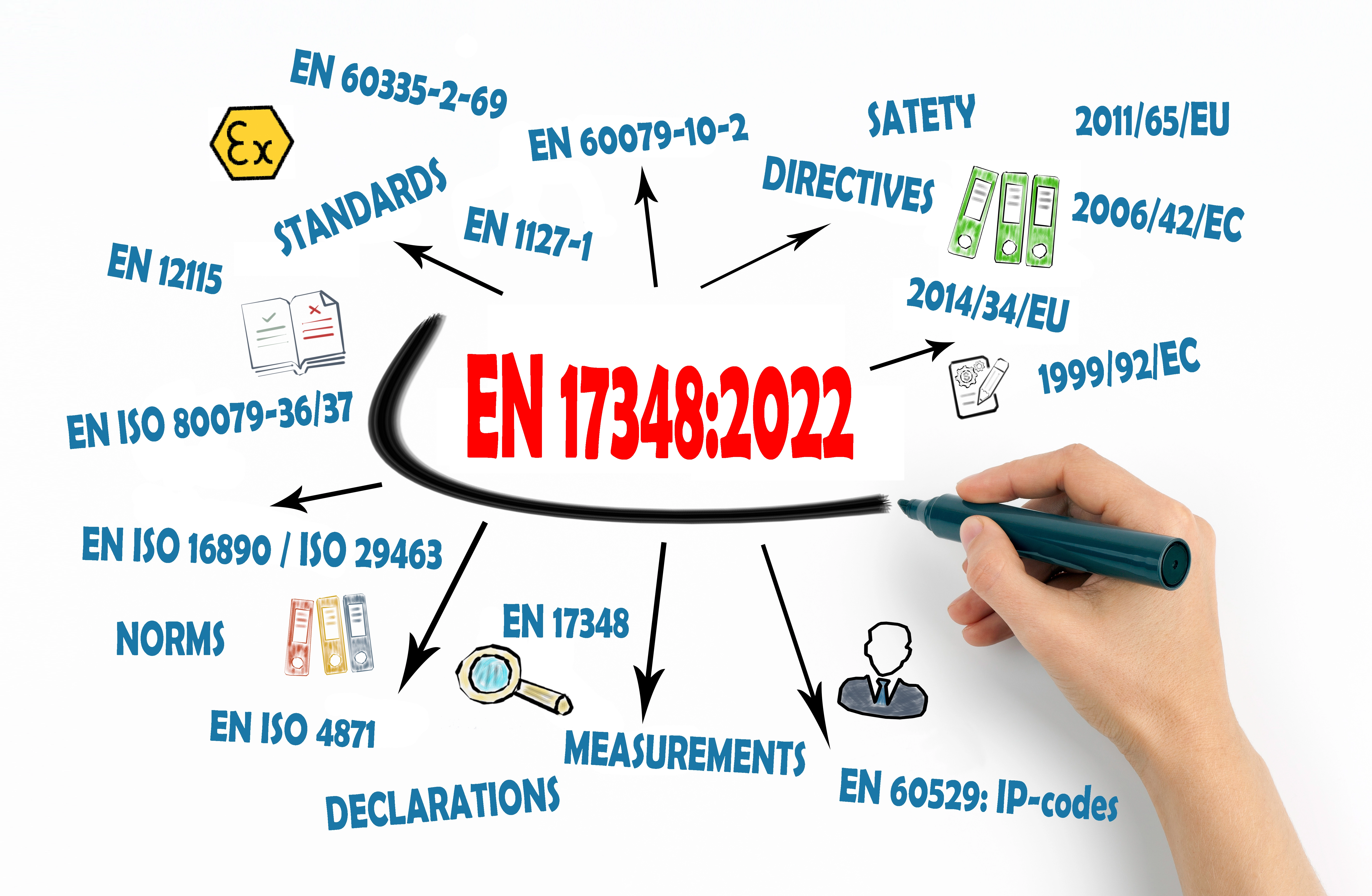
Maybe it is not dangerous. Not yet. Maybe you are simply collecting dust, day in and day out, until one day there is a BANG and someone asks: “Was the equipment approved for Zone 20? Did it have double filtration? Can you document it?” That is exactly the situation EN 17348:2022 has been introduced to prevent. In that sense, the standard is as important as your latest virus update.
Why did ATEX come about?
To understand why we have arrived at yet another standard, the historical background matters. Because as noted: everything changes, not least when we learn more.
Before the ATEX directives there were no common European rules for handling explosive atmospheres. Each member state had its own standards, creating a patchwork of different safety requirements. Companies did not know whether their equipment was safe enough when it had to be used in other countries. And when accidents happened, and they did, it was often because different standards did not speak to each other.
The French grain silo that became a turning point in dust safety
In the south-west of France, near the town of Blaye on the Gironde river, stood a large grain silo that played a central role in the local agricultural economy. On 20 August 1997 the silo was hit by a violent explosion that turned it into an inferno of flames and collapsing concrete structures in an instant.
The explosion started in the northern hall of the silo, an area where fine grain dust had accumulated over time. When an unknown ignition source set the particles alight, the flame front travelled through the gallery connecting the many silos at shockwave speed.
The damage was enormous. The flame front moved horizontally through the narrow connecting corridors, where a thin layer of dust along the walls was stirred up and formed the basis for a secondary and far more powerful dust explosion. More than two thirds of the 44 chambers partially or completely collapsed, and the upper gallery was levelled to the ground.
The consequences were tragic: 11 people lost their lives, seven of them SEMABLA employees, three technicians in the administration building and a fisherman who was found buried in the rubble days later. One further person was seriously injured.
The force of the explosion was felt for a long way around. Projectiles of concrete, metal and glass were thrown more than 100 metres, and smaller fragments were found as far as 500 metres from the facility. Several nearby buildings had shattered windows, and local businesses reported damage to their installations.
The Blaye accident became a decisive wake-up call in European safety thinking. It demonstrated clearly that even a thin layer of dust can trigger a chain reaction of explosions, and that the consequences reach far beyond the production facility itself.
The textbook case from Aars: two explosions and no learning
The company Dangrønt in Aars began producing wood pellets in 2001. The wood flour was stored in a large hall with up to 500 tonnes of material, a massive intermediate store of combustible dust.
In 2002 the facility exploded for the first time. The explosion destroyed the roof and blew out walls and gates. A forklift driver survived miraculously. The police concluded that a spark from the mill had ignited the dust. The case was closed without further investigation.
But eight years later, in 2010, the facility exploded again. A front loader ignited the wood flour during a routine task. This time an employee died of his burns. Once again the focus turned to the equipment rather than the processes behind it. The intermediate store, the core of the problem, was never identified as the cause.
The story of Dangrønt is not just the tale of two explosions. It is the tale of what happens when we do not learn from the first accident. When no one asks about workflows, design choices and fundamental safety.
What exploded was not just wood flour. It was the absence of critical questions.
What do the ATEX directives actually cover?
- ATEX 137 (1999/92/EC): applies to companies and employers. It is about mapping zones, training employees and minimising risks.
- ATEX 114 (2014/34/EU): applies to equipment manufacturers. It determines how products such as vacuum cleaners must be designed, tested and marked.
- The name ATEX comes from the French “Atmosphères Explosibles”.
When one dust explosion becomes many, and why it is not just a myth
Many people imagine that a dust explosion is a single, violent event. But in reality it is often what happens afterwards that causes the most damage.
Even a thin layer of dust of less than 1 mm can create an explosive atmosphere if it is stirred up into the air, and it will be stirred up if something else explodes first. An explosion always creates a pressure wave, like a giant bellows that blows all the dust up into the air.
When sparks or fire from the first explosion spread, the airborne dust ignites and a secondary dust explosion is created. That is often the one that destroys buildings and costs lives. A domino effect with catastrophic consequences.
“We have never had any problems…”
You may have heard it before, or said it yourself: “We have used the same vacuum cleaner for years. Nothing has ever happened.”
But that is exactly what is dangerous about explosion risk: things go well until they do not. Explosions happen rarely, but when they do, the damage is violent and irreversible. It is a bit like insurance. It is never fun to pay, but it is the best money you have ever spent when an accident strikes and you need it.
From component certification to holistic assessment
So is it enough for the vacuum cleaner to have “ATEX” or “EX” printed on it, so it must be approved? Yes, and no. The ATEX marking has long been used as a kind of “trust stamp”. But not everyone knows that it was previously possible to certify a single component, for example the motor, and still sell the whole machine as ATEX-approved.
With EN 17348:2022 that has changed. Now the entire vacuum cleaner has to be assessed, from hoses and filters to wheels and seals. It is not enough for one part to be safe. What counts is the whole. So a nice label is not enough to protect you and your colleagues.
EN 17348:2022 was officially harmonised with the ATEX Directive 2014/34/EU in March 2023. From August 2024 it has also been harmonised with the Machinery Directive 2006/42/EC. The standard is therefore now a central reference point for both directives, meaning manufacturers can use it to establish a “presumption of conformity” when CE-marking their equipment.
Dust explosions happen where no one is looking
The technical label is therefore no guarantee in itself. But neither does dust in the air, or the absence of it, tell the whole story. Because dust explosions often start where no one is looking.
“There is no dust in the air, so why classify zones?” Because it is not the visible dust that is dangerous. And even if you feel comfortable with the equipment, it is worth remembering that dust often hides where no one looks.
Dust explosions often start with fine particles you can hardly see. They settle in corners, behind machines, under shelves. When something explodes elsewhere, the dust is stirred up and ignites from the fire and sparks of the first explosion, and suddenly you are in the middle of a secondary explosion.
More than 50% of dust explosions start somewhere other than where the accident occurs. And it is often the secondary explosions that are dangerous to people, buildings and machines.
What does EN 17348:2022 require, and why it matters
In the past it was enough for an industrial vacuum cleaner to have an ATEX sticker somewhere on the housing. Perhaps the motor was spark-free, or the hose antistatic. But there was no common standard that brought together requirements for the entire machine, from filtration and tightness to material selection and electrical dissipation. That made it hard to know what you were actually buying, and even harder to document that it was safe in practice.
EN 17348:2022 changed that fundamentally. For the first time, a standard sets clear and verifiable requirements for how an industrial vacuum cleaner must be constructed and documented if it is to be used in areas with explosion risk, particularly Zone 20. It is no longer about labels, but about real, measurable properties.
The standard is also comprehensive in scope. It covers classic vacuum cleaners for solid and dry materials, wet-type units, transportable devices and both electrically and pneumatically driven models. Its requirements also apply to accessories such as hoses, wheels and nozzles, if they come into contact with the dust stream.
Requirements in EN 17348:2022 and what they mean for you
The dust must first be retained in a primary filter (minimum ISO 15E, a filter class corresponding to the former EN 1822 E11 level, now defined in ISO 29463). This means the filter must retain at least 95% of particles in the 0.3–1 µm range. It must then pass through a HEPA H14 filter that functions as an additional safeguard. Think of the HEPA filter as the final stop: it has to catch what was not caught in the first round.
The inside of the vacuum cleaner, where the dust collects, must be treated as an explosive atmosphere. This means every internal component has to be able to handle an explosive dust-air mix without becoming an ignition source.
Dust can build up charge that creates sparks. Two requirements therefore apply to electrical resistance:
- EN 60079-32-2 requires that the equipment as a whole (container, motor housing, frame and wheels) has a combined resistance to earth of ≤ 106 Ω.
- EN 17348:2022 adds a specific requirement for parts in direct contact with the dust stream, such as hoses, filters and seals. Here the resistance must be < 108 Ω.
Both values must be met and must be demonstrable through measurement with suitable instruments.
The vacuum cleaner must be tested to ensure no dust escapes into the motor compartment. It must be able to withstand impact, wear and ageing, and remain safe years after purchase.
The standard describes detailed test procedures for, among other things, dust ingress, thermal effects, impact resistance and ageing tests. Existing equipment that has not been tested against EN 17348:2022 can still be used, but new models must meet the requirements. Many manufacturers, however, voluntarily upgrade their documentation and test results for older models, so they stand stronger at audit and appear more credible to customers and authorities.
Does your vacuum cleaner comply with EN 17348:2022?
The short answer is: it is not enough just to check the declaration of conformity. Even if the manufacturer has listed EN 17348:2022 under applied standards, there can be a big difference in how thoroughly the requirements have been followed. As we will see, there is a difference between claiming compliance and actually documenting it.
A confusion you can almost reach out and touch
As we often see, some manufacturers try to make life easy for themselves. With ATEX, that can be catastrophic. If the wording is bent so the marketing department gets something new and exciting to tell, the customer can end up with a product that only lives up to the standard on glossy paper. We see this happening right now, which is why you should hold your tongue straight in your mouth when manufacturers talk about Zone 20 and EN 17348:2022.
There are three levels to distinguish:
- Saying that you comply with EN 17348:2022. Here the manufacturer has read the standard and assessed that their design matches the requirements. That can range from thorough internal testing to a paper exercise.
- Documenting how you comply with EN 17348:2022. Here test reports, risk assessments and descriptions of the methods used to evaluate, for example, bonding, tightness and filtration are made available.
- Being certified by a Notified Body. Here an independent third party has tested and approved the equipment and issued an official ATEX certificate. This typically applies to category 1 equipment, which is where internal Zone 20 belongs.
Our experience and suspicion is that some manufacturers settle for level 1, for example by simply writing in the manual that the machine “complies with EN 17348”, and still marketing their equipment as Zone 20 under the standard. On paper it can sound correct, but without documentation (level 2) or a Notified Body certificate (level 3), it is difficult for a customer to know how thoroughly the requirements have been followed.
For you as a buyer it means you should always ask for clear documentation. And if you want to be entirely on the safe side, choosing equipment that is certified by a Notified Body can be the right solution.
What is a declaration of conformity, and where do I find it?
The declaration of conformity is the document in which the manufacturer states in writing that the product complies with the relevant EU directives and standards. In other words, it is a legally binding guarantee that the equipment meets the law.
It must always contain:
- Name and address of the manufacturer
- Which directives the product is covered by (for example ATEX, the Machinery Directive)
- Which standards have been used to demonstrate conformity (for example EN 17348:2022)
- Serial number or product type
- Signature from the responsible person at the manufacturer
It is often part of the user manual so it does not disappear. It can also be supplied separately in a folder or as a data sheet. Either way, it is the most important legal document you have, and you are entitled to receive it at the time of purchase.
Quick check list
If you are unsure whether your vacuum cleaner meets the latest requirements, here is a quick check list:
- Does it have double filtration (ISO 15E + HEPA H14)?
- Is there documentation for tightness, dust ingress and ageing?
- Is it marked with a zone (for example Zone 20) and a temperature class (for example T80 °C)?
- Can you measure earth resistance below 108 ohms on hoses, wheels and seals?
- Is the zone classification mentioned in the user manual or CE declaration?
- Is EN 17348:2022 listed in the declaration of conformity under applied standards?
Note: some of these checks require technical equipment or expertise. Contact your supplier if you are in doubt about the documentation.
Zone 20: the hidden hazard inside the vacuum cleaner
When people talk about ATEX zones, most think of the room itself, a production area, or perhaps a closed space around a process. But Zone 20 is not only about the surroundings. It is also about what happens inside the vacuum cleaner itself.
EN 17348:2022 establishes that the internal space of a vacuum cleaner, that is, where the dust is collected, must be treated as an explosive atmosphere. That is where fine combustible dust accumulates. That is where turbulence can develop. And that is where sparks, hot surfaces or static electricity can ignite the dust and create an explosion.
Zone 20 means that an explosive atmosphere is, or often can be, continuously or frequently present. It is not an “emergency”. It is an expected condition.
That applies for example when you vacuum fine plastic, flour, sugar, wood or metal dust, or collect dust in a closed container where it does not dissipate into the open air but instead accumulates over time, quickly exceeding the critical threshold where even less than 1 mm of dust can be enough to create an explosive atmosphere.
It also applies when you use a HEPA filter as the final stage of filtration. Because the filter is so effective, the dust stays in the system and cannot escape. Over time a high concentration of fine, dry dust builds up, and that is exactly what defines an explosive atmosphere.
Many are surprised that they have to think of the inside of the vacuum cleaner as a dangerous zone. But that is precisely what separates the old thinking from the new reality: it is not only the surroundings that are dangerous. The equipment itself can also become an ignition point if it is not built correctly.
The legal basis today: ATEX + EN 17348:2022
When people discuss ATEX, you often hear the phrase: “It is CE-marked, so it is approved.” And yes, the CE mark means the manufacturer declares that the product complies with applicable legislation. But it says nothing about how. That is why you need to know which directive and which standard the product is built on.
The ATEX Directive requires that all equipment used in explosive atmospheres (such as vacuum cleaners, filters, hoses, etc.) must:
- Be designed, constructed and tested correctly
- Be marked with zone classification, temperature and Ex symbol
- Be documented with a technical dossier and a declaration of conformity
But the directive does not go into detail on how the vacuum cleaner manufacturer should meet the requirements. That is where the standards come in. EN 17348:2022 is a harmonised standard under ATEX 2014/34/EU. That means if the manufacturer meets the requirements in the standard, they have a presumption of conformity with the directive.
In other words: if the vacuum cleaner manufacturer follows the standard, they have the strongest possible documentation for meeting the law. That makes it considerably easier to prove conformity if authorities ask.
And that matters. Because if something goes wrong, the authorities do not ask: “Did it have a label?” They ask: “Can you document that it met the requirements?”
In that context, EN 17348:2022 is a lifeline: it brings the requirements together in one place, and it makes it possible to say: “Yes, this vacuum cleaner is tested and documented to the recognised standard for internal Zone 20.”
From internal Zone 20 to the bigger ATEX picture
Until now we have talked about the inside of the vacuum cleaner and the requirements EN 17348:2022 places on materials, filtration, zone classification and dissipation of static electricity. That matters. But it is only half the picture. Where the dust comes from, and how it moves in the space around, matters just as much.
A vacuum cleaner can be approved for internal Zone 20. But what if it stands in an area where an explosive atmosphere can also arise?
Here the classic standards still apply: EN 60079-10-2 (classification of dust atmospheres) and EN 1127-1 (principles of explosion protection). We do not cover them here, but you can read more in our article ATEX ABC, where we explain the zones step by step.
What do you do now?
If you have read all the way through, you may still have more questions than answers, and that is entirely fine. We know it can feel complex to navigate directives, zone classifications and new standards such as EN 17348:2022. That is fair, it is not your job to know every detail.
But it matters whether the equipment you use is safe, and can be documented as safe. If you are in doubt, ask us. We are happy to assess whether your current solution meets the latest requirements, without obligation.
What matters most is not what you choose, but that you can stand behind the choice you make.
Unsure whether your current solution complies with EN 17348:2022?
We review documentation and markings together with you and find out whether your vacuum cleaner meets the requirements for internal Zone 20 and for the external zones.
Contact us- Directive 2014/34/EU (ATEX Equipment Directive). eur-lex.europa.eu
- Directive 1999/92/EC (ATEX Workplace Directive). eur-lex.europa.eu
- Directive 2006/42/EC (Machinery Directive).
- EN 17348:2022 — Requirements for the design and testing of vacuum cleaners for use in potentially explosive atmospheres.
- ISO 29463 / EN 1822 — Classification and testing of fine filters (EPA/HEPA/ULPA). ISO 15E / H14.
- EN 60079-32-2 — ESD test methods. Requires earth resistance ≤ 106 Ω.
- EN 60079-10-2 — Classification of areas with explosive dust atmosphere (zones 20/21/22).
- EN 1127-1 — Explosive atmospheres: prevention and protection.
- Blaye silo explosion, France, 20 August 1997 (SEMABLA).
- Dangrønt wood pellets, Aars, Denmark: explosions in 2002 and 2010.
- Thomas Lyngskjold. “ATEX ABC — Before there are sparks, there are choices.” Particulair Ex-Vac Hub, 2026. ex-vac/en/articles
- Thomas Lyngskjold. “Inert vs ATEX.” Particulair Ex-Vac Hub, 2026. ex-vac/en/articles
- Thomas Lyngskjold. “The invisible weakest link.” Particulair Ex-Vac Hub, 2026. ex-vac/en/articles