
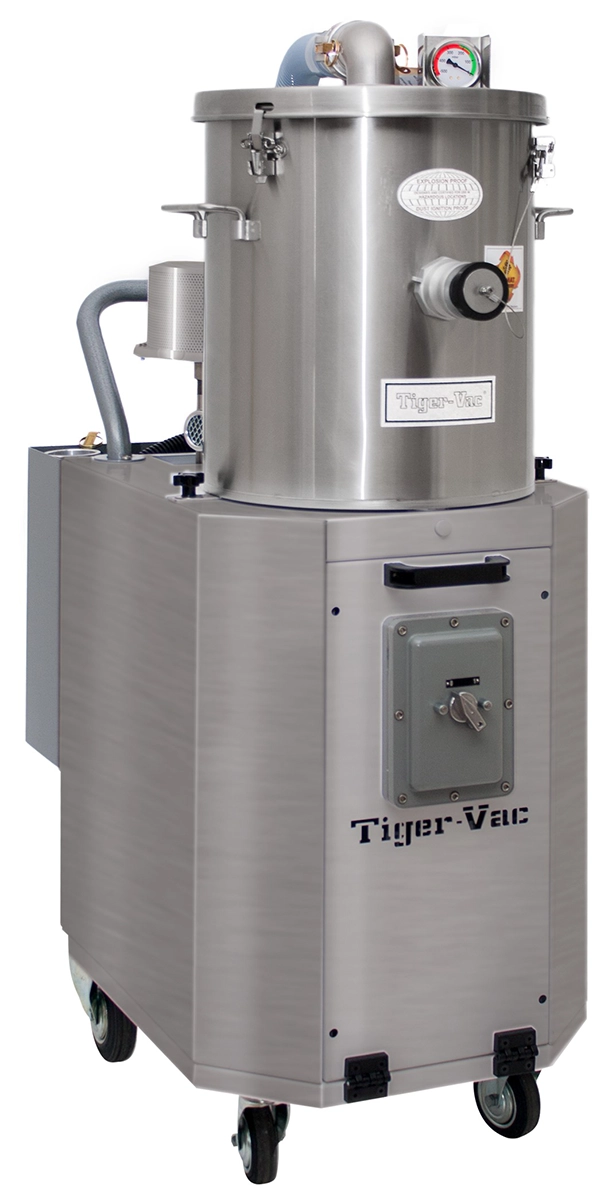
Tiger-Vac CD-230V EX (CFB) PHARMA
Stationary single-phase TEFC ATEX combined vacuum for internal Zone 20 / external Zone 21 dust + Zone 0/1 gas -- 50 L tank, 1.5 kW, Conductive Filter Bag (CFB) -- dedicated pharma variant
- Pharmaceutical API production (active substances) where operator exposure must be minimised
- Potent molecules and controlled substances in Zone 1/21
- Stationary connection to tablet presses, mixers and granulators with internal Zone 20
- Cleanroom pharmaceutical production where close-coupled process extraction is required
- Applications where sealed disposal of collected dust is a compliance requirement
- ATEX Directive 2014/34/EU -- II 1/2GD Ex db h IIB T4 Gb / Ex h tb IIIC T135°C Db IP65 -- Intern: Ex h IIC T6 Ga / Ex h IIIC T50°C Da -- LCIE 03 ATEX 6295 X -- IECEx LCI 10.0040X -- EN 17348 DT
- EN 17348:2022 (harmonized March 2023)
- IEC 60335-2-69 (industrial vacuums)
Tiger-Vac CD-230V EX (CFB) PHARMA
The Tiger-Vac CD-230V EX (CFB) PHARMA is the pharma-dedicated variant of the CD-230V series -- marked II 1/2GD (CAT. 2GD Z1-21) to EN 17348 DT, i.e. category 1/2 for both dust (internal Zone 20, external Zone 21) and gas (internal Zone 0, external Zone 1). The model uses a Conductive Filter Bag (CFB) as the primary collection method -- a static-dissipative filter bag that continuously collects dust in the tank. When the bag is full, it is sealed and replaced as a closed unit, so the operator never comes into direct contact with the collected dust. This is the preferred method for particularly active or toxic pharmaceutical substances (APIs, potent molecules, controlled substances) where cross-contamination and operator exposure must be minimised. It differs from the CFB HEPA variant (cd-230v-ex-cfb-hepa) by being specifically configured for pharma with additional documentation and identification. Motor is 1.5 kW single-phase TEFC (explosion-proof Ex d IIA T4 Gb), flow 212 m3/h at 2540 mmH2O, and the whole housing is AISI 304 stainless steel with IP65 protection.
Applications
- Pharmaceutical API production (active substances) where operator exposure must be minimised
- Potent molecules and controlled substances in Zone 1/21
- Stationary connection to tablet presses, mixers and granulators with internal Zone 20
- Cleanroom pharmaceutical production where close-coupled process extraction is required
- Applications where sealed disposal of collected dust is a compliance requirement
Technical specifications
| ATEX marking | II 1/2GD Ex db h IIB T4 Gb / Ex h tb IIIC T135°C Db IP65 -- Intern: Ex h IIC T6 Ga / Ex h IIIC T50°C Da -- LCIE 03 ATEX 6295 X -- IECEx LCI 10.0040X -- EN 17348 DT |
|---|---|
| Internal / external zone | 20 / 21 |
| Motor type | Single-phase TEFC motor, explosion-proof (Ex db h IIB T4 Gb / Ex h tb IIIC T135°C Db), 1.5 kW / 12.3 A |
| Duty cycle | Continuous |
| Airflow | 212 m³/h |
| Vacuum | 249 mbar (2540 mmH₂O) |
| Container | 50 L |
| Sound pressure | 68 dB(A) |
| Filter class | H class |
| Filter type | HEPA H14 final filter (EN 1822-5, 99.995 % @ 0.3 µm MPPS) + static conductive filter bag (CFB) |
| Primary filter | Conductive Filter Bag (CFB) -- static conductive primary filter bag that continuously collects the dust in the container |
| Cleaning system | No cleaning -- the CFB bag is replaced as a sealed unit when full (no operator exposure) |
| Collection system | Detachable container |
| Material | AISI 304 stainless steel |
| IP class | IP65 |
| Power | 1.5 kW |
| Current | 12.3 A |
| Voltage | 230 V / 50 Hz / 1~ |
| Inlet | Ø 50 mm |
| Dimensions (L × W × H) | 640 x 480 x 1510 mm |
| Weight | 95 kg |
Questions and answers
What is a Conductive Filter Bag (CFB), and how is it different from MRPFT?
CFB (Conductive Filter Bag) is a static-dissipative filter bag that acts as the primary filter. Dust is collected continuously in the bag, and when full it is sealed and replaced as a combined closed unit. The benefit is compliance: the operator never comes into direct contact with the collected dust, and the bag can be disposed of according to applicable regulations for toxic or active medical dust. MRPFT (Manual Reverse Purge with Filter Tubes), in contrast, uses fixed filter tubes that are manually reverse-pulsed -- dust falls into the tank, and the operator empties the tank manually. MRPFT has longer service intervals (no bag changes) but requires the operator to handle open dust. Choose CFB for active pharmaceutical ingredients and toxic dust; choose MRPFT for harmless process dust with continuous operation and few bag changes.
Why is the mobility filter set to stationary when the unit has wheels?
The CD-230V EX (CFB) PHARMA is physically mobile on a Carriage Base (CB) with 4 wheels, but in pharma production it is used almost exclusively as a stationary central connection to process extraction. We therefore categorise it as 'stationary' in the catalogue -- it reflects real-world use, not physical mobility. The wheels make it easy to roll the machine to other process equipment during changeover or service. This matches our 20 April 2026 editorial rule 'Mobility override': mobile frames may be set as stationary if the model is in practice used fixed-connected to process extraction.
What is the difference from CD-230V EX (CFB) HEPA?
Same II 1/2GD certification, same motor, same flow, same CFB collection. The difference is that the PHARMA variant is specifically configured and documented for pharmaceutical production -- typically with additional material certificates (US FDA-compliant elastomers, FDA 21 CFR 177.1520 polyethylene for the CFB bag), additional surface finish documentation, and optionally IQ/OQ/PQ documentation at delivery. CFB HEPA is the same base unit without the extended pharma documentation -- suited for non-pharma 1/2GD tasks where the CFB method fits. Choose PHARMA if your GMP compliance requires additional documentation; choose CFB HEPA if you need the same physical function without pharma-specific paperwork.
How does the operator change the CFB bag in practice?
The procedure is designed to minimise exposure. The operator shuts down suction, waits 30-60 seconds until pressure has equalised, and opens the tank by releasing the latches. The CFB bag typically has a built-in closure mechanism (drawstring or clip) at the opening -- the operator compresses the top of the bag, closes the mechanism and lifts the bag out of the tank as a combined sealed unit. The bag is placed directly in a disposal bag or container according to applicable regulations for that substance type. A new CFB bag is inserted, attached to the suction inlet internally, and the latches closed again. The whole operation typically takes 2-3 minutes and can be performed without special PPE in most pharma applications -- however disposable gloves and P3 respirator are recommended for active substances.
Can it pick up liquids?
No. The CD-230V EX (CFB) PHARMA is a dry-only collector -- EN 17348 DT. The CFB system works only with dry dust -- liquid would damage the bag and compromise ATEX safety. For wet/dry in the same II 1/2GD class choose the Delfin 802 WD AIREX 1/2D-2/2G.
How does CD-230V CFB PHARMA compare to CD-230V MRPFT HEPA?
Both are II 1/2GD stationary pharma machines in the same base chassis and flow class. The difference lies in collection method: CFB (bag) vs MRPFT (filter tubes with reverse pulse). CFB PHARMA captures dust in a sealed bag and is optimal for active, toxic or controlled substances where operator exposure must be zero. MRPFT HEPA achieves much longer service intervals (no bag changes) and is optimal for large dust volumes of harmless process dust. Rule of thumb: choose CFB PHARMA for potent APIs and controlled substances. Choose MRPFT HEPA for continuous process extraction with larger volumes of non-toxic dust. Both can be used in the same base chassis, so the choice is fully determined by the process scenario you need to cover.