
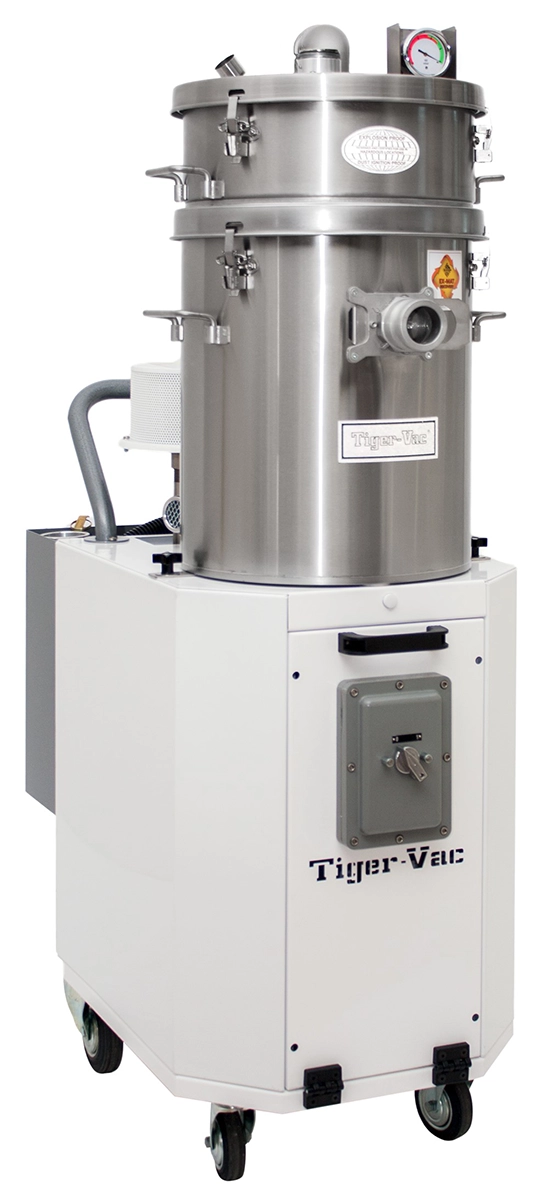
Tiger-Vac CD-230V EX MRPFT HEPA
Stationary single-phase TEFC ATEX combined vacuum for internal Zone 20 / external Zone 21 dust + Zone 0/1 gas -- 50 L tank, 1.5 kW, Manual Reverse Purge with Filter Tubes (MRPFT) cleaning
- Stationary connection to process extraction in pharmaceutical tablet production
- Permanent installation at reactors and mixers in chemical process
- Life-science cleanrooms with internal Zone 20 (piped recovery of API powders)
- Zone 0/1 gas environments where the unit must withstand flammable vapours
- Process filtration where MRPFT manual cleaning extends filter service intervals
- ATEX Directive 2014/34/EU -- II 1/2GD Ex db h IIB T4 Gb / Ex h tb IIIC T135°C Db IP65 -- Intern: Ex h IIC T6 Ga / Ex h IIIC T50°C Da -- LCIE 03 ATEX 6295 X -- IECEx LCI 10.0040X -- EN 17348
- EN 17348:2022 (harmonized March 2023)
- IEC 60335-2-69 (industrial vacuums)
Tiger-Vac CD-230V EX MRPFT HEPA
The Tiger-Vac CD-230V EX MRPFT HEPA is a stationary ATEX combined vacuum certified II 1/2GD to EN 17348 -- that is category 1/2 for dust (internal Zone 20, external Zone 21) and category 2 for gas (internal Zone 0, external Zone 1). It is typically used connected to process extraction in life science, pharmaceutical production and chemical process plants where the machine is permanently tied to a fixed installation. A 1.5 kW TEFC motor (explosion-proof Ex d IIA T4 Gb) delivers 212 m3/h at 2540 mmH2O vacuum, ample for piped recovery on process equipment. Filter cleaning is Manual Reverse Purge with Filter Tubes (MRPFT): active filter tubes can be manually reverse-pulsed to remove the filter cake without opening the machine, significantly extending service intervals between filter changes. HEPA H14 final filter (EN 1822-5, 99.995 % at MPPS) is standard, and the whole housing is built in AISI 304 stainless steel with IP65 protection.
Applications
- Stationary connection to process extraction in pharmaceutical tablet production
- Permanent installation at reactors and mixers in chemical process
- Life-science cleanrooms with internal Zone 20 (piped recovery of API powders)
- Zone 0/1 gas environments where the unit must withstand flammable vapours
- Process filtration where MRPFT manual cleaning extends filter service intervals
Technical specifications
| ATEX marking | II 1/2GD Ex db h IIB T4 Gb / Ex h tb IIIC T135°C Db IP65 -- Intern: Ex h IIC T6 Ga / Ex h IIIC T50°C Da -- LCIE 03 ATEX 6295 X -- IECEx LCI 10.0040X -- EN 17348 |
|---|---|
| Internal / external zone | 20 / 21 |
| Motor type | 1-faset TEFC-motor, eksplosionssikret (Ex d IIA T4 Gb / Ex t IIIC T135°C Db), 1,5 kW / 12,3 A |
| Duty cycle | Continuous |
| Airflow | 212 m³/h |
| Vacuum | 249 mbar (2540 mmH₂O) |
| Container | 50 L |
| Sound pressure | 68 dB(A) |
| Filter class | H class |
| Filter type | HEPA H14 (EN 1822-5, 99,995 % @ 0,3 µm MPPS), 211027B |
| Primary filter | SD epitropic polyester med PTFE fingers-filter samling (219150) + cloth fingers filter SD (219154) |
| Cleaning system | Manual Reverse Purge with Filter Tubes (MRPFT) -- manuel omvendt-puls af filterrør uden aabning |
| Collection system | Detachable container |
| Material | AISI 304 rustfri stål |
| IP class | IP65 |
| Power | 1.5 kW |
| Current | 12.3 A |
| Voltage | 230 V / 50 Hz / 1~ |
| Inlet | Ø 50 mm |
| Dimensions (L × W × H) | 640 x 480 x 1510 mm |
| Weight | 97 kg |
Questions and answers
What does II 1/2GD mean in the ATEX marking?
II 1/2GD means the unit is category 1 internally and category 2 externally -- for both gas (G) and dust (D). In practice: the inside of the vacuum (filter chamber, suction hose, container) may be exposed to Zone 0 for gas or Zone 20 for dust, where explosive atmospheres are continuously or long-term present. The surrounding environment may be Zone 1 for gas or Zone 21 for dust, where explosive atmospheres occur occasionally under normal operation. This makes the model suitable for piped recovery from process equipment that itself maintains Zone 0/20 internally.
Why is the mobility filter set to stationary when the unit has wheels?
The CD-230V EX pair (MRPFT and CFB) is physically mobile on a 4-wheel Carriage Base, but in life science and chemical process they are almost exclusively used as stationary central connections to process extraction or fixed pipe runs. We therefore categorise them as "stationary" in the catalogue -- it reflects real-world use, not physical movability. The wheels make it easy to wheel the machine to another piece of process equipment during changeover or service.
What is MRPFT versus the CFB variant?
The CD-230V EX is available in two versions: MRPFT (Manual Reverse Purge with Filter Tubes) and CFB (Conductive Filter Bag). MRPFT uses fixed filter tubes that can be manually reverse-pulsed -- the operator activates a lever that briefly reverses airflow, releasing the cake from the filter. This extends service intervals significantly and suits continuous large volumes (pharma tablet production, chemical process). CFB uses a static-dissipative filter bag that continuously collects dust; when full, the bag is sealed and disposed -- suited where dust must be disposed in sealed units (API powders, toxic active ingredients). Both share the same motor, flow, vacuum, container size and ATEX class.
Can it pick up liquids?
No. The CD-230V EX MRPFT HEPA is dry-only -- EN 17348 DT. For wet + dry in the same ATEX class, choose the Delfin 802 WD AIREX 1/2D-2/2G, which is also II 1/2GD and covers both dust and gas. For dust only (not simultaneous gas), the Delfin 202 DS 3 AIREX is a slimmer choice.
What value does the IECEx certificate add in the EU?
The CD-230V EX carries a dual certification: ATEX (LCIE 03 ATEX 6295 X) which is the legal requirement in the EU/EEA, and IECEx (LCI 10.0040X) which is the international counterpart. In the EU, ATEX is the primary, and the IECEx certificate is useful if the machine is exported to IECEx countries (UK post-Brexit, Australia, parts of Asia and the Middle East). It is not a dual approval that gives "extra" safety -- both certificates rest on the same technical documentation and the same construction.
How does the operator perform an MRPFT cleaning in practice?
MRPFT is manual, not automatic. The operator shuts down suction, activates the cleaning handle on the side of the filter housing (typically 3-5 strokes back and forth), which reverses airflow through the filter tubes and shakes the dust down into the container. The procedure takes under a minute and is usually done after each shift or when the vacuum reading drops. Because it is manual, there is no automatic timer and no electronic valves to certify -- this keeps ATEX safety simple and maintenance low.