
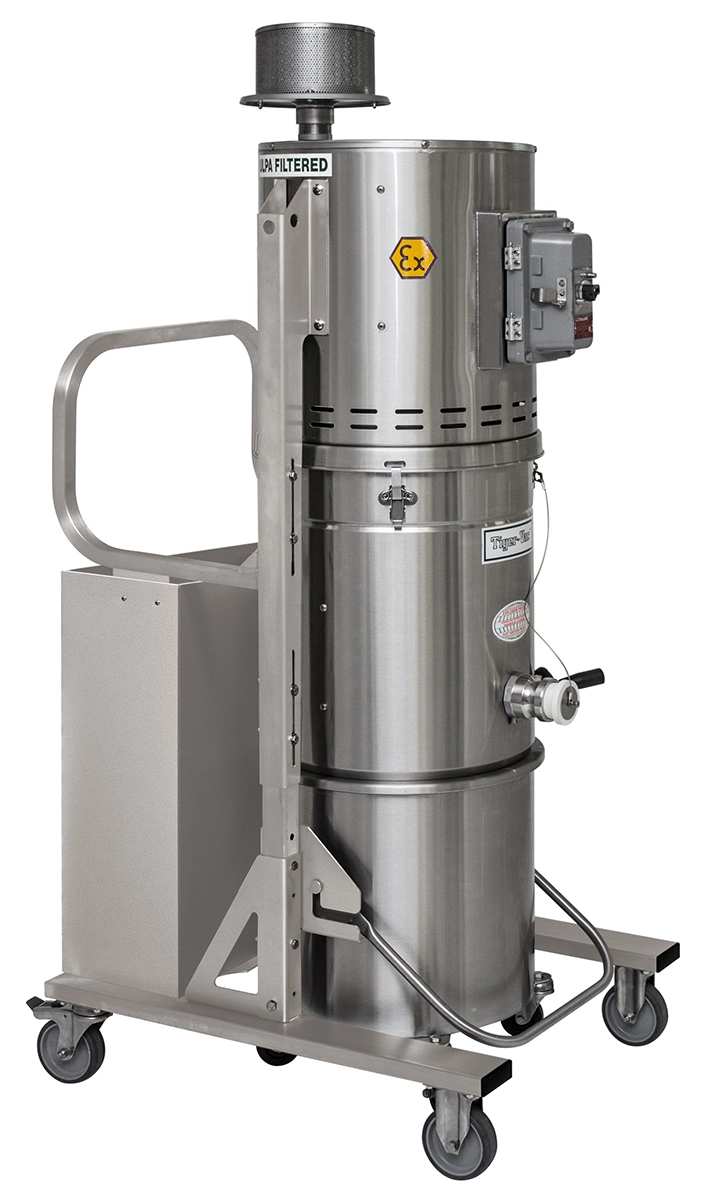
Tiger-Vac CD-36L EX DT (MFS) ULPA WITH SS CART
Mobile three-phase TEFC (single-phase option) ATEX combined vacuum for internal Zone 20 / external Zone 21 dust + Zone 0/1 gas -- 36 L detachable tank, Manual Filter Shaker (MFS), ULPA U15, stainless SS304 cart
- Pharmaceutical solid-form production in Zone 1/21 with dry, non-sticky dust
- Chemical process plants where gas and dust atmospheres occur simultaneously
- Cleanrooms ISO Class 4 where ULPA exhaust is required
- Mobile applications requiring full 1/2GD coverage with MFS cleaning over MRP
- Process equipment with close-coupled extraction where Zone 0/20 is maintained internally
- ATEX Directive 2014/34/EU -- II 1/2GD Ex db h IIB T4 Gb / Ex h tb IIIC T135°C Db IP65 -- Intern: Ex h IIC T6 Ga / Ex h IIIC T50°C Da -- LCIE 03 ATEX 6295 X -- IECEx LCI 10.0040X -- EN 17348 DT
- EN 17348:2022 (harmonized March 2023)
- IEC 60335-2-69 (industrial vacuums)
Tiger-Vac CD-36L EX DT (MFS) ULPA WITH SS CART
The Tiger-Vac CD-36L EX DT (MFS) ULPA WITH SS CART is the combined variant of the CD-36L series with Manual Filter Shaker (MFS) as cleaning system -- marked II 1/2GD to EN 17348 DT, i.e. category 1/2 for both dust (internal Zone 20, external Zone 21) and gas (internal Zone 0, external Zone 1). MFS uses a filter shaker mechanism where the operator manually activates a shaker that knocks dust cake off the primary filter and lets it fall into the detachable 36 L tank. The difference from MRP (Manual Reverse Purge) is in the mechanics: MFS shakes the filter mechanically without reversing airflow, while MRP uses reverse air pulse. Both are operator-activated and without electronic valves (keeping ATEX safety simple). MFS suits dry, heavier dust that releases easily from the filter surface, while MRP is better for fine, sticky dust types where reverse pulsing is more effective. The ULPA U15 final filter is ISO Class 4 (former Class 10) compatible, and the entire housing is SS304 / IP65.
Applications
- Pharmaceutical solid-form production in Zone 1/21 with dry, non-sticky dust
- Chemical process plants where gas and dust atmospheres occur simultaneously
- Cleanrooms ISO Class 4 where ULPA exhaust is required
- Mobile applications requiring full 1/2GD coverage with MFS cleaning over MRP
- Process equipment with close-coupled extraction where Zone 0/20 is maintained internally
Technical specifications
| ATEX marking | II 1/2GD Ex db h IIB T4 Gb / Ex h tb IIIC T135°C Db IP65 -- Intern: Ex h IIC T6 Ga / Ex h IIIC T50°C Da -- LCIE 03 ATEX 6295 X -- IECEx LCI 10.0040X -- EN 17348 DT |
|---|---|
| Internal / external zone | 20 / 21 |
| Motor type | 3-faset TEFC-motor (standard), eksplosionssikret (Ex db h IIB T4 Gb / Ex h tb IIIC T135°C Db), 2,2 kW / 4,8 A, 400 V / 50 Hz |
| Duty cycle | |
| Airflow | 212 m³/h |
| Vacuum | 249 mbar (2540 mmH₂O) |
| Container | 36 L |
| Sound pressure | 72 dB(A) |
| Filter class | H class |
| Filter type | ULPA U15 (EN 1822, 99,999 % @ 0,12 µm MPPS / 99,9995 % @ 0,18 µm IEST-RP-CC001), aerosol-leak-testet |
| Primary filter | Statisk ledende epitropic polyester primærfilter med MFS-rystersamling |
| Cleaning system | Manual Filter Shaker (MFS) -- operatør-aktiveret ryster på siden røger støvkaken af filtret og lader den falde i beholderen |
| Collection system | Detachable container |
| Material | AISI 304 rustfri stål |
| IP class | IP65 |
| Power | 2.2 kW |
| Current | 4.8 A |
| Voltage | 400 V / 50 Hz / 3~ (standard) -- 230 V / 50 Hz / 1~ option |
| Inlet | Ø 50 mm |
| Dimensions (L × W × H) | 780 x 560 x 1780 mm |
| Weight | 99 kg |
Questions and answers
What is the difference between MFS and MRP?
MFS (Manual Filter Shaker) and MRP (Manual Reverse Purge) are two different manual cleaning systems offered on the CD-36L series. MFS uses a mechanical shaker: the operator activates a lever on the side of the filter housing that shakes the primary filter so the dust cake releases and falls into the tank. MRP uses reverse air pulse: same operator action, but instead of mechanical shaking the airflow is briefly reversed through a static-dissipative reverse-purge cartridge so the cake is thrown off. MFS is best suited for dry, heavier dust types that naturally release from the filter surface (mineral dust, granulate, tablet dust). MRP is better for fine, sticky dust types (powder coating, hygroscopic substances, active pharmaceutical ingredients) where reverse pulse is more effective at releasing the cake. Both systems are operator-activated, ATEX certified, and maintain the same II 1/2GD certification.
What is the difference from CD-36L EX DT (MFS) HEPA?
Same MFS cleaning system, same II 1/2GD certification, same motor options, but two real physical differences: (1) chassis material -- MFS ULPA WITH SS CART is built on a full stainless SS304 cart, while MFS HEPA has a painted chassis; and (2) final filter -- ULPA U15 on this model, HEPA H14 on MFS HEPA. Choose ULPA WITH SS CART when operating in ISO Class 4 cleanrooms or where cross-contamination between production batches must be kept to an absolute minimum. Choose MFS HEPA when standard H14 filtration is sufficient and painted chassis suits your application (lower cost, less chassis cleaning between batches).
How does the operator perform an MFS cleaning in practice?
The procedure is simple and takes less than a minute. The operator shuts down suction, activates the shaker handle on the side of the filter housing (typically 5-10 strokes up and down) which shakes the primary filter mechanically. Dust cake releases and falls into the detachable 36 L tank. The operator can then restart suction -- vacuum returns to normal. Cleaning is typically performed after each shift or when vacuum drops. Note that the downstream ULPA U15 final filter is not cleaned by MFS -- it must be replaced periodically (typically annually under normal duty). The static primary filter lasts for several years with regular MFS cleaning, since it is not subjected to daily wear in the same way as standard filters.
When should I choose three-phase over single-phase TEFC?
The three-phase 400 V TEFC motor at 2.2 kW is standard on the 1/2GD variant and provides better reserve under continuous duty. Current draw is only 4.8 A versus 12.3 A on the single-phase variant (which is only 1.5 kW), giving smaller cable sizing and less heat buildup. If 400 V industrial three-phase is available on site (and it is standard at most production sites), three-phase is the right choice. Single-phase is reserved for situations where only 230 V household or service connection is available -- typically temporary setups or service visits.
Can it pick up liquids?
No. The CD-36L EX DT (MFS) ULPA WITH SS CART is dry-only -- EN 17348 DT. For wet/dry in the same II 1/2GD class choose the Delfin 802 WD AIREX 1/2D-2/2G, which is also II 1/2GD and covers both dust and gas.
What does the IECEx certificate mean for us in the EU?
The CD-36L series is dual certified ATEX (LCIE 03 ATEX 6295 X) and IECEx (LCI 10.0040X). In the EU/EEA, ATEX is the legal requirement and IECEx is not needed -- but if you export your products or plant to an IECEx country (UK post-Brexit, Australia, parts of Asia and the Middle East), it is useful to be able to document that the equipment also meets IECEx requirements. It is not a dual approval that gives extra safety -- both certificates rest on the same technical documentation and the same construction. In practice it is a documentation advantage, not a technical one.