
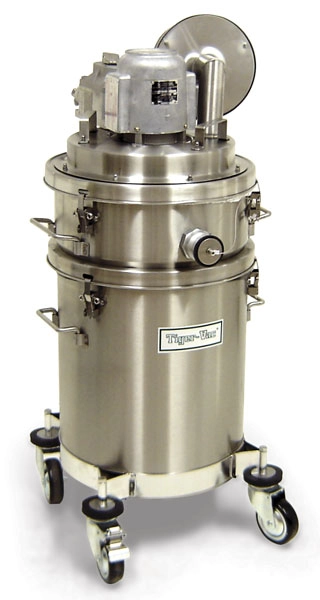
Tiger-Vac EXP1-40L (4W) RE HEPA (FR-P) DRY
Single-phase TEFC ATEX combined vacuum for shooting ranges, ammunition depots and pyrotechnic industries -- 38 L tank, dry-only recovery of flammable and toxic powders (lead contaminants, unspent gunpowder)
- Shooting ranges -- daily cleaning of bays and firing chambers
- Ammunition depots and military installations
- Ammunition and pyrotechnic manufacturing -- unspent gunpowder and residues
- Pyrotechnic fireworks factories with simultaneous gas and dust zones
- Defence industry and civil gun range servicing
- ATEX Directive 2014/34/EU -- II 2GD Ex d IIA T3 Gb / Ex t IIIC T200°C Db IP6X -- LCIE 03 ATEX 6297 -- EN 17348
- EN 17348:2022 (harmonized March 2023)
- IEC 60335-2-69 (industrial vacuums)
Tiger-Vac EXP1-40L (4W) RE HEPA (FR-P) DRY
The Tiger-Vac EXP1-40L (4W) RE HEPA (FR-P) DRY is purpose-built for recovery of flammable and toxic powders -- unspent gunpowder, lead contaminants and pyrotechnic residues. Certified II 2GD to EN 17348 for simultaneous Zone 1 gas and Zone 21 dust, with a 38 litre collection container and 4-wheel dolly. FR-P stands for "Firing Range - Pyrotechnic" and reflects that the construction is approved for the specific risks of shooting ranges and ammunition factories, where the dust itself can contain impact-sensitive material. HEPA H14 final filter (EN 1822-5, 99.995 % at MPPS) and a static-dissipative poly liner ensure collected dust can be disposed of without direct contact. 1.0 kW TEFC motor, 224 m3/h, 1550 mmH2O, AISI 304 stainless construction.
Applications
- Shooting ranges -- daily cleaning of bays and firing chambers
- Ammunition depots and military installations
- Ammunition and pyrotechnic manufacturing -- unspent gunpowder and residues
- Pyrotechnic fireworks factories with simultaneous gas and dust zones
- Defence industry and civil gun range servicing
Technical specifications
| ATEX marking | II 2GD Ex d IIA T3 Gb / Ex t IIIC T200°C Db IP6X -- LCIE 03 ATEX 6297 -- EN 17348 |
|---|---|
| Internal / external zone | -- / 21 |
| Motor type | Single-phase TEFC motor, explosion-proof (Ex d IIA T3 Gb / Ex t IIIC T200°C Db), 1.0 kW / 4.5 A |
| Duty cycle | Continuous |
| Airflow | 224 m³/h |
| Vacuum | 152 mbar (1550 mmH₂O) |
| Container | 38 L |
| Sound pressure | 78 dB(A) |
| Filter class | H class |
| Filter type | HEPA H14 (EN 1822-5, 99,995 % @ 0,3 µm MPPS), 211027B |
| Primary filter | Main filter assembly SD (211013A) with electropolished stainless steel cage (212734A) + pre-filter SD (212007) |
| Cleaning system | Ingen (manuel) -- filter skiftes eller bankes rent |
| Collection system | Detachable container |
| Material | AISI 304 stainless steel |
| IP class | IP6X |
| Power | 1.0 kW |
| Current | 4.5 A |
| Voltage | 230 V / 50 Hz / 1~ |
| Inlet | Ø 50 mm |
| Dimensions (L × W × H) | 480 x 740 x 1040 mm |
| Weight | 34.5 kg |
Questions and answers
What does FR-P specifically mean?
FR-P stands for "Firing Range - Pyrotechnic" and is Tiger-Vac's own product designation for models designed for shooting ranges and pyrotechnic production. The specific risk is that the dust itself can contain unspent gunpowder, primer substances or pyrotechnic residues that ignite on friction or spark. The entire design is therefore extraordinarily focused on eliminating any ignition source: TEFC motor, static-dissipative materials throughout (under 10 ohms resistance), grounding system, and a conductive poly liner so collected material can be disposed of without direct contact or electrostatic risk.
Why is this model dry-only?
The DRY variant (111334B) is certified EN 17348 DT for combined dust recovery. For wet recovery, the W&D variant (111335B) exists as a separate product page. The FR-P series does have an open liquid-recovery option even on the DRY model (floater system can be retrofitted), but the certified and sold configuration is dry-only.
How do I safely dispose of lead-containing dust?
Lead particles from shooting ranges are both chemically toxic (heavy metal) and under certain conditions pyrotechnic. The procedure is: collect in the conductive poly liner (212100S) while the machine is grounded, close the liner with the drawstring and seal, transport via mechanical lift (not hand) and dispose as hazardous waste per local environmental legislation. Lead particles must never enter normal household waste. The operator should wear PPE (mask, gloves, safety glasses). Always follow local regulations -- Particulair can obtain the applicable Danish rulebook.
Can the unit be retrofitted for wet recovery?
Yes. Tiger-Vac has a liquid recovery conversion kit (floater + replacement primary filter to polypropylene wet type) that fits 10/15/25 gallon exp proof vacs. However: this changes the model's certified use configuration and should be approved by a notified body before use in a formal ATEX installation. Many customers simply buy the W&D variant (111335B) at purchase if wet recovery is a known use case.
Why is it called (4W) and not just EXP1-40L?
(4W) refers to 4-Wheel dolly -- the 4-wheel transport base. Tiger-Vac builds the EXP1 range in several cart types: (4W) dolly (this one), (TC) tilt cart (EXP1-15/25/55), (SS-FOD CART) FOD basket (EXP1-10), (DT) Detachable Tank cart with removable container, and (CB) Carriage Base stationary. The notation in the model name identifies the cart configuration -- important because it determines footprint, mobility and accessory options.
Shooting ranges also use ACD vacuums -- when should I choose which?
ACD (Apparatus for Combustible Dust, IEC 60335-2-69 Annex AA) covers combustible dust in areas not ATEX-classified. ATEX II 2GD (like FR-P) covers combustible dust in areas that ARE ATEX-classified as Zone 1/21 or greater. For a typical indoor shooting range, ACD is usually sufficient if there are no gas zones, and an ACD vacuum (e.g. Delfin MTL 302 ACD) is cheaper and simpler. FR-P is chosen where the zone is formally classified (ammunition depots, pyrotechnic factories, installations near natural gas) or where gunpowder vapours can constitute a gas atmosphere.