
Depureco BL 45 DEX 1/3D INERT
Reactive metal powder -- BL 45 INERT with N2-flushed container, hydrogen vent and brushless 1.1 kW motor, 45 L, T140°C, single-phase
- Aluminium grinding powder from CNC machining of aerospace alloys
- Titanium chips from 3D-print collection and support-material removal
- Lithium-bearing electrode powder from battery prototyping
- Magnesium chips from light-metal foundry with moisture risk
- Zirconium powder from dental implant production
- Reactive metals in R&D environment where zoning is Zone 22 + 1
- ATEX Directive 2014/34/EU -- II 1/3D Ex h IIIC T140°C Da/Dc
- EN 17348:2022 (harmonized March 2023)
- IEC 60335-2-69 (industrial vacuums)
Depureco BL 45 DEX 1/3D INERT
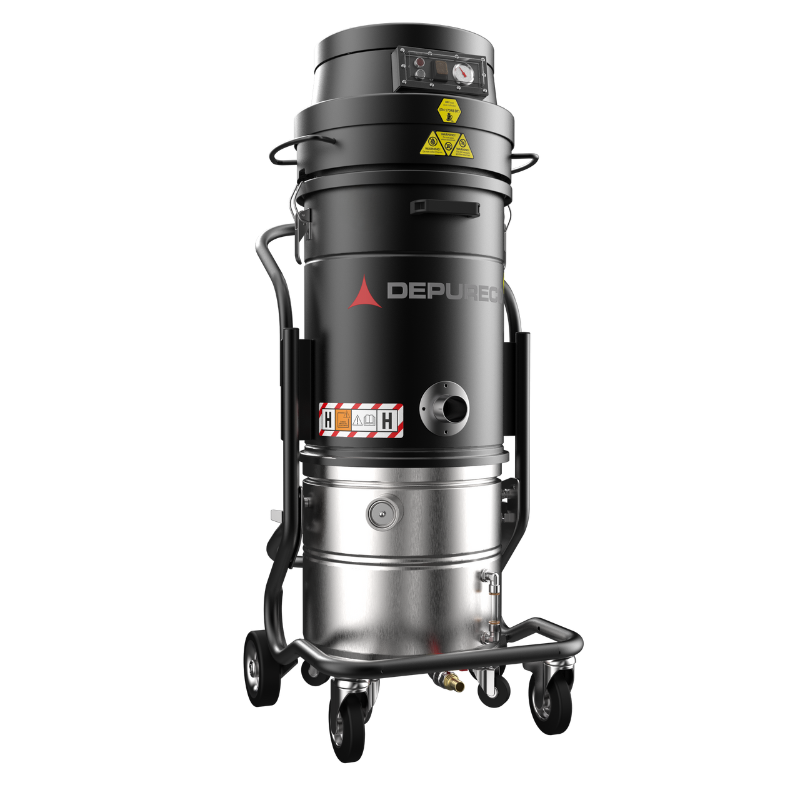
The BL 45 DEX 1/3D INERT is Depureco's compact answer to a tricky task: collecting reactive metal powder -- aluminium, titanium, lithium, magnesium, zirconium -- where contact between fine powder, oxygen and a spark can start an explosion or a self-ignition reaction. The defining difference from a standard BL 45 DEX is the *inerting container*: an N2-flushed inner chamber that displaces oxygen in the collection zone and keeps the powder under an oxygen-poor atmosphere while it rests. The user supplies their own 2-4 bar nitrogen from their own installation -- the BL 45 has no integrated N2 supply, but distribution valve, nozzles and pressure switch are fitted. The ATEX marking is dual: II 1/3D Ex h IIIC T140°C Da/Dc (this slug) *and* II 1/2D Da/Db -- the same physical unit (SKU A1295) is certified in both zone combinations. The motor is brushless 1.1 kW single-phase 110/230V, which gives it a lower T140°C surface temperature than a classical side-channel blower -- intended for use where the powder's minimum ignition temperature is below 160°C.
Applications
- Aluminium grinding powder from CNC machining of aerospace alloys
- Titanium chips from 3D-print collection and support-material removal
- Lithium-bearing electrode powder from battery prototyping
- Magnesium chips from light-metal foundry with moisture risk
- Zirconium powder from dental implant production
- Reactive metals in R&D environment where zoning is Zone 22 + 1
Technical specifications
| ATEX marking | II 1/3D Ex h IIIC T140°C Da/Dc |
|---|---|
| Internal / external zone | 22 / 22 |
| Motor type | 1x brushless ATEX-motor, 1-faset 110/230V 50/60 Hz |
| Duty cycle | Periodic |
| Airflow | 220 m³/h |
| Vacuum | 230 mbar (2345 mmH₂O) |
| Container | 45 L |
| Sound pressure | 72 dB(A) |
| Filter class | H class |
| Filter type | Cartridge-primærfilter antistatisk polyester HEPA13 (EN 60335-2-69 klasse H) + E10 cooling-air + E10 absolutfilter-udblæsning |
| Primary filter | Cartridge antistatisk polyester klasse HEPA13 |
| Cleaning system | Manuel filterrens (bagudtryk) |
| Collection system | Detachable container + INERT neutralisation bath |
| Material | Lakeret stålkonstruktion, AISI 304 støvbeholder med N2-fluxet inerting-indsats |
| Power | 1.1 kW |
| Voltage | 230 V / 50-60 Hz |
| Venturi units | 0 pcs |
| Inlet | Ø 50 mm |
| Dimensions (L × W × H) | 550 x 620 x 1400 mm |
| Weight | 50 kg |
Questions and answers
Why does the INERT model use a brushless motor rather than side-channel blower?
Because the BL 45 INERT is rated T140°C -- 20 degrees lower than its ECOBULL sibling's T160°C. A side-channel blower develops temperatures around 145-155°C on the surface under continuous operation, which is not sufficient for powders with MIT (minimum ignition temperature) below 160°C. A brushless motor stays below T140°C even under fault conditions, and this is why reactive metal powders -- where MIT is often 100-140°C -- can only be collected by a brushless-driven BL 45 INERT. In other words, it is not just "smaller" than the ECOBULL INERT, but has a different safety principle.
How does the inerting container work in practice?
The inerting container is an N2-flushed double-walled construction inside the collection tank itself. The user supplies 2-4 bar nitrogen from their own installation via an ATEX-certified quick coupling. The BL 45's distribution valve opens automatically at start-up and maintains a constant N2 flow -- typically 8-15 Nl/min -- throughout the operating period. Oxygen concentration in the container drops from 20.9 % to below 8 % within 60-90 seconds, well below the LOC (limiting oxygen concentration) for most reactive metal powders. No gas is integrated in the BL 45 -- the customer must supply their own N2 tank or generator.
What is the safety hydrogen vent and why is it included?
Some reactive metals -- especially aluminium, magnesium and zirconium -- react with water or humid air and form hydrogen gas (H2). H2 is extremely flammable (LEL 4 %, also known as the "flammable hydrogen zone") and can accumulate inside a sealed inerting container. The safety hydrogen vent is a calibrated pressure-relief valve with flame arrester that discharges accumulated H2 outside the collection vessel as soon as pressure exceeds 5-10 mbar. It is mandatory for all inerting collection of reactive metals per EN 14491 and is included on the BL 45 INERT as standard.
What is the difference between the 1/3D and 1/2D variant -- they are the same SKU?
It's a pure zone-application difference, not two different units. SKU A1295 is dual-certified: the same physical unit may be used both in Zone 21 with Zone 22 outside (II 1/2D Da/Db -- found on the other slug, bl-45-dex-1-2d-inert) and in Zone 22 + Zone 22 (II 1/3D Da/Dc -- this slug). Price is identical, documentation is identical. We split it into two slugs because it needs to be findable via searches for *both* zone combinations, and because customers who think of it as "a 1/2D machine" do not always cross-reference with a 1/3D list. You receive the same delivery regardless of which slug you order from.
Which powders are NOT suitable for the BL 45 INERT?
As a rule of thumb: powders with MIT below 100°C (certain nano-aluminium and nano-titanium powders), powders with pyrophoric self-ignition at room temperature (e.g. fine-grained zirconium hydride), and powders that react with N2 itself (e.g. certain magnesium nitride systems). These require either a full gas-isolated system (argon instead of N2) or a custom-built unit. When in doubt: read the powder's SDS safety data sheet, look for "autoignition temperature" and "MIT", and contact us for a review. We have experience with 40+ metal powder lists and can recommend the right setup.
Do I need a separate ATEX zone rating for the N2 hose?
Yes. The N2 feed hose from your nitrogen source to the BL 45's quick coupling must be ATEX-certified for the zone it passes through. If the installation is Zone 22 throughout, an antistatic polyurethane hose with grounded flange ends is sufficient. If it passes through Zone 21, the hose must have ATEX II 2D certification or higher. The nitrogen source itself (tank, generator, dewar) typically stands outside the zone. The regulator and pressure switch on the BL 45 are themselves ATEX-certified as part of the unit.
How often must the cartridge filter be replaced?
Under normal reactive-metal-powder operation: once every 4-8 months at 8-hour shifts, or when the pressure-drop gauge on the filter housing exceeds 40 mbar. Reactive metal powders tend to compact faster than ordinary industrial dust, and the cartridge form -- rather than star filter -- is designed to be cleaned with reverse pulse without tearing itself apart. Note that a used filter from INERT service may still contain reactive powder -- it must be handled by trained personnel in N2 atmosphere at replacement. Particulair offers filter replacement as part of a service package.