
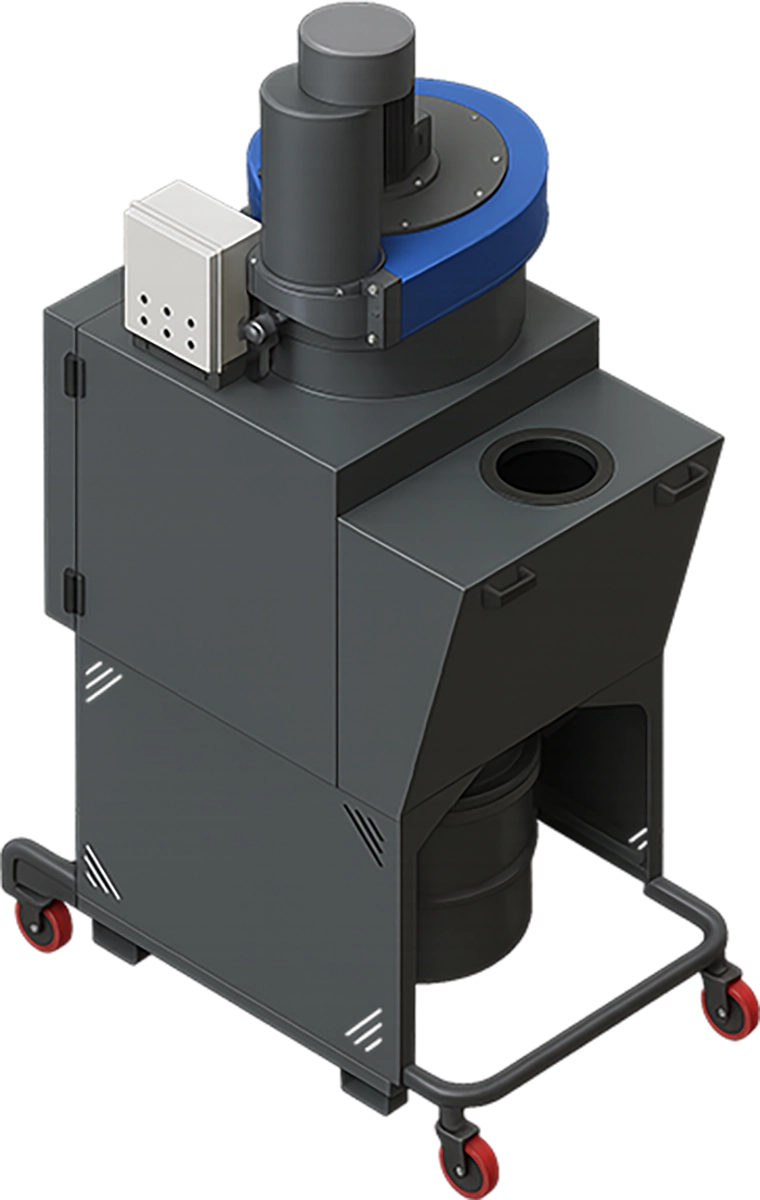
Delfin CUBE 20 K4 PN Z22
Top-model ATEX deduster in the CUBE chassis for Zone 22 -- 4 kW centrifugal fan, 3,500 m³/h, 36 mbar vacuum, 2 cartridge filters with pulse-jet cleaning, continuous operation without operator intervention
- Large central suction systems in ATEX Zone 22 with 4-6 collection points and continuous 24/7 operation
- Chemical and pharmaceutical industry with demanding powder handling in classified zones
- Food production with larger flour or spice dust under Zone 22 regime
- Powder coating halls with full zone classification and high dust volume
- Light-metal machining in aerospace or defense industry with ATEX Zone 22 classification
- ATEX Directive 2014/34/EU -- II 3D Ex h IIIC T80°C (int) / T135°C (ext) Dc
- EN 17348:2022 (harmonized March 2023)
- IEC 60335-2-69 (industrial vacuums)
Delfin CUBE 20 K4 PN Z22
The Delfin CUBE 20 K4 PN Z22 is the top model in Delfin's ATEX deduster range in the CUBE chassis -- a stationary, certified industrial dust collector for ATEX Zone 22. With a 4 kW centrifugal fan, 3,500 m³/h airflow and 370 mmH²O (36 mbar) static vacuum it is the most powerful ATEX-certified deduster Delfin offers. The combination of automatic pulse-jet cleaning on 2 large cartridge filters (200,000 cm² combined filter surface), Ex-certified motor and control box, and a 90 L detachable container with plastic liner makes it ideal for large central suction systems with 4-6 collection points in classified production areas. Note that the noise level here is 74 dB(A) (2 dB(A) higher than the K2 variant due to the stronger motor). ATEX-certified II 3D Ex h IIIC T80°C (int) / T135°C (ext) Dc, self-certified per EN 17348:2022 (harmonised 2023). IP65 enclosure, stainless steel AISI 304 electrical panel, forklift lifting points in the chassis bottom.
Applications
- Large central suction systems in ATEX Zone 22 with 4-6 collection points and continuous 24/7 operation
- Chemical and pharmaceutical industry with demanding powder handling in classified zones
- Food production with larger flour or spice dust under Zone 22 regime
- Powder coating halls with full zone classification and high dust volume
- Light-metal machining in aerospace or defense industry with ATEX Zone 22 classification
Technical specifications
| ATEX marking | II 3D Ex h IIIC T80°C (int) / T135°C (ext) Dc |
|---|---|
| Internal / external zone | 22 / 22 |
| Motor type | Centrifugalventilator IE3 (4 kW, 3-faset 400 V), Ex h IIIC T135°C ekstern / T80°C intern, Ex tb Dust Tight Certified |
| Duty cycle | Continuous |
| Airflow | 3500 m³/h |
| Vacuum | 36 mbar (370 mmH₂O) |
| Container | 90 L |
| Sound pressure | 74 dB(A) |
| Filter class | H class |
| Filter type | HEPA H14 (EN 1822-5), 99,995 % MPPS, slutfilter -- standard inkluderet |
| Primary filter | 2 patron-filtre i polyester med PTFE-belagt overflade, klasse ANT M antistatisk, 200.000 cm² samlet filterflade |
| Cleaning system | Automatisk pulsejet-rensning (PN -- pneumatisk modstroemsskyl med trykluft under sugning), alternerende mellem patroner |
| Collection system | Plastic bag |
| Material | Malet stålkonstruktion med rustfri AISI 304 elektrisk panel og gaffeltruck-loftepunkter i bunden |
| IP class | IP65 |
| Power | 4.0 kW |
| Voltage | 400 V / 50 Hz / 3~ |
| Inlet | Ø 200 mm |
| Dimensions (L × W × H) | 1350 x 880 x 2550 mm |
| Weight | 250 kg |
EXTRACTION ARM & SOURCE CAPTURE — CENTRAL DUST COLLECTION
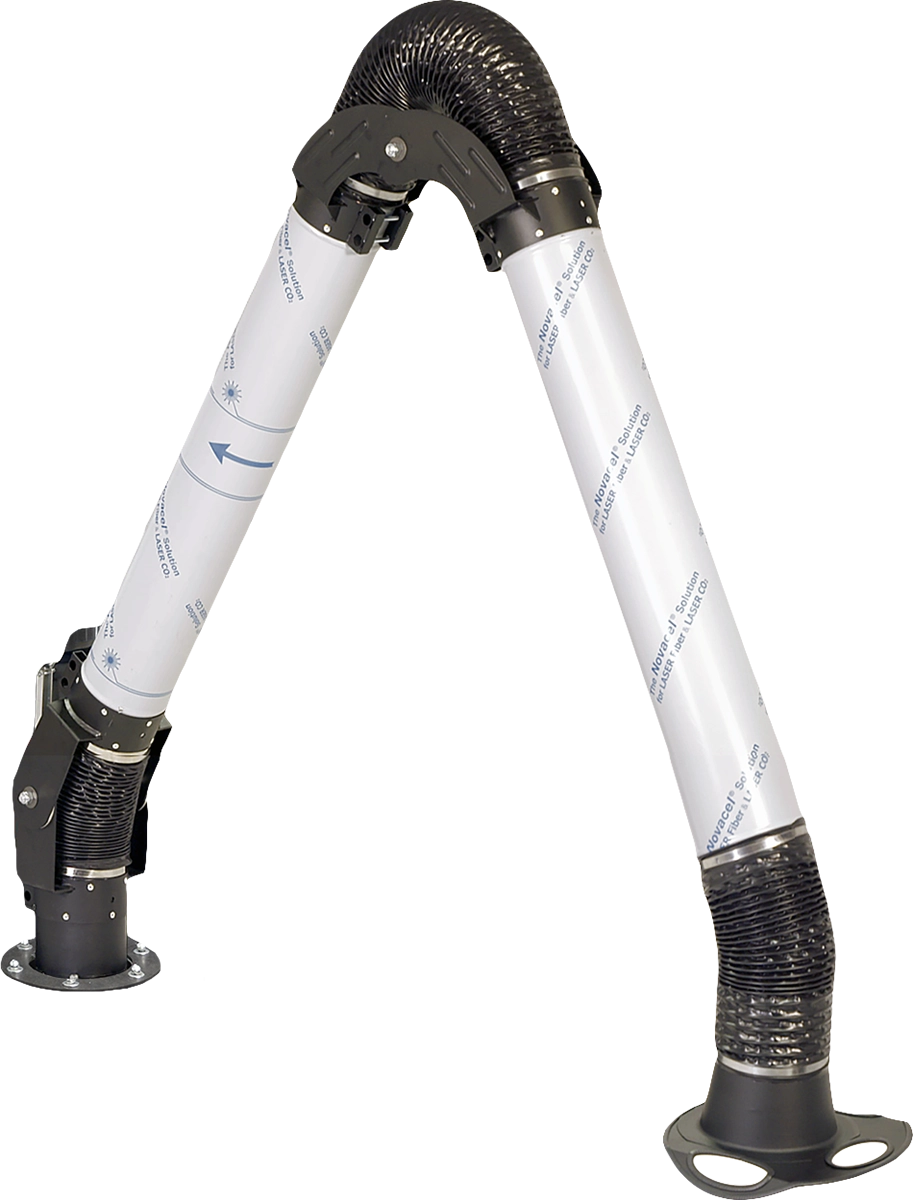
Extraction arm for source capture on central dedusters
An articulated extraction arm is a free-standing, balanced arm that places the deduster's suction point directly at the particle source — welding, grinding, solder fume, bag emptying, mixing stations or quality-control booths. The difference from a fixed hose run is that the operator can adjust the arm's height, reach and angle during operation without tools and without stopping the suction. This delivers far more effective source capture than a general room-extraction system, because the contamination is collected before it reaches the operator's breathing zone.
Why a deduster + extraction arm work so well together
The deduster is a centrifugal-fan based particle collector built for high airflow at low static vacuum — exactly the characteristic an extraction arm needs. The arm's flexible run has low pressure drop per metre, and the wide trumpet-shaped hood at the end loses a small additional amount of vacuum. A centrifugal fan (1,000-3,500 m³/h) supplies the required volume, whereas a side-channel blower (typically 200-400 m³/h at high vacuum) would concentrate the suction on far too small a capture area.
Available dimensions and accessories
Three standard arm configurations are available as accessories, all 3000 mm reach and with earth grounding (MT) included for ESD control: TA.0177.0000 (oe150 arm to oe150 filter chamber inlet), TA.1256.0000 (oe150 arm to oe200 filter chamber inlet — reducing from the deduster's larger inlet to a smaller arm) and TA.0511.0000 (oe200 arm to oe200 filter chamber inlet — maximum airflow). Tubo-flex reductions (SL.2632.0200, SL.6882.0200, SL.3775.0200, SL.6883.0200) allow connection of other hose dimensions, and Y-branches (SL.2775.0200, SL.2692.0200, SL.3022.0200) enable two extraction arms on the same deduster.
Typical industrial scenarios
Arm-equipped dedusters are used for welding fume extraction (MAG, MIG, TIG, arc welding), grinding dust from metal and polymer processing, solder fume and brazing vapours in electronics manufacturing, bag emptying and powder handling in food, pharmaceutical and chemical production, and quality-control booths where particles must be captured but not dispersed. On the ATEX Zone 22 models the arm installation requires ESD earthing throughout the system, and the MT function delivers exactly that. On ACD models (non-ATEX areas with combustible dust) earthing is likewise recommended, because static build-up on the inner wall of the arm can generate ignition sources even without ATEX classification.
Questions and answers
Why 74 dB(A) on the K4 Z22 versus 72 dB(A) on the K4 ACD -- same motor?
It is a consequence of the difference in pulse-jet cleaning timing. The ACD version's 'automatic alternating air washing system' fires pulses in an even, rotating pattern that is often less audible to the operator. The Z22 version's 'automatic filter cleaning with operated air during suction' is ATEX-compatibly timed with the suction-point vacuum, meaning pulses can overlap with phases where the motor is already producing more sound due to load variation. The difference is 2 dB(A) -- noticeable but not significant. Both models remain below the occupational exposure limit of 80 dB(A) for 8-hour exposure. If noise level is critical, a separate technical room or sound-absorbing cabinet that reduces 10-15 dB(A) is recommended.
Can the CUBE 20 K4 PN Z22 handle Zone 21 if I upgrade the installation?
No -- constructively it is NOT certified for Zone 21 (II 2D category). The Z22 model is certified category 3D which is the lowest ATEX dust category, where explosive atmosphere occurs briefly or rarely during normal operation. Zone 21 (category 2D) requires a higher level of protection where explosive atmosphere occurs periodically during normal operation -- this demands heavier construction, notified third-party certification, and additional explosion dampening. For Zone 21 installations you must choose a II 2D model (such as the MTL 202 1/2D LP or a specially ordered Z21 deduster). It is important to note: you cannot upgrade a Z22 deduster to Z21 by retrofitting -- certification class is determined by the underlying construction.
What does the Z22 version require extra in the installation versus the ACD version?
Four things, beyond the ACD version's standard requirements. (1) Explosivity assessment documented by the installation responsible party for zoning (a so-called 'EX document' in Denmark, previously 'Explosion Protection Document'). (2) Installation must be performed by an ATEX-qualified technician with documented competence -- in Denmark typically an installer with ATEX course from DBI or equivalent. (3) Annual inspection of the unit documented in an ATEX inspection report per EN 60079-17 -- typically a technical check of continuity, isolation and wear. (4) Secure storage of CE declaration, nameplate photo and EN 17348:2022 compliance documentation in the unit's operating log. These requirements are not physical items on the unit, but administrative discipline around installation.
How fast is delivery time for the CUBE 20 K4 PN Z22 in Scandinavia?
Standard delivery time from Delfin Italy is 8-14 weeks for standard configuration (painted steel, inox control box, standard cartridge filters). With option selections -- e.g. XXX full AISI 304 construction, PTFE ANT filter, or LOC REM remote control -- delivery typically extends by 2-4 weeks. Freight from Italy to Denmark takes 3-7 days depending on carrier. Installation and commissioning phase at customer is typically 1-3 days, for mechanical connection, electrical hookup and functional test. So from order to operational, 10-18 weeks should be allowed. If delivery is urgent, Delfin can sometimes offer in-stock models at their Italian factory -- contact sales@particulair.com for current stock status.
What documentation is required upon delivery -- what should I retain?
Upon delivery of the CUBE 20 K4 PN Z22 five documents accompany. (1) CE Declaration of Conformity with reference to the ATEX directive 2014/34/EU, Machinery directive 2006/42/EC and Low Voltage directive 2014/35/EU. (2) ATEX nameplate with marking 'II 3D Ex h IIIC T80°C (int) / T135°C (ext) Dc' -- must be visibly affixed to the deduster throughout its lifetime. (3) Operating manual and safety instructions in Danish (and typically English/German/Italian). (4) EN 17348:2022 performance test documentation on request. (5) Electrical schematics and spare parts list. All documents must be retained in the unit's operating log throughout its lifetime -- during annual inspection it must be verified that the nameplate is legible and documentation is accessible.
Is a Z22 deduster a markedly greater investment than an ACD deduster for the same capacity?
Yes -- typically 2,500-4,000 EUR extra for the Z22 version (compare price list: CUBE 20 K4 PN ACD 10,975 EUR versus CUBE 20 K4 PN Z22 13,810 EUR -- difference 2,835 EUR or ca. 26 %). The surcharge covers Ex-certified motor, dust-tight testing and certification of the enclosure, stainless steel AISI 304 electrical panel, documentation and nameplate marking, plus the manufacturer's compliance work per the ATEX directive. If your area is actually classified as Zone 22, the Z22 version is legally necessary and the surcharge cannot be avoided. If the area is borderline classification (could be ACD or Zone 22 depending on risk analysis), it can pay to commission a risk analysis from an ATEX consultant before deciding. A wrong ACD installation in a Zone 22 zone is a serious violation of the ATEX directive.