
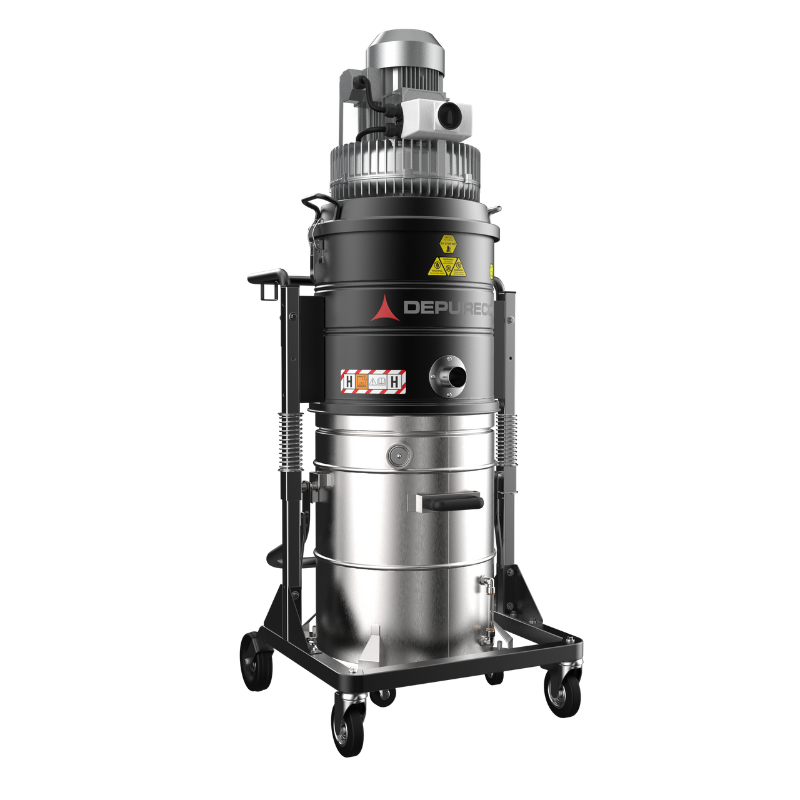
Depureco ECOBULL M DEX 1/2D INERT
ECOBULL M INERT for Zone 20 internal + Zone 21 external -- 100 L, uprated 2.2 kW single-phase side-channel blower, cartridge HEPA13, N2 flush
- Battery-electrode manufacturing in Zone 21 with reactive lithium powder and single-phase installation
- Aluminium grinding cell classified Zone 21 (frequent fine-dust presence)
- Pharmaceutical pilot plant with reactive excipients and Zone 20/21 zoning
- Titanium machining in defense industry, smaller workshops without 400V supply
- Zinc-powder handling in laboratories and research pilot production
- Magnesium grinding in small scale, shooting ranges with reactive projectile powder
- ATEX Directive 2014/34/EU -- II 1/2D Ex h IIIC T160°C Da/Db
- EN 17348:2022 (harmonized March 2023)
- IEC 60335-2-69 (industrial vacuums)
Depureco ECOBULL M DEX 1/2D INERT
The ECOBULL M DEX 1/2D INERT is the stricter EPL Da variant of the ECOBULL M INERT range, designed for areas where a dust-explosive atmosphere may be present *continuously or for long periods* (Zone 20) inside the machine, and *occasionally* (Zone 21) around it. It is the go-to choice for reactive metal powder capture in dedicated process rooms -- aluminium polishing, titanium grinding cells, lithium battery blending stations -- where the risk of an explosive dust cloud inside the collector chamber itself is permanent, not just during operation. The ATEX class II 1/2D Ex h IIIC T160°C Da/Db, together with the N2-flushed inerting container, safety hydrogen vent and lockable lid, is the highest protection level Depureco offers on the dust side. The motor is uprated to 2.2 kW (from 1.8 kW in the 1/3D variant) to ensure stable operation within the T160°C surface temperature limit even under fault scenarios in the stricter Da class, which is a requirement in ATEX product standards EN 1127-1 and EN 13463-1. Air performance is identical to the 1/3D model: 240 m³/h and 180 mbar -- the extra capacity goes to safety, not to pulling power.
Applications
- Battery-electrode manufacturing in Zone 21 with reactive lithium powder and single-phase installation
- Aluminium grinding cell classified Zone 21 (frequent fine-dust presence)
- Pharmaceutical pilot plant with reactive excipients and Zone 20/21 zoning
- Titanium machining in defense industry, smaller workshops without 400V supply
- Zinc-powder handling in laboratories and research pilot production
- Magnesium grinding in small scale, shooting ranges with reactive projectile powder
Technical specifications
| ATEX marking | II 1/2D Ex h IIIC T160°C Da/Db |
|---|---|
| Internal / external zone | 20 / 21 |
| Motor type | 2D ATEX-certificeret sidekanalblæser, 2,2 kW 1-faset 230V 50/60 Hz |
| Duty cycle | |
| Airflow | 240 m³/h |
| Vacuum | 180 mbar (1836 mmH₂O) |
| Container | 100 L |
| Sound pressure | 72 dB(A) |
| Filter class | H class |
| Filter type | Cartridge-primærfilter antistatisk polyester HEPA13 (EN 60335-2-69 klasse H) |
| Primary filter | Cartridge antistatisk polyester klasse HEPA13 |
| Cleaning system | Manuel filterrens (bagudtryk) |
| Collection system | Detachable container + INERT neutralisation bath |
| Material | Lakeret stålkonstruktion, AISI 304 støvbeholder med N2-fluxet inerting-indsats |
| IP class | IP55 |
| Power | 2.2 kW |
| Voltage | 230 V / 50-60 Hz |
| Venturi units | 0 pcs |
| Inlet | Ø 50 mm |
| Dimensions (L × W × H) | 660 x 800 x 1630 mm |
| Weight | 95 kg |
Questions and answers
Why is the motor uprated from 1.8 to 2.2 kW in the 1/2D version?
The difference is not suction -- flow and vacuum are identical to the 1/3D variant -- it is thermal margin. EPL Da class (which applies to internal Zone 20) requires that the safety level is maintained even under *two-fault scenarios* (per EN 1127-1 Table 1 and EN 13463-1). This means the motor must handle, for example, simultaneous bearing wear and airflow blockage without the surface temperature rising above T160°C. By using a 2.2 kW motor instead of 1.8 kW, the motor runs well below its nominal load during normal operation -- longer power margin = less heat production = a safe distance from T160°C even under fault scenarios. It is a classic ATEX design principle: let the motor sweat so safety does not have to.
If I already have a 1/3D INERT, when should I upgrade to 1/2D?
Short answer: when your ATEX zone classification requires it. In practice, this means -- when the collector's internal chamber is in Zone 20 (a dust-explosive atmosphere is present continuously, for long periods or frequently in operation) and not Zone 22 (only briefly under abnormal operation). Three concrete scenarios: (1) a battery blending station where the chamber is always filled with active-material dust -- Zone 20; (2) an aluminium polishing cell with continuous dust production and limited ventilation -- Zone 20; (3) a grinding workshop that kicks up dust twice a week -- Zone 22, 1/3D is sufficient. If you are in doubt, your employer's ATEX zone assessment (the Explosion Protection Document per directive 1999/92/EC article 8) should provide the answer. We cannot make that decision for you over the phone -- but we can help with the right model selection once the document is available.
Is the hydrogen vent a physical safety device or a sensor?
Physical safety device. The safety hydrogen vent is a calibrated membrane valve (with constant flow characteristic) installed at the top of the inerting container's N2 chamber, and releases hydrogen gas under control if lithium or aluminium dust reacts with small amounts of moisture and generates H2 inside the chamber. The design is based on EN 14460 principles for flame-arresting devices, but sized so hydrogen escapes before reaching the explosive limit (4 volume percent in air). The vent is passive -- no electronics, no power supply, no battery. It is the single most important safety function on the ECOBULL 1/2D INERT for lithium battery powder capture, and uses the same principle as the safety vents on lithium battery cells themselves.
What is the difference between this and an ATEX Zone 20 Ex-d explosion-proof vacuum?
They are two entirely different protection philosophies. Ex-d (flameproof enclosure, EN 60079-1) encloses the motor in a pressure-tested metal housing so any internal explosion cannot escape -- heavy, expensive, and limited to the motor compartment. The ECOBULL 1/2D INERT is based on 'Ex h' (non-electrical, constructional safety per EN ISO 80079-36/37) combined with pure mechanical inerting: inside the chamber the atmosphere is filled with N2 until the O2 level is below 8 volume percent -- the limit below which most metal-powder explosions cannot propagate. In practice, the INERT philosophy is cheaper, lighter and more universal (works for all conductive metals, not just electrically connected ones), but requires an N2 supply -- typically 50 L/cycle consumption at a 10-bar regulator. See also CENELEC TR 50404 for a short overview of constructional safety versus flameproof enclosure in dust applications.
Do I need a N2 tank or a N2 generator?
Both options work technically, but the right decision depends on usage frequency and available space. A N2 cylinder (typically a 50 L industrial cylinder, 200 bar, about 10 m³ usable gas) lasts about 150-200 inerting cycles -- suitable for a unit used 1-3 times per day. For continuous operation (e.g. a 24/7 battery production line), a N2 generator based on PSA (pressure swing adsorption) or membrane technology is recommended -- it delivers 99.5% pure N2 from compressed air, with capacities from 5 to 50 Nm³/hour. The generator solution has a fixed investment (20,000-50,000 € for 10 Nm³/hour) but zero running cost. We do not supply N2 ourselves, but can recommend the Atlas Copco NGP/NGM series or Parker NITROSource -- both are well tested in the ATEX industry. The N2 supply must be regulated down to 10 bar and connected via the 6 mm pressure regulator fitting on the back of the unit.
How often should the lockable lid and safety hydrogen vent be checked?
Our recommendation: the lockable lid must be lock-tested *before every collection cycle* (about 30 seconds of visual checking), and the safety hydrogen vent must be function-tested *quarterly* (plug pressure test at 50 mbar -- described in the service manual). In addition, the grounding cable resistance must be measured quarterly with an insulation meter (must be below 10⁶ Ω), and the inerting container itself must be deep-cleaned every 6 months or after every 500 collection cycles, whichever comes first. All inspections must be documented in the machine log per directive 1999/92/EC article 8(2)(d). If the vent or lid does not pass the test, the machine must be taken out of operation until repaired -- this is an absolute rule, not a recommendation. Spare parts are delivered within 5-10 working days from Depureco Italy.
Is single-phase 230V realistic at 2.2 kW -- or will I have problems with the group fuse?
It is realistic, but you need a 16 A fixed installation on a dedicated group. A 2.2 kW single-phase motor typically draws 13-14 A at full load (with cosφ around 0.85 and power factor correction), which sits comfortably below the 16 A fuse. Important: do *not* use a 10 A fuse, and do not use extension cords -- starting current is 50-70 A in the first half-second, and an undersized cable creates voltage drops that can trigger the thermal protection. If the installation does not have a 16 A dedicated group, consider the T model (A1091) instead -- three-phase 400V 3 kW draws only 5.5 A per phase and is thermally more stable under long runs. Contact a licensed electrician for installation if in doubt. We deliver with a standard CEE 7/7 'Schuko' plug, but prefer industrial CEE 17 blue 16 A as an option (not at an extra cost).