
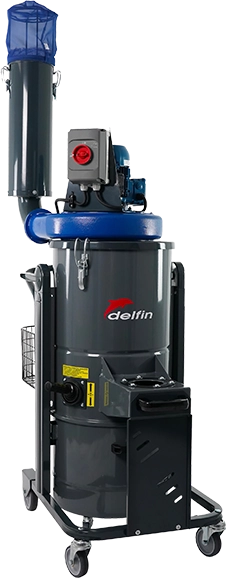
Delfin ZFR EV 420 Z22 K07
Stationary ATEX deduster with centrifugal fan -- 1000 m³/h airflow, 45 L container with plastic liner, HEPA H14, Zone 22 self-certified per EN 17348:2022
- Extraction-arm mounted source capture at welding workstations in Zone 22 classified production halls
- Central suction of process dust in smaller mills, feed plants and bakeries with ATEX zone classification
- Grinding and polishing dust from metal processing on heavily classified laboratory and production equipment
- Bag and sack emptying of combustible powder in coatings, plastics manufacturing and fine chemistry under Zone 22 regime
- Permanent installation at newly established production cells where a mobile ATEX vacuum cannot be permanently coupled
- ATEX Directive 2014/34/EU -- II 3D Ex h IIIC T80°C (int) / T135°C (ext) Dc
- EN 17348:2022 (harmonized March 2023)
- IEC 60335-2-69 (industrial vacuums)
Delfin ZFR EV 420 Z22 K07
The Delfin ZFR EV 420 Z22 K07 is the entry-level model in Delfin's centrifugal-fan based ZEFIRO deduster range -- a stationary ATEX dust collector for Zone 22-classified areas. At its core is a 0.75 kW centrifugal fan (three-phase 400 V, IE3 motor) delivering 1,000 m³/h airflow at 180 mmH²O (18 mbar) static vacuum -- a characteristic optimised for source capture with extraction arm or central piping, not for hand-held suction. Filtration is two-stage: a star-shaped polyester primary filter (L class, 20,000 cm² surface) retains coarser particles, and a HEPA H14 final filter (99.995 % efficiency at MPPS per EN 1822-5) ensures exhaust that is clean down to the finest health-hazardous particles. Collection is in a detachable 45-litre steel container with internal plastic liner, keeping cleaning simple and contamination-free. The model is ATEX-certified II 3D Ex h IIIC and built to the harmonised standard EN 17348:2022 -- the European norm for industrial vacuums in ATEX zones.
Applications
- Extraction-arm mounted source capture at welding workstations in Zone 22 classified production halls
- Central suction of process dust in smaller mills, feed plants and bakeries with ATEX zone classification
- Grinding and polishing dust from metal processing on heavily classified laboratory and production equipment
- Bag and sack emptying of combustible powder in coatings, plastics manufacturing and fine chemistry under Zone 22 regime
- Permanent installation at newly established production cells where a mobile ATEX vacuum cannot be permanently coupled
Technical specifications
| ATEX marking | II 3D Ex h IIIC T80°C (int) / T135°C (ext) Dc |
|---|---|
| Internal / external zone | 22 / 22 |
| Motor type | Centrifugalventilator IE3 (0,75 kW, 3-faset 400 V), Ex h IIIC T135°C ekstern / T80°C intern, Ex tb Dust Tight Certified |
| Duty cycle | Continuous |
| Airflow | 1000 m³/h |
| Vacuum | 18 mbar (180 mmH₂O) |
| Container | 45 L |
| Sound pressure | 70 dB(A) |
| Filter class | H class |
| Filter type | HEPA H14 (EN 1822-5), 99,995 % MPPS, 10 m² filterflade -- standard inkluderet |
| Primary filter | Stjerne/taske polyester L-klasse (IEC 60335-2-69), 20.000 cm², diameter 420 mm, manuel rensning |
| Cleaning system | Manuel filterrensning via udvendig hank |
| Collection system | Plastic bag |
| Material | Malet stålkonstruktion (AISI 304 som option) |
| IP class | IP55 |
| Power | 0.75 kW |
| Voltage | 400 V / 50 Hz / 3~ |
| Inlet | Ø 100 mm |
| Dimensions (L × W × H) | 580 x 630 x 1800 mm |
| Weight | 60 kg |
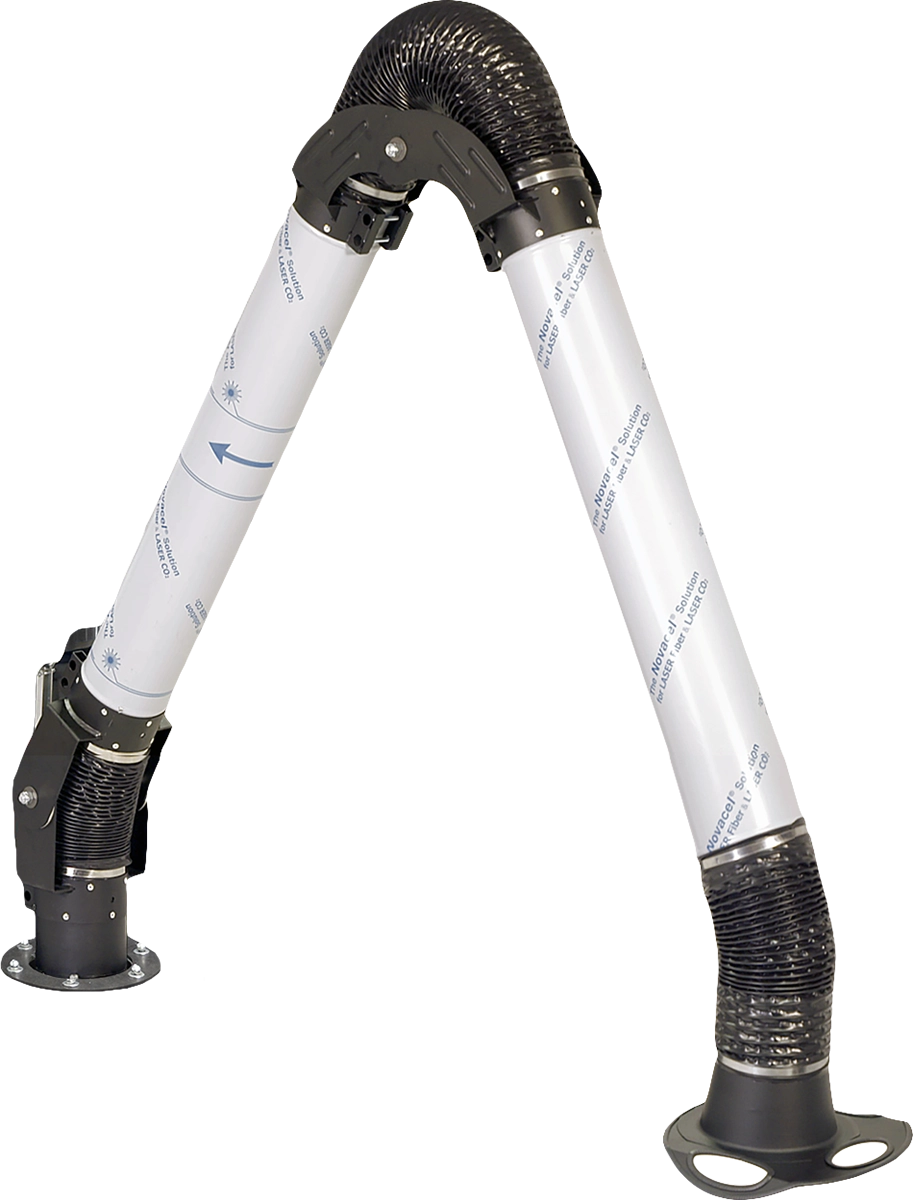
EXTRACTION ARM & SOURCE CAPTURE — CENTRAL DUST COLLECTION
Extraction arm for source capture on central dedusters
An articulated extraction arm is a free-standing, balanced arm that places the deduster's suction point directly at the particle source — welding, grinding, solder fume, bag emptying, mixing stations or quality-control booths. The difference from a fixed hose run is that the operator can adjust the arm's height, reach and angle during operation without tools and without stopping the suction. This delivers far more effective source capture than a general room-extraction system, because the contamination is collected before it reaches the operator's breathing zone.
Why a deduster + extraction arm work so well together
The deduster is a centrifugal-fan based particle collector built for high airflow at low static vacuum — exactly the characteristic an extraction arm needs. The arm's flexible run has low pressure drop per metre, and the wide trumpet-shaped hood at the end loses a small additional amount of vacuum. A centrifugal fan (1,000-3,500 m³/h) supplies the required volume, whereas a side-channel blower (typically 200-400 m³/h at high vacuum) would concentrate the suction on far too small a capture area.
Available dimensions and accessories
Three standard arm configurations are available as accessories, all 3000 mm reach and with earth grounding (MT) included for ESD control: TA.0177.0000 (oe150 arm to oe150 filter chamber inlet), TA.1256.0000 (oe150 arm to oe200 filter chamber inlet — reducing from the deduster's larger inlet to a smaller arm) and TA.0511.0000 (oe200 arm to oe200 filter chamber inlet — maximum airflow). Tubo-flex reductions (SL.2632.0200, SL.6882.0200, SL.3775.0200, SL.6883.0200) allow connection of other hose dimensions, and Y-branches (SL.2775.0200, SL.2692.0200, SL.3022.0200) enable two extraction arms on the same deduster.
Typical industrial scenarios
Arm-equipped dedusters are used for welding fume extraction (MAG, MIG, TIG, arc welding), grinding dust from metal and polymer processing, solder fume and brazing vapours in electronics manufacturing, bag emptying and powder handling in food, pharmaceutical and chemical production, and quality-control booths where particles must be captured but not dispersed. On the ATEX Zone 22 models the arm installation requires ESD earthing throughout the system, and the MT function delivers exactly that. On ACD models (non-ATEX areas with combustible dust) earthing is likewise recommended, because static build-up on the inner wall of the arm can generate ignition sources even without ATEX classification.
Questions and answers
What is a deduster, and how does it differ from a conventional industrial vacuum?
A deduster (centrifugal-fan based particle collector) is a stationary dust collector designed to capture airborne particles via high airflow at relatively low static vacuum. Where a mobile industrial vacuum delivers 100-300 m³/h at 200-300 mbar (designed to draw through a long hose into a bin on the floor), the ZFR EV 420 K07 delivers 1,000 m³/h at just 18 mbar (designed to capture diffuse particles at the source via extraction arm or central piping). These are two different working principles: point collection versus volume capture. The deduster's strength is continuous, automatic operation with large airflow.
What dust types is the ZFR EV 420 K07 designed for?
The model is intended for dry combustible dust and fine suspended particles -- typically metallic grinding dust, polymer dust from plastics processing, organic process powders such as flour and spices, and fine chemicals in powder form. The filter class is L (IEC 60335-2-69) with HEPA H14 final filter (EN 1822-5), so the exhaust meets even stringent workplace requirements. The model is NOT designed for wet or sticky materials, large mechanical chips, or reactive metallic dust (all of these require specialised models -- wet variants, heavier chassis or INERT liquid bath).
How is the ZFR EV 420 K07 ATEX-certified for Zone 22?
The marking is 'II 3D Ex h IIIC T80°C (int) / T135°C (ext) Dc' -- group II (above-ground industry), category 3 for dust (Zone 22 external, EPL Dc). The type of protection is 'h' (constructive safety per EN ISO 80079-37) for dust group IIIC (all dust effect groups including conductive). Internal surface temperature is limited to 80°C, external to 135°C -- important to ensure that dust contacting the enclosure does not ignite. The centrifugal fan and control box are both 'Ex tb Dust Tight Certified', and the entire unit is performance-tested to EN 17348:2022, the harmonised European standard for industrial vacuums in ATEX zones.
Should an extraction arm be used, or can it be connected directly to a machine?
Both are valid, and the choice depends on the scenario. With an articulated extraction arm (TA.0177.0000 oe150 or TA.0511.0000 oe200, 3,000 mm reach) the model becomes a flexible source-capture station -- ideal for welding fume extraction, grinding workstations or bag emptying. Without an arm the deduster can be connected directly to a machine or process via the 100 mm suction inlet -- typically a CNC, grinder or mixer with fixed suction tubing. Tubo-flex reductions (SL.6883.0200 from oe200/100) allow adaptation to other hose dimensions. Earth grounding (MT) is included as standard.
Why a centrifugal fan rather than a side-channel blower?
The two blower types solve different problems. A side-channel blower delivers high vacuum (200-300 mbar) at moderate airflow (200-400 m³/h) -- ideal for a mobile vacuum with a long hose. A centrifugal fan delivers the opposite: high airflow (1,000-3,500 m³/h) at low vacuum (15-40 mbar) -- ideal for source capture and central suction where the extraction arm or piping has low pressure drop. If you try to capture diffuse particles at a welding workstation with a side-channel blower, the concentration of air movement will be too small. If you try to draw through a long hose into a bin with a centrifugal fan, the vacuum will be too low. Choose type by application, not by general preference.
What does filter class L combined with HEPA H14 mean?
The primary filter is L class per IEC 60335-2-69 -- 'low risk' category for dust with MAK value above 1 mg/m³ (or rather: not-particularly-hazardous dust). It is the least restrictive of the three vacuum cleaner classes (L, M, H). BUT the important thing is that the final filter is HEPA H14 per EN 1822-5 -- 99.995 % efficiency at MPPS (Most Penetrating Particle Size, ca. 0.3 micrometre). This means that regardless of what dust type the primary filter retains, the final exhaust will be clean at H level. The deduster's overall capability is therefore equivalent to an H-class vacuum -- the L-class rating on the primary filter is part of the construction specification, not an output requirement.