
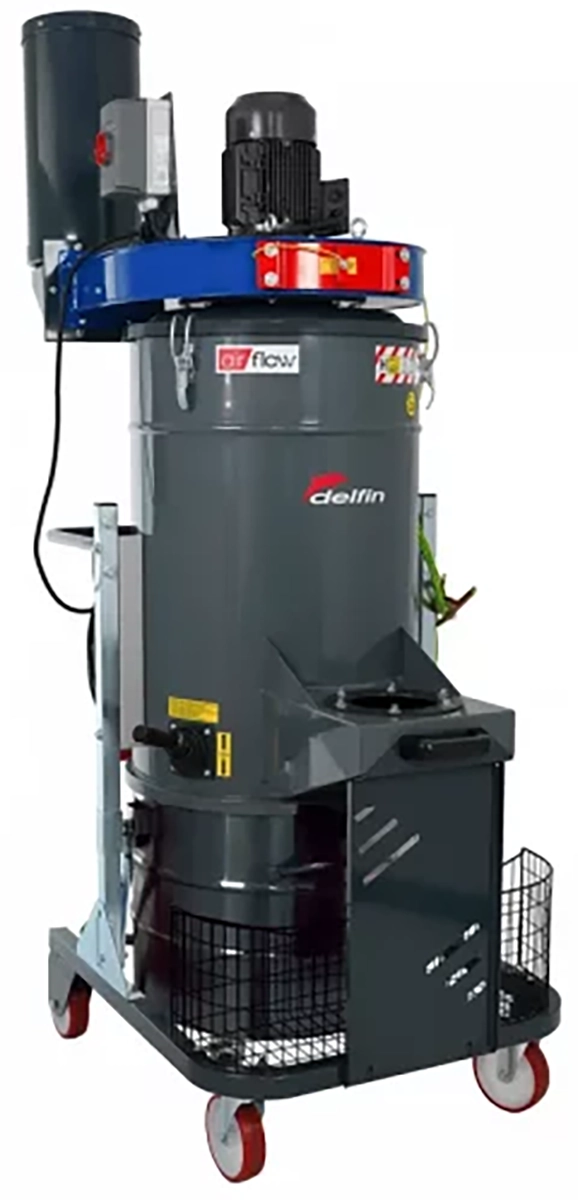
Delfin ZFR EV AP 560 K1 Z22
Stationary ATEX deduster in the AP 560 chassis -- 1,500 m³/h airflow, 1.1 kW centrifugal fan, 100 L container, antistatic polyester ANT M + HEPA H14
- Central suction on medium-sized production plants in Zone 22 with 2-3 collection points
- Dual-arm source capture via Y-branch at two welding workstations simultaneously
- Continuous suction from mixers and granulators in polymer and feed industries
- Dust collection from cyclone-based primary separators at larger process plants
- Stationary installation on CNC halls with multiple machines under shared local extraction
- ATEX Directive 2014/34/EU -- II 3D Ex h IIIC T80°C (int) / T135°C (ext) Dc
- EN 17348:2022 (harmonized March 2023)
- IEC 60335-2-69 (industrial vacuums)
Delfin ZFR EV AP 560 K1 Z22
The Delfin ZFR EV AP 560 K1 Z22 is the smallest motor variant in the AP 560 chassis -- a stationary ATEX deduster with a 1.1 kW centrifugal fan and substantially greater capacity than the smaller 420 model. Airflow reaches 1,500 m³/h at 160 mmH²O (16 mbar) static vacuum, while the 100-litre tank capacity and 200 mm suction inlet place the model in the central-suction segment. The primary filter is polyester ANT M class (antistatic, 50,000 cm² surface, 560 mm diameter), providing both a larger filtration surface and ESD control -- important when diffuse particles travel through an extraction arm or long piping where static build-up would otherwise become an ignition source. The HEPA H14 final filter is standard, and collection is in a detachable 100-litre steel container with internal plastic liner. The model is ATEX-certified II 3D Ex h IIIC and built to EN 17348:2022.
Applications
- Central suction on medium-sized production plants in Zone 22 with 2-3 collection points
- Dual-arm source capture via Y-branch at two welding workstations simultaneously
- Continuous suction from mixers and granulators in polymer and feed industries
- Dust collection from cyclone-based primary separators at larger process plants
- Stationary installation on CNC halls with multiple machines under shared local extraction
Technical specifications
| ATEX marking | II 3D Ex h IIIC T80°C (int) / T135°C (ext) Dc |
|---|---|
| Internal / external zone | 22 / 22 |
| Motor type | Centrifugalventilator IE3 (1,1 kW, 3-faset 400 V), Ex h IIIC T135°C ekstern / T80°C intern, Ex tb Dust Tight Certified |
| Duty cycle | Continuous |
| Airflow | 1500 m³/h |
| Vacuum | 16 mbar (160 mmH₂O) |
| Container | 100 L |
| Sound pressure | 72 dB(A) |
| Filter class | H class |
| Filter type | HEPA H14 (EN 1822-5), 99,995 % MPPS, 10 m² filterflade -- standard inkluderet |
| Primary filter | Stjerne/taske polyester ANT M-klasse antistatisk (IEC 60335-2-69), 50.000 cm², diameter 560 mm, manuel rensning |
| Cleaning system | Manuel filterrensning via udvendig hank |
| Collection system | Plastic bag |
| Material | Malet stålkonstruktion (AISI 304 som option) |
| IP class | IP55 |
| Power | 1.1 kW |
| Voltage | 400 V / 50 Hz / 3~ |
| Inlet | Ø 200 mm |
| Dimensions (L × W × H) | 780 x 850 x 2140 mm |
| Weight | 100 kg |
EXTRACTION ARM & SOURCE CAPTURE — CENTRAL DUST COLLECTION
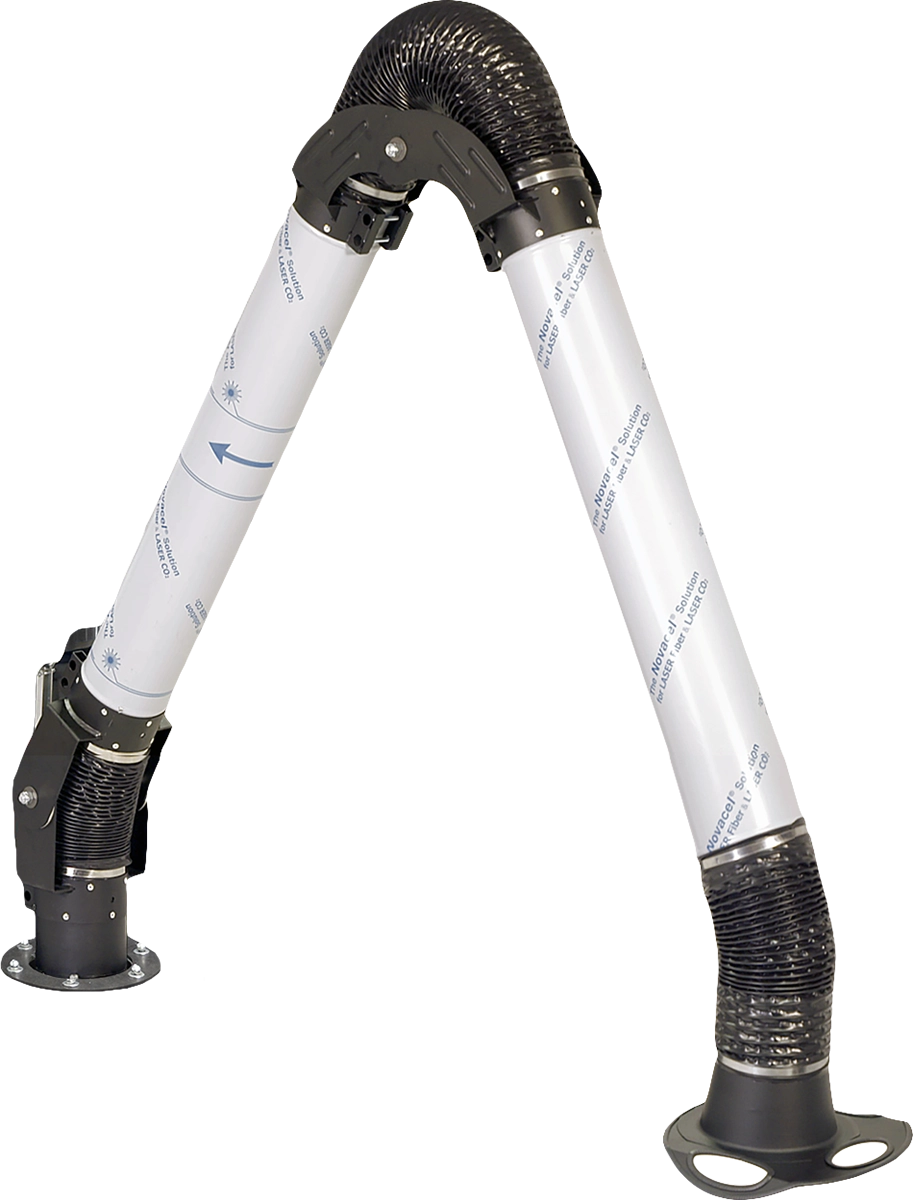
Extraction arm for source capture on central dedusters
An articulated extraction arm is a free-standing, balanced arm that places the deduster's suction point directly at the particle source — welding, grinding, solder fume, bag emptying, mixing stations or quality-control booths. The difference from a fixed hose run is that the operator can adjust the arm's height, reach and angle during operation without tools and without stopping the suction. This delivers far more effective source capture than a general room-extraction system, because the contamination is collected before it reaches the operator's breathing zone.
Why a deduster + extraction arm work so well together
The deduster is a centrifugal-fan based particle collector built for high airflow at low static vacuum — exactly the characteristic an extraction arm needs. The arm's flexible run has low pressure drop per metre, and the wide trumpet-shaped hood at the end loses a small additional amount of vacuum. A centrifugal fan (1,000-3,500 m³/h) supplies the required volume, whereas a side-channel blower (typically 200-400 m³/h at high vacuum) would concentrate the suction on far too small a capture area.
Available dimensions and accessories
Three standard arm configurations are available as accessories, all 3000 mm reach and with earth grounding (MT) included for ESD control: TA.0177.0000 (oe150 arm to oe150 filter chamber inlet), TA.1256.0000 (oe150 arm to oe200 filter chamber inlet — reducing from the deduster's larger inlet to a smaller arm) and TA.0511.0000 (oe200 arm to oe200 filter chamber inlet — maximum airflow). Tubo-flex reductions (SL.2632.0200, SL.6882.0200, SL.3775.0200, SL.6883.0200) allow connection of other hose dimensions, and Y-branches (SL.2775.0200, SL.2692.0200, SL.3022.0200) enable two extraction arms on the same deduster.
Typical industrial scenarios
Arm-equipped dedusters are used for welding fume extraction (MAG, MIG, TIG, arc welding), grinding dust from metal and polymer processing, solder fume and brazing vapours in electronics manufacturing, bag emptying and powder handling in food, pharmaceutical and chemical production, and quality-control booths where particles must be captured but not dispersed. On the ATEX Zone 22 models the arm installation requires ESD earthing throughout the system, and the MT function delivers exactly that. On ACD models (non-ATEX areas with combustible dust) earthing is likewise recommended, because static build-up on the inner wall of the arm can generate ignition sources even without ATEX classification.
Questions and answers
When is the K1 variant the right choice over K2 or K4?
The K1 (1.1 kW, 1,500 m³/h) is the optimal choice when the load is moderate -- typically one or two extraction arms on shorter piping, a single CNC machine, or a smaller cyclone installation. If you plan three or more simultaneous collection points, or if the extraction arm is more than 5-6 metres from the deduster, the K2 (2.2 kW, 2,500 m³/h) is the more robust choice. The K4 (4 kW, 3,500 m³/h) is reserved for central suction systems with four or more points, or for scenarios where the particle is particularly sticky or heavy. Operating economy should weigh in: the K1 draws less current and is quieter in operation -- do not choose a K4 if a K1 suffices.
What does 'ANT M' on the primary filter mean, and why is it important?
ANT is the Italian abbreviation for 'antistatico' -- antistatic. The filter medium is deliberately made electrically conductive (typically via graphite additives or metal fibres in the polyester weave) to ensure that the static charge built up as particles brush past the filter can be conducted away to earth. On an antistatic filter in a Zone 22 area this is an ATEX-critical function: a non-antistatic filter could accumulate several kV of static potential and generate a spark that ignites the collected dust. Filter class M (medium) indicates that the filter retains dust with MAK values down to 0.1 mg/m³ -- moderately strict for dust types one would not want to inhale, but not in the carcinogenic category.
Why did the vacuum drop from 180 mmH²O on the 420 model to 160 mmH²O on the 560 K1?
It is a consequence of the centrifugal fan's characteristic. When stepping up to a larger rotor and larger inlet diameter (560 mm vs 420 mm), the fan shifts toward higher airflow at lower static vacuum -- a so-called movement along the fan curve. The K1 variant delivers 50 % more airflow (1,500 vs 1,000 m³/h) but 11 % lower static vacuum (160 vs 180 mmH²O). For a deduster with short piping and low-resistance filtration this is a good trade -- volume flow takes over from point vacuum. For applications with long hoses or clogged filters the 420 model will maintain suction-point vacuum better. So: choose by the pressure profile of the installation, not by peak figures.
How often should the container be emptied during continuous operation?
With 100 L capacity, and depending on dust density, there is typically 1-3 operating shifts between emptyings. For light wood dust (density ca. 0.3-0.4 t/m³) 100 L corresponds to roughly 30-40 kg -- at 5 kg/h collection the container lasts ca. 6-8 hours. For heavier metal dust (density 2.5-7 t/m³) the container lasts much longer in volume, but weight can become a handling problem -- roll the container out on wheels before it is filled to the rim. The plastic liner is folded over the container rim to prevent dust on the outer edge, and is pulled in from above when the container is emptied. AISI 304 inox container is available as option for greater chemical resistance.
What earth grounding does an extraction arm installation require in Zone 22?
In Zone 22 the entire suction system -- the deduster, the extraction arm, all metallic piping and even the hoses -- must be electrically connected and earthed to the same potential. Maximum resistance to earth is typically specified at 10⁸ ohm in ATEX practice. Delfin's TA arm configurations are supplied with earth grounding (MT) integrated as standard -- a metallic threaded coupling connection between the arm joints and the deduster chassis. When the arm and deduster are installed, the installer must measure the resistance between the arm tip and earth potential to verify continuity. Antistatic hoses must also be series-earthed via metallic end clamps.
Can the model be combined with a cyclone pre-separator?
Yes, and it is a good idea when collecting heavy or coarse particles (foundry chips, sandblasting residue, coarser plastic chips). A cyclone installed before the deduster typically retains 70-90 % of heavy particles in its own container, which extends the primary filter's life significantly and keeps the container less filled with 'empty volume'. With the K1 model's 200 mm suction inlet a standard ATEX-approved cyclone (oe200 inlet) can be connected directly. Important: the cyclone and the deduster must be at the same ATEX zone level (both Zone 22), and earth grounding must be carried through the entire system including the cyclone wall.