
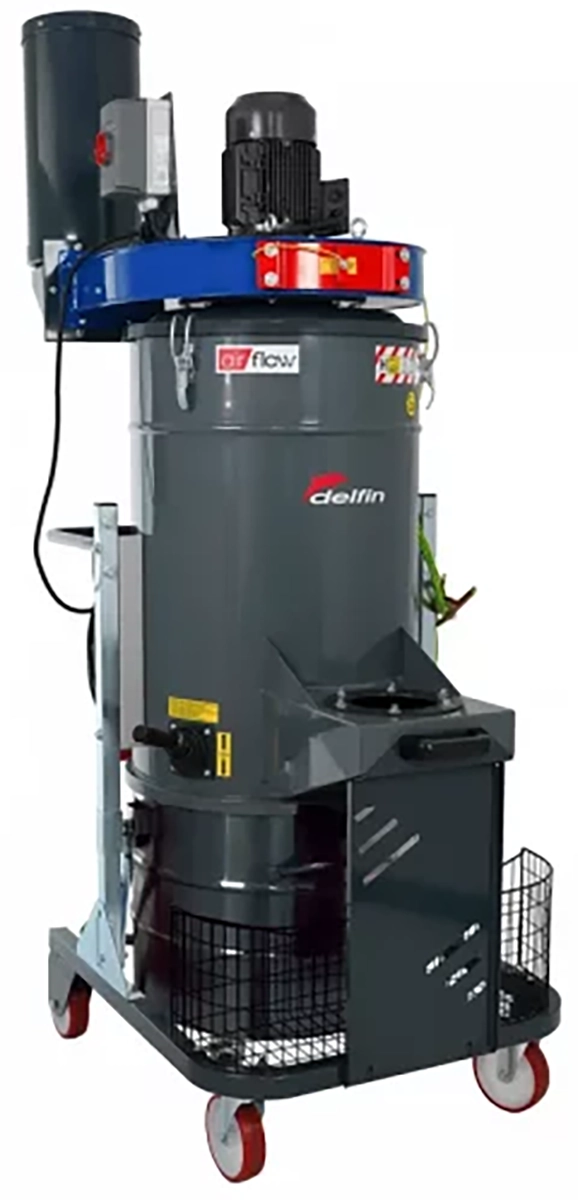
Delfin ZFR EV AP 560 K2 Z22
Stationary ATEX deduster in the AP 560 chassis -- 2,500 m³/h airflow, 2.2 kW centrifugal fan, 21 mbar vacuum, 100 L container, antistatic polyester ANT M + HEPA H14
- Central suction on larger production plants in Zone 22 with 3-4 simultaneous collection points
- Extraction-arm installation for welding fume capture in modern ATEX-conscious halls
- Dust collection from granulator, mixer and sieve stations in pharmaceutical and chemical industries
- Fixed suction circuits at bakeries and feed plants where dust demands Zone 22 discipline
- Permanent installation in woodworking and MDF production with ATEX classification
- ATEX Directive 2014/34/EU -- II 3D Ex h IIIC T80°C (int) / T135°C (ext) Dc
- EN 17348:2022 (harmonized March 2023)
- IEC 60335-2-69 (industrial vacuums)
Delfin ZFR EV AP 560 K2 Z22
The Delfin ZFR EV AP 560 K2 Z22 is the middle variant in the AP 560 chassis -- a stationary ATEX deduster with a 2.2 kW centrifugal fan delivering 2,500 m³/h airflow at 210 mmH²O (21 mbar) static vacuum. It is the most selected variant among centrifugal-fan based dedusters on Danish industrial plants, because it strikes the optimal balance between operating economy and capacity for typical multi-point installations. Antistatic polyester ANT M primary filter (50,000 cm², 560 mm diameter) and HEPA H14 final filter provide complete ESD control and exhaust that meets even stringent workplace requirements. The 100-litre detachable steel container with internal plastic liner supports intervals of 1-3 operating shifts depending on dust density. ATEX-certified II 3D Ex h IIIC per EN 17348:2022 -- built for Zone 22 classified production plants.
Applications
- Central suction on larger production plants in Zone 22 with 3-4 simultaneous collection points
- Extraction-arm installation for welding fume capture in modern ATEX-conscious halls
- Dust collection from granulator, mixer and sieve stations in pharmaceutical and chemical industries
- Fixed suction circuits at bakeries and feed plants where dust demands Zone 22 discipline
- Permanent installation in woodworking and MDF production with ATEX classification
Technical specifications
| ATEX marking | II 3D Ex h IIIC T80°C (int) / T135°C (ext) Dc |
|---|---|
| Internal / external zone | 22 / 22 |
| Motor type | Centrifugalventilator IE3 (2,2 kW, 3-faset 400 V), Ex h IIIC T135°C ekstern / T80°C intern, Ex tb Dust Tight Certified |
| Duty cycle | Continuous |
| Airflow | 2500 m³/h |
| Vacuum | 21 mbar (210 mmH₂O) |
| Container | 100 L |
| Sound pressure | 72 dB(A) |
| Filter class | H class |
| Filter type | HEPA H14 (EN 1822-5), 99,995 % MPPS, 10 m² filterflade -- standard inkluderet |
| Primary filter | Stjerne/taske polyester ANT M-klasse antistatisk (IEC 60335-2-69), 50.000 cm², diameter 560 mm, manuel rensning |
| Cleaning system | Manuel filterrensning via udvendig hank |
| Collection system | Plastic bag |
| Material | Malet stålkonstruktion (AISI 304 som option) |
| IP class | IP55 |
| Power | 2.2 kW |
| Voltage | 400 V / 50 Hz / 3~ |
| Inlet | Ø 200 mm |
| Dimensions (L × W × H) | 780 x 850 x 2140 mm |
| Weight | 100 kg |
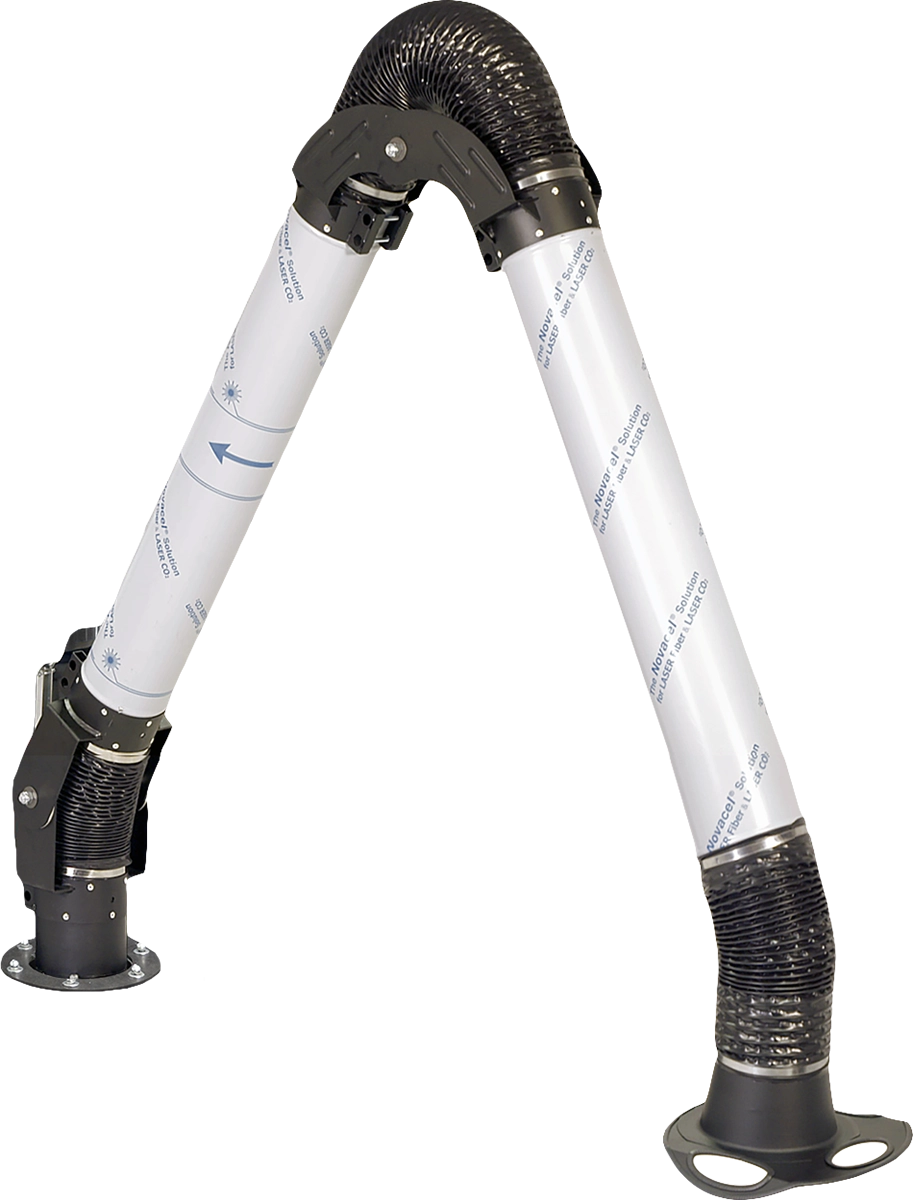
EXTRACTION ARM & SOURCE CAPTURE — CENTRAL DUST COLLECTION
Extraction arm for source capture on central dedusters
An articulated extraction arm is a free-standing, balanced arm that places the deduster's suction point directly at the particle source — welding, grinding, solder fume, bag emptying, mixing stations or quality-control booths. The difference from a fixed hose run is that the operator can adjust the arm's height, reach and angle during operation without tools and without stopping the suction. This delivers far more effective source capture than a general room-extraction system, because the contamination is collected before it reaches the operator's breathing zone.
Why a deduster + extraction arm work so well together
The deduster is a centrifugal-fan based particle collector built for high airflow at low static vacuum — exactly the characteristic an extraction arm needs. The arm's flexible run has low pressure drop per metre, and the wide trumpet-shaped hood at the end loses a small additional amount of vacuum. A centrifugal fan (1,000-3,500 m³/h) supplies the required volume, whereas a side-channel blower (typically 200-400 m³/h at high vacuum) would concentrate the suction on far too small a capture area.
Available dimensions and accessories
Three standard arm configurations are available as accessories, all 3000 mm reach and with earth grounding (MT) included for ESD control: TA.0177.0000 (oe150 arm to oe150 filter chamber inlet), TA.1256.0000 (oe150 arm to oe200 filter chamber inlet — reducing from the deduster's larger inlet to a smaller arm) and TA.0511.0000 (oe200 arm to oe200 filter chamber inlet — maximum airflow). Tubo-flex reductions (SL.2632.0200, SL.6882.0200, SL.3775.0200, SL.6883.0200) allow connection of other hose dimensions, and Y-branches (SL.2775.0200, SL.2692.0200, SL.3022.0200) enable two extraction arms on the same deduster.
Typical industrial scenarios
Arm-equipped dedusters are used for welding fume extraction (MAG, MIG, TIG, arc welding), grinding dust from metal and polymer processing, solder fume and brazing vapours in electronics manufacturing, bag emptying and powder handling in food, pharmaceutical and chemical production, and quality-control booths where particles must be captured but not dispersed. On the ATEX Zone 22 models the arm installation requires ESD earthing throughout the system, and the MT function delivers exactly that. On ACD models (non-ATEX areas with combustible dust) earthing is likewise recommended, because static build-up on the inner wall of the arm can generate ignition sources even without ATEX classification.
Questions and answers
Why is the K2 variant the most popular motor choice on the AP 560 chassis?
The K2 (2.2 kW) is the largest 'standard' motor choice before stepping up to a 4 kW industrial motor, and it strikes a particularly good balance in the centrifugal characteristic. At 2,500 m³/h airflow and 21 mbar vacuum it handles 3-4 simultaneous extraction arms without visible capacity loss, and the IE3 motor is operationally economical, quiet and with moderate current draw (typically 4-5 A). The K1 (1.1 kW) is often too weak for continuous multi-point operation, and the K4 (4 kW) is often overkill with double current draw and higher purchase price. Statistically 60-70 % of Danish ATEX installations choose K2 for typical welding, grinding and powder handling applications.
How long piping can a K2 draw through without capacity loss?
With 21 mbar static vacuum the model typically handles 8-12 metres of smooth oe200 steel pipe without visible loss of suction-point vacuum -- provided simple, short bends and clean filters. If you reach 15-20 metres or introduce several 90° bends, the suction-point vacuum will drop by 3-5 mbar per additional length-metre once bends and transitions are accounted for. For installations over 20 metres the K4 (370 mmH²O = 36 mbar vacuum, 60-70 % greater) is the correct choice. Note that pressure drop is not linear: a clogged primary filter or a 90° bend costs more than the equivalent length-metre of clean hose.
What dust volume can the K2 realistically collect over an 8-hour shift?
It depends naturally on the process source, but for typical welding fume extraction on MAG steel the measured aerosol level in the source zone is ca. 5-15 mg/m³. With 2,500 m³/h airflow and 80 % capture rate the deduster collects ca. 10-30 g/h -- 80-240 g per 8-hour shift, corresponding to 0.5-1.5 L volume. This means the 100-litre container on the K2 typically needs emptying every 1-3 months for welding applications. For heavier applications such as grinding dust (50-150 mg/m³) or granulator (100-500 mg/m³) the container must be emptied every shift or every day. Dust density governs the container interval far more than the airflow figure.
What is the difference between LOC REM remote control and local start/stop?
The standard model is supplied with a local start/stop button on the deduster itself -- an operator must be physically nearby to start and stop. LOC REM (Local/Remote) is an option that adds a 24V remote control input plus electrical panel, so the unit can be started/stopped from a central control station, a PLC, or via a compressed-air signal from the processing equipment the deduster serves. It is mandatory on larger central suction systems where the deduster stands in a separate technical room and is not to be accessed manually during production. LOC REM is Delfin code +1,562.50 EUR (2026 price level) -- typically quickly recouped in automated applications.
What happens if the primary filter clogs -- does the model have automatic filter cleaning?
No, the model has manual filter cleaning via an external handle next to the filter housing -- the operator pulls the handle a few times daily to shake the primary filter clean. If you require automatic filter cleaning for continuous operation, you should instead choose the CUBE 20 PN model in the same capacity class, which has pulse-jet based automatic cartridge cleaning. Manual cleaning is fully sufficient for most multi-point applications, and it prevents overflow protection by giving the operator a clear 'handle' on system health. A clogged primary filter manifests as falling suction-point vacuum -- typically markedly below 15 mbar -- and is the first sign that the handle should be pulled.
Which additional options are recommended on the K2 model for ATEX Zone 22 installation?
Three options are worth considering. (1) PTFE ANT (class M antistatic filter) -- replaces standard polyester primary filter for even lower dust pass-through and greater chemical resistance; surcharge ca. 434 EUR. (2) X / XX / XXX stainless steel AISI 304 -- replaces painted steel in collection container, container + filter chamber, or entire construction respectively; important with moisture, chemical attack or hygiene-critical processes (pharma, food); from 785 EUR. (3) MT earth grounding -- included as standard, but double-check installation verifies continuity. PTFE and X options are typically relevant for chemical and pharma; MT is an ATEX baseline requirement on all Zone 22 installations.