
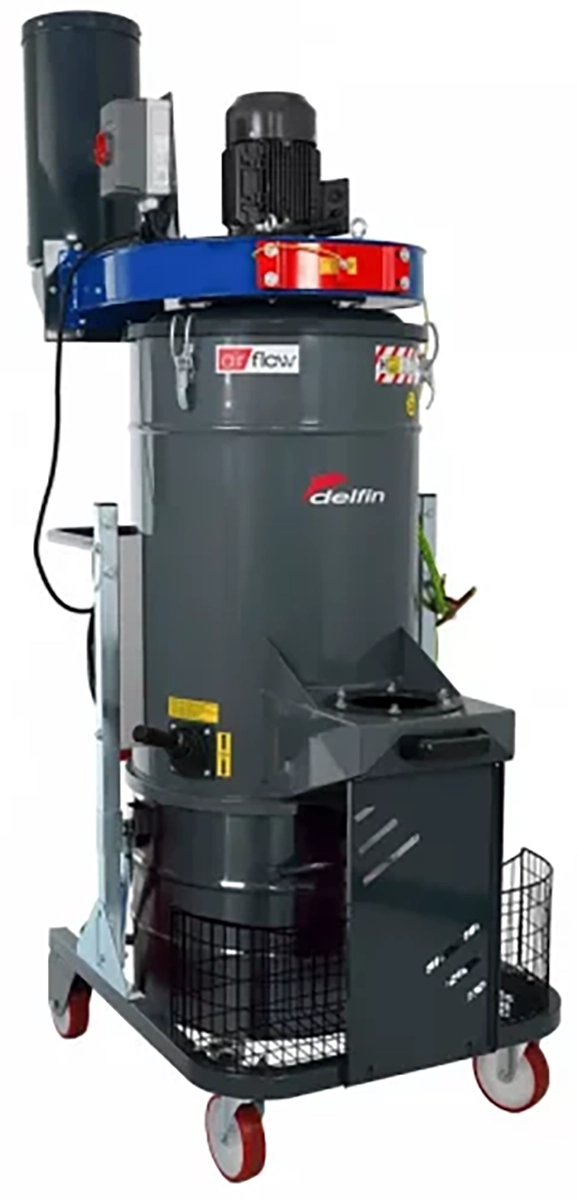
Delfin ZFR EV AP 560 K4 Z22
Top model in the AP 560 chassis -- 3,500 m³/h airflow, 4 kW centrifugal fan, 36 mbar vacuum, 100 L container, for large central suction systems in ATEX Zone 22
- Larger central suction systems in Zone 22 with 4-6 simultaneous collection points or long piping
- Multi-arm welding halls where several welding booths are served by the same deduster
- Heavy-duty source capture in CNC halls with greater dust potential (aluminium machining, MDF milling)
- Cyclone-based central suction installation where a primary separator pre-treats heavy particles
- Process plants with fixed suction circuits on larger mixers, granulators or extruders
- ATEX Directive 2014/34/EU -- II 3D Ex h IIIC T80°C (int) / T135°C (ext) Dc
- EN 17348:2022 (harmonized March 2023)
- IEC 60335-2-69 (industrial vacuums)
Delfin ZFR EV AP 560 K4 Z22
The Delfin ZFR EV AP 560 K4 Z22 is the top model in the AP 560 chassis -- a stationary ATEX deduster with a 4 kW centrifugal fan delivering 3,500 m³/h airflow at 370 mmH²O (36 mbar) static vacuum. It is the most powerful centrifugal-fan based deduster in the Delfin range and the correct choice for large central suction systems with 4-6 collection points, long piping runs or particularly demanding source-capture applications. With twice the vacuum of the K2 variant the K4 can draw through longer piping runs without losing suction-point vacuum, and the 40 % greater airflow enables simultaneous extraction arms at multiple workstations. Antistatic polyester ANT M primary filter, HEPA H14 final filter and 100-litre detachable container with plastic liner. ATEX II 3D Ex h IIIC, EN 17348:2022. Weighs 130 kg -- 30 % more than K1/K2 due to the heavier motor and chassis design.
Applications
- Larger central suction systems in Zone 22 with 4-6 simultaneous collection points or long piping
- Multi-arm welding halls where several welding booths are served by the same deduster
- Heavy-duty source capture in CNC halls with greater dust potential (aluminium machining, MDF milling)
- Cyclone-based central suction installation where a primary separator pre-treats heavy particles
- Process plants with fixed suction circuits on larger mixers, granulators or extruders
Technical specifications
| ATEX marking | II 3D Ex h IIIC T80°C (int) / T135°C (ext) Dc |
|---|---|
| Internal / external zone | 22 / 22 |
| Motor type | Centrifugalventilator IE3 (4 kW, 3-faset 400 V), Ex h IIIC T135°C ekstern / T80°C intern, Ex tb Dust Tight Certified |
| Duty cycle | Continuous |
| Airflow | 3500 m³/h |
| Vacuum | 36 mbar (370 mmH₂O) |
| Container | 100 L |
| Sound pressure | 74 dB(A) |
| Filter class | H class |
| Filter type | HEPA H14 (EN 1822-5), 99,995 % MPPS, 10 m² filterflade -- standard inkluderet |
| Primary filter | Stjerne/taske polyester ANT M-klasse antistatisk (IEC 60335-2-69), 50.000 cm², diameter 560 mm, manuel rensning |
| Cleaning system | Manuel filterrensning via udvendig hank |
| Collection system | Plastic bag |
| Material | Malet stålkonstruktion (AISI 304 som option) |
| IP class | IP55 |
| Power | 4.0 kW |
| Voltage | 400 V / 50 Hz / 3~ |
| Inlet | Ø 200 mm |
| Dimensions (L × W × H) | 780 x 850 x 2140 mm |
| Weight | 130 kg |
EXTRACTION ARM & SOURCE CAPTURE — CENTRAL DUST COLLECTION
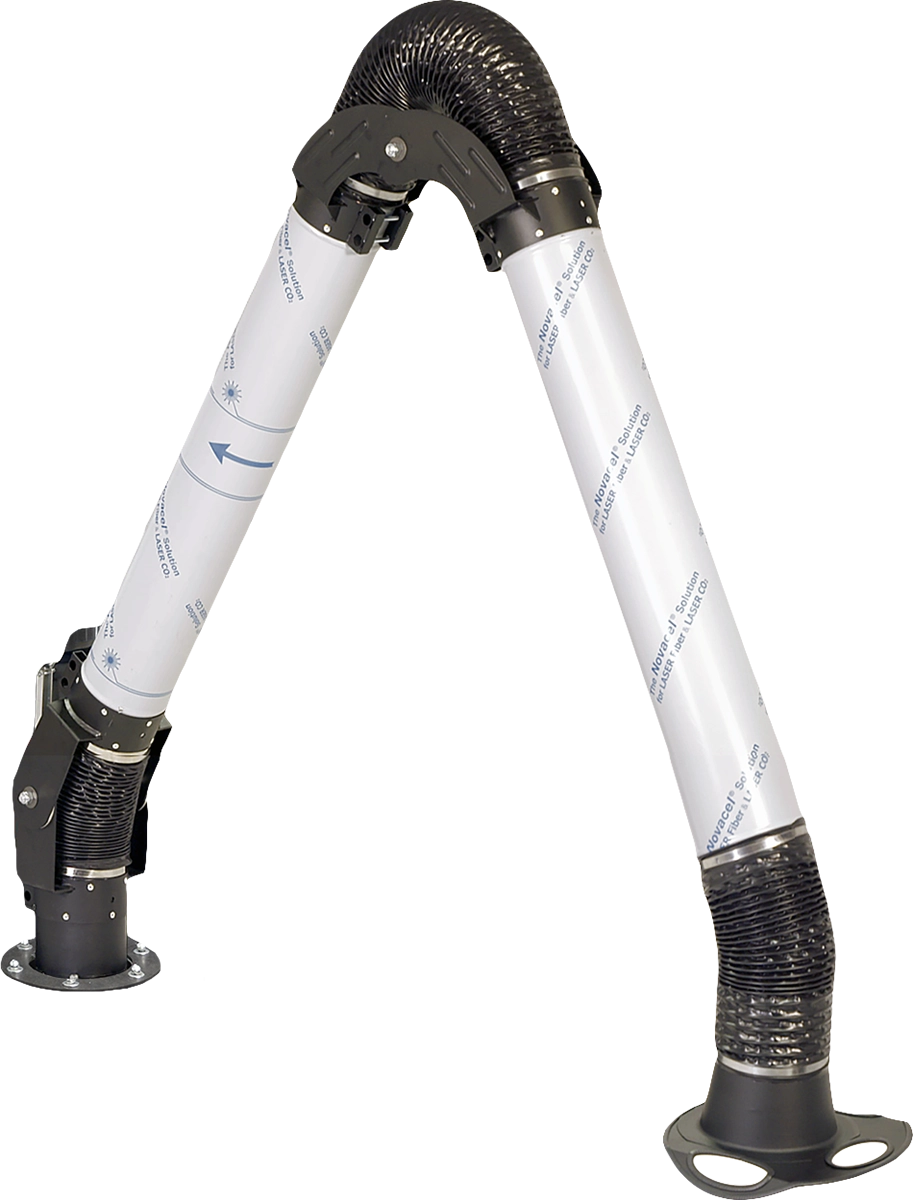
Extraction arm for source capture on central dedusters
An articulated extraction arm is a free-standing, balanced arm that places the deduster's suction point directly at the particle source — welding, grinding, solder fume, bag emptying, mixing stations or quality-control booths. The difference from a fixed hose run is that the operator can adjust the arm's height, reach and angle during operation without tools and without stopping the suction. This delivers far more effective source capture than a general room-extraction system, because the contamination is collected before it reaches the operator's breathing zone.
Why a deduster + extraction arm work so well together
The deduster is a centrifugal-fan based particle collector built for high airflow at low static vacuum — exactly the characteristic an extraction arm needs. The arm's flexible run has low pressure drop per metre, and the wide trumpet-shaped hood at the end loses a small additional amount of vacuum. A centrifugal fan (1,000-3,500 m³/h) supplies the required volume, whereas a side-channel blower (typically 200-400 m³/h at high vacuum) would concentrate the suction on far too small a capture area.
Available dimensions and accessories
Three standard arm configurations are available as accessories, all 3000 mm reach and with earth grounding (MT) included for ESD control: TA.0177.0000 (oe150 arm to oe150 filter chamber inlet), TA.1256.0000 (oe150 arm to oe200 filter chamber inlet — reducing from the deduster's larger inlet to a smaller arm) and TA.0511.0000 (oe200 arm to oe200 filter chamber inlet — maximum airflow). Tubo-flex reductions (SL.2632.0200, SL.6882.0200, SL.3775.0200, SL.6883.0200) allow connection of other hose dimensions, and Y-branches (SL.2775.0200, SL.2692.0200, SL.3022.0200) enable two extraction arms on the same deduster.
Typical industrial scenarios
Arm-equipped dedusters are used for welding fume extraction (MAG, MIG, TIG, arc welding), grinding dust from metal and polymer processing, solder fume and brazing vapours in electronics manufacturing, bag emptying and powder handling in food, pharmaceutical and chemical production, and quality-control booths where particles must be captured but not dispersed. On the ATEX Zone 22 models the arm installation requires ESD earthing throughout the system, and the MT function delivers exactly that. On ACD models (non-ATEX areas with combustible dust) earthing is likewise recommended, because static build-up on the inner wall of the arm can generate ignition sources even without ATEX classification.
Questions and answers
When does the K4 become necessary over the K2?
The K4 becomes the right choice when one of three criteria is met. (1) The piping run's total length exceeds 15-20 metres, or contains more than 4-5 bends (90° bend typically costs 3-5 mbar). (2) The number of simultaneous collection points is 4 or above, and the K2's 2,500 m³/h is spread too thinly across them. (3) The dust is particularly sticky or heavy -- e.g. moist swarf, moist concrete dust, or MDF chips with adhesive, where the suction-point vacuum must be robust against varying load. If none of these apply, the K2 suffices at markedly lower current draw and purchase price.
How much more current does the K4 draw compared with the K2?
At nominal operation the K4 draws ca. 8-9 A versus the K2's 4-5 A -- roughly double. The power difference is 4 kW vs 2.2 kW (82 % greater), and inrush current can be 5-7 times the nominal current in the first 1-2 seconds. For a typical Danish industrial installation with a 32 A three-phase outlet the K4 represents ca. 25 % of available current -- ample headroom, but if you plan multiple dedusters on the same phase distribution, sizing must be verified. Operating economy: K4 costs ca. 1.8-2.0 kWh per hour vs K2's ca. 1.0-1.2 kWh -- the 0.7 kWh difference over 8 hours = 5.6 kWh per day, at 1.5 DKK/kWh = 8.4 DKK per day or ca. 2,000 DKK per year.
The noise level is rated at 74 dB(A) -- what does this mean in practice?
74 dB(A) at 1 metre is 'normal conversation level' -- audible but not annoying short-term and below the workplace limit of 80 dB(A) for an 8-hour shift. For comparison the K2 is at 72 dB(A) and the 420 model at 70 dB(A). The difference is logarithmic: 4 dB(A) higher sound = roughly double the perceived intensity. If the deduster stands in the same room as operators, measurement with a C-weighted dB meter at the workstation position is recommended, because room acoustics (reverberation, reflection) add 2-5 dB(A). A sound-absorbing cabinet or separate technical room typically reduces 10-15 dB(A) -- relevant for continuous 8-hour operation.
Can the K4 be used as a 'master deduster' with multiple sub-suction circuits?
Yes -- and it is a typical architecture for larger industrial plants. With 3,500 m³/h airflow at 36 mbar the K4 can serve as the main suction source for a larger branched duct system, where sub-circuits serve different production zones. Y-branches (SL.2775.0200 oe200/150/150 or SL.3022.0200 oe200/100/100) allow the airflow to be distributed across two or three points simultaneously. Critical factors: (1) earth grounding must run through the entire system including all Y-branches and T-fittings, (2) suction-point vacuum drops logarithmically with the number of open take-offs, and (3) air balance between collection points must be tuned with throttle dampers to ensure equal suction at all points.
What is the difference between the K4 and a CUBE 20 K4 PN -- they have the same motor power?
Both models have the same 4 kW centrifugal fan and the same airflow/vacuum characteristic (3,500 m³/h at 370 mmH²O), but they differ markedly in filter system, collection and chassis. The ZFR EV AP 560 K4 has a star/pocket primary filter (50,000 cm², manual cleaning) and a 100 L container with plastic liner. The CUBE 20 K4 PN has 2 cartridge filters (200,000 cm² larger filter surface, automatic pulse-jet cleaning) and a 90 L container. The CUBE is built for continuous operation without operator intervention -- pulse-jet cleans the filter automatically. The ZFR EV requires daily manual cleaning. The CUBE is also larger (135x88x255 cm vs 78x85x214 cm) and heavier (250 kg vs 130 kg), and can be lifted with a forklift. Choose ZFR EV for price-conscious installations with daily oversight; choose CUBE for unmanned continuous operation.
What installation requirements does the K4 place on flooring and anchoring?
With 130 kg weight and 78x85 cm footprint at 0.66 m², surface loading is ca. 200 kg/m² -- well below the standard concrete floor's load capacity of 500-1,000 kg/m². The substrate must be flat and rigid, but no special reinforcement is needed. Anchoring to the floor is not recommended in normal installations, but if the deduster stands in a tornado-prone area (rare in Denmark) or on an upper floor with vibration-sensitive equipment below, 4 M12 expansion bolts in the corners can secure stability. Vibration dampers are NOT necessary -- the centrifugal fan's balancing is typically within ISO 1940 grade G6.3, which is quiet enough for any industrial installation. Ensure the IP55 enclosure is not blocked by building dampening.