
Delfin ZFREV AP 1/3D 560 INERT K2
Stationary ATEX INERT vacuum system with centrifugal fan and INOX demister -- 1300 m³/h airflow, 44 L tank, HEPA H14 hydro-oleophobic coalescing cartridge
- Fixed central suction installation at larger process plants in Zone 22
- 3D-printing factories with multiple suction points and reactive metal powder
- Defense industry's larger ammunition facilities with stationary installation
- Light-metal machining in aerospace with centralised dust capture
- Process plants where mobile vacuums cannot deliver the required airflow
- ATEX Directive 2014/34/EU -- II 3D Ex tc IIIC T135°C XDC
- EN 17348:2022 (harmonized March 2023)
- IEC 60335-2-69 (industrial vacuums)
Delfin ZFREV AP 1/3D 560 INERT K2
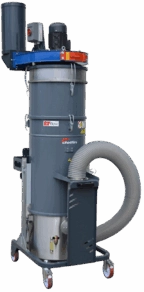
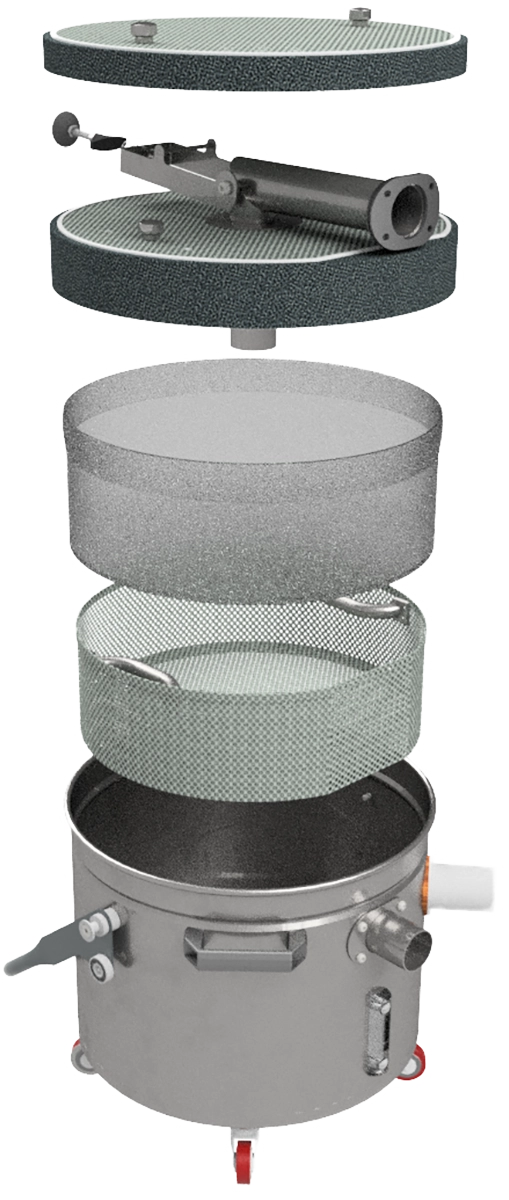
The Delfin ZFREV AP 1/3D 560 INERT K2 is a stationary industrial INERT vacuum system -- not a mobile vacuum, but a fixed installation with centrifugal fan, INOX demister and a hydro-oleophobic coalescing cartridge in H14 class. The centrifugal fan is ATEX 3GD IP65-certified (2.2 kW IE3, 4.4 A, 400 V three-phase) and delivers 1300 m³/h airflow -- on par with a large central suction installation. The collection principle is two-stage: first the INOX demister that retains droplets and coarser particles, then the coalescing cartridge that captures fine aerosol. The neutralisation bath (27 L liquid, variable level 24-44 L) inactivates reactive dust directly in the collection tank. Used where airflow and filter volume outgrow a standard vacuum: central suction at larger process plants with reactive powder and Zone 22 classification.
Applications
- Fixed central suction installation at larger process plants in Zone 22
- 3D-printing factories with multiple suction points and reactive metal powder
- Defense industry's larger ammunition facilities with stationary installation
- Light-metal machining in aerospace with centralised dust capture
- Process plants where mobile vacuums cannot deliver the required airflow
Technical specifications
| ATEX marking | II 3D Ex tc IIIC T135°C XDC |
|---|---|
| Internal / external zone | 20 / 22 |
| Motor type | Centrifugalventilator IE3 (2,2 kW, 4,4 A, 3-faset), ATEX 3GD IP65 IIIC |
| Duty cycle | Continuous |
| Airflow | 1300 m³/h |
| Vacuum | 27 mbar (280 mmH₂O) |
| Container | 44 L |
| Sound pressure | 74 dB(A) |
| Filter class | H class |
| Filter type | HEPA H14 hydro-oleophob coalescing-kartusche (EN 1822-5), 99,995 % MPPS |
| Primary filter | INOX-demister (rustfrit stål-metalmesh, AISI 304) |
| Cleaning system | Demister-afdrypning (automatisk) + manuel skift af coalescing-kartusche |
| Collection system | INERT neutralisation bath |
| Material | AISI 304 rustfrit stål (beholder, demister, kapsling) |
| IP class | IP65 |
| Power | 2.2 kW |
| Current | 4.4 A |
| Voltage | 400 V / 50 Hz / 3~ |
| Inlet | Ø 125 mm |
| Dimensions (L × W × H) | 780 x 850 x 2460 mm |
| Weight | 120 kg |
INERT TECHNOLOGY — EN 17348:2022
What is an INERT vacuum cleaner?
Delfin's INERT vacuum cleaners are built to collect reactive metallic dust — the kind of dust that can self-ignite or react violently with oxygen, heat or water. Instead of collecting dust dry in a bag or container, the vacuum channels it directly into a neutralising liquid bath (typically water with a passivating agent added), where the reactive metal particle is inactivated on the spot. That is the difference between a controlled process and a vacuum that can itself become the ignition source.
Tested to EN 17348:2022
The INERT range is certified and performance-tested to EN 17348:2022, the harmonized European standard for industrial vacuum cleaners in ATEX zones. The test confirms that the neutralisation system actually inactivates reactive dust under real operating conditions — not merely in a lab setup. Combined with HEPA H14 final filtration (99.995 % efficiency at MPPS per EN 1822-5), the exhaust is clean down to the finest health-hazardous particles.
Typical applications
INERT vacuums are used at shooting ranges (lead dust and primer residue from cartridges), in ammunition manufacturing, for 3D printing with metal powders (aluminium and titanium are highly reactive when finely divided), in light-metal machining in aerospace and defense, and at process plants where pyrophoric powders such as zirconium and magnesium are handled. Some models are ACD-certified (IEC 60335-2-69 Annex AA) for non-ATEX-classified areas, others are ATEX-certified for Zone 20, 21 or 22 — but they all share the same neutralising liquid bath and the same uncompromising filtration.
INERT versus conventional HEPA filtration
A conventional HEPA vacuum retains particles in a filter but leaves them dry and potentially reactive. With reactive metallic dust that is not enough — the particle may react with oxygen (exothermic oxidation) or moisture (hydrolysis of certain metal hydrides) and disrupt the collection process itself. INERT technology solves this by inactivating the particle at the moment of collection: dust is immersed in the liquid before it can react, and the HEPA H14 filter then captures any residual aerosol before exhaust.
Questions and answers
What does INERT mean in this context?
INERT denotes a vacuum cleaner with a neutralising liquid bath in the collection tank. Dust is channelled directly into the liquid and inactivated immediately, so it cannot react with oxygen, heat or sparks. The technology is developed for reactive metallic dust (aluminium, titanium, magnesium, zirconium, lead dust from shooting ranges), where conventional dry collection would itself be an ignition source.
Is the INERT system tested to EN 17348:2022?
Yes. The entire Delfin INERT range is performance-tested to EN 17348:2022 -- the harmonized European standard for industrial vacuum cleaners in ATEX zones. The test confirms that the neutralisation bath actually inactivates reactive dust under real operating conditions, not just in a lab setup. Documentation available on request.
What types of dust is INERT technology intended for?
Reactive metallic dust: aluminium and aluminium alloys, titanium, magnesium, zirconium, fine iron powder, lead dust and primer residue from shooting ranges, and pyrophoric powders from aerospace and defense. For non-reactive dust (organic process dust, plastics, etc.) the INERT technology adds no further safety -- a standard ATEX or ACD model without liquid bath is selected instead.
How does the HEPA H14 final filter work together with the liquid bath?
The neutralisation bath inactivates dust at the moment of collection, but there will always be a fine aerosol fraction that passes the liquid surface. The HEPA H14 filter captures 99.995 % of particles down to 0.3 micrometres per EN 1822-5 (MPPS method) before exhaust. The combination secures both safe collection (no reactive dry particle) and clean exhaust (no health-hazardous aerosol). The filter is Included/Incluso as standard on all INERT models.
Why is the motor type 'centrifugal fan' and not side-channel blower?
The centrifugal fan is a different type of air pump from the side-channel blower: it delivers high airflow (1300 m³/h) at low static vacuum (27 mbar / 280 mmH₂O). The side-channel blower by contrast delivers less airflow (300-500 m³/h) at much higher vacuum (3000+ mmH₂O). The ZFREV AP is designed for fixed installation with short hoses and large volume flow -- not mobile point collection where vacuum must overcome long-hose drop. The motor is 3GD-certified as ATEX equipment and the liquid must stop droplets before they reach the coalescing cartridge.
Why is it catalogued as 1/3D when the factsheet shows only 3D?
The factsheet marking is 'II 3D Ex tc IIIC T135°C XDC' -- that is, only external category 3 (Zone 22). The model name however contains '1/3D', indicating internal Zone 20 due to the internal construction of the INERT tank and its H14 coalescing cartridge. We follow Delfin's naming convention and catalogue it under 1/3D, but the nameplate marking will read as above. For projects specifically relying on Zone 20 interpretation we recommend clarifying directly with Delfin.