High-temperature · up to +450 °C
CP HiTex® 487
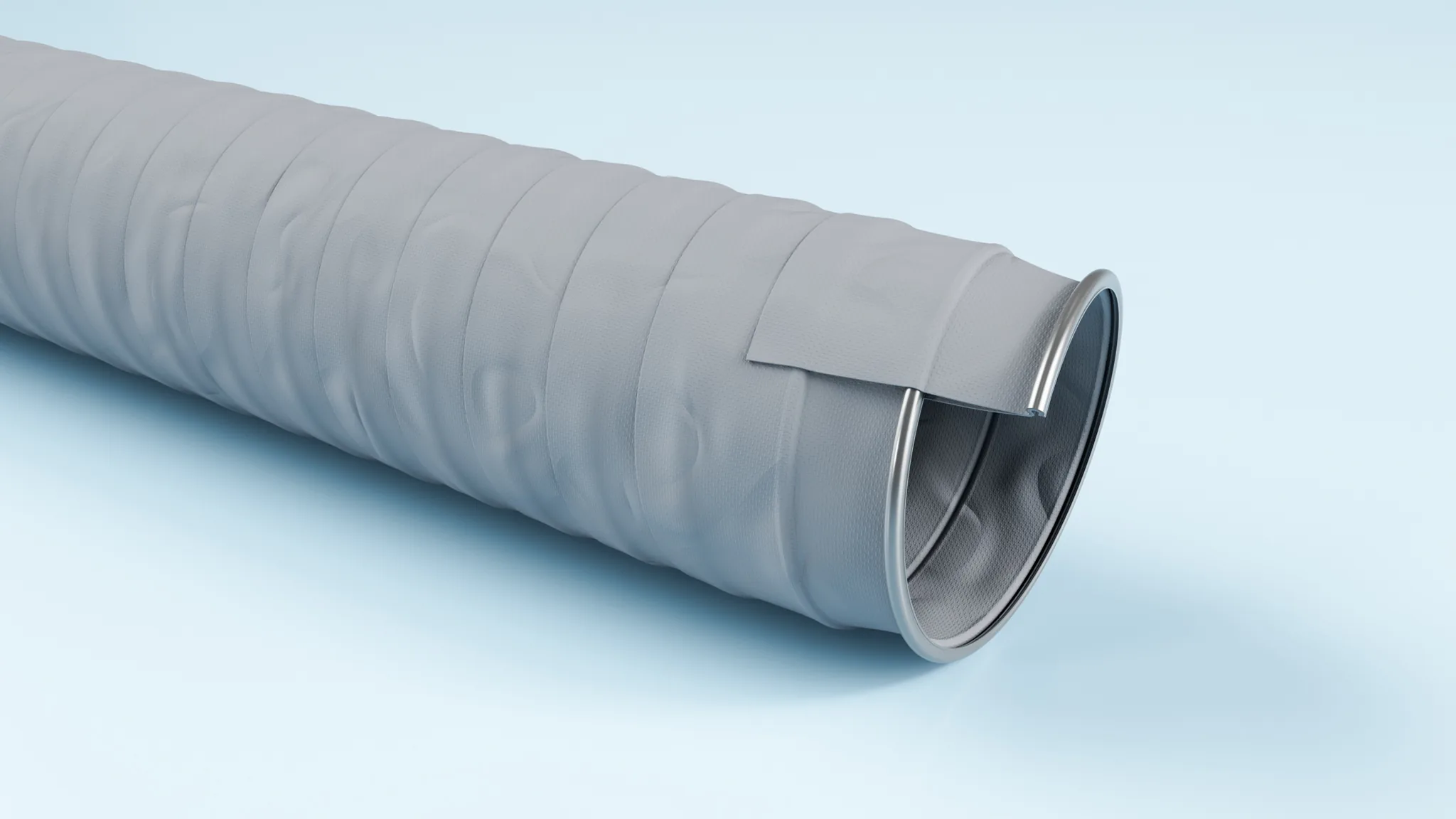
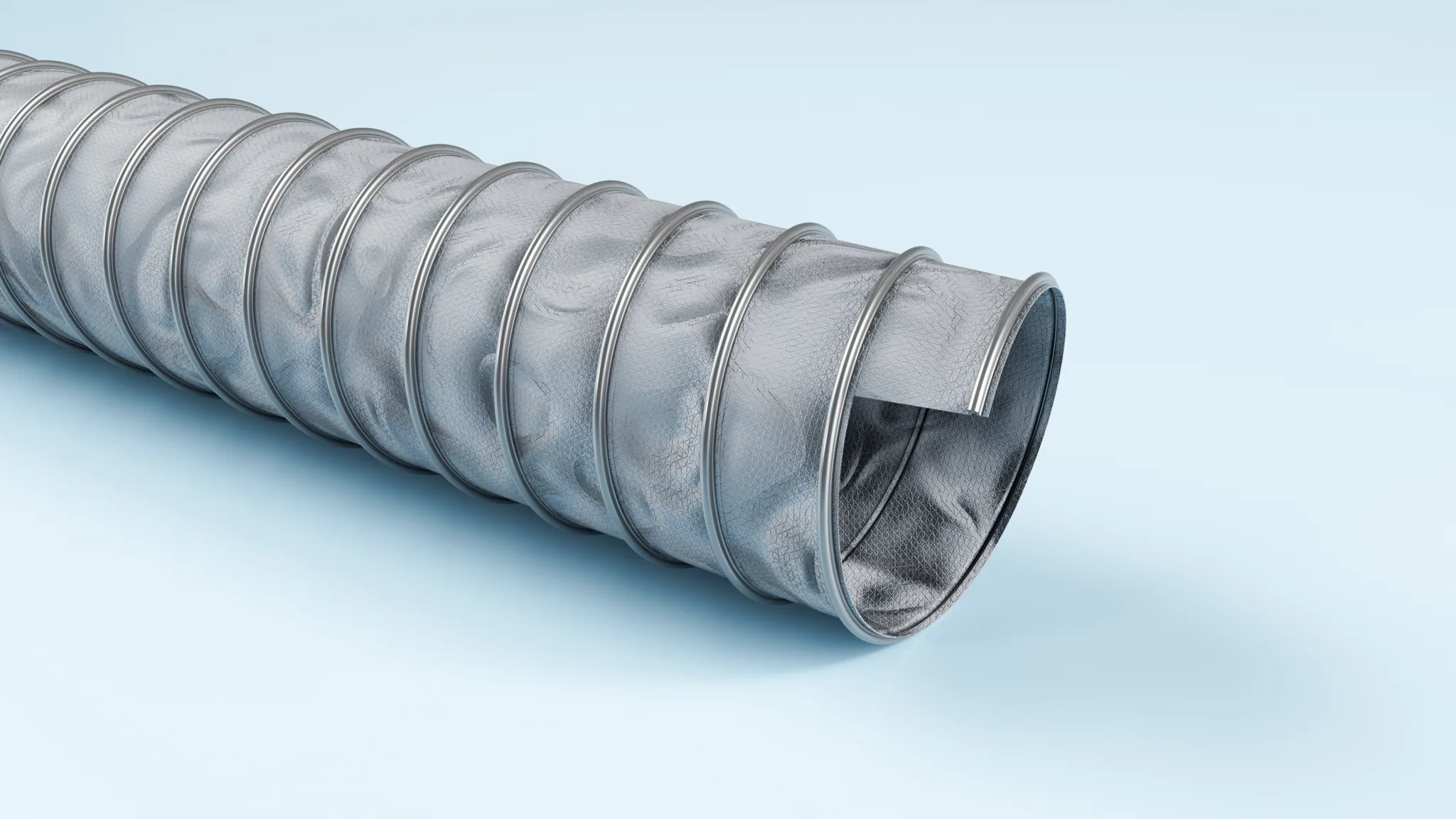
High-temperature clamp-profile hose for hot and cold gases, exhaust and high-temperature extraction. A galvanised steel spiral holds the form, while an external clamp profile protects against wear and deformation. Highly flexible and compressible, with a normal range up to 450 °C and short-term peaks up to 500 °C.
- Up to +450 °C, peak +500 °C
- Galvanised steel clamp profile
- Highly flexible and compressible
- Gases, fumes, exhaust
- Cut to length
- REACH and RoHS
Why this hose?
When a hose has to convey hot gases, fumes or exhaust at temperatures that exceed ordinary polymer materials, the choice of construction is decisive. CP HiTex® 487 is built for exactly this range. A spiral of galvanised steel holds the form and provides flexibility, while an external clamp profile protects against wear and deformation.
The hose handles a normal operating temperature up to 450 °C and short-term peaks up to 500 °C. That covers most industrial high-temperature applications, from welding fume extraction to engine exhaust. The construction is highly flexible and compressible, so the hose can be coiled for transport and bent without losing its shape.
"CP" stands for clamp profile, and "HiTex" for high-temperature texture — a designation for the hose family's high-temperature resistance. Model 487 is part of a series of clamp-profile hoses, where 487 covers the practical middle ground: enough temperature resistance for most industrial uses without being over-specified.
The clamp-profile construction is a metallic hose without an internal liner. This means the hose can handle extreme temperatures, but also that it is not fully gas-tight in the way a polymer hose is — minor leakage may occur through the clamp profile. For applications with higher tightness requirements, other high-temperature constructions are available.
Where it is used
CP HiTex® 487 is used where the temperature is too high for polymer hoses and flexibility is still required. That covers a large share of industrial high-temperature handling, from welding industries to engine and engine-test facilities.
In practice we see it most often used for waste gas extraction and car gas extraction in test-cell installations, for welding fume extraction and welding robots where high temperatures occur in short pulses, and for engine exhaust in workshop environments.
It is also used for hot air dryers, steam soaking and as an air supply hose at higher temperatures than ordinary polymer hoses can handle. Bend radius values are moderate, so the hose can be installed in compact pipe runs.
The formal name is CP HiTex® 487. In daily use, many simply call it "the metal hose", "the clamp-profile hose" or "the welding fume hose". All three work.
Technical specifications
Specifications are current as of 13 April 2026 and refer to 20 °C unless otherwise stated.
| Material | Galvanised steel (clamp profile construction) |
|---|---|
| Colour | Silver-grey (galvanised steel) |
| Wall construction | Clamped profile bands over galvanised steel spiral |
| Spiral material | Galvanised steel wire |
| Conveying media | Gas (hot and cold) |
| Temperature range | −60 °C to +450 °C |
| Short-term peak | +500 °C |
| Compressibility | Highly flexible and compressible |
| Cut to length | Yes |
| Manufacturer SKU (model group) | 4870000 |
Dimensions and ordering
CP HiTex® 487 is supplied in 33 standard sizes from inner Ø 75.6 mm to 450 mm. Each size has its own article number from the manufacturer. Standard roll lengths are 3 m and 6 m, and the hose can be cut to length. Maximum production length is 10 m for all dimensions.
| Inner Ø |
Outer Ø |
Vacuum |
Bend radius |
Max. length |
Weight |
Roll |
Article no. |
|---|---|---|---|---|---|---|---|
| 75.6 | 87.6 | 0.23 | 33 | 10 | 1.03 | 3, 6 | 48700750000 |
| 80 | 92 | 0.2 | 34 | 10 | 1.08 | — | 48700800000 |
| 90 | 102 | 0.14 | 37 | 10 | 1.21 | 6 | 48700900000 |
| 101.5 | 113.5 | 0.12 | 51 | 10 | 1.06 | 6 | 48701000000 |
| 101.5 | 113.5 | 0.12 | 51 | 10 | 1.06 | 3, 6 | 48701020000 |
| 110 | 122 | 0.105 | 55 | 10 | 1.15 | — | 48701100000 |
| 115 | 127 | 0.097 | 58 | 10 | 1.2 | — | 48701150000 |
| 120 | 132 | 0.09 | 59 | 10 | 1.25 | 3, 6 | 48701200000 |
| 126.5 | 138.5 | 0.085 | 61 | 10 | 1.31 | 3, 6 | 48701270000 |
| 126.5 | 138.5 | 0.085 | 61 | 10 | 1.31 | 3, 6 | 48701250000 |
| 140 | 152 | 0.06 | 67 | 10 | 1.44 | — | 48701400000 |
| 151.5 | 163.5 | 0.05 | 38 | 10 | 1.17 | — | 48701520000 |
| 151.5 | 163.5 | 0.05 | 38 | 10 | 1.17 | 3, 6 | 48701500000 |
| 158 | 170 | 0.045 | 39 | 10 | 1.22 | 3, 6 | 48701580000 |
| 160 | 172 | 0.045 | 40 | 10 | 1.23 | 3, 6 | 48701600000 |
| 170 | 182 | 0.04 | 42 | 10 | 1.31 | 3, 6 | 48701700000 |
| 175 | 187 | 0.04 | 44 | 10 | 1.34 | 3, 6 | 48701750000 |
| 180 | 192 | 0.04 | 44 | 10 | 1.38 | 3, 6 | 48701800000 |
| 202.3 | 214.3 | 0.03 | 48 | 10 | 1.55 | 3, 6 | 48702000000 |
| 202.3 | 214.3 | 0.03 | 48 | 10 | 1.55 | — | 48702030000 |
| 208 | 220 | 0.03 | 50 | 10 | 1.59 | — | 48702080000 |
| 215 | 227 | 0.03 | 52 | 10 | 1.64 | 3, 6 | 48702150000 |
| 225 | 237 | 0.025 | 54 | 10 | 1.71 | 3, 6 | 48702250000 |
| 250 | 262 | 0.025 | 58 | 10 | 1.9 | 3, 6 | 48702500000 |
| 254 | 266 | 0.02 | 60 | 10 | 1.93 | 3, 6 | 48702540000 |
| 258 | 270 | 0.015 | 62 | 10 | 1.96 | — | 48702580000 |
| 300 | 312 | 0.015 | 68 | 10 | 2.27 | 3, 6 | 48703000000 |
| 315 | 327 | 0.015 | 71 | 10 | 2.38 | 3, 6 | 48703150000 |
| 330 | 342 | 0.015 | 75 | 10 | 2.49 | 3, 6 | 48703300000 |
| 350 | 362 | 0.015 | 78 | 10 | 2.64 | 3, 6 | 48703500000 |
| 356 | 368 | 0.015 | 80 | 10 | 2.69 | 3, 6 | 48703560000 |
| 400 | 412 | 0.01 | 88 | 10 | 3.01 | 3, 6 | 48704000000 |
| 450 | 462 | 0.01 | 98 | 10 | 3.39 | 3, 6 | 48704500000 |
Note: Fields without a value (—) are not specified in the manufacturer's factsheet. The hose has no specified working pressure — it is primarily designed for vacuum and low-pressure extraction. Bend radius is measured along the inside of the hose bend.

Standards and compliance
CP HiTex® 487 is a metallic hose without a polymer layer, and the standards landscape is therefore different from polymer hoses. The hose complies with the European chemical and environmental regulations but does not have ATEX or food-grade approval.
- REACH. EU regulation 1907/2006 on the registration, evaluation and authorisation of chemicals. The hose meets REACH requirements for the substances used in the galvanised steel construction.
- RoHS. EU directive 2011/65/EU on the restriction of hazardous substances in electrical and electronic equipment.
The hose is not ATEX-certified and is not intended for use in explosion-hazard zones. For ATEX-relevant high-temperature applications, other hose types are available in the FlexCore range.
Documentation and downloads
Additional documents about this hose, its compliance and installation. Click to download as PDF in a new tab.
Industries that use it
CP HiTex® 487 is used across many different industrial settings. Common to all of them is the combination of high temperatures and a need for flexibility.
In welding industries and welding robot installations it is used for local welding fume extraction at temperatures that exceed the limits of polymer materials. In automotive and vehicle construction it forms part of test-bench systems for engine exhaust, both for passenger cars and commercial vehicles.
In glass industry and in the glass, ceramics and refractory industry the hose handles hot air and hot gases from furnaces and melters. In the paper industry it is used for hot air and steam in drying processes.
In municipal vehicles and specialty vehicles it serves as engine and exhaust hose. Across all these industries, the common factor is that the hose is deployed where an ordinary polymer hose would melt or deform.
Custom lengths and assemblies
CP HiTex® 487 can be cut to length and assembled with couplings and flanges suitable for metal hoses, so it fits your installation precisely. We supply finished hose assemblies with end fittings tailored to the process requirements.
For high-temperature installations it is particularly important that couplings and flanges have the same temperature tolerance as the hose itself. The whole system needs to handle the thermal loads, not only the flexible section.

Frequently asked questions
What temperature can CP HiTex® 487 withstand?
The hose is specified for a normal operating temperature up to 450 °C and short-term peaks up to 500 °C. Minimum working temperature is −60 °C, so the hose can also handle cold gases. The figures refer to the thermal limit of the construction material.
Is the hose ATEX-approved?
No. CP HiTex® 487 is not ATEX-approved and is not intended for use in explosion-hazard zones. The hose is a metal construction without a continuous electrical dissipation system. For ATEX-relevant high-temperature applications, other hose types are available in the FlexCore range.
What is a clamp-profile construction?
Clamp profile means that the hose wall consists of clamped profile bands wrapped around a steel spiral. The construction gives high flexibility and compressibility combined with abrasion resistance, since the profile bands function as external protection. The hose has no internal liner, which makes it ideal for extreme temperatures.
Is the hose gas-tight?
The clamp profile construction is not fully gas-tight in the way a polymer hose is. There can be minor leakage through the profile. For applications where high tightness is critical, other high-temperature constructions are available. Contact us if you are uncertain which variant suits your process.
Can CP HiTex® 487 be supplied in custom lengths?
Yes. The hose can be cut to length and assembled with couplings and flanges suitable for metal hoses. Maximum production length is 10 m for all dimensions. Standard roll lengths are typically 3 m and 6 m. We supply finished hose assemblies with suitable end fittings.
How is the hose cleaned?
CP HiTex® 487 is a metal construction and can be cleaned using standard industrial methods, including mechanical cleaning and hot rinsing. It is not food-grade, so cleaning need not meet food-contact requirements. Take care not to deform the clamp profile through harsh mechanical impact.