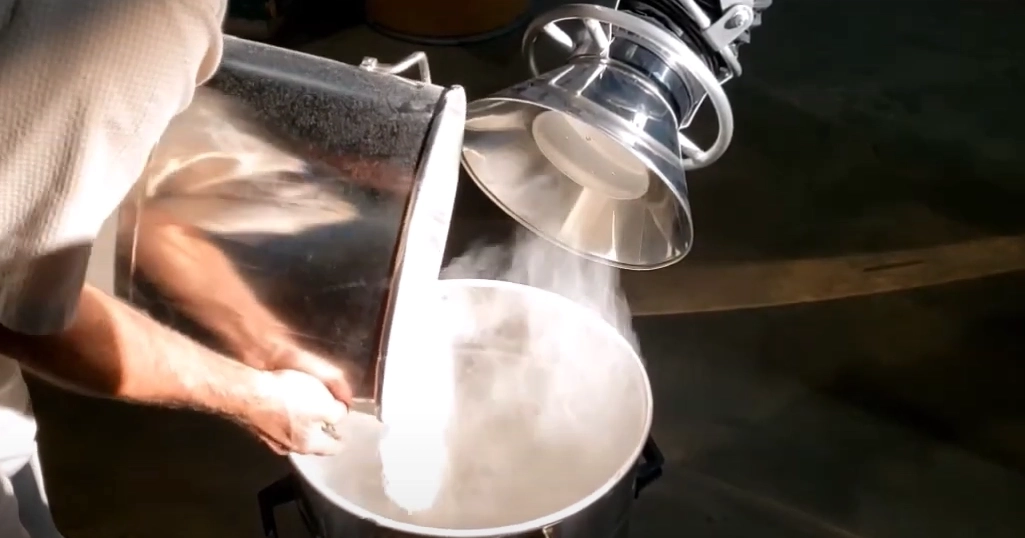
In many companies, dust is treated as a by-product to be dealt with once production is finished. We will look at it when there is time. When things calm down. When the “real work” is done. The problem is that dust neither arises by chance nor disappears on its own. It is created by the process itself — movement, vibration, joining, dosing and machining of materials. And when dust is generated there, it rarely makes sense to remove it afterwards. That is, in practice, double the work.
It is far more effective to solve the problem when and where it arises — and to do so continuously. Not only to protect employees, but also to protect what you produce and the equipment you produce with.
In life science, pharma and cleanroom environments this takes on an added dimension. Here, dust is not only an occupational-health or operational problem, but a question of product safety, cross-contamination and documented quality. A single airborne gram of powder can be the difference between an approved and a rejected batch — which is why these settings place entirely different demands on how closely and how continuously the dust is removed.
Let us start with the term dust collector
In Danish we call it a partikelfanger — literally a particle catcher. The English term is dust collector, sometimes also called a deduster. Whatever the name, the concept is the same: a dedicated piece of process equipment designed to capture dust and particles at the source.
A dust collector is neither a traditional vacuum cleaner nor a conventional ventilation system. It is its own category of equipment, developed for situations in manufacturing where dust arises locally, continuously — as a direct consequence of the process.
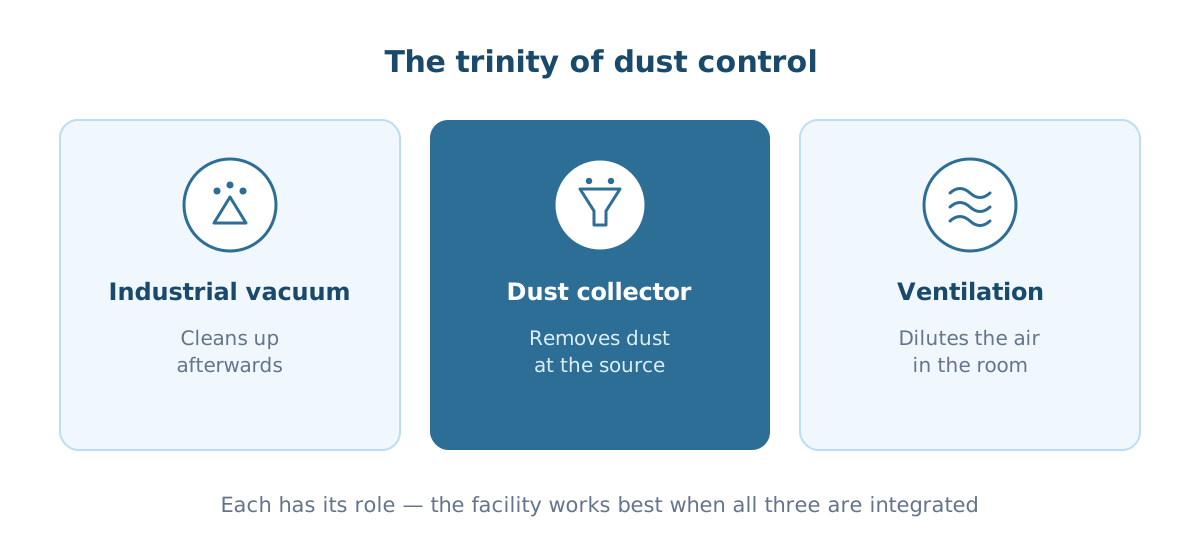
This is where the dust collector differs fundamentally from other solutions. Where a vacuum cleaner is used to clean up after the fact, and ventilation works to dilute airborne particles across an entire room, the dust collector’s purpose is to remove dust and particles directly at the source, before they spread through the working environment and the rest of the process.
That does not mean the dust collector replaces either the vacuum cleaner or the ventilation system. On the contrary — it makes their work easier. You could say the three together form a kind of trinity of dust control, each with its own role, and the facility only truly operates at its best when all three are properly integrated.
Point extraction beats room ventilation when dust arises locally
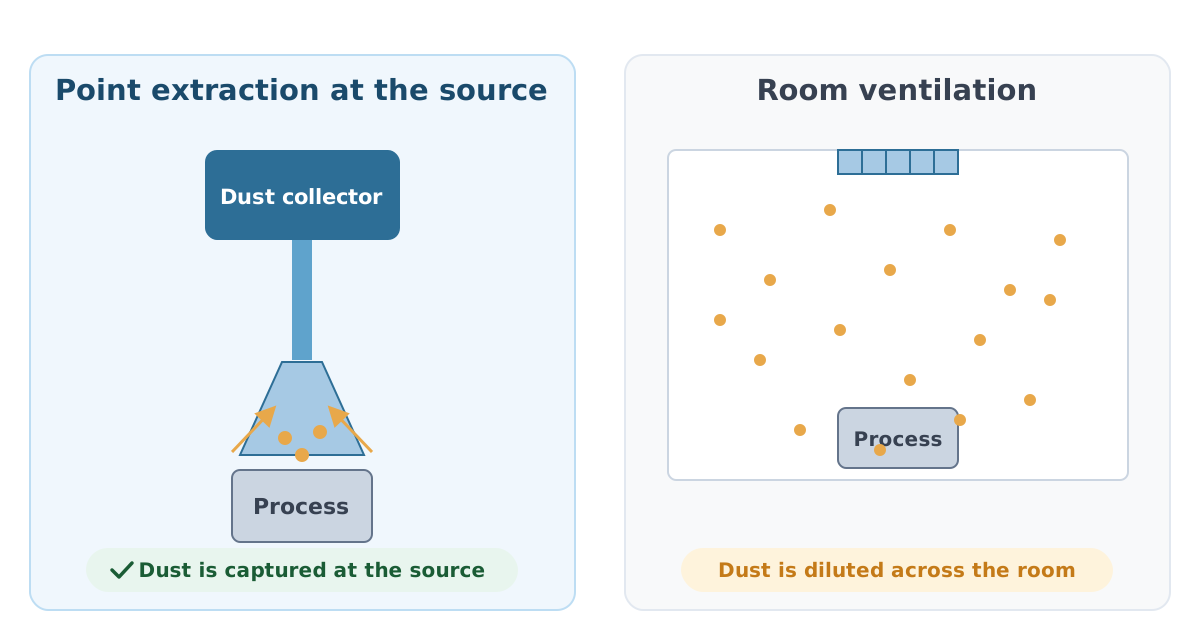
Ventilation certainly has its place. It provides fresh air, comfort and a generally good indoor climate. But ventilation is rarely the answer when dust arises at one specific point in a process.
A dust collector works with point extraction. That means dust is removed precisely where it is generated — before it has a chance to spread, settle on surfaces, or find its way into machinery, installations and products. In principle it operates like ventilation with large airflows — far larger than a vacuum cleaner. But because the air volume is targeted at a single point, the effectiveness increases significantly.
In many processes, dust is released inside machines, cabinets and enclosures. It may be dust that was already present on materials or components before entering the process, but only becomes airborne once the process is running. If it is not captured there, it will inevitably end up throughout the machine — and unfortunately outside it as well. Then the cleaning, maintenance and fault-finding begins.
In a GMP environment that spread is precisely the danger. When powder from one product settles where it does not belong, it becomes cross-contamination — and then it is no longer housekeeping, but batch integrity and patient safety, that is at stake. Point extraction is therefore not merely good practice in pharma. It is one of the most direct ways of keeping separated processes separate.
Point extraction is therefore not simply a benefit that all facilities should consider. It is often the only solution that genuinely works — and, frankly, the most economical one as well.
Do you have process dust at a specific production point?
We can help assess which type of point extraction suits your process, your environment and your materials.
Contact usProcess equipment – not cleaning equipment
It is important to be clear: a dust collector is not designed for manual cleaning. It is designed for process extraction.
It is used where dust arises as part of the operation — at open process points, during filling and dosing of powders and granules, or inside machines and enclosures where movement, vibration or the assembly of components releases dust.
In pharmaceutical production the problem is often greatest during weighing, filling and dosing of active ingredients (APIs). Here even small quantities of airborne powder are both a contamination and an exposure problem, and it is the hazard of the material — expressed through containment requirements and OEB band — that determines how close to the source the extraction must sit and how high a capture efficiency is required.
In many cases the dust is already present. It is on the materials, on the components or inherent in the process. The dust collector’s job is to remove it while the process is running — before that dust develops into an occupational health problem, a quality problem or a maintenance problem.
Once you understand the principle behind a dust collector, everything falls into place — including the fact that it can take many forms depending on the task. Sometimes through hoses or fixed pipe installations, sometimes via extraction arms or integrated nozzles tailored to the application. And in many cases it is precisely the combination that makes the difference.
Vacuum cleaner, dust collector or ventilation – what does each actually do?
Although the three solutions are often mentioned in the same breath, they have fundamentally different roles. The table below makes this clear when viewed side by side:
| Function & Application | Industrial vacuum | Dust collector | Ventilation |
|---|---|---|---|
| Manual cleaning | ✓ Primary function | ✗ Not designed for this | ✗ Not relevant |
| Process extraction | △ Temporary solution | ✓ Primary function | ✗ Not sufficient |
| Point extraction at source | ✗ Not designed for this | ✓ Yes, continuously | △ Only with special design |
| Internal extraction inside machines and enclosures | ✗ Unsuitable | ✓ Ideal solution | ✗ Not effective |
| Room-level extraction | ✗ Not relevant | ✗ Wrong approach | ✓ Primary function |
| Continuous operation (24/7) | ✗ Not designed for this | ✓ Yes | ✓ Yes |
| Collection in container | ✓ Yes | ✓ Yes | ✗ No (not typical) |
| Typical daily operating hours | △ 1–2 hours | ✓ 8–24 hours | ✓ 24 hours |
In short: the dust collector minimises the problem at source. The vacuum cleaner and ventilation are the backstops that handle the remaining dust on surfaces and in the air.
When dust is no longer just dust
In any production environment, dust is not simply a matter of housekeeping. When dust is not removed at source, it spreads. It settles inside machines, in enclosures, on sensors and in moving parts. It ends up on products, in packaging and in areas where it does not belong.
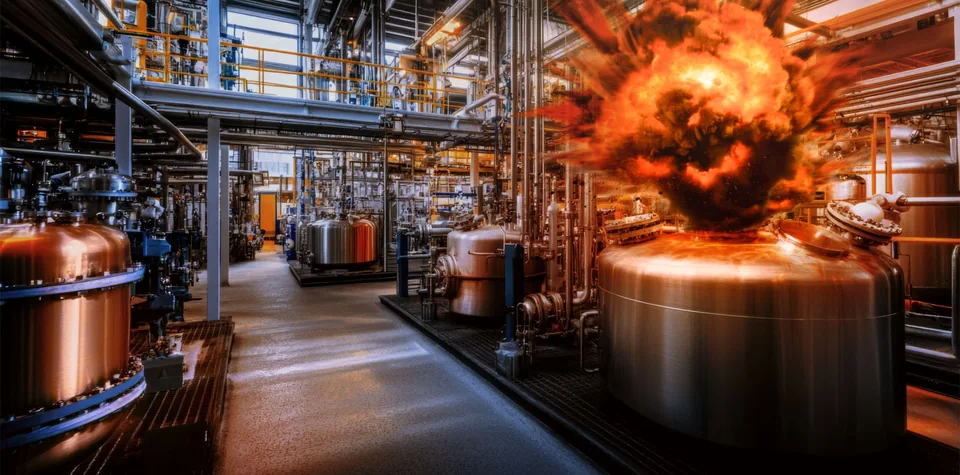
Over time this affects operational stability, product quality and maintenance requirements. And in some cases dust also becomes a safety issue — for example when the material is flammable or hazardous to health. When that happens, you are presented with ATEX directives and standards such as EN 17348 and EN 60335-2-69. These exist because experience has demonstrated what happens when dust is not controlled.
In life science, however, the requirements go beyond safety. Here it is the hazard of the particles that determines the filtration needed. EN 60335-2-69 divides dust into classes L, M and H, where class H is intended for the health-hazardous and carcinogenic particles. And when the air is returned to a cleanroom, even a high dust class is rarely enough on its own — here you work with HEPA and ULPA filtration, which retains particles right down to the most penetrating particle size (MPPS). Point extraction and the correct filter class are therefore two sides of the same coin: one removes the dust at source, the other ensures it does not escape again.
In that context, a dust collector is not something you have merely to comply with “some regulation”. It is a control tool — a piece of equipment that makes it possible to manage something that would otherwise quickly get out of hand.
The economic case, which should matter to everyone
Many organisations only discover the true cost of dust when they look at the time spent on cleaning and maintenance. The calculation is easy to set up yourself. Half an hour a day at one process point adds up to roughly 110 working hours per year (0.5 hour × approx. 220 working days) — at just one point in the facility.
Multiply those 110 hours by your own internal hourly cost, and add production stoppages, extra quality checks, more maintenance and accelerated wear, and the annual cost of a single dust point quickly reaches a five-figure sum. In life science there is also the cost that is hardest to quantify but most expensive to incur: a rejected batch, a deviation in the quality system or an observation at a GMP audit.
Set against what point extraction at the source costs, the payback period is in many cases months rather than years — not because the equipment is cheap, but because it shifts resources from constant remediation to stable operation. The precise calculation depends on your process, and we are happy to help set it up for your specific installation.
Would you like to know which dust collector suits your process?
We advise on equipment for process dust — from simple point extraction arms to integrated system solutions with ATEX certification and continuous operation.
Contact us See dust collectorsThree examples from our own range for process dust in life science — from a stationary cleanroom solution to explosion-proof ATEX units with HEPA and ULPA filtration. Links lead to the full specifications.
-
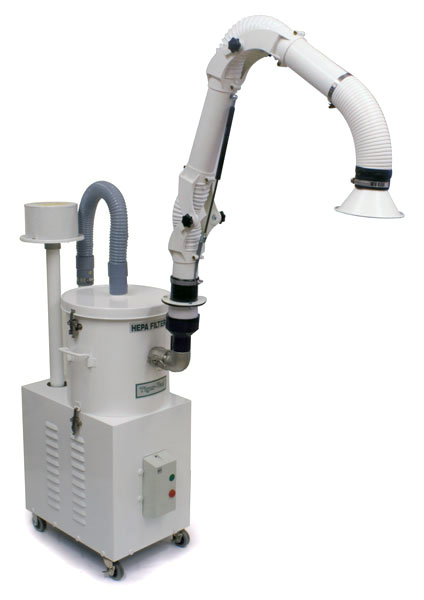 Tiger-Vac CD-1500 CR (PFB) White Line
Stationary cleanroom vacuum solution for pharma and food production. TEFC motor for continuous operation, ISO Class 4 compatible, with HEPA H14 and ULPA U15 available as options.
View product → -
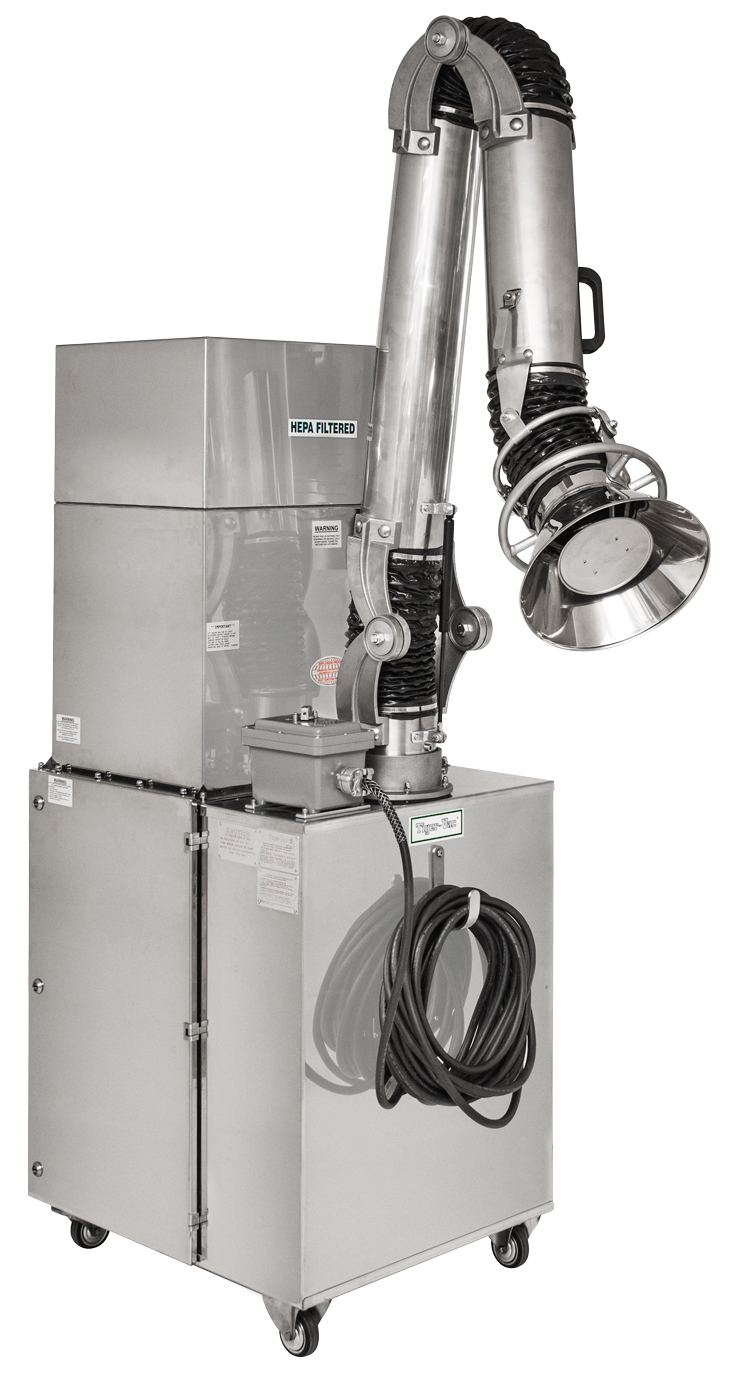 Tiger-Vac CD-600 EX HEPA, stainless steel
ATEX-certified dust collector in stainless steel with HEPA H14 included. For Zone 1 (gas) and Zone 21 (dust) — source capture of combustible pharma dust in classified areas.
View product → -
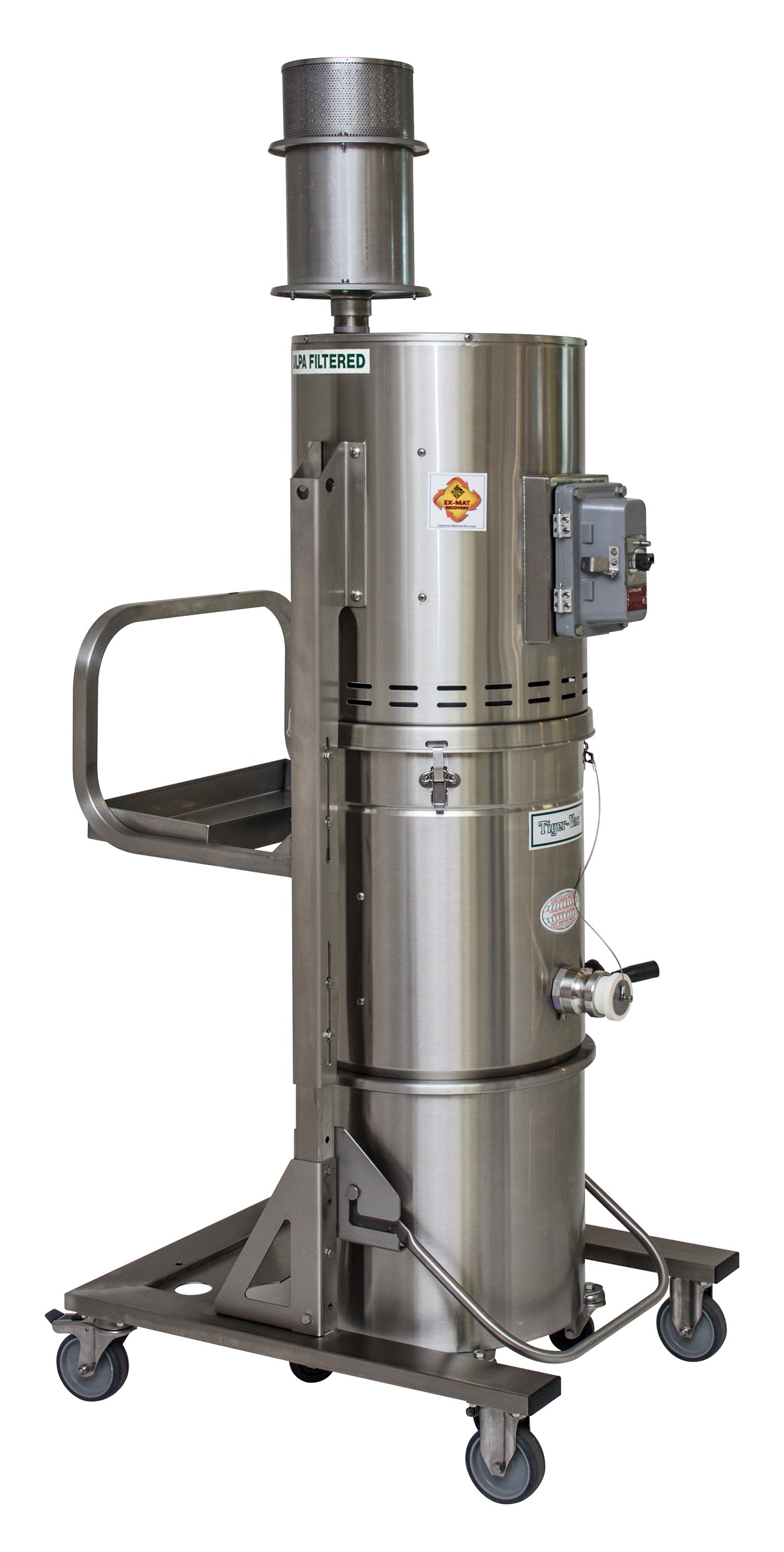 Tiger-Vac CD/EUR-36L EX ULPA
Compact, explosion-proof unit with ULPA filtration and a stainless-steel trolley — for processes where even a high dust class is not enough and the air must return to a clean environment.
View product →
- EN 17348:2022 — Requirements for design and testing of vacuum cleaners for use in potentially explosive atmospheres. Defines requirements for the design, construction and testing of vacuum cleaners for ATEX areas.
- EN 60335-2-69 — Household and similar electrical appliances — Safety — Particular requirements for wet and dry vacuum cleaners, including power brush, for commercial use. Basis for the dust classes L, M and H.
- ATEX Directive 2014/34/EU — Equipment and protective systems intended for use in potentially explosive atmospheres. eur-lex.europa.eu
- Thomas Lyngskjold. “ATEX ABC — before there are sparks, there are choices.” particulair.eu, 2025. particulair.eu
- Thomas Lyngskjold. “The invisible weakest link.” Particulair Life Science Hub, 2026. life-science/en/articles