
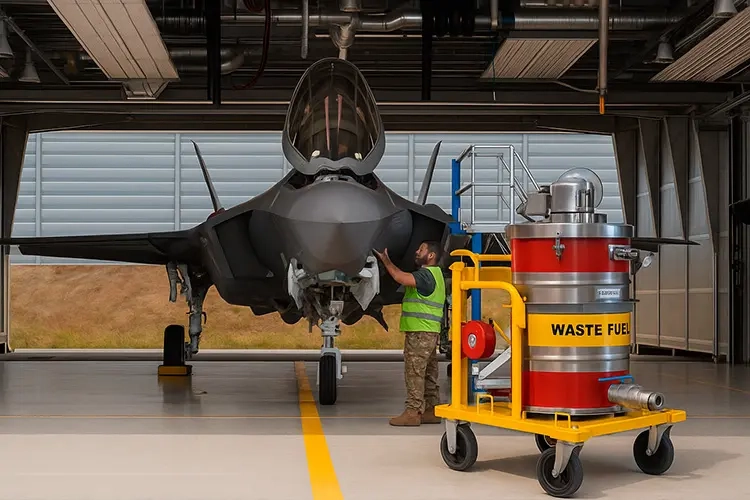
Residual fuel, vapours and static electricity are more than a technical challenge. They are a potential ignition source. In both military and industrial environments where flammable liquids are handled daily, the risk of explosion is real. That is why defueling, depuddling and tank cleaning call for much more than standard equipment.
When fuel becomes an occupational safety issue
Tiger-Vac is based in Québec, Canada, and with a foot firmly planted in both the European and the North American markets, the company has built its reputation where it matters most: in the explosive zones where no mistake is tolerated. Their explosion-protected vacuum systems are in daily use at American air bases, and the equipment is officially recommended by the U.S. Air Force.
But the solutions are not reserved for the Americans. With full ATEX compliance and a European presence, Tiger-Vac is today one of the few manufacturers that combines Canadian engineering, European zone classification and documented military use.
Military requirements for safe fuel handling
Fuel is never just fuel in a military context. It is a risk, a procedural detail and a responsibility that often ends up in the hands of technicians and maintenance teams who work close to both aircraft and people. When a fighter aircraft such as the F-35 returns from a mission, disconnecting hoses and wiping up afterwards is not enough. Residual fuel, vapours and unintended spills have to be handled efficiently and without creating new hazards.
In these situations, “industrial quality” is no longer sufficient. The situation calls for equipment that is not merely built to handle liquids, but to withstand explosions. Equipment that does not generate sparks. That is bonded to earth. That can be operated with gloves. That does not draw more oxygen into a confined space than it can filter safely back out.
That is also where you discover that not all vacuum cleaners are created equal. Many of the machines used in traditional workshops or production environments will simply not be allowed in a NATO-approved hangar, let alone close to fuel tanks, where the ignition points are lower than the temperature of a hot summer day in southern Europe.
The defence sector therefore imposes demands that only a few suppliers can meet. Not just technical demands, but demands for documentation, testing, redundancy and robustness. Canadian Tiger-Vac has found its place in exactly that space.
Tested and recommended by the U.S. Air Force
When technicians from the U.S. Air Force first rolled a Tiger-Vac industrial vacuum cleaner into the hangar at Eglin Air Force Base, it was not to evaluate the design. It was about something far more down to earth, and far more explosive. Every day, residual fuel, vapours and dust had to be removed from beneath the airframes. Every day, someone was sent into zones where a single spark could be enough.
There is equipment that can handle this kind of work on paper. But in the U.S. defense testing programme, the Management and Equipment Evaluation Program, better known as MEEP, paper is only the beginning. Products are exposed to reality here. And that is exactly what happened. Tiger-Vac was used, not merely evaluated. Not merely reviewed, but deployed. The conclusion was put in writing: “The Tiger-Vac is recommended for Air Force use.”
The recommendation was subsequently published in an internal technology bulletin. Not to promote a brand, but because a piece of equipment had been found that could solve a concrete task with minimum risk. The filtration system, the explosion-protected housing, the bonding system, all of the features described in the manual worked when it mattered.
Today, more than twenty years later, Tiger-Vac is still used in American defence logistics and maintenance. Not as a name, but as a tool. That is what makes the difference.
ATEX, the EU and the difference between certification and trust
Safety in explosive atmospheres in Europe speaks one language: ATEX. It is not merely a label on a machine. It is a legal and technical framework that determines whether equipment may be used in certain zones at all. Zone 1. Zone 21. Zone 22. These are not names. They are warnings.
Tiger-Vac understood long ago that being relevant in European risk zones requires more than translating your documentation. You have to understand the European approach to responsibility. That is why their vacuum cleaners are built in stainless steel and aluminium, not just for durability but to eliminate spark generation. That is why they use activated carbon to trap solvent vapours, not for comfort but to make sure no ignition source escapes the filtration. And that is why the entire system is consistently antistatic, from hose to exhaust.
Even their castors are chosen with spark-free operation in mind.
The models used in both American and European aviation maintenance can be supplied in versions that comply with directive 2014/34/EU, the one we know as the ATEX Directive. Several models meet what EN 17348 today requires when handling flammable liquids, vapours and dust in combination. This is not just legislation. It is reality, and it is precisely where Tiger-Vac positions itself.
They do not use ATEX as a sales pitch. They treat it as the minimum standard and set the bar so high that comparison rarely makes sense. In environments where one mistake can cost an aircraft, a building or a life, you do not choose between good solutions. You choose what has been proven. And that is often where Tiger-Vac stands alone.
What sets Tiger-Vac apart
On the surface it can look like something you have seen before: a stainless tank, a few castors, a hose and a switch. But what sets Tiger-Vac apart from most other industrial vacuum cleaners is not what you see. It is what you do not need to think about when you use it.
It starts with the construction. Not just explosion-protected, but built from the ground up to operate where sparks are lethal. No retrofitted safety zones or antistatic kits as options. Every detail is part of a chain where no link may fail: bonding throughout the structure, internal liners, hose arms with metal spirals, castors with conductive rubber, and exhaust through activated carbon.
But it does not stop at material choice. It continues with functionality. Several models are equipped with a Dead Man Brake, a system that requires active pressure to move. Not as a gimmick, but to make sure no machine rolls while the operator is fumbling with hoses in a cloud of vapour. Other models can be tipped hydraulically so they can be emptied without lifting, even when loaded with heavy fuel. This is not comfort. It is risk reduction.
And then there is the filtration. When Tiger-Vac says HEPA, they mean 99.995% at 0.3 micron. Not in the laboratory, but at the working point. Combined with ULPA and activated carbon, both particles and vapours are held in place. This is not a general upgrade. It is a construction where filters are as central as the motor.
All of this together means that Tiger-Vac does not simply deliver an industrial vacuum cleaner. They deliver a level of safety that in many cases exceeds the requirements, and leaves competitors with a choice: try to catch up or find another category to compete in.
From hangars to the field: Tiger-Vac in operational use
It is easy to talk about zones and directives in a meeting room. It is considerably harder when fuel is in your nose and time is short. That is where Tiger-Vac’s vacuum cleaners do their work without fanfare, in environments where equipment does not have to impress, it just has to work. Every time.
In hangars such as those at Eglin Air Force Base, Tiger-Vac is a fixed part of turnaround preparation. After a flight, residual fuel and vapours are removed with equipment built to withstand both the atmosphere and the task. This is not about cleaning, but about safety readiness. Technicians work close to air intakes, open fuel tanks and hot components. Every potential failure point, including an electrical spark, must be eliminated. That is why Tiger-Vac is there.
But it does not stop in the hangar. There are mobile units equipped with pneumatic systems and antistatic castors that can be used directly at fuelling stations, at depots and at air stations with unpredictable terrain. Some models are supplied with a hydraulic tipping function so the tank can be emptied in the field without heavy lifting. Others come with suction wands and nitrile hoses that reach deep into containers where residual fuel has collected.
And while Europe may not yet have seen the full deployment, there is no doubt that NATO has. Tiger-Vac vacuum cleaners carry NSN numbers (NATO Stock Numbers) and are therefore approved for military logistics and supply across borders. That means they are already part of the systems that support European operations in the field.
This is not equipment that needs to convince anyone with brochures. It is equipment that speaks its own language once it is in use.
Conclusion: When safety cannot be improvised
Europe is rearming. Not necessarily by choice, but out of necessity. The threat landscape has changed, and military materiel is once again a priority. In the shadow of political urgency, purchases are made, often blindly, and the wish to demonstrate action risks outrunning good judgement. Precisely for that reason, now is the time to stop and ask: What already works? What is documented? What has stood the test?
Tiger-Vac has not built its position by following the current, but by delivering solutions that have worked under pressure, in environments where failure is not tolerated. Their industrial vacuum cleaners are not new to the market. They are rooted in more than twenty years of experience with explosion-protected work in aviation and defence, both in the United States and under NATO.
This is not technology for its own sake. It is safety made concrete. Not only because their solutions meet ATEX and EN 17348, but because they are already in service where the rest of us only read the risk assessment.
If you work in a sector where ATEX zones are not theoretical but a part of your daily reality, the question is simple: Do you place your trust in what has just been launched, or do you choose what has already been in use under tough conditions?
Working in defence, aviation or other critical safety sectors?
We help identify the Tiger-Vac equipment that matches your zone classification, your military requirements and the practical conditions of your operation.
Contact usKey regulations
| EU regulations | USA and Canada regulations |
|---|---|
| ATEX Directive (2014/34/EU) Equipment for explosive atmospheres (hazardous areas) |
NFPA 70 (National Electrical Code) Electrical installations in Ex areas |
| ATEX Workplace Directive (1999/92/EC) Zones in the working environment |
NFPA 30 (Flammable and Combustible Liquids Code) Safe storage of flammable liquids |
| EN ISO 80079-36:2016 Non-electrical equipment in Ex zones |
OSHA (Occupational Safety and Health Administration) Workplace safety for dust and HEPA filtration |
| EN ISO 80079-37:2016 Design without ignition sources |
EPA (Environmental Protection Agency) Environmental rules and health hazards |
| EN 60335-2-69:2012 Vacuum cleaners for environments with combustible dust |
— |
| REACH Classification and approval of chemical substances |
— |
| CLP Labelling and warnings for chemical substances |
— |
- Directive 2014/34/EU (ATEX Equipment Directive). eur-lex.europa.eu
- Directive 1999/92/EC (ATEX Workplace Directive). eur-lex.europa.eu
- EN 17348:2022 — Requirements for the design and testing of vacuum cleaners for use in potentially explosive atmospheres.
- EN ISO 80079-36 and -37 — Non-electrical equipment for use in explosive atmospheres.
- EN 60335-2-69:2012 — Safety requirements for vacuum cleaners.
- U.S. Air Force Management and Equipment Evaluation Program (MEEP) — Tiger-Vac evaluation bulletin.
- NFPA 70 National Electrical Code.
- NFPA 30 Flammable and Combustible Liquids Code.
- NATO Stock Numbers (NSN) — official military supply logistics.
- Thomas Lyngskjold. “ATEX approval is no longer enough — get to know EN 17348:2022.” Particulair Ex-Vac Hub, 2026. ex-vac/en/articles
- Thomas Lyngskjold. “Inert vs ATEX.” Particulair Ex-Vac Hub, 2026. ex-vac/en/articles