HF 30P Z22
- Heavy central vacuum plants in Zone 22 where dust load exceeds HF capacity
- Production plants with many open extraction points or large pipe diameter (Ø130 mm inlet)
- Localized discharge to big-bag, Longopac cassette, rotary valve + container or direct pipe
- Continuous operation without stopping to empty a bin
- ATEX-regulated production environments with non-conductive dust (class 3D, IIIB)
- Installations with clear ceiling height above 3.8 m or outdoors / under canopy
- ATEX Directive 2014/34/EU -- II 3 D Ex htc IIIB T140 Dc
- EN 17348:2022 (harmonized March 2023)
- IEC 60335-2-69 (industrial vacuums)
HF 30P Z22
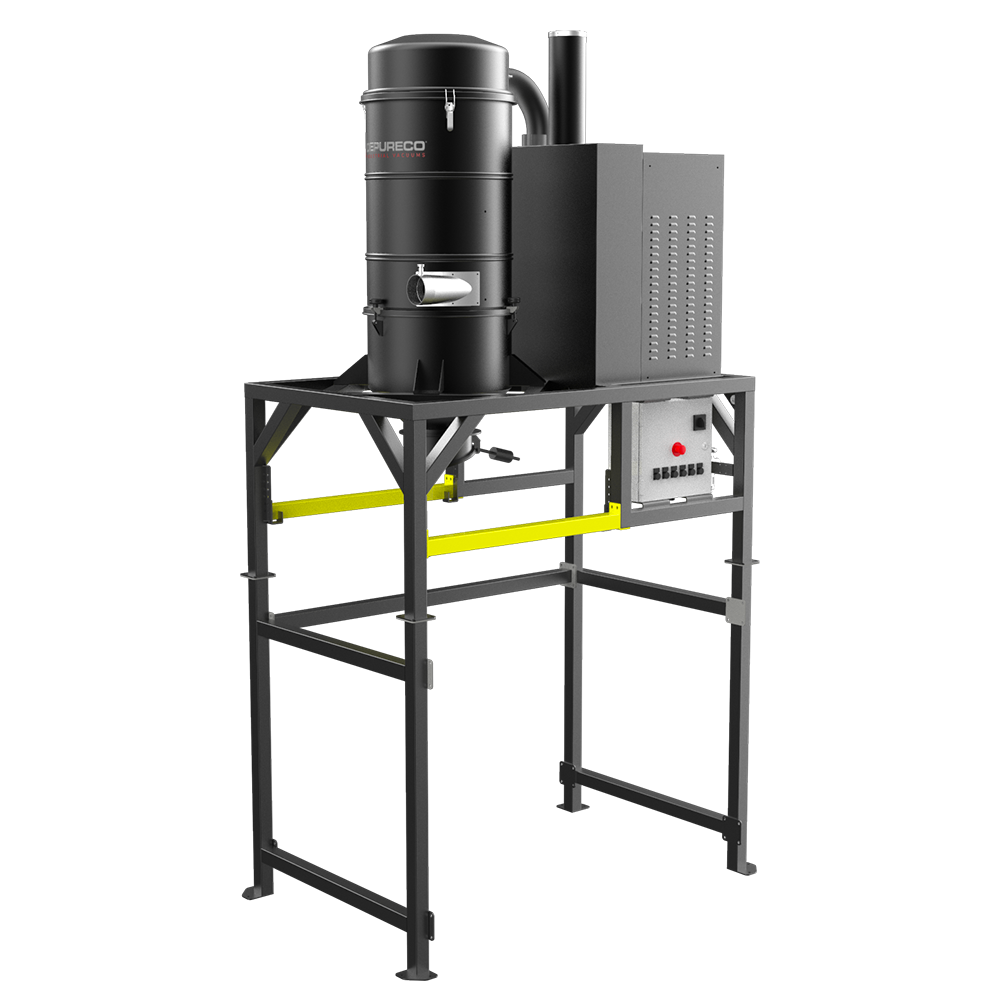
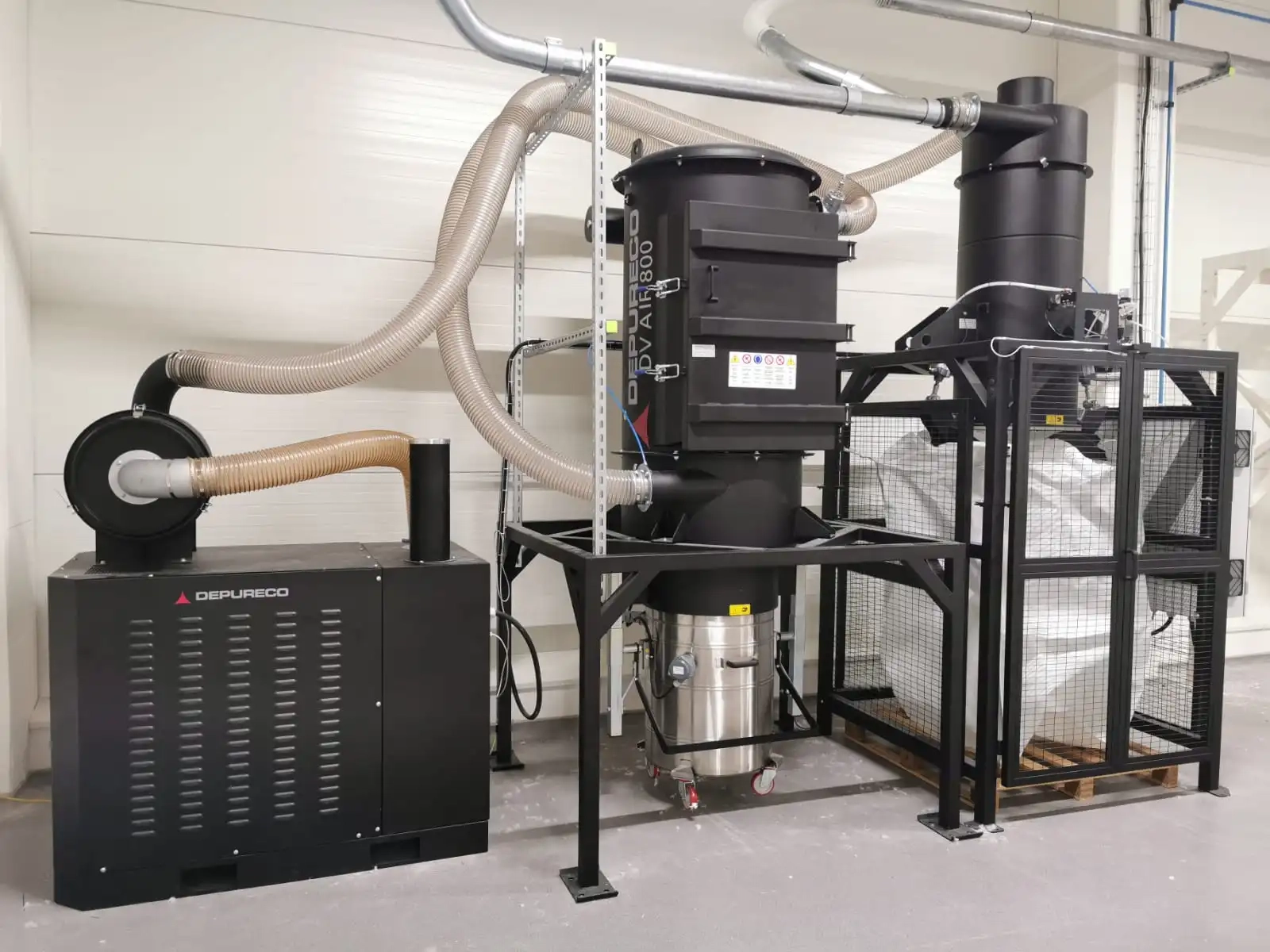
The Depureco HF 30P Z22 is the Heavy Duty variant of the HF chassis -- a stationary ATEX central vacuum cleaner for Zone 22, supplied WITHOUT an integrated dust bin. The motor tuning is the P (Performance) type. A 22-30 kW ATEX-certified side-channel blower (top-mounted) pulls air through cylindrical cartridge filters (180,000 cm2 M class, antistatic polyester -- 50% more filter area than the standard HF) and delivers 1,856 m3/h at 300 mBar vacuum. The inlet is Ø130 mm, tangential with cyclone pre-separation. Dust is discharged continuously via a flange connection at the bottom to the customer's own discharge system (big-bag, Longopac cassette, rotary valve + container, or direct pipe to process silo). SP automatic reverse-jet pulsejet keeps differential pressure stable under high dust loads. Safety valve, remote vacuum control and inlet silencer are included from factory. Footprint 1240x1910 mm, height 3488 mm -- requires clear ceiling height or outdoor placement. Typical use: heavy central systems with high dust loads or long pipe runs requiring capacity headroom. ATEX marking II 3 D Ex htc IIIB T140 Dc (dust Zone 22 external).
Applications
- Heavy central vacuum plants in Zone 22 where dust load exceeds HF capacity
- Production plants with many open extraction points or large pipe diameter (Ø130 mm inlet)
- Localized discharge to big-bag, Longopac cassette, rotary valve + container or direct pipe
- Continuous operation without stopping to empty a bin
- ATEX-regulated production environments with non-conductive dust (class 3D, IIIB)
- Installations with clear ceiling height above 3.8 m or outdoors / under canopy
Technical specifications
| ATEX marking | II 3 D Ex htc IIIB T140 Dc |
|---|---|
| Internal / external zone | - / 22 |
| Motor type | 1x 3-faset ATEX-sidekanalblaeser (Ex h IIIB Dc, top-monteret, Heavy Duty) |
| Duty cycle | Continuous |
| Airflow | 1856 m³/h |
| Vacuum | 300 mbar |
| Sound pressure | 74 dB(A) |
| Filter class | M class |
| Filter type | Cylindriske patroner (Heavy Duty) |
| Primary filter | Cylindriske patroner, 180.000 cm2 total, klasse M, antistatisk polyester |
| Cleaning system | SP-automatisk reverse jet (pulsejet) |
| Collection system | Localized discharge (container not included) |
| Material | Lakeret staal-filterhus (beholder leveres ikke -- se lokaliseret udledning) |
| IP class | IP55 |
| Power | 30.0 kW |
| Voltage | 400 V / 50-60 Hz |
| Dimensions (L × W × H) | 1240x1910x3488 mm |
Accessories and safety systems
Discharge and safety systems designed for this series. See details, SKUs and compatibility rules on the accessories page.
See all accessories and safety systems →Questions and answers
What does the ATEX marking II 3 D Ex htc IIIB T140 Dc mean?
The model is EU type-approved under ATEX directive 2014/34/EU for stationary operation in external Zone 22 (dust, low risk). 'Ex h' is the construction protection type per EN ISO 80079-36/37, and 'tc' specifies the enclosure protection level against dust ignition. 'IIIB' covers non-conductive dust (paper, fibres, grain, bag dust etc.) -- note that class IIIC (conductive metallic dust) requires separate approval. 'T140' is maximum surface temperature in operation (140 degrees C). 'Dc' is the EPL code for Zone 22.
What is the difference between HF 30P and HF 30S -- which should I choose?
HF HD comes in two variants with the same chassis and the same filter area, but different motor tunings: **P = Performance** (HF 30P, 22-30 kW) prioritises airflow -- 1,856 m3/h at 300 mBar vacuum. Suitable when the plant has many extraction points open simultaneously or large pipe diameters, where it is air volume that drives the capture of dust. **S = Suction** (HF 30S, 18.5-25 kW) prioritises vacuum -- 1,100 m3/h at 380 mBar. Suitable when the plant has long pipe runs or high resistances (many bends, small diameter transitions, HEPA after-filter), where it is pressure drop that limits suction at the hose end. In short: many open points / large pipes = P, long pipes / high pressure drop = S. The P/S logic is also known from the PUMA series (e.g. PUMA 15P/15S). We are happy to calculate for your specific plant.
Why is the HF 30P Z22 supplied without a dust bin?
The HF HD chassis is designed for central systems where dust is not emptied at one point but discharged continuously to an external system. The catalogue calls this 'localized discharge'. A flange connection sits at the bottom of the filter chamber, and the customer fits the discharge system that suits the process. Typical choices are: (1) big-bag connection with drawstring clamp, suitable for high volume and easy disposal; (2) Longopac cassette, suitable for contaminated dust where containment matters; (3) rotary valve + container below, suitable for fixed service cycles; or (4) direct pipe to process silo or central collection. The HD variant has 50% more filter area and a larger inlet (Ø130 mm) than the standard HF -- adding capacity headroom, but it does not change the approach to discharge. We are happy to help size the right discharge system for your plant.
When do I choose the HF 30P Z22 over the standard HF Z22?
HF HD uses the same chassis as HF but has three differences that make it a heavier workhorse: (1) **50% more filter area** (180,000 vs 120,000 cm2) -- handles higher dust concentrations without reverse-jet cleaning running constantly; (2) **Larger inlet Ø130 mm** (vs Ø100 mm) -- lower inlet pressure drop and room for slightly coarser material; (3) **Higher power 22-30 kW** (vs max 25 kW on HF 25 Z22) -- more capacity headroom at high resistance. The standard HF Z22 covers most central installations for ordinary construction, production and food dust. HF HD is the choice when dust load is above normal (fibre, biomass, large volumes) or when the pipe network has many open points or high resistances requiring capacity headroom. The price difference between HF and HF HD is typically 50-80%, so the choice is best made based on specific plant sizing.
When do I choose the HF 30P Z22 over PUMA FIX Z22 or DF FIX Z2-22?
All three are stationary Zone 22 units, but they solve different tasks. **HF HD Z22** (this model) is a heavy central variant without an integrated dust bin and with 180,000 cm2 filter area -- suitable when dust must be discharged continuously via big-bag, Longopac, rotary valve or direct pipe to process/silo, and dust load is above what the standard HF can handle. **PUMA FIX Z22** is also a central system, but with a 175 L AISI 304 bin included -- suitable when dust volume is moderate and an emptiable bin is practical. **DF FIX Z2-22** is a different kind of unit: high airflow and lower vacuum, for airborne dust extraction from large machines or multiple suction arms simultaneously -- not a central hose-outlet system. In short: HF HD = heavy continuous discharge, PUMA FIX = bin emptying, DF FIX = high airflow for point extraction.
Which filter option should I choose on the HF 30P Z22 for fine-particle emissions?
The standard configuration is cylindrical cartridges M class (180,000 cm2 of antistatic polyester) with SP automatic reverse-jet cleaning (pulsejet). For fine-particle emissions or emission requirements below 0.1 mg/m3, Depureco offers a HEPA H14 secondary filter option (110,000 cm2 fibreglass). The combination gives a filter stack that meets requirements for hazardous, pharmaceutical or metallic fine dust. Note that HEPA H14 adds pressure drop -- on HF HD it is typically the S variant (30S) that best handles the extra resistance, while the P variant (30P) is suitable for plants without a HEPA stack.
What installation requirements does the HF 30P Z22 impose?
The HF HD Z22 is a tall unit: the footprint is 1240x1910 mm and the total height is 3488 mm (about 3.5 m). This means your location must have clear ceiling height of at least 3.8 m for service (filter replacement from above), otherwise the unit is placed outdoors, under a canopy or in a technical shelter. The Ø130 mm inlet requires piping of at least the same diameter to avoid creating a bottleneck pressure drop. The unit ships with safety valve, remote vacuum control and inlet silencer included. The customer must ensure: (1) grounding of the chassis and all metallic pipes in the suction circuit -- the ATEX requirement for Zone 22 equipment to avoid electrostatic charging; (2) correct pipe sizing with as few bends as possible; (3) 400 V/3~ 50-60 Hz supply with sufficient amperage (up to 30 kW P variant); (4) installation and sizing of the discharge system (big-bag, Longopac, rotary valve or direct pipe) -- see FAQ on localized discharge. IP55 and insulation class F make the unit suitable for indoor halls and under canopies.
Does Particulair handle installation?
Yes. We offer both installation and commissioning of central ATEX plants and mobile solutions, and ensure that the equipment is installed correctly, documented and adjusted to your environment. Installation is carried out in collaboration with your own electrical and piping trades -- we deliver the plant, the ATEX documentation and the technical commissioning, and we verify grounding, safety valve, pipe sizing and the chosen discharge system before start-up. See 'About Particulair' for our geographic coverage.
What does service and maintenance look like after delivery?
We stay around. Particulair offers service agreements on both central plants and mobile solutions, ensuring that all equipment is continuously maintained and complies with applicable requirements -- including ATEX inspection, filter replacement and annual servicing. A typical service agreement covers scheduled inspections, spare parts access and documentation maintenance. Contact us for a specific agreement tailored to your plant and duty cycle.