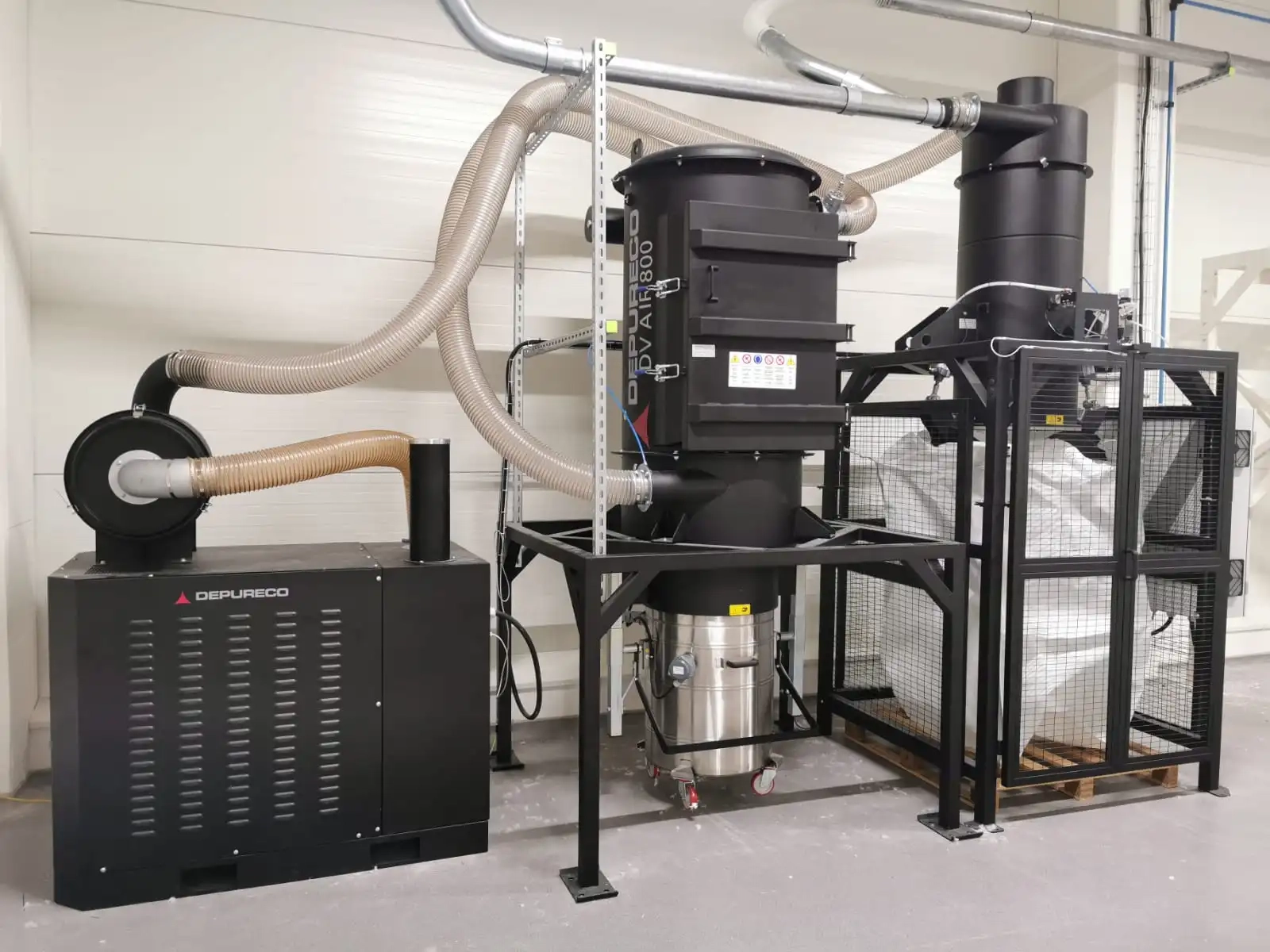
Discharge system = how the collected dust leaves the filter unit (intermittent batch, continuous operation, or big-bag). Safety system = the five ATEX-certified components that prevent an internal dust explosion from spreading to the rest of the building (vent panel, non-return valve, flameless vent, CO2 extinguishing). Both categories are sold separately from the filter unit — because the component choice depends on your process, your zone classification and your risk assessment.
Why sold separately from the filter unit?
All of Depureco's central filter units — DV AIR, DV AIR WB, FILTERING PRE-SEPARATOR WB, FILTER HOPPER, HF / HF HD Z22 and the CVS centrals — ship without discharge and safety components. Datasheets consistently refer to the phrase “DISCHARGE SYSTEMS — see dedicated section” and “SAFETY SYSTEMS — see dedicated section”. The reason is that the component choice is application-dependent: two installations with the same filter can have very different requirements for discharge method, ATEX variant and safety instrumentation.
Specifically, the choice depends on:
- Operating pattern: is the filter emptied in batch (manual or intermittent), or does it need to run continuously in production?
- Zone classification: does the discharge component itself sit in or near an ATEX-classified zone? That determines whether you need the standard or ATEX variant.
- Risk assessment: which ATEX safety barriers are required per EN 14491 (vent discharge), EN 14460 (pressure-resistant construction) and EN 16447 (isolation via non-return valve)?
- Dust character: is the dust conductive (IIIC) or non-conductive (IIIB)? Is it self-heating? Reactive?
Therefore this page is not a catalogue overview alone, but a selection guide: for each component there is a short explanation of when it makes sense — and when it does not.
Discharge Systems
Depureco's discharge catalogue follows two main operating patterns: intermittent (batch emptying, manual or counterbalance-driven) and continuous (continuous outflow via rotary valve or electropneumatic damper). In addition there is a level sensor used to trigger continuous discharge on and off. Big-bag collection is not part of this page — the big-bag frame logically belongs with the pre-separators and is found on the FILTER HOPPER pages.
Intermittent discharge — batch emptying
Used when the filter unit is emptied at stopped operation or at regular intervals. Simple mechanics, no electropneumatics, no ATEX variant in the catalogue — because the component sits at the filter outlet and has no spark or heat sources in normal operation. The choice is between counterbalanced flap (opens under dust weight) and manual butterfly valve (handwheel, operator controlled).
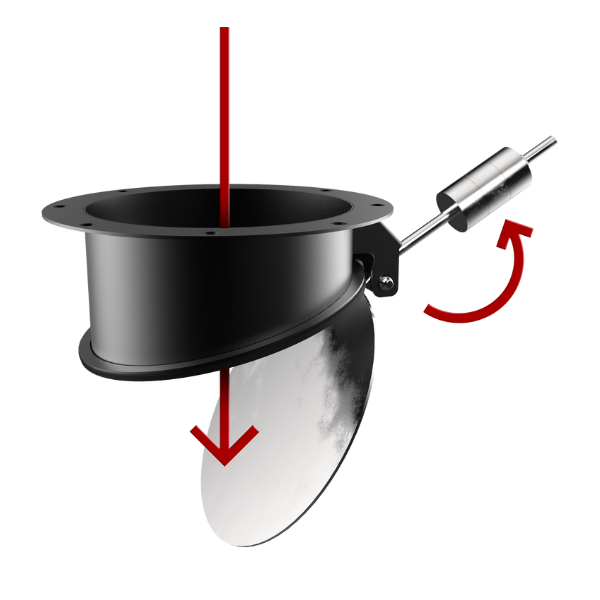
Counterbalanced flap discharge — 150 mm
Counterweight flap that opens when dust weight overcomes spring tension. Suitable for FILTER HOPPER 450 (150 mm outlet) and DV AIR 800 (150 mm outlet in certain configurations). No external power, no pneumatics.
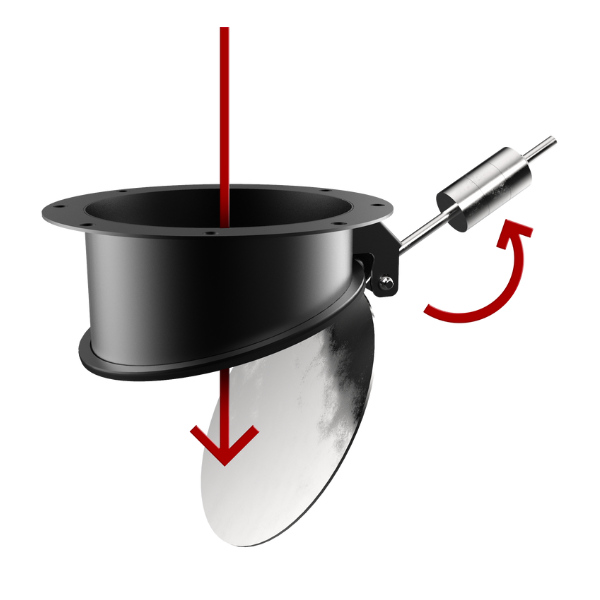
Counterbalanced flap discharge — 250 mm
Same mechanism in larger format for FILTER HOPPER 570/800 and FILTERING PRE-SEPARATOR 570/800 WB.
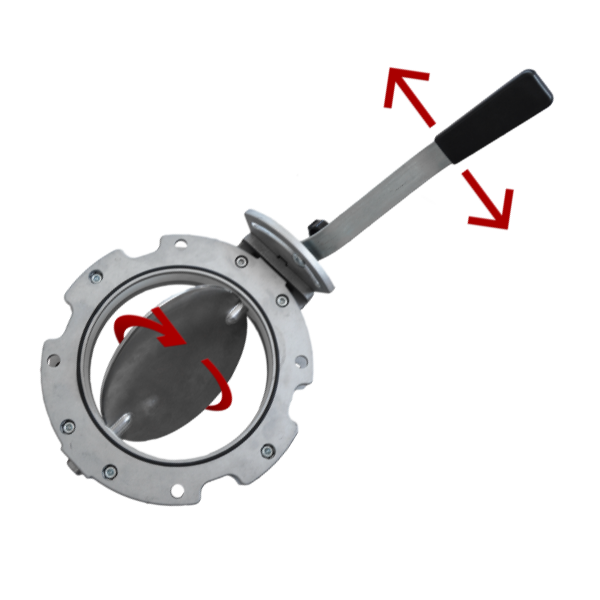
Manual butterfly valve — 150 mm
Handwheel-operated butterfly valve for 150 mm outlet. Used when emptying happens at a defined time under operator control — for example at shift change or planned downtime.
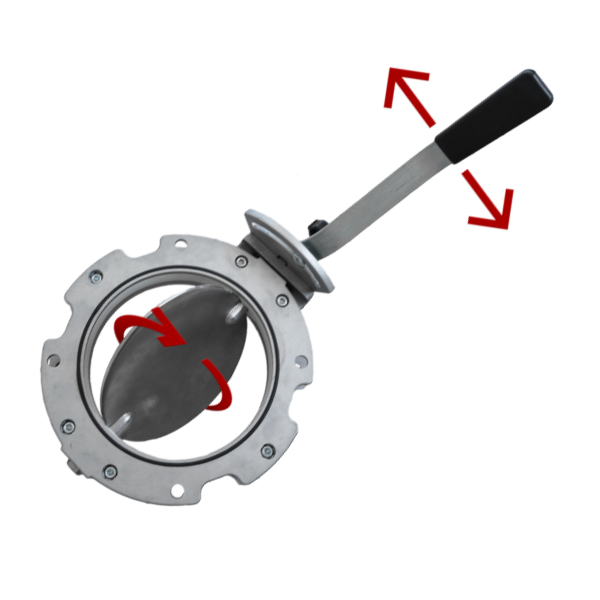
Manual butterfly valve — 250 mm
250 mm variant for larger filter units. Same handwheel type.
Continuous discharge — uninterrupted operation
Used when the filter must run without interruption and dust flows continuously to a next-stage collector (big-bag, container, conveyor). All three types come in both standard and ATEX variants — the ATEX variant must be used when the component sits in or near an ATEX-classified zone.
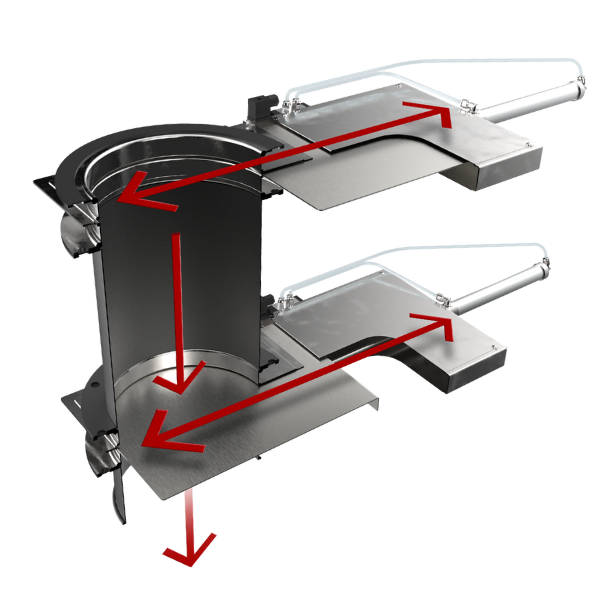
Double exhaust, electropneumatic guillotine dampers — 300 mm
Airlock principle: two guillotine dampers that open and close in sequence so there is never direct flow-through in the filter. Electropneumatic control via compressed air. Standard variant for non-classified installation.
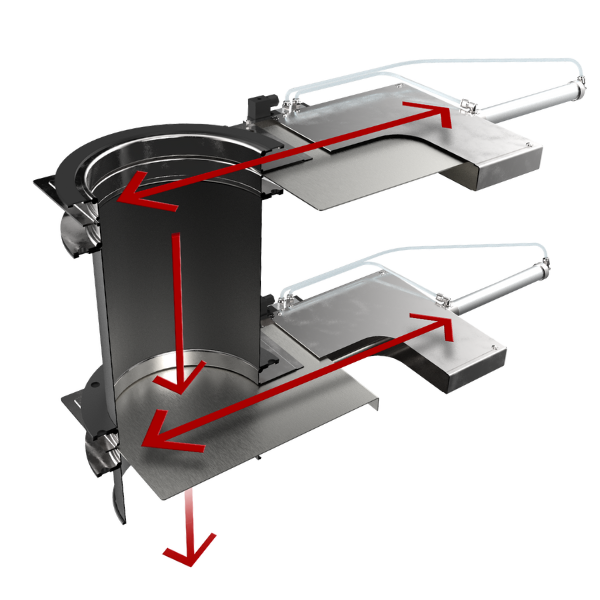
Double exhaust, electropneumatic guillotine dampers — 300 mm (ATEX)
Same mechanism as P13245, but ATEX-certified for installation in or near a classified zone. Choose this when the discharge component sits in Zone 22 or higher.
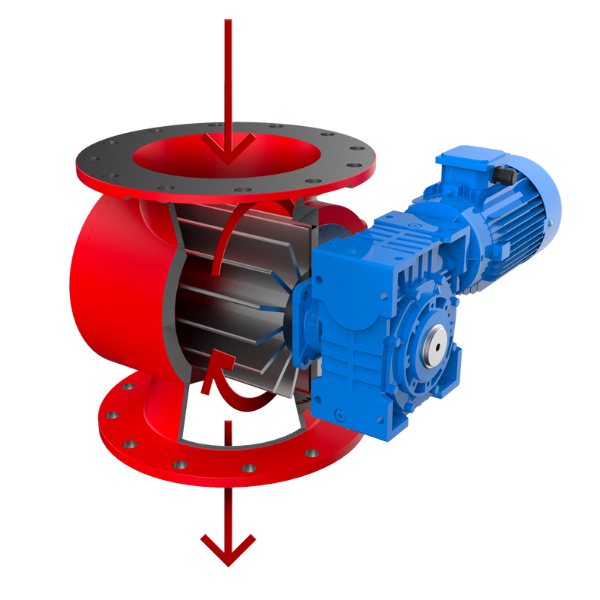
Rotary valve — 250 mm
Classic star-shaped rotor that transports dust through a fixed airlock. Constant extraction without pneumatic cycling. Electric drive, speed adjustable.
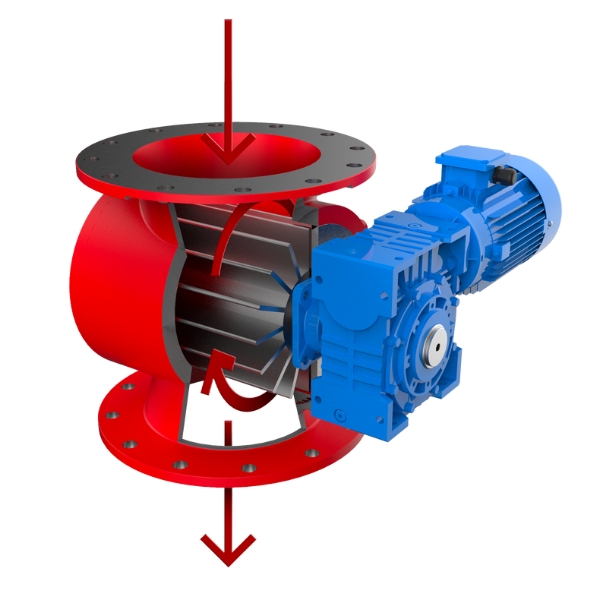
Rotary valve — 250 mm (ATEX)
ATEX-certified rotary valve. Certification covers grounding, spark-free construction and surface temperature. Choose this when discharge happens in a classified zone.
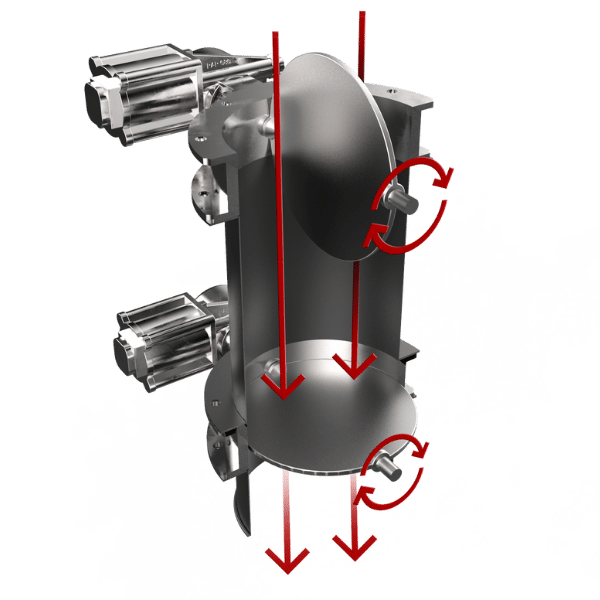
Double discharge, electropneumatic butterfly dampers — 150 mm
Two butterfly dampers in sequence — airlock principle similar to guillotine dampers, but more compact for 150 mm outlets. Electropneumatic control.
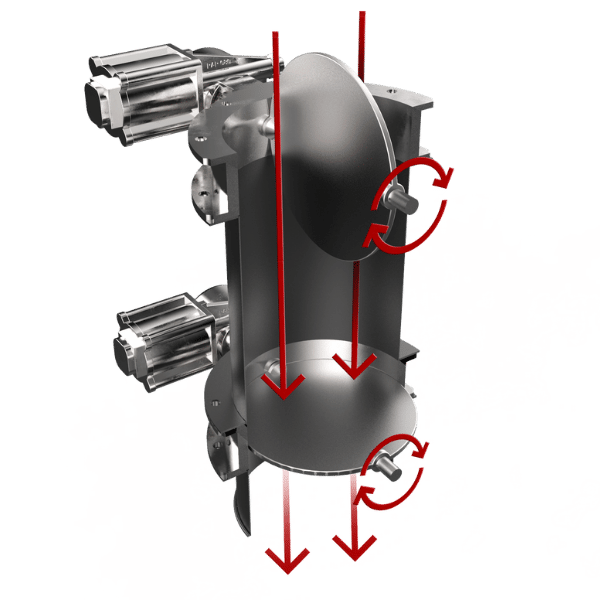
Double discharge, electropneumatic butterfly dampers — 150 mm (ATEX)
ATEX variant of P12394. Same airlock mechanics, zone-certified.
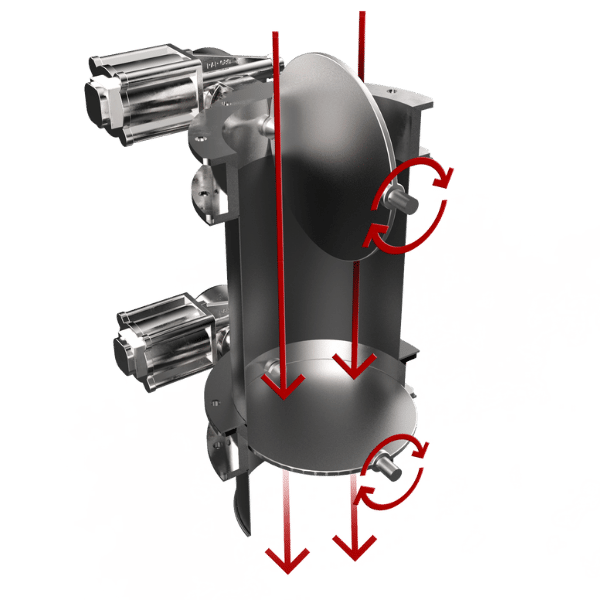
Double discharge, electropneumatic butterfly dampers — 250 mm
250 mm variant of the butterfly-damper airlock. Used with FILTER HOPPER 570/800 and FILTERING PRE-SEPARATOR 570/800 WB, which have 250 mm outlets.
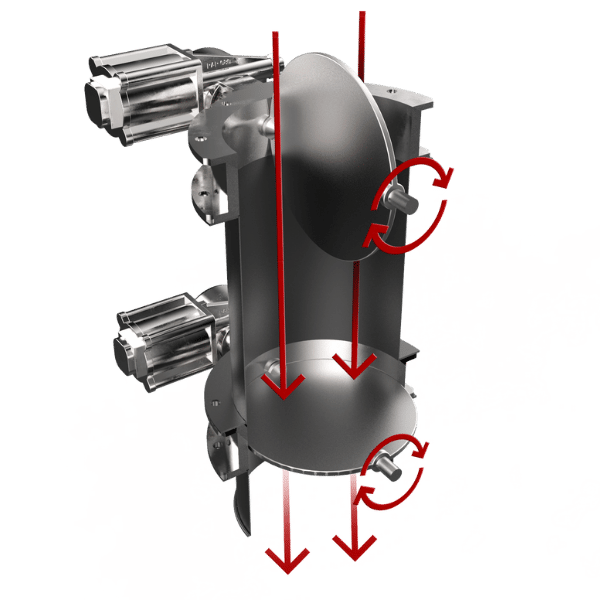
Double discharge, electropneumatic butterfly dampers — 250 mm (ATEX)
ATEX variant of P12395. Typical choice for FILTER HOPPER in Zone 22 areas.
Level activation — discharge system activation
Sits on the filter hopper or bin and provides an on/off signal when the dust level reaches a defined height. The signal is used to start or stop continuous discharge automatically — an airlock running “blind” does more work than necessary and wears unnecessarily.
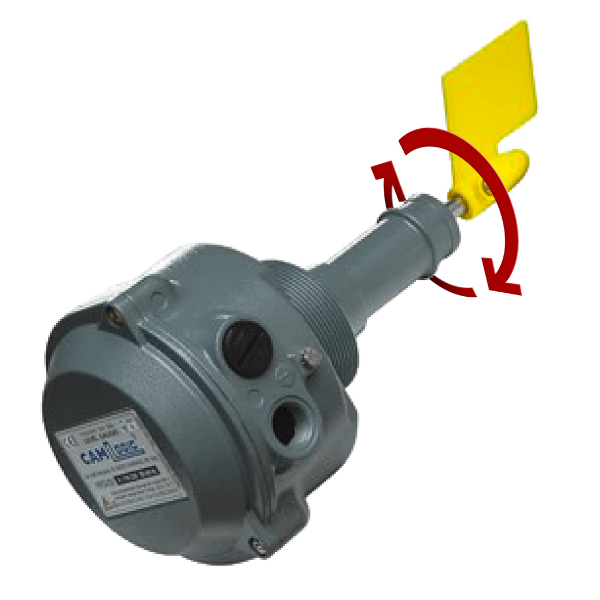
Rotary level sensor
Mechanical level detector with a rotor blade that stalls when dust reaches sensor height. Simple, robust, no electronics in the dust zone. Typical choice for continuous installations with rotary valve or double damper.
Safety Systems
Detect — Isolate — Protect
The ATEX Directive requires industrial users to draft an Explosion Protection Document that shows how the risk is managed. The five safety components in this catalogue are not extras — they are the concrete solutions to the ATEX principle detect, isolate, protect.
1. Detect
Register the initiating event. Level sensor, pressure rise, temperature — all signals that in the Depureco line tie into standard control systems and, for active protection, trigger the CO2 extinguishing system.
2. Isolate
Stop the flame front from progressing. Non-return valves (P12774-ST1, P12774) close against reverse pressure and prevent an internal explosion from propagating to upstream equipment. Certified per EN 16447.
3. Protect
Vent the pressure in a controlled manner. Vent panel (P12773) to open air, flameless vent (P12775) indoors, and CO2 system (P12777) as active extinguishing. The construction must match the documented reduced explosion pressure Pred.
The five components below are Depureco's catalogue series. Which combination you need depends on a concrete risk assessment per EN 14491, EN 14460 and EN 15089 — plus building geometry and dust type (IIIB vs IIIC).
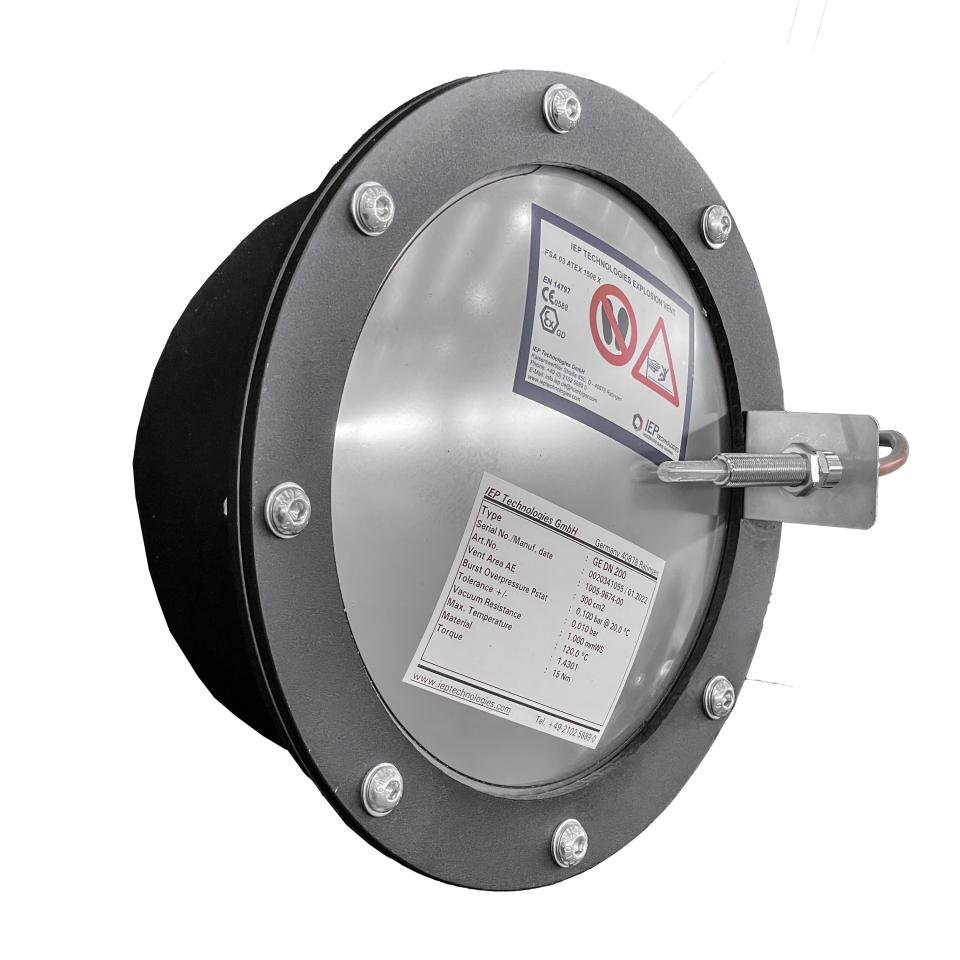
Vent panel G5 — 200 mm
Open pressure relief. At internal overpressure the panel bursts and releases the pressure wave and flame to open air. Requires that the filter stands at an outer wall or rooftop, and that the discharge zone is clear of personnel and equipment. Cheaper and more reliable than flameless vent, but limited by building geometry.
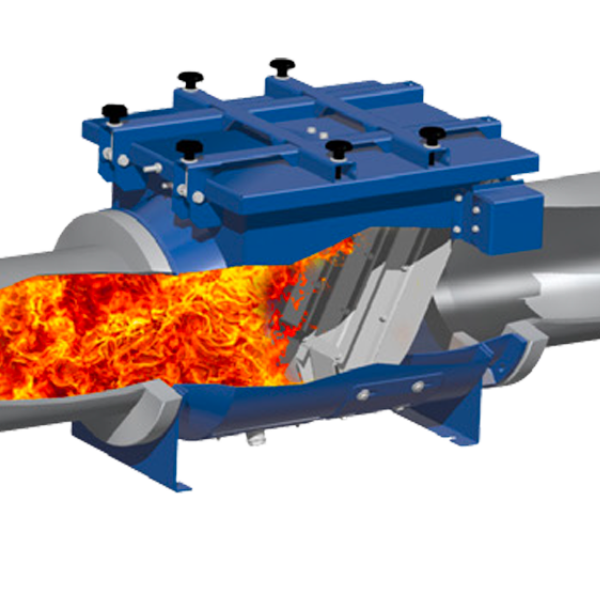
Non-return valve, non-metallic powders — 100 mm
EN 16447 certified passive non-return valve. Closes when buoyant pressure from an explosion moves backwards toward upstream equipment. Variant for non-conductive dust (IIIB level) — milk, pharma powder, plastic granulate, wood.
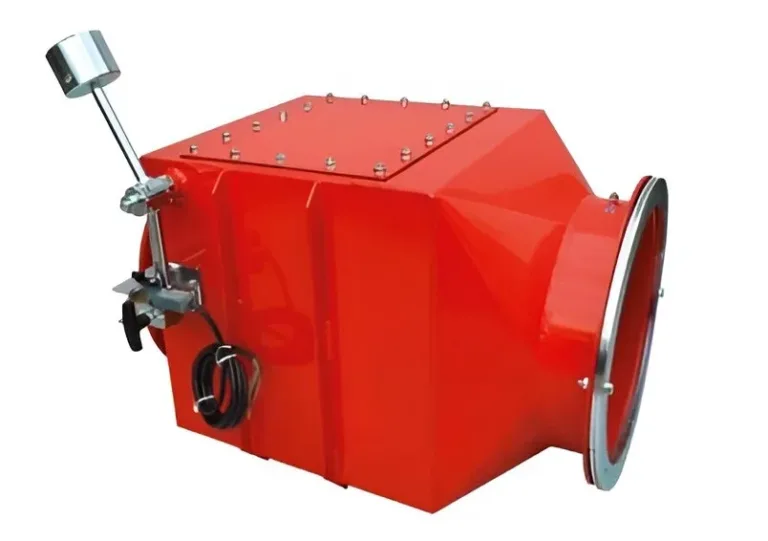
Non-return valve, IIIC explosive powders — 100 mm
Heavier variant for conductive dust (IIIC) — aluminium, titanium, carbon fibre, fine metal shavings. Covers the entire IIIC group and the highest ST1/ST2 explosion classes, with a maximum surface temperature of 180°C.
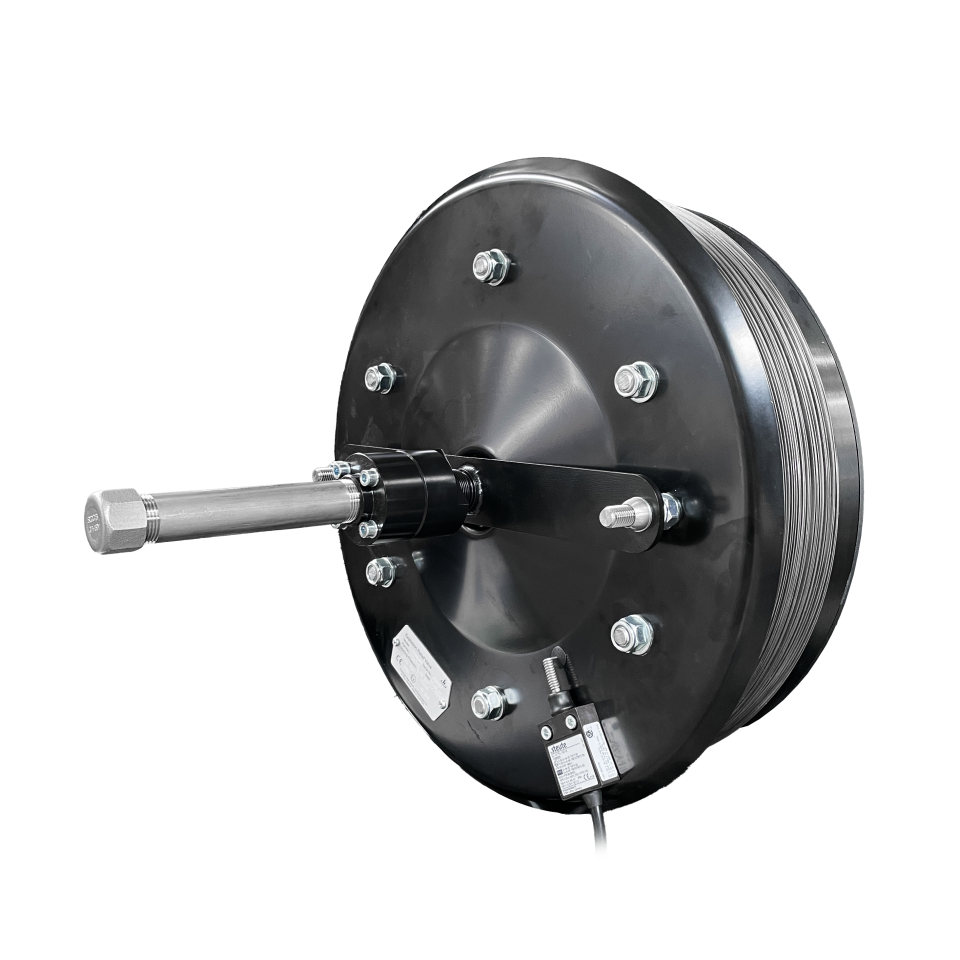
Flameless valve vent
Flame-free pressure relief for indoor use. Contains a mesh filter that cools the exiting gas below the ignition temperature before releasing it to the room — i.e. the pressure is vented but no flame escapes. More expensive than an open vent panel, but necessary when building geometry or space constraints rule out external venting.
CO2 extinguishing system
Active sensor-triggered extinguishing. CO2 is injected into the filter chamber when a spark or incipient thermal event is detected by a sensor. Used in installations where passive venting (vent panel / flameless vent) alone is insufficient — typically with highly reactive dust types or as a supplementary barrier in multi-layer protection.

Not sure what to choose?
The combination of discharge and safety systems depends on the filter unit, dust type, operating pattern and your risk assessment. We help you walk through the configuration, also if you already have an existing Depureco installation and need to supplement or upgrade. Call or write — we reply within one business day.
Frequently asked questions
Why isn't the discharge system included with the filter unit?
Do I need the ATEX variant or the standard variant of the discharge system?
When does my installation require a vent panel or flameless vent?
Can I buy Depureco's accessories separately from the filter unit itself?
What's the difference between a non-return valve for IIIB and for IIIC dust?
Can we install discharge and safety systems ourselves, or does it require authorised installation?
How often do discharge and safety systems need servicing?
What is the rotary level sensor for, and do I need one?
Compatible filter units
The accessories on this page are compatible with Depureco's stationary filter units and central systems. Here is a short overview of the filter units the accessories typically pair with:
Pre-separators (FILTER HOPPER)
DV AIR filter units
Central systems (CVS and HF)
References
Directives and harmonised standards
- EU: ATEX Directive 2014/34/EU — Equipment and protective systems intended for use in potentially explosive atmospheres.
- EU: Directive 1999/92/EC (ATEX 137) — minimum requirements for the safety and health of workers at risk from explosive atmospheres.
- CEN: EN 14491:2012 — Dust explosion venting protective systems.
- CEN: EN 14460:2018 — Explosion resistant equipment.
- CEN: EN 16447:2014 — Explosion isolation flap valves.
- CEN: EN 15089:2009 — Explosion isolation systems.
- CEN: EN ISO 80079-36:2016 — Explosive atmospheres. Part 36: Non-electrical equipment. Basic method and requirements.
- CEN: EN 1127-1:2019 — Explosive atmospheres. Explosion prevention and protection. Part 1: Basic concepts and methodology.
Manufacturer documentation
- Depureco: ENG Price List 2026 v1.1, Centralized Vacuum Systems, page 162 (Discharge Systems) and page 163 (Safety Systems).
- Depureco: Don't Let Dust Threaten Your Production — ATEX Vacuum Catalogue 2026, Volpiano (TO), 2025.
Danish legislation
- Executive Order No. 590 of 26 June 2003 on the classification of explosive atmospheres (ATEX 137 in Denmark).
- The Danish Working Environment Authority: guideline C.0.9 on explosive atmospheres.