BARDUC® hoses
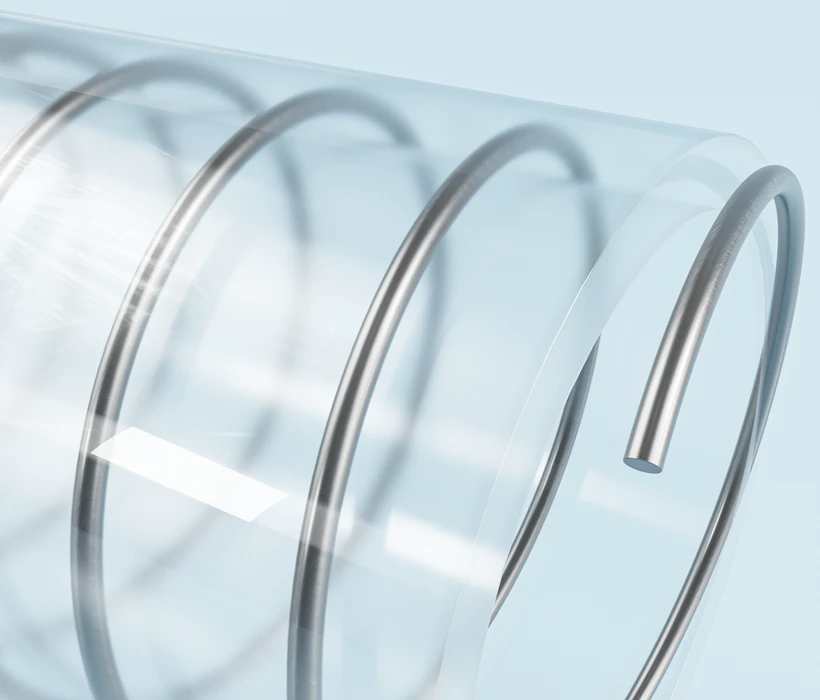
BARDUC® is the NORRES BAGGERMAN construction with spring steel embedded in a smooth wall. Where AIRDUC and PROTAPE show a visible spiral profile on the outside, BARDUC's outer wall is even — both inside and out. The result is a hose with high axial stiffness, good flexibility and a smooth interior surface that stays smooth even when the hose is bent.
Construction description
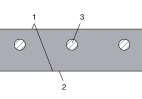
BARDUC is built from a spring steel wire cast directly into a homogeneous wall. The construction combines the steel spiral's measure of stiffness and electrical conductivity with an even, smooth surface both inside and out. The weld seam is coherent, gas- and liquid-tight, and the entire hose can be coloured — even completely — from the factory.
The smooth outer wall is what sets BARDUC apart from the other spring-steel constructions. AIRDUC and PROTAPE have a visible spiral pattern on the outside because the profile strip or film tape is welded around the steel wire in a spiral path. BARDUC does the opposite: the steel wire is cast into a wall without showing a spiral pattern on the outside. That gives a hose that can glide freely across machine surfaces without the spiral profile catching, and that is suitable where an even outer surface is needed for hygienic, aesthetic or mechanical reasons.
The benefit on the inside is subtle but practically important: because the steel wire is embedded in a homogeneous wall, there is no ribbing on the interior. The interior surface remains largely smooth even when the hose is bent — the kind of property that matters when flow or cleanliness require a consistent surface profile.
Properties
- Smooth interior and exterior surfacesBARDUC's distinction: no visible spiral profile on the outside and a consistently smooth interior surface.
- Smooth interior surface even when bentThe homogeneous wall preserves the interior surface even when the hose bends — lower pressure loss in bend zones.
- High axial stiffnessThe spring steel spiral gives the construction the same lengthwise stiffness as AIRDUC.
- Good flexibilityThe construction follows bends without sharp kinks — both because of the spring steel and the wall's elasticity.
- Lightweight compared to rubber hosesMarkedly lower weight than a comparable rubber hose — easier handling and less load on the suspension.
- Gas- and liquid-tightThe coherent weld seam and homogeneous wall provide high reliability against leakage.
- Electrically dischargeableThe spring steel spiral can be grounded — relevant for conveying potentially charging media in ATEX zones.
- Full colouring possibleBARDUC can be supplied fully coloured from the factory — useful for zone marking and branding.
Applications
BARDUC is typically chosen wherever a hose must combine flexibility and electrical conductivity with a smooth outer surface — for example in process plants where the hose must glide through tight openings, where external cleanliness is critical, in laboratory and pharma environments with hygiene requirements, and in industrial applications where a visible spiral profile would conflict with aesthetics or mechanical interaction with the surroundings.
The smooth interior surface makes BARDUC a good choice on lines where pressure loss must be consistent regardless of whether the hose is straight or bent. In ATEX areas, BARDUC is used together with antistatic material formulations and grounding via the steel spiral. Specific zone suitability requires a documented test report.
Manufacturer and distribution
BARDUC® is developed and manufactured by NORRES BAGGERMAN in Gelsenkirchen, Germany — one of the world's leading producers of technical hose systems for industrial and process applications, ISO 9001:2015 certified by TÜV Rheinland. Particulair is the distributor for NORRES BAGGERMAN in Scandinavia and provides the local advisory work, customisation and installation support that makes the construction practical in your specific process.
Related constructions and documentation
Frequently asked questions about BARDUC
What makes BARDUC unique among the spring steel constructions?
BARDUC has smooth surfaces on BOTH the inside and the outside — that is the central distinction. AIRDUC and PROTAPE have a visible spiral profile on the outside; BARDUC's outer wall is even. That gives two practical benefits: the hose can be dragged across floor or machine surfaces without the spiral profile catching, and the interior surface remains largely smooth even when the hose is bent — because the spring steel is embedded in a homogeneous wall without creating ribbing on the inside.
When should I choose BARDUC over AIRDUC?
Both are spiral-welded constructions with spring steel and high axial stiffness. Choose BARDUC when the smooth outer wall is critical — the hose must be able to glide freely across machine surfaces, be drawn through tight openings, or used where external cleanliness is a premise (laboratories, food areas, pharma). Choose AIRDUC when the extruded profile strip and reinforcement at wear points provide a mechanical advantage — typically with more abrasive media.
Can BARDUC be used in ATEX zones?
Yes. The embedded spring steel spiral can be grounded — BARDUC is electrically dischargeable in the same way as AIRDUC and PROTAPE. Specific ATEX zone approval depends on material choice and a documented test report. All approved variants are listed in the ATEX & TRGS zones documentation, which references the NORRES BAGGERMAN test report under ATEX 2014/34/EU and TRGS 727.
Why does the interior surface stay smooth when BARDUC is bent?
The spring steel is embedded in a homogeneous wall without an extruded profile strip — so the wall itself is even both inside and out. When the hose bends, the interior surface therefore largely retains its smoothness, and pressure loss under bends is lower than in constructions with a visible interior spiral. That is a benefit on lines where flow or cleanliness require a consistent interior surface profile.
Is BARDUC suited to vacuum?
Yes. The spring steel spiral provides good vacuum capacity on a par with AIRDUC. The specific vacuum limit depends on dimension, wall thickness and material choice — check the data sheet or contact us.
Where do I find the specific BARDUC models?
This construction page describes the construction principle. The actual BARDUC variants (with material and certification details, dimension tables and lead times) are listed under the product overview. If you need help finding the right match for your application, contact us.