AIRDUC® profile hoses
AIRDUC® is the profile hose construction from NORRES BAGGERMAN — a spiral-welded hose with spring steel embedded in the wall and an extruded profile strip that gives a smooth, wear-resistant interior surface. The result is a hose with high axial stiffness, good flexibility and a weight advantage that often makes it the right choice over a rubber hose.
Construction description
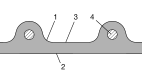
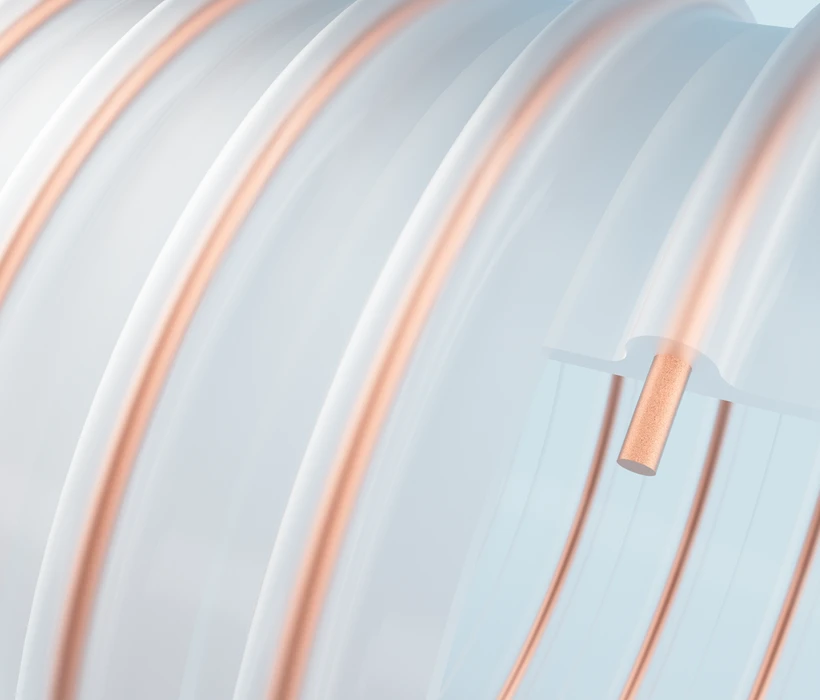
AIRDUC is built from four elements: an extruded profile strip, an embedded spring steel wire, a weld seam and an optimised cross-section. The strip is wound spirally around the steel wire and welded together into a coherent, gas- and liquid-tight seam. It is the long weld seam that gives the construction its process and operational reliability, and it is the spring steel that holds the shape under bending and negative pressure.
The profile strip is extruded with a geometry that both optimises flow and reinforces the wall at primary wear points. That gives two consequences in service: the medium runs evenly without deposition thanks to the smooth interior, and the wall lasts longer because the exposed zones are already thicker by design. The hose is light compared to an equivalent rubber hose, but it has the axial stiffness that lets it hang freely in longer suspended runs without kinking.
Properties
The four construction elements give AIRDUC a combined property profile that makes the construction a versatile basis for the conveying and extraction of air, gas and bulk material:
- Smooth interior surfaceReduces deposition and lowers pressure loss — the power requirement of the blower drops, and with it the operating cost.
- High axial stiffnessThe hose does not kink in longer suspended runs. Important on suction and blower lines over distance.
- Good flexibilityFollows a tight bend and folds evenly — without sharp kinks that block flow.
- Reinforced wall at wear pointsThe profile strip geometry has extra material exactly where wear exposure is highest.
- Gas- and liquid-tight weld seamThe long, coherent seam provides high reliability against leakage and medium loss.
- Electrically dischargeableThe spring steel spiral can be grounded — relevant when conveying wood dust, granulates and other potentially charging media in ATEX zones.
- Low weightSignificantly lighter than a rubber hose with comparable dimensions and pressure rating — easier handling and less load on the suspension.
- Customisable colourFull or partial colouring is available from the factory — useful for zone marking or branding.
Variants — TIMBERDUC® 533 and 534
TIMBERDUC® 533 and 534 are AIRDUC variants optimised for the woodworking industry. They build on the same spiral-welded profile construction and spring steel, but are tuned to the specific loads of wood dust, chips and granulate — typically with formulations that withstand the abrasion of hardwoods and retain flexibility at the lower ambient temperatures often found in wood workshops. Beyond TIMBERDUC, AIRDUC is also available in FOOD, AS (antistatic) and HT (high-temperature) variants depending on the application.
Applications
AIRDUC is typically used wherever air, gas or solid bulk material must be conveyed under moderate positive or negative pressure — suction systems, extraction, blowers and pneumatic transport. The construction principle of a spiral-welded profile strip with embedded spring steel makes it a natural choice when flexibility, axial stiffness and wear resistance must all be present at once.
In the woodworking industry, the TIMBERDUC variants handle chips, dust and granulate from sawmills, furniture production and panel processing. In the plastic and granulate industry, AIRDUC is used for pneumatic transport of raw and recycled granulate. In food and pharma production, AIRDUC FOOD with Ether-PUR and contact-with-food certifications is available. And in ATEX areas, the AS variant is used with an antistatic formulation combined with grounding via the steel spiral.
Manufacturer and distribution
AIRDUC® is developed and manufactured by NORRES BAGGERMAN in Gelsenkirchen, Germany — one of the world's leading producers of technical hose systems for industrial and process applications, ISO 9001:2015 certified by TÜV Rheinland. Particulair is the distributor for NORRES BAGGERMAN in Scandinavia and provides the local advisory work, customisation and installation support that makes the construction practical in your specific process.
Related constructions and documentation
Frequently asked questions about AIRDUC
What is the difference between AIRDUC and PROTAPE?
Both are spiral-welded hoses with spring steel, but they weld different materials. AIRDUC uses an extruded profile strip with a reinforced wall at primary wear points — that gives higher axial stiffness and better wear resistance. PROTAPE uses a thinner extruded film tape — making the hose extremely light, compressible and foldable, but with lower axial stiffness than AIRDUC. AIRDUC is typically chosen for bulk material conveying; PROTAPE for air transport where low weight matters most.
What is TIMBERDUC, and how does it differ from a standard AIRDUC?
TIMBERDUC® 533 and 534 are AIRDUC variants optimised for the woodworking industry. They build on the same spiral-welded profile construction with spring steel, but are specifically tuned to wood dust, chips and granulate — typically with formulations that withstand the abrasion of hardwoods and retain flexibility at the lower ambient temperatures often found in wood workshops.
Does AIRDUC handle abrasive media?
Yes — AIRDUC is built for it. Two construction features make the difference: the extruded profile strip has a reinforced wall at primary wear points, and the smooth interior surface reduces deposition and gives gentle material movement. AIRDUC in Pre-PUR® is particularly wear-resistant — Pre-PUR® has documented 2.5–5× higher abrasion resistance than many rubber compounds and 3–4× higher than soft PVC measured at 20°C.
Can AIRDUC be used in ATEX zones?
AIRDUC can be grounded via the embedded spring steel spiral and is therefore electrically dischargeable. Specific ATEX zone approval depends on material choice and a documented test report — all approved variants are listed in the ATEX & TRGS zones documentation, which references the NORRES BAGGERMAN test report under ATEX 2014/34/EU and TRGS 727.
Why is the interior surface so smooth?
The profile strip is extruded to a geometry that produces a high interior smoothness when spiral-welded. Two benefits follow: deposition of the conveyed medium is reduced (important with sticky or fine particles), and pressure loss drops, which lowers the power requirement of the blower — and with it the operating cost. The smooth surface is part of the optimised cross-section of the construction.
Where do I find the specific AIRDUC models?
This construction page describes the construction principle. The actual AIRDUC variants (with material and certification details, dimension tables and lead times) are listed under the product overview. If you need help finding the right match for your application, contact us.