Hose constructions
NORRES BAGGERMAN builds its hose programme around six fundamental constructions. The construction — not the material alone — decides whether the hose can withstand vacuum, how tightly it bends, how well it resists wear, and whether it can be grounded against electrostatic discharge. Here they are walked through one by one.
Why the construction matters
The material determines which chemicals the hose tolerates and at what temperatures. But once that is settled, four to five critical properties remain that the material does not control alone: vacuum capacity, axial stiffness, bend radius, abrasion resistance and folding pattern. They are the territory of the construction.
Two hoses moulded from the same polyurethane can behave very differently: an AIRDUC® profile hose folds neatly in a tight bend and holds its shape under negative pressure, while an axially extruded NORFLEX® without reinforcement may collapse under the same vacuum — not because the material is wrong, but because the construction is not built for it. That is the kind of trade-off the six constructions handle.
Key terms
- Axial stiffness
- How well the hose holds its shape lengthwise. High axial stiffness keeps the hose from kinking in long suspended runs — important on suction and blower lines that carry the medium over distance.
- Vacuum capacity
- The hose's ability to keep its cross-section under negative pressure. A hose without an embedded spiral collapses under even moderate vacuum — one with a stiff spiral holds its shape.
- Abrasion resistance
- How well the wall resists wear — both from the medium running on the inside (granulate, chips, particles) and from external contact (the hose dragging across floor or chain).
- Folding pattern
- How the hose follows a tight bend. Spiral-welded constructions fold evenly and preserve the inner conveying surface, while unreinforced hoses can kink sharply and block flow.
- Pre-PUR®
- NORRES BAGGERMAN's own blend of ester- and ether-polyurethane. It is a block copolymer where hard segments deliver mechanical stability and soft segments provide flexibility and dynamic load capacity. Abrasion resistance is 2.5–5× higher than many rubber compounds and 3–4× higher than soft PVC measured at 20°C. The ether variant is hydrolysis-resistant and used in moisture and food applications; the ester variant is the classic formulation.
The seven constructions
Six basic constructions plus PROTAPE® MEMORY treated as its own sub-construction — click through to read each in depth.
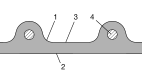
AIRDUC® profile hoses
Spiral-welded profile strip with spring steel
Smooth interior surface, high axial stiffness, good flexibility and lightweight compared to an equivalent rubber hose. Reinforced wall at primary wear points. Includes the TIMBERDUC® 533-534 variant for woodworking.
Read more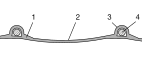
PROTAPE® film hoses
Spiral-welded film tape with spring steel
Extremely light, compressible and flexible. Thinner wall than AIRDUC, optimised for air transport where weight matters. Includes the TIMBERDUC® 531-532 variant.
Read more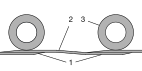
PROTAPE® MEMORY
PROTAPE with outer reinforcement and folding geometry
A special film construction with outer reinforcement that gives semi-crush-resistant or crush-resistant properties. High vacuum performance through the outer folding geometry, plus external abrasion protection.
Read more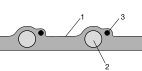
NORPLAST® full plastic hoses
Hard plastic spiral in spiral-welded wall
Smooth interior surface, lighter than steel-wire-reinforced hoses, but typically less flexible. Available with and without an inner liner, and can be supplied with a stranded earthing wire.
Read more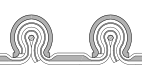
Clamp profile hoses (CP)
Fabric or film clamped in a clamping profile
Single-, double- or multi-layered strip materials combined in a clamping profile with an embedded wire to prevent slippage. Flexible, compressible, with high external abrasion resistance. Available in chemical- and heat-resistant variants.
Read more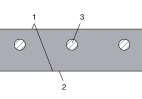
BARDUC® hoses
Spring steel cast in a smooth wall
Smooth interior and exterior surfaces, high axial stiffness, good flexibility and lightweight compared to rubber. The interior surface remains largely smooth even when the hose is bent.
Read more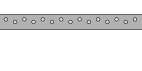
NORFLEX® hoses
Axially extruded, optionally with fabric reinforcement
Axially extruded without weld seams. Smooth interior and exterior surfaces, uniform wall thickness, gas- and liquid-tight. Available without or with fabric reinforcement for higher pressure capacity.
Read moreComparison of the seven constructions
A quick overview of core properties. Use the table as a pointer — the final decision requires a match between construction, material and your specific application.
| Construction | Spiral reinforcement | Flexibility | Axial stiffness | Vacuum capacity | Electrical discharge |
|---|---|---|---|---|---|
| AIRDUC® | Spring steel | Good | High | Good | Via steel spiral |
| PROTAPE® | Spring steel | Extremely high | Lower than AIRDUC | Lower than AIRDUC | Via steel spiral |
| PROTAPE® MEMORY | Spring steel + outer reinforcement | High | High | High (special folding geometry) | Via steel spiral |
| NORPLAST® | Hard plastic spiral | Lower than steel-reinforced | Medium | Good | Limited (with stranded earthing wire) |
| CP clamp profile | Embedded wire in clamping profile | Good | Medium-high | High (esp. multi-layer) | Depends on material |
| BARDUC® | Spring steel | Good | High | Good | Via steel spiral |
| NORFLEX® | None / optional fabric | Medium | Medium-high (with fabric) | Low without / high with fabric | Depends on material |
The property ratings are qualitative and based on the construction principle alone — the specific material and dimension choice affects actual performance. Check the technical data sheets for exact figures.
The manufacturer — NORRES BAGGERMAN
The seven constructions are developed and manufactured by NORRES BAGGERMAN in Gelsenkirchen, Germany — one of the world's leading producers of technical hose systems for industrial and process applications, with over 135 years of experience and ISO 9001:2015 certified by TÜV Rheinland. Particulair is the distributor for NORRES BAGGERMAN in Scandinavia and provides the local advisory work, customisation and installation support that turns the technology into practical use.
Cross-references
Construction understanding does not stand alone. It connects with material choice, ATEX zone classification and field installation:
Frequently asked questions about hose constructions
What is the difference between a spiral-welded and an axially extruded hose?
A spiral-welded hose — like AIRDUC, PROTAPE or NORPLAST — is built by winding a strip or profile of material spirally and welding it together. It has a visible spiral path in the wall and can typically be bent very tightly. An axially extruded hose — like NORFLEX — is pressed out in one length without a weld seam. That gives a perfectly even wall thickness and a smooth surface, but the hose is typically stiffer and bends less flexibly.
Why do some hoses use spring steel and others a hard plastic spiral?
Spring steel — used in AIRDUC, PROTAPE and BARDUC — retains its strength at high temperatures and can be grounded for electrical discharge. A hard plastic spiral — used in NORPLAST — is lighter and more chemically inert, but softens at high temperatures and cannot in itself be grounded. The choice depends on operating temperature, weight requirements, and whether the hose is to be used in ATEX zones.
Which construction should I choose for vacuum and suction applications?
Constructions with a stiff embedded spiral — AIRDUC, NORPLAST or PROTAPE MEMORY in the crush-resistant variant — are best for vacuum and suction because the spiral prevents the hose from collapsing under negative pressure. PROTAPE MEMORY also has a special outer folding geometry that delivers high vacuum performance. NORFLEX without fabric reinforcement is not suited to strong vacuum, but NORFLEX with fabric reinforcement increases pressure resistance.
What does Pre-PUR® mean, and why does it matter for the construction?
Pre-PUR® is NORRES BAGGERMAN's own blend of ester- and ether-polyurethane. It is a block copolymer where hard segments deliver mechanical stability and soft segments provide flexibility and dynamic load capacity. It is the internal segment structure that lifts the material's performance above a generic PUR — according to NORRES Baggerman, abrasion resistance is 2.5–5 times higher than many rubber compounds and 3–4 times higher than soft PVC measured at 20°C. The principle is worth noting: two hoses both labelled simply "PUR" can perform very differently because the specific formulation is not the same. Pre-PUR® is a documented formulation — not generic PUR.
Can the hoses be customised with colour, dimension or special reinforcement?
Yes. NORRES BAGGERMAN can adjust virtually every parameter — wall thickness, inner liner, colour (full or partial), dimension, reinforcement at primary wear points, and special antistatic or ATEX-suitable variants. Particulair coordinates the customisation between you and the factory. Read more about custom hoses.
What is the difference between AIRDUC and PROTAPE — they look similar?
Both are spiral-welded hoses with spring steel. The difference lies in what is welded: AIRDUC uses an extruded profile strip with a reinforced wall at primary wear points, while PROTAPE uses a thinner extruded film tape. The consequence is that AIRDUC has higher axial stiffness and is more robust under wear. PROTAPE is extremely light, compressible and foldable — best for air transport where low weight and flexibility matter most.
Are all constructions electrically dischargeable?
Constructions with spring steel — AIRDUC, PROTAPE and BARDUC — can be grounded via the steel spiral and are therefore electrically dischargeable. NORPLAST can be supplied with a stranded earthing wire, providing limited discharge capability. Axially extruded NORFLEX hoses have no built-in metal conductor but can be supplied in antistatic material variants. ATEX zone suitability requires a documented test report — that is found under ATEX & TRGS zones.