Clamp profile hoses (CP)
The CP construction (CP = "clamp profile") solves a different problem than the spiral-welded hoses: instead of welding a strip and a spiral together, one or more layers of strip material are clamped tightly in a clamping profile with an embedded wire. The result is a construction with high external abrasion resistance, high vacuum capacity, and the option to combine layers with different properties.
Construction description
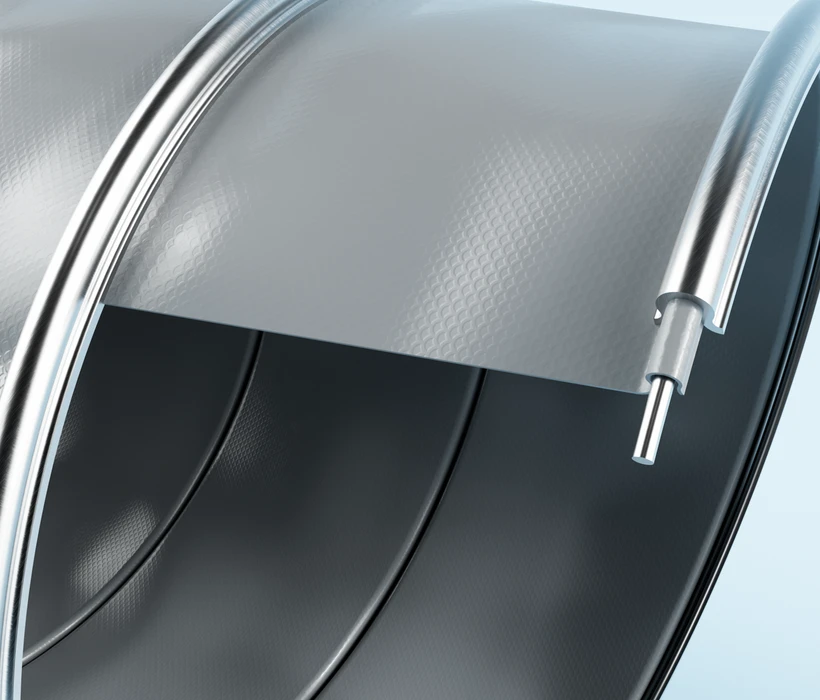
The CP construction combines single-, double- or multi-layered strip materials in a clamping profile. An embedded wire holds the strip firmly in the clamping profile and prevents it from slipping out under pressure or dynamic load. The clamping profile itself has a special drop-shaped geometry with a round inner edge and rounded ends — that geometry is what makes the construction distinctive.
The drop-shaped clamping profile gives a high geometric moment of inertia, translating into high compression strength and high vacuum load capacity. The round inner edge distributes the clamping force evenly around the strip material and avoids point stress peaks that would weaken the seal. The rounded ends act as a protective baffle around the strip material and give the construction high dynamic load and high overpressure capacity. The result is a hose that withstands both positive and negative pressure without losing its shape — while supporting a high-performance strip material that does not slip or deform.

Variants
Single-layer CP
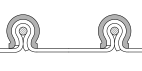
The simplest CP construction: one strip material clamped in the profile. Suited when a single core property is critical — for example chemical resistance, thermal resistance or high flexibility. The drop-shaped clamping profile gives the construction its high vacuum capacity and compression strength independently of the number of layers.
Single-layer
Multi-layer
HYP / ARAMID PROTECT
Multi-layer CP
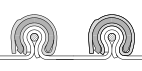
The multi-layer construction combines multiple strip materials in the same hose. It allows you to choose properties layer by layer: an outer layer for external abrasion resistance, an inner layer for chemical resistance, an intermediate layer for thermal or acoustic insulation. The multi-layer variant typically gives better internal impermeability than single-layer, and is the preferred construction when several properties must be achieved in the same hose.
CP HYP 450 PROTECT and CP ARAMID 461 PROTECT
The PROTECT variants add an outer protective profile in elastic material — an extra geometry on top of the clamping profile itself. The protective profile provides impact resistance and elevated abrasion resistance when the hose is dragged across floor, chain or machine surfaces. The specially developed protected geometry secures firm clamping against slippage, and a beading at the end of the profile provides additional resistance to slippage.
CP HYP 450 PROTECT uses HYP (hypalon/CSM) as the strip material — chemically and UV resistant. CP ARAMID 461 PROTECT uses aramid fibre — high thermal and mechanical stability. The protective profile can be supplied in any colour.
Properties
- High external abrasion resistanceThe clamping profile sits outermost and takes the wear first — the strip material itself is protected.
- High compression strengthThe drop-shaped clamping profile provides a high geometric moment of inertia.
- High vacuum load capacityThe same drop-shaped geometry provides good vacuum capacity — particularly in the multi-layer variant.
- Even clamping force distributionThe round inner edge of the clamping profile ensures no spot gets a point stress peak.
- High dynamic loadThe rounded clamping profile ends protect the strip material and provide high resistance to repeated loads.
- Selective adjustment of propertiesThe multi-layer variant lets each layer be dedicated to a specific property — chemical, thermal, acoustic.
- Improved impermeability (multi-layer)Multiple layers increase sealing security — important when the medium must be contained without leakage.
- Thermal and acoustic insulation (multi-layer)The layered structure can be used to dampen heat and sound transmission through the wall.
Applications
The CP construction is typically chosen wherever a hose must withstand high external wear, handle large positive and negative pressure swings, or combine multiple material properties in one hose. Concrete application areas include high-temperature extraction, chemical transport where a particularly resistant liner must be combined with a mechanically robust outer construction, and demanding industrial applications where the hose is dragged across the floor or chain during operation.
The HYP and ARAMID PROTECT variants are reserved for situations where wear and chemicals or heat are simultaneous challenges — for example chemical loading, high-temperature exhaust and processes where impact loading is expected.
Manufacturer and distribution
Clamp profile hoses (CP) are developed and manufactured by NORRES BAGGERMAN in Gelsenkirchen, Germany — one of the world's leading producers of technical hose systems for industrial and process applications, ISO 9001:2015 certified by TÜV Rheinland. Particulair is the distributor for NORRES BAGGERMAN in Scandinavia and provides the local advisory work, customisation and installation support that makes the construction practical in your specific process.
Related constructions and documentation
Frequently asked questions about CP clamp profile hoses
What is the difference between single-layer and multi-layer CP?
Single-layer CP uses one strip material clamped in the clamping profile — it is the simplest and most flexible variant. Multi-layer CP combines several layers with different properties: one layer can be chosen for chemical resistance, another for thermal insulation, a third for sound dampening. The multi-layer variant gives better impermeability and selective adjustment of properties, but the hose becomes thicker and more expensive. Choose single-layer when one property is critical; choose multi-layer when several properties must be combined in the same hose.
Why does the CP hose have a drop-shaped clamping profile?
The drop-shaped clamping profile gives a high geometric moment of inertia, which translates into high compression strength and high vacuum load capacity. The round inner part of the clamping profile distributes the clamping force evenly around the strip material — without point stress peaks that would otherwise weaken the seal. The rounded ends act as a protective baffle around the strip material and provide high dynamic load and high overpressure capacity. It is the specific geometry that lifts the CP construction above an ordinary spiral hose.
What are CP HYP 450 PROTECT and CP ARAMID 461 PROTECT?
The PROTECT variants are CP hoses with an external protective profile in elastic material that adds further impact and abrasion resistance. The geometry is specially developed to ensure firm clamping against slippage, and an additional beading at the profile end provides further resistance to slippage. CP HYP 450 PROTECT uses HYP (hypalon/CSM) as the strip material — chemically and UV resistant. CP ARAMID 461 PROTECT uses aramid fibre — high thermal and mechanical stability. The PROTECT profile is available in any colour.
What kind of wire is used to prevent slippage?
The CP construction has a wire embedded in the clamping profile to prevent the strip material from slipping out under load or movement. The wire material is chosen according to construction variant and application. Functionally, it is critical for the hose to withstand dynamic load and higher pressure without losing geometric integrity.
When should I choose CP over AIRDUC or NORPLAST?
CP is the right choice when the hose must withstand particularly high external abrasion (wear against floor, chains, machine parts), combine chemical or thermal resistance with flexibility, or be supplied in a multi-layer construction where properties must be tuned layer by layer. AIRDUC and NORPLAST are simpler constructions with fewer customisation options — choose them when a standard spiral-welded profile hose is sufficient. Choose CP when the requirement is composite and the hose is exposed to hard external load.
Where do I find the specific CP models?
This construction page describes the construction principle. The actual CP variants (with material and certification details, dimension tables and lead times) are listed under the product overview. If you need help finding the right match for your application, contact us.