OLI VBS · bin aerators

Bin aerators for silos, hoppers and pipes

A disc in the silo wall that directs compressed air towards the outlet instead of up into the material.

Dry, fine powders consolidate in the cone and stop flowing. A VBS is a small disc-shaped aerator with a silicone membrane, mounted in the wall, that fluidises the material exactly where it is stuck. The range covers nine variants from Ø55 to Ø104 mm, in food-grade, high-temperature and metal-detectable versions.

VBS9 variants0.8–6 bar−40 to 235 °CFDA 177.2600
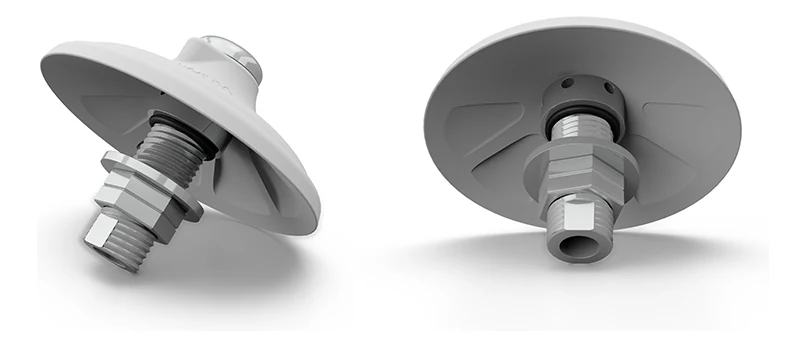
Two VBS bin aerators with a white disc-shaped head and a threaded stem.
The problem

Two faults, one cause

A bridge and a rathole look different, but they share a cause: the particles have been allowed to consolidate, and the material now carries its own weight. Pressurised air breaks that cohesion, and the material starts to flow again.

Bridge over the outlet

Bridge over the outlet

The material forms an arch across the opening and carries its own weight. The silo is full, but nothing comes out. The technical term is bridging.

Rathole through the middle

Rathole through the middle

A narrow channel runs down through the centre while the rest stands still along the wall. Only a fraction of the capacity comes out, and the remainder ages in the silo.

Loadout too slow

Loadout too slow

The material does come out, but more slowly than the plant needs. This is what the VBS is built for: the air flow is aimed at the outlet instead of spreading in all directions.

Walkthrough

Four steps through the product

Click through: from the powder that will not move to the number of units and where they go on your own cone.

01 The problem

The same silo with and without an aeratorSection through a silo, split by a vertical line. To the left of the line the material has formed a bridge across the cone, and below the bridge the space is empty: nothing comes out. To the right, six aerators sit in the cone, arrows show the air aimed down at the outlet, and the material falls freely out through the spout. The line can be dragged from side to side.Without aeratorWith aerators

Without air the material carries its own weight: the bridge stands and the silo does not empty. With air the powder loses its internal cohesion and behaves once more like something that can flow. It is the same silo on both sides of the line.

02 The technology

The aerator seen in the silo wallA section through part of a sloping silo wall. The silicone membrane sits inside the material as a bell-shaped disc, 104 mm across and 39 mm deep, with a small cap at the centre and a thickened rim resting against the inner face of the wall. The Venturi cavity lies beneath the membrane. The stem passes out through the wall to a washer, a nut and the compressed-air fitting. Three arrows show the air running down along the wall towards the outlet, while a single faint arrow points the other way. A cloud of small dots shows the zone where the air loosens the material. Top right, a small inset: the disc seen from below, with eight leaf-shaped pockets between the ribs.The material in the siloThe silo wallThe Venturi cavityCompressed air in from outsideHere the air meets the materialTowards the outletThe disc seen from below

The disc has a Venturi-shaped cavity on its underside. That gives the air a preferred direction, down towards the outlet, instead of spreading it evenly in all directions. The outer face is smooth, so material does not settle on the disc.

  • White silicone · −40 to 170 °C
    VBS · VBSI · VBSM · VBSMI · VBSME
  • Red silicone · −40 to 235 °C
    VBSIHT · VBSMIHT
  • Blue silicone · −40 to 170 °C
    VBSIMD · VBSMIMD

03 The installation

The pneumatic circuitSilo with aerators in the cone. On the left the compressed air supply, a filter with flow control valve and the controller. A wire runs from the controller to one solenoid valve per ring, and a ring line runs from each valve to the aerators. A rotary valve sits below the outlet, and the material falls out beneath it. Five numbered points mark the parts.12345

An aerator is never alone. From the compressed air supply the air passes through a filter and a flow control valve to one solenoid valve per ring, and the controller opens the rings in sequence from the bottom up, so the material always has a free outlet to fall towards.

  1. Compressed air supply The VBS runs on non-lubricated compressed air of class 5.4.1, or on dry inert gases. The recommended working pressure is 4 bar. The full range is 0.8 to 6 bar, and 0.8 to 2 bar for the Micro versions.
  2. Filter and flow valve The circuit requires a filter and a flow control valve. This is where the air volume per aerator is set, before the air is distributed to the rings on the cone.
  3. Control and solenoid valves One solenoid valve per ring, and a controller that opens them in sequence from the bottom up. That way the material always has a free outlet to fall towards. An electronic control board is available for the sequence, activating up to fifteen units, with a timer and multi-voltage coils from 24 V DC and AC up to 230 V, also in an ATEX version. The controller can run on a timer or be started by a signal from the rotary valve, so the aerators only work during loadout. We set the number of valves and the pulse time together with you, once the plant is known.
  4. The aerators in the cone The discs sit in the lower part of the cone, where the material is most consolidated. The disc is Ø104 mm in the standard version and Ø55 mm in the Micro version, with a 1/2 inch and 1/4 inch BSPP connection respectively.
  5. Outlet and rotary valve Because the air flow is directed towards the outlet rather than up into the material, the aerators work where the material needs to leave. The rotary valve meters it on into the plant.

04 The placement

Position of the aerators in the coneSection through the silo with rings of aerators on the cone. Each ring is labelled with its diameter and the number of aerators.Ø2980 · 6 stkØ2120 · 4 stkØ1260 · 4 stkØ863 · 2 stkØ406Ø4400 · 80 tSection · schematicDistribution of the aerators seen from abovePlan view of the silo bottom with concentric rings. The rings carry six, four, four and two aerators, counted from the outside in, and each ring is rotated half a step relative to the one below. The outlet is in the centre.30°Plan view · to scale

4 rings · 16 aerators in total

The aerators sit in concentric rings around the cone, offset by half a step from ring to ring. Drag the slider to see how the rings build up from the bottom, and what that means for the count.

The drawing is an example, not a sizing rule. We work out the number and the placement for your silo together with you, from the cone angle, the material and the pressure you have available.

The technology

Tramontana®: air in one direction

An ordinary fluidising nozzle blows air evenly in every direction. That loosens the material, but a large share of the air goes upward, where it is not needed.

The Tramontana® disc is shaped differently. Its underside is a Venturi cavity, which gives the air a preferred direction, down towards the outlet. The material is loosened where it needs to leave, not up in the silo. The outer face of the disc is smooth, so no layer builds up on it.

The aerator runs on ordinary non-lubricated compressed air. The circuit needs a filter and a flow control valve, and the recommended working pressure is 4 bar. The full range is 0.8 to 6 bar, and 0.8 to 2 bar for the Micro versions.

Data

Technical specifications

ApplicationSilos, hoppers and pipes. Also dry bulk tank trailers and dry bulk rail tankers
Material in the vesselDry, fine, granular powder
Problem solvingBridge and rat-holing
Duty cycleContinuous or discontinuous
Working pressure0.8 to 6 bar (12 to 87 psi). Recommended 4 bar (58 psi)
Working pressure, Micro0.8 to 2 bar (12 to 29 psi)
Pneumatic circuitFilter and flow control valve
Air supply qualityNon-lubricated compressed air, class 5.4.1, or dry inert gases
TechnologyVibro-aerator
MembraneSilicone, food grade, FDA 177.2600. Red membrane for high temperature, blue membrane metal detectable
StemAluminium or AISI 316 stainless steel, food and pharmaceutical grade
VBSE, external versionPolyamide body with steel ring and Supralen filter
OptionsExternal mounting kit, rectangular or circular, stainless steel. Electronic control board for up to fifteen units, with a timer and coils from 24 V to 230 V, also in an ATEX version
Models

All nine variants

Air consumption is given in Nl/min, normal litres per minute at the stated pressure. The dashes at 4 and 6 bar for the Micro versions are not missing data: the Micro works at a maximum of 2 bar. Dimension A is the disc diameter, B the overall length.

Air consumption in Nl/min
ModelMembraneStem0.8 bar2 bar4 bar6 barTemperatureABConnection
VBSWhiteAluminium6008009501150-40 to 170 °CØ104 mm79 mm1/2" BSPP
VBSIWhiteStainless steel6008009501150-40 to 170 °CØ104 mm79 mm1/2" BSPP
VBSIHTRedStainless steel6008009501150-40 to 235 °CØ104 mm79 mm1/2" BSPP
VBSIMDBlueStainless steel6008009501150-40 to 170 °CØ104 mm79 mm1/2" BSPP
VBSMWhiteAluminium150200-40 to 170 °CØ55 mm54 mm1/4" BSPP
VBSMIWhiteStainless steel150200-40 to 170 °CØ55 mm54 mm1/4" BSPP
VBSMIHTRedStainless steel150200-40 to 235 °CØ55 mm54 mm1/4" BSPP
VBSMIMDBlueStainless steel150200-40 to 170 °CØ55 mm54 mm1/4" BSPP
VBSMEWhiteNylon130150-40 to 80 °CØ66 mm62 mm3/8" BSPP

How to read the model name: VBS is the OLI aerator, VBSM the Micro version, I means a stainless steel stem, HT high temperature, MD metal detectable and E external mounting.

The membrane

White, red or blue — and when to choose which

The colour is not cosmetic. It tells you which silicone the membrane is made from, and therefore what the aerator can take and what it may touch.

White silicone

−40 to 170 °C

The standard version. Food-grade silicone to FDA 177.2600. This is the one most plants need.

VBS · VBSI · VBSM · VBSMI · VBSME

Red silicone

−40 to 235 °C

The high-temperature version, 65 degrees above the rest. Chosen where the material or the silo is hot, typically downstream of a dryer or a kiln.

VBSIHT · VBSMIHT

Blue silicone

−40 to 170 °C

Metal detectable. If a piece of the membrane comes loose, the metal detector in the line will catch it. A requirement in many food and pharmaceutical plants.

VBSIMD · VBSMIMD

The VBSME is the only one with a nylon body and is therefore limited to 80 °C. The other eight have an aluminium or AISI 316 stainless steel stem.

Mounting

How a disc gets inside a closed silo

The aerator is normally fitted from the inside: you enter the vessel, push the stem out through a hole in the wall and tighten the nut from outside. But many silos cannot be entered, and then the disc has to go in through the wall from outside. That is what the two mounting kits solve, each in its own way.

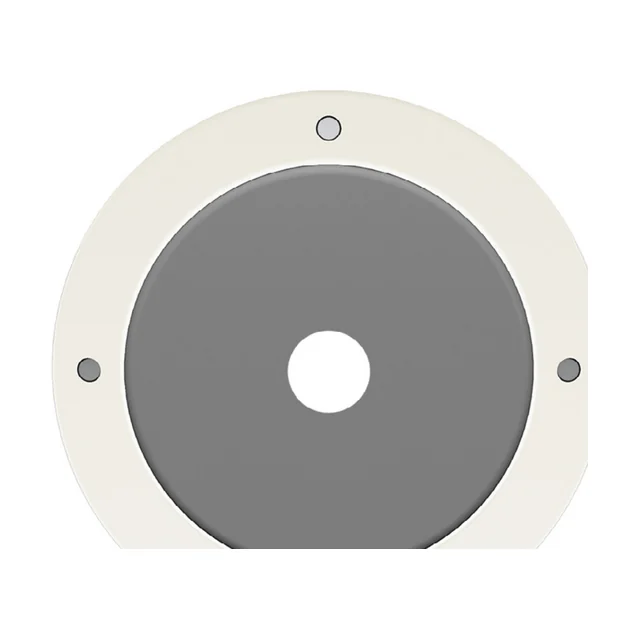
Circular mounting kit: a white round flange with three bolt holes and a grey gasket with a hole in the middle.

Circular mounting kit CPKIT

For round silos and hoppers. Here the hole in the wall is larger than the disc, so the aerator passes straight through.

Hole in the wallØ 110 mm
The discØ 104 mm — passes straight through
MaterialAISI 304 stainless steel plate with an S235JR steel flange, NBR gasket
Working temperature−40 to +80 °C
  1. A round hole of Ø 110 mm is cut in the silo wall.
  2. The aerator is pushed through the hole from outside so that the disc ends up inside the silo and the stem points outwards.
  3. The flange with its gasket is placed over the hole and fixed with the three bolts. The gasket seals against the wall.
  4. The nut is tightened on the stem from outside and the air line is connected. All the work is done outside the silo.
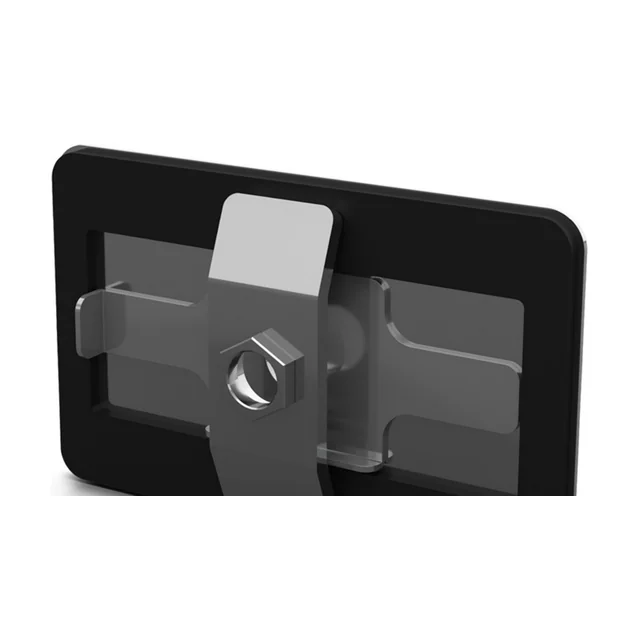
Rectangular mounting kit: a black oblong plate with a bracket across it and a nut in the middle.

Rectangular mounting kit RPKIT

For rectangular silos and hoppers. Here the hole is a narrow, long slot, and the disc is turned into place behind the wall.

Hole in the wall67 × 162.5 mm
The discØ 104 mm — enters edgewise through the slot
MaterialAISI 304 stainless steel plate, EPDM gasket
Working temperature−20 to +95 °C
  1. A slot of 67 × 162.5 mm is cut in the wall, oriented along the slope of the cone.
  2. The slot is longer than the diameter of the disc. The aerator is therefore fed in edgewise through the slot, with the disc at an angle.
  3. Behind the wall the disc is turned a quarter turn so that it lies flat against the wall and covers the whole slot from inside.
  4. The cover plate with its EPDM gasket goes on the outside and is tightened with the nut. The plate closes the slot, and the stem is ready for the air line.

The aerator is not included in the mounting kit. The VBSME is a ready-made Micro version for external mounting with its own nylon body.

Application

Where it sits and what it works in

VesselsSilos, hoppers and pipes
TransportDry bulk tank trailers and dry bulk rail tankers
MaterialsCement, lime, pigments, plastics, starch, flour, sugar and coffee
SuitabilityCompatible with foods and chemicals. Available in two sizes, Micro and standard, and with external mounting

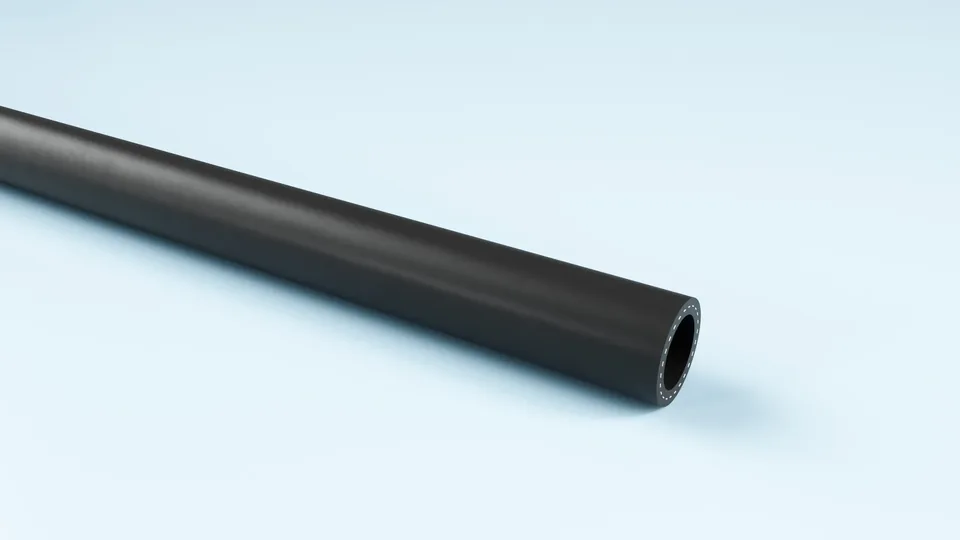
Black TPE air hose, coiled.

FlexCore

ARIAFORM/15

TPE air hose for industry and workshop. Handles water, air and oil-laden compressed air, and is light enough to move around.

Material
TPE
Inner diameter
16–25 mm
Working pressure
15 bar
Temperature
-30 to +80 °C

See the full product page on FlexCore →

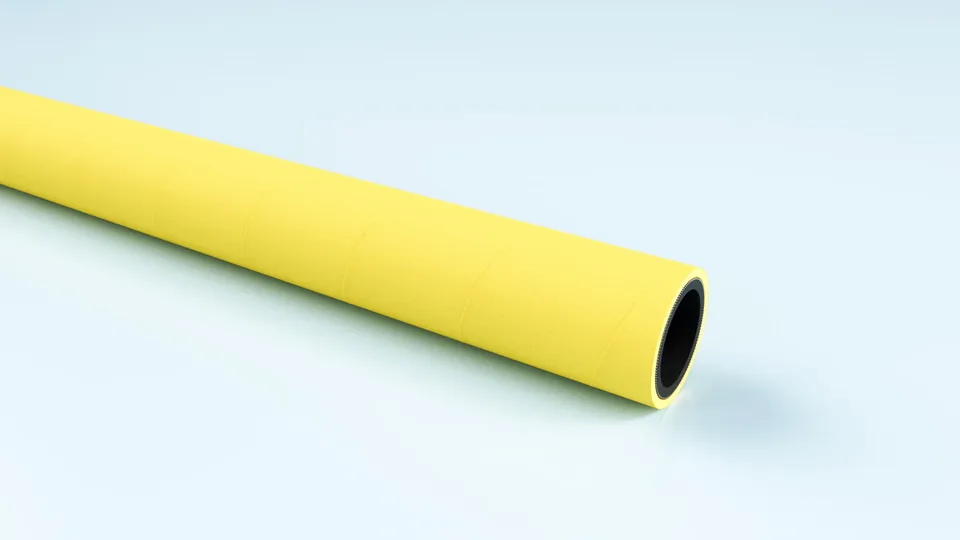
Yellow EPDM compressed air hose, coiled.

FlexCore

ARIACORD/YELLOW

Rugged EPDM hose for compressed air and water, 25 bar. Weather and UV resistant, so it can live outdoors beside the silo.

Material
EPDM
Inner diameter
32–76 mm
Working pressure
25 bar
Temperature
-30 to +80 °C

See the full product page on FlexCore →

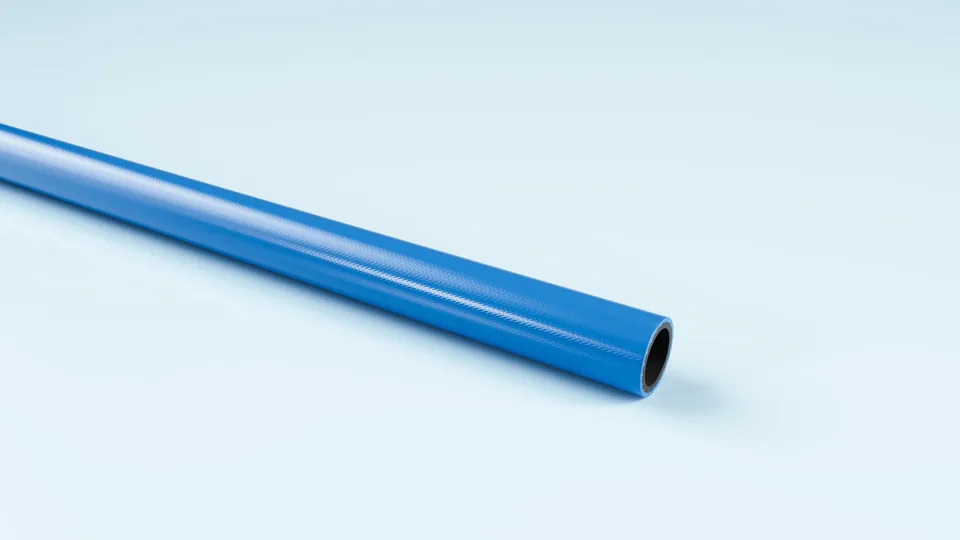
Blue polyurethane hose, coiled.

FlexCore

ARIAFORM/TPU

Light polyurethane hose for tools and reel systems. The softest of the three, where the hose has to follow the work.

Material
TPU
Inner diameter
6–13 mm
Working pressure
20 bar
Temperature
-30 to +80 °C

See the full product page on FlexCore →

Portrait of a technical adviser at Particulair.

Technical advice

Shall we work it out?

Tell us what is in the silo, how large the cone is and what your compressed air can deliver. We come back with a number, a placement and a price — not with a catalogue.

Contact us Try the product selector