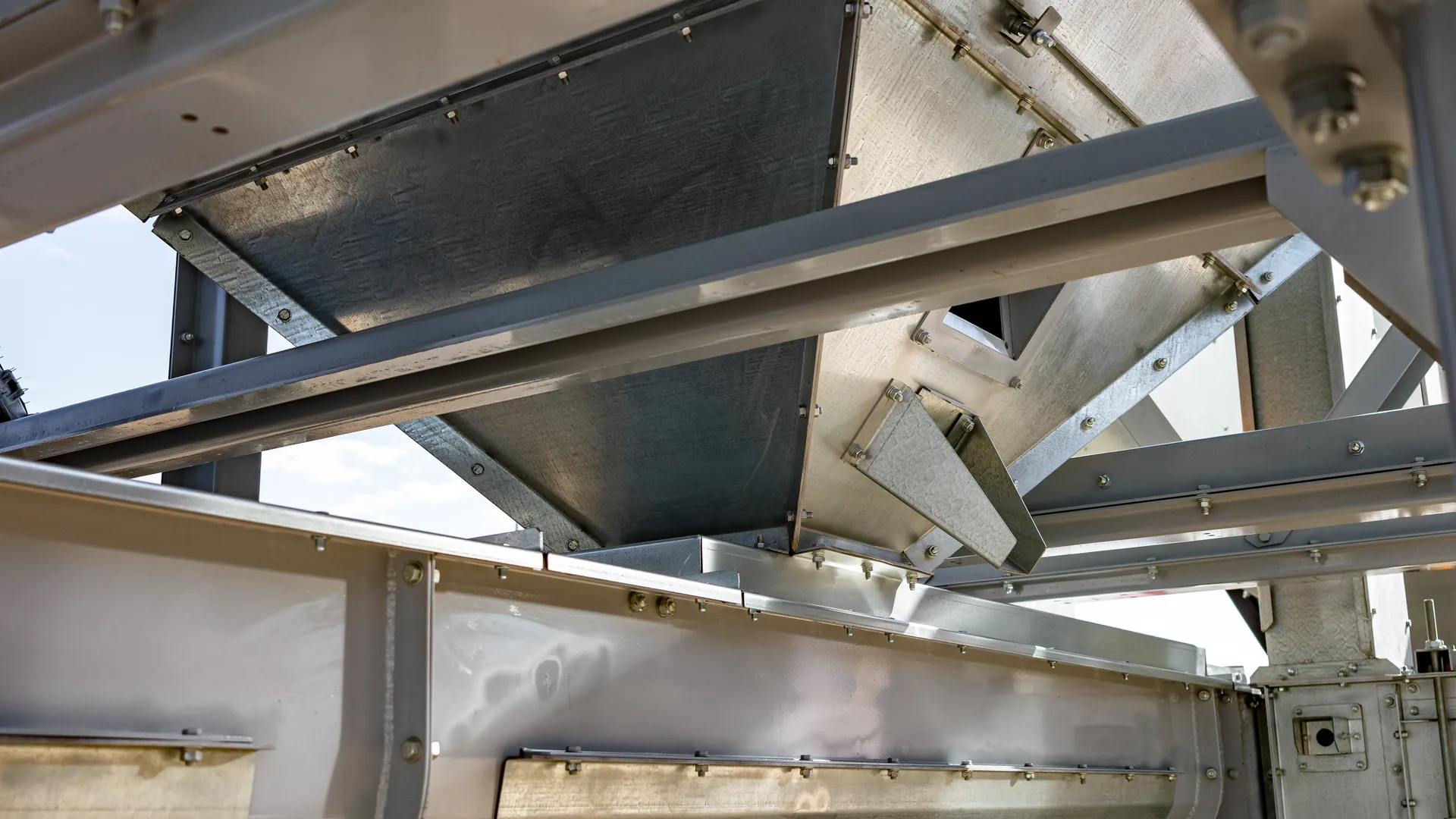
The conveyor is running, the motor is humming and the valve is open. But nothing is coming out.
Everyone who works with powder knows this situation. It has a name. In fact it has three, and they are not alike.
The three conditions do not have the same cause, and they are not solved in the same way. The most common reason a fix does not hold is that one of the problems has been treated as though it were one of the others.
To get all the way there, you need to know three things: what the material does, what kind of stoppage you have, and when the equipment should run. Get those right from the start, and the solution will hold for years.
1. The problem has a name, and there are three of them
The arch
The first problem we call an arch. Think of a sandcastle. You cannot build with dry sand, it runs out between your fingers. With damp sand you can build towers, because the grains cling to one another.
The same thing happens in a silo. When the particles cling to one another, they can carry each other's weight. They then form a vault across the outlet, just like the stones in an old bridge arch. The material above presses down, but the vault holds, and nothing comes out even though the silo is full.
That is what we call an arch. In technical language, the ability of the particles to cling to one another is called cohesion, which is really just a word for stickiness.
There are two kinds of arch, and understanding them takes a separate explanation for each.
The cohesive arch
This arch forms when the particles bond, or stick, to one another. In damp material it is the water that does the work, exactly as in the sandcastle. But why does a drop of water actually act like glue?
You have seen it in a café. You lift your beer glass, and the beer mat comes up with it. There is no glue on it. There is a thin film of water, and that is enough.
Two things are going on, and they pull in the same direction.
The first is that water behaves as though it has a skin. You can see that skin when you fill a glass right to the brim and the water bulges above the rim without spilling over. You can see it when a pond skater walks dry-shod across a lake. And you can see it on a freshly waxed car, where the rain gathers into round beads. The skin will always make itself as small as it can, and the smallest shape there is, is a sphere. That is why the drop is round.
Now, if there is water sitting between two grains of sand, the skin spans the gap. If you want to pull the two grains apart, you have to stretch the skin and make it bigger. It resists that. So it holds the grains together.
The second thing is suction. The water between two grains is shaped like an hourglass, thinnest in the middle. When the skin curves inwards like that, it squeezes in on the water, like an elastic band stretched around a waist. That squeeze means the pressure inside the water becomes a shade lower than the air pressure around it. And when the pressure inside is lower than outside, the air presses the two grains together. It is the same mechanism as in a suction cup, just without anyone having pressed it into place.
Together, these are the two forces that hold the beer mat under the glass, and the same two that let damp sand carry a tower. In a silo they carry an arch across your outlet.
Note how little it takes. There does not have to be much water. It just has to sit at the contact points between the grains. That is why a few per cent of extra moisture can change the whole picture in a silo. [27]
In completely dry material something more surprising happens. Even bone-dry particles attract one another.
You know the principle from a balloon you have rubbed against your hair. It stays stuck to the wall because the rubbing has created an imbalance in the electrical charges. The force we are talking about here rests on something similar, but it needs no rubbing. It arises entirely on its own, all the time, between everything.
To understand why, you need two words. Everything is built from atoms, which are the smallest building blocks matter can be divided into. And every atom has a heavy nucleus with a positive electrical charge, surrounded by a swarm of light electrons with a negative charge.
Normally the swarm is evenly distributed, and from the outside the particle looks electrically neutral. But the electrons do not stand still. They are in constant motion, and at any given instant there are slightly more of them on one side than on the other. At that very instant, then, the particle has a weakly negative side and a weakly positive side. It has become a tiny version of the balloon.
And that is enough. The imbalance nudges the electrons in the neighbouring particle, so that it goes lopsided the other way, and opposite charges attract one another.
The imbalance lasts only a split second. But in that same second a new one appears somewhere else, and then another. It happens billions of times a second, across the whole area where the two particles touch. What you can measure is the sum of all of them, and that sum is a weak but entirely steady attraction.
The force I am describing is named after a Dutch schoolteacher who ended up becoming a physicist. There is a nice story here: Johannes van der Waals could not get into university because he lacked Greek and Latin, so he taught by day and read physics in the evenings. In 1873 he published an important thesis on why gases and liquids do not behave as theory predicted, and the answer was that the smallest parts of matter attract one another. It won him the Nobel Prize in Physics in 1910. [4] He did not know that he had at the same time explained why cement gets stuck in a silo. But that is something we can be glad of today.
Two interesting things decide why this matters at all in your plant when we are talking about getting your material to move.
The first is range, or distance if you prefer. The force only works when the surfaces are almost touching, and if there is even the slightest gap, it is gone. In return it is astonishingly strong when the contact area is large enough. That is how a gecko can walk up a vertical pane of glass. The gecko has millions of microscopic hairs under its toes, and in 2002 researchers showed that what holds it in place is neither glue, suction cups nor moisture, but precisely the force between the hairs and the glass, which gives it the same superpower as Spiderman. [5]
The second is surface area. The force grips the surface, while gravity pulls on the weight, and the two do not keep pace with each other when you grind a material finer. Take a cube and divide each edge into ten. Now you have 1,000 small cubes, the total surface area is ten times as large, and the weight is exactly the same.
That is the whole explanation behind the rule of thumb. The finer a material is, the more surface it has to stick with, and the less weight there is per grain to tear it free again. That is why fine material flows worse than coarse.
How fine is fine? We are talking about micrometres, that is, thousandths of a millimetre. A human hair is about 70 micrometres thick. Cement and fly ash are typically below 45. Ordinary beach sand is above 200.
The figures from practice show what a difference those thousandths make. In fly ash the cohesive strength rises steeply as the particles get smaller, and the boundary between cohesive and free-flowing ash has been measured at 53 micrometres. [1] In wheat flour an arch has been measured spanning 348 millimetres, and the same flour becomes around 50 per cent denser when it is compacted than when it lies loose. [2]
There is a widespread assumption that moisture is the reason powder cakes, and that a dry material therefore flows freely. But it does not hold up. Very fine iron ore dust has been measured as cohesive even after drying to below 0.2 per cent water. [3]
Once the water is gone, two forces remain, and they are not the same thing. One is the van der Waals force, which arises of its own accord and is always there. The other is static electricity, that is, the charge the material picks up as it rubs against pipes, walls and itself during transport. That one has to be created by rubbing, and it can be discharged again. The two forces act independently, but they pull in the same direction.
The point is the same, whichever of them dominates. Drying the material is not in itself the solution. If the grains are small enough, they will stick anyway.
The interlocking arch is something else entirely.
Have you ever tried pulling a single branch out of a pile of brushwood? The branches are not sticky. They have simply come to rest across one another, and every time you pull on one, three others hold it fast.
That is how the second kind of arch forms. Here the particles do not stick in the slightest. They are simply too big, too long or too angular for the opening they have to pass through, and so they lock into one another.
The difference between the cohesive arch and the interlocking arch can be boiled down to one sentence from mining: coarse material stops because the pieces wedge fast, while fine material stops because the grains stick. [6]
Shape, quite simply, is everything. A trial with 3D-printed shapes showed that cubes and three-dimensional crosses are the worst, precisely because they can grip one another and resist being rotated. Spheres of the same size gave far fewer problems. [9]
In practice, this is where you meet the interlocking arch.
Wood chips. A study of chips for energy use found that the single factor that mattered most for arching was the proportion of pieces longer than 100 millimetres. Not the moisture, not the species of wood, but the length. [7]
Wood pellets. Researchers from Sheffield have suggested that the arch here is not caused by cohesive strength at all, but by the pellets locking into one another. Their rule of thumb is that the outlet should be ten to twelve times the pellet diameter. [8]
Waste and recycling. The Wolfson Centre describes a group of materials that are typically four to ten times longer than they are wide: plastic film, broken glass, shredded tyres, chopped straw. These materials are not sticky at all, but when they are pressed together, strong interlocking forces arise, and then they jam in any storage space you care to name. [10]
Recycled PET. A trial with flakes from plastic bottles showed that they jammed between the screw and the feed tube. The flakes averaged 12.6 square millimetres and were anything but round. [11]
Household waste. At incineration plants it is described in so many words: the waste is squeezed together and locks fast across the openings in the crane grab. [12]
Large rocks. In mining a distinction is drawn between blockages caused by boulders wedging fast and blockages caused by caked fines. Those are two different problems in the same channel. [13]
Because the problem is geometry and not cohesive strength, the answer is a different one too. Making the material less sticky does not help here. The opening has to be large enough in relation to the biggest pieces. The trade press typically gives six to nine times the largest particle for a round outlet, but that is a rule drawn from experience, not a calculation, and that needs saying out loud. There is no recognised formula for interlocking arches.
A note about pipes and hoses, because the question always comes up. The rule above applies to an outlet where the material is standing still and has to fall of its own accord. In a pipe or a suction hose the situation is a different one. Here the material is carried by an air stream, and the blockage typically happens because the air velocity drops too low, because there is a bend, or because deposits have built up on the inside. The principle itself, that elongated and angular pieces lock one another in a narrow opening, still applies. But the figures you find for hopper outlets cannot simply be transferred to a pipe diameter, and I have not been able to find a source that does so.
An honest caveat belongs with my claim about two types of arch. The Wolfson Centre research centre in England itself calls the interlocking arch a not particularly common problem. [14] Most of the arches you meet in practice are the cohesive kind.
The rathole
Pour flour out of a bag without shaking it. A tunnel runs down through the middle, while the flour along the sides stays where it is. Keep going, and in the end nothing comes out, even though the bag is half full.
That is a rathole. In a silo, only the material directly above the outlet moves, and a vertical shaft is created down through the powder, from the surface to the outlet. It is a cavity with material all the way around it, like a well dug into a heap of sand. I call that cavity the channel from here on. The rest of the material stands still along the walls, and it only comes out if you empty the silo completely. [15]
When only part of the material moves, the technical term is funnel flow. The opposite is mass flow, where the whole contents sink at the same time. Mass flow is what you want to have. Funnel flow is what most plants actually have.
The crucial thing about the channel is that it does not collapse. The material around it has become strong enough to carry itself, exactly like the arch over the outlet, only vertical instead of horizontal.
That gives a clear design rule. If you want to be certain that a rathole never forms, the outlet has to be at least as wide as the channel the material can hold open on its own. [16] If the outlet is wider, the channel cannot stand. If it is narrower, it can.
The rule is easy to write and hard to live up to, and an example shows why.
A laboratory measured three washing powders and worked out how wide a channel each of them could hold open. For the worst of the three the answer was 1.5 metres. [17]
One and a half metres. That is the outlet opening you would have to build to be on the safe side. The silo in the example is 2 metres in diameter, so the outlet would have to take up most of the bottom. In practice that is no longer an outlet. It is an open bottom.
Nobody builds a silo like that. That is why most plants have an outlet far narrower than the channel the material can hold open, and that is why the rathole is such a common problem.
So what does it cost? We can finish with two figures from the food industry. In reality an operator can only count on 10 to 20 per cent of a hopper's capacity if there is a rathole. And it is not uncommon for 90 per cent of the hoppers in the industry to run in funnel flow. [18]
In effect that means nine out of ten hoppers are running in a state where a rathole can form. And if one does, you get only between a tenth and a fifth of the storage capacity out of the silo that you have paid for. The rest stands still in there until someone hammers on the silo, pokes a rod down into it or climbs inside. And material that has stood still for weeks has usually gone harder in the meantime.
2. The cheapest mistake to fix
The most common reason a vibrator disappoints is neither its size nor its type. It is the timing.
You know the effect from your own kitchen. If you have a bag of coffee or flour filled to the brim, you knock the bag against the worktop. The contents sink, and there is room for more. You have not removed anything, you have shaken the air out from between the grains so that they lie closer together.
Exactly the same thing happens in a silo when a vibrator runs while the outlet is closed. The material cannot go anywhere, so the only thing the vibrations achieve is to pack it harder together.
This is not a new insight. As far back as 1983, two British researchers, A.R. Reed and C.H. Duffell, reviewed the whole field of aids to hopper discharge in the journal bulk solids handling. Their verdict on the closed valve is short and without reservation: vibrating equipment should never run while the outlet is closed, because it will only compact the product. [22]
The interesting part is the sentence immediately after. It says what the mistake costs. The vibrator now has to start a product that has become stronger than it was before the vibrator went to work. So you have not simply failed to solve the problem. You have made it bigger while watching it happen.
The point has held. When the same journal returned to the subject 29 years later, it said almost exactly the same thing: the equipment should only run when material is being taken out of the silo, because otherwise the vibration will always cause the material to consolidate. [23] Two articles, three decades apart, the same conclusion.
But isn't it good to get the air out?
A reasonable question arises here. If air in the powder is what causes flushing, is it not an advantage to knock the air out?
No, and the reason is worth understanding, because it explains the whole difference.
There is a difference between removing air and pressing grains together. When a powder is left to deaerate at rest, it settles and becomes denser, but the grains still touch one another in the same way as before. When you shake material that cannot go anywhere, on the other hand, you press the grains into each other, and the contact areas grow. And the contact area is precisely what the cohesive forces take hold of. So you have not just removed air. You have built strength.
On top of that, a fully deaerated powder is not the goal either. Johanson, who described flushing, points out the opposite problem himself: a powder does not flow at a steadily high rate unless it contains a certain amount of air, and if it is completely deaerated, the rate can fall below what the plant needs. [19] So air is not the enemy. Too much air in the wrong place is.
An important distinction belongs here, because this does not apply to every plant. In a silo, gravity is the engine, and air is a side issue that either helps or ruins things. In a vacuum system or a pneumatic conveying system it is the other way round. There, the air is the engine itself, and the material comes along as a passenger. What is called flushing in a silo is the normal state in a suction hose. That is why you cannot transfer experience directly from one to the other, and why the first question is always what moves the material.
Why it is so easy to fix
The effect is so well known that the pharmaceutical industry has made it an official test method. You fill a defined measure with powder, tap it a set number of times and measure how much the volume shrinks. The method is described in both the American and the European pharmacopoeia, that is, the official rulebooks for medicines. [24] It exists because the result is predictable every single time. It is the same physics working against you in the silo.
Mike Bradley, who heads powder handling research at the University of Greenwich, puts it plainly in a guide for the industry: vibrators must always be controlled so that they only run when material is being drawn away from the outlet. [25] That is not a recommendation to be careful. It is a condition for the equipment working as intended.
And the fix costs next to nothing. It is an electrical interlock between the vibrator and the conveyor below it, so that the vibrator can only run when material is being taken out. A relay, a timer setting. Reed and Duffell even document a duty cycle that worked in practice: 30 seconds of operation in every minute, and only while the conveyor was running.
That is also why pneumatic units are often supplied with a built-in solenoid valve and timer, and why controllers exist for 15 units at a time. That function is not decoration. It is the precondition for the equipment doing what you bought it to do.
So when does vibration help?
All of this could be read as though vibration were a bad thing. It is not, and an experiment from 2009 shows why.
A group of researchers in France and Spain built a small hopper and let grains run out of it. Without vibration there is a lower limit: once the opening becomes smaller than a few grain diameters, the grains form an arch across the hole and everything comes to a stop. It is the interlocking arch from chapter 1, just in miniature.
Then they set the hopper vibrating while the opening was clear. Now the grains ran out through openings far below the limit at which they would otherwise have jammed. [26]
So why does it work one time and not the other? The answer lies in what an arch actually is.
An arch is not a lump. It is a structure, and like any structure it only stands as long as the forces within it are in balance. Every grain rests against its neighbours at exactly the angle that lets it carry the load on through the arch and down into the wall. It is a fragile balance, and it only has to be disturbed a fraction before it collapses.
That is exactly what a vibration does. It moves the grains a few thousandths of a millimetre, the arch loses its grip, and it falls.
And here the paths divide.
If the outlet is open, the material falls down and out. The arch is gone, and there is nothing left to build a new one from.
If the outlet is closed, the material also falls down. But it has nowhere to go, so it lands on top of the material already lying there and compacts it. A moment later it forms a new arch. The new arch is built from grains that now lie closer together than before, and it is therefore stronger than the one you have just broken. If the vibrator keeps going, it happens again, and each time the arch becomes a little more solid.
That is the whole explanation. The same vibration breaks an arch and builds a stronger one, and the only thing that decides which of the two happens is whether there is a way out.
That is why the question you should put to a supplier is not how powerful the unit is. It is how it is controlled.
3. Time in the silo works against you
You know it from the salt cellar. Salt that has been standing has caked. The sugar in the opened bag has gone hard. The coffee is no longer loose.
The same thing happens in a silo, just on an entirely different scale. Many materials grow stronger from standing still, and that is why Monday morning is the worst time of the week for a hopper.
There are three mechanisms behind it, and they are well described in the literature. [29] None of them requires anything to happen from outside. They work entirely on their own while the plant stands idle.
Water migrates and leaves crystals behind. There is almost always a little moisture in a powder, and it does not sit in the same place all the time. If it gets warmer during the day and colder at night, the moisture moves, and every time it evaporates somewhere, it leaves behind what it had dissolved. If the material is salt, sugar, fertiliser or washing powder, that means tiny crystals grow at the contact points between the grains. Those crystals are hard. This is no longer cohesive strength, it is glue.
Weight flattens the contact points. The material at the bottom of a silo carries everything lying above it. Under that pressure, the points where two grains touch are pressed flat. The contact area grows, and as you saw in chapter 1, the contact area is precisely what the cohesive forces work on. The longer the pressure is allowed to act, the larger the area becomes.
The material goes soft. Quite a few powders have a temperature at which they change character from hard to soft. Think of a toffee. Cold, it is hard and brittle. Warm, it is chewy and sticky. The boundary is not a melting point but a gradual shift. If a powder goes above its boundary, the grains begin to flow together at the contact points, slowly and imperceptibly, and when the material cools down again, they are stuck fast.
The scale of it surprises most people.
One of the clearest examples comes from platinum mining. The channel the material could keep open by itself grew from 5.79 metres to 7.12 metres after just two days standing still. Same material, same silo, two days. And when the moisture content in another test rose from 5 to 10 per cent, the amount that could actually be got out of a silo holding 2,000 tonnes fell to 999 tonnes. [20] Five percentage points of water thus cost half the contents of the silo.
From the dairy industry comes the figure that best explains the difference between Friday and Monday. Skimmed milk powder, stored 2.5 degrees below the temperature at which it goes soft, began to cake after 110 hours. When the temperature was raised by four degrees, that time fell to 18 hours. [21] So four degrees' difference in the storage room cut 80 per cent off the time you have before the problem starts.
But nothing is so bad that there is no solution. You can have your material measured, so that you know its properties and know how long it may stand still.
There is a laboratory test in which a sample of your material is taken, compressed with the load it will carry in your silo, left to stand for the time your plant actually pauses, and then measured for how much force it takes to break it again. The result tells you how large the outlet needs to be for your particular material and your particular operating rhythm. [23] The test costs a fraction of what a wrong investment in equipment does.
Measurement is worth most, though, when you are about to order a new silo, because then you can build to the figure. If you already have the silo and your material will not come out of it, help is on the way in chapters 4 and 5. Very few can rebuild, and that is precisely why equipment exists to help the material on its way. An existing silo with an outlet that is too small for the material's actual resting time is not a mistake to be ashamed of. It is a normal situation, and it has a normal solution.
4. The material determines the tool
There are four families of tools. They do not solve the same problem, and they cannot swap places.
Air
In chapter 1 you saw what happens when air flows up through a powder: the grains are carried by the air instead of by each other, and the material begins to behave like a liquid. That is the extreme case. Aerators and fluidisation pads use a far gentler version. They give just enough air for the friction against the silo wall to drop and the material to start sliding, without it tipping over into free flow.
Reed and Duffell give a useful starting point: around 0.1 cubic metres of air per minute per square metre of hopper area, and the method works best on dry powders finer than about 70 micrometres. [22]
One detail is often confused, and it matters. Fluidisation through porous pads and nozzles is a steady, small flow of air that runs while material is drawn off. Bin aerators work differently: they run in pulses or in sequence from the bottom ring upwards, controlled together with the outlet, and only while material is drawn off. Constant air on a fine powder in a closed vessel does the opposite of what it is there for: the material packs, and the dust rises through the inlets. And whichever of the two is chosen, the vessel must be able to let the air out again through a filtered vent.
Vibration
There are two basic forms, and the difference is roughly the difference between shaking and knocking.
Many small, fast vibrations work mostly at the surface, that is, at the boundary between the material and the silo wall. They release what is sticking to the plate. A few powerful blows, by contrast, reach deeper into the material and set the whole column in motion.
The research confirms the split. A trial with dry, fine powders showed that slow excitation improves the material's ability to flow, while very fast excitation instead reduces friction and tears lumps apart. [25] Those are two different jobs.
In practice, wall mounted vibrators run at 20 to 120 vibrations per second. Rotary types go much higher, and turbine vibrators reach up to 42,000 vibrations per minute. [26] At the other end of the scale, a pneumatic hammer delivers one powerful blow at a time, up to 2,186 newtons at a pressure of six bar for the largest model. That is roughly equivalent to dropping 220 kilos onto the plate every time it strikes.
There is a widespread rule of thumb that fine, dry material responds best to many small vibrations, while sticky, moist material responds best to a few powerful blows. The rule holds up in practice, but it is only described in the manufacturers' own material, not in independent research. [28] The physics behind the two forms of excitation is well documented. The link from a particular material type to a particular setting, on the other hand, is experience. Reed and Duffell say it outright: the conditions are too complex to calculate, so the settings are normally found by trial and error. That is worth knowing when a supplier presents a choice as a calculation.
Air cannons
An air cannon works in a third way. A vessel is filled with compressed air, and the entire contents are released in one go through a large valve. The pressure wave hits the material like a blow and tears deposits off the wall. [29]
They typically work at three to six bar and are used where vibration is not enough: on coarse, irregular and fibrous materials, and on build-up that has set hard on the inside of a large vessel.
A word of warning belongs here, and it comes from the very same Reed and Duffell. If the cannon does not get the material to release, the energy still has to go somewhere, and they describe cases where the silo wall itself has taken the punishment. [22] An air cannon is therefore not somewhere to guess. What you do instead is in chapter 5.
Electric and hydraulic
Compressed air is not always the answer. An electric vibrator is, quite simply, an electric motor with a weight on each end of the shaft. The weights are off centre, that is, heaviest on one side, and when the shaft turns they are flung outwards. Because they sit off centre, they pull the motor first to one side and then to the other, many times a second. That movement is what you feel as vibration. If you want more or less force, you turn the weights relative to each other, and you do that by unscrewing the cover at the end of the motor and loosening a bolt. So the weights sit inside the vibrator itself, not on the outside. Electric units are used on silos, dosing equipment, mixers and for shaking filter bags clean.
The hydraulic ones need neither electricity nor compressed air, just a hose from the machine's own hydraulic system. That makes them an obvious choice on tipper trucks, excavators and agricultural machinery, where there is neither a compressor nor a socket nearby. In a fixed installation, on the other hand, where both power and compressed air are already available, they are rarely the answer.
When vibration is the wrong answer
There are cases where vibration is not the solution, no matter how large a unit you fit. The Wolfson Centre lists three.
Very sticky materials, which simply get harder when they are pressed. Very elastic materials, which absorb the vibration instead of passing it on, rather like a mattress. And very fine powders around 30 micrometres and below, where the cohesive forces are so dominant that vibration does not shift them. [14]
That is worth knowing in advance rather than after a wasted investment, and it is one of the pieces of information a supplier rarely offers unprompted.
5. From symptom to solution
Up to now we have talked about what goes wrong. The rest of the chapter is about what you do about it.
I describe the solutions by their function and not by product names, because the function is what you have to choose first. Once that is settled, the rest is a question of size, connection and approvals.
Find the symptom that looks like yours and read on from there.
In the silo and the hopper
Fine, dry powder stands as an arch over the outlet. It is cement, lime, fly ash, flour and pigments. The material is so fine that the cohesive forces dominate, and you cannot shake it free, because vibration just packs it tighter.
The solution is air, supplied in small quantities through the cone wall. There are two ways of doing it. Either porous pads or nozzles that lay a thin film of air between the material and the steel, so the friction drops and the material starts to slide. Or diaphragm units, which both let air in and move the diaphragm, so they break the material loose and direct the air flow down towards the outlet. The latter type is the one that moves most, because it concentrates the air where you want the material to go.
Watch out for three things. The air must be controlled together with the outlet and run while material is drawn off: porous plates and nozzles give a steady, small flow, while bin aerators run in pulses or in sequence from the bottom ring upwards. The vessel must be able to let the air out again through a filtered vent. It must be dry and filtered, because moist air does precisely the opposite of what you are paying for. And the quantity must be metered, not turned up, because if you give too much you end up with flushing.
Moist or sticky material sticks to the cone wall. It is clay, gypsum, filter cake, sludge, feed blends and everything else that clings. Air does not help here, because the material is not airy. It hangs on.
The solution is a powerful blow. A piston is driven forward by compressed air and strikes a plate welded onto the outside of the silo. The blow travels through the plate and pushes the layer off. A single unit delivers up to a good 2,000 newtons, which is equivalent to dropping around 220 kilos onto the plate.
If you would rather have a steady action than single blows, there is a type that knocks continuously instead. It is typically used on salt spreaders, tipper trucks and rail wagons, where the material is wet and sticky all the way through.
Watch out for the noise. A single blow is around 125 decibels, and that is above the limit for what an ear may be exposed to without protection. Placement and running time need thinking through.
Coarse, fibrous or irregular material forms an arch. It is wood chips, bark, waste, RDF, plastic flakes and anything with long or angular pieces. The problem is geometry, not cohesive strength, and that is why neither air nor ordinary vibration works particularly well.
The solution is a pressure wave. A vessel is filled with compressed air, and the entire contents are released in one go through a large valve. The wave travels into the material instead of shaking the wall, and at the same time it tears build-up off the inside. If the jet is aimed along the wall, the material follows it down instead of piling up.
Watch out for the sizing, and see the section below on how to avoid guessing.
There is a rathole, and the silo is running at a fraction of its capacity. You can tell because the level indicator shows a full silo while almost nothing comes out, and because the surface has a funnel in the middle.
There are two routes here, and you need to know both before you choose.
The right solution is geometric. The channel cannot stand if the outlet is wider than it is. If you can widen the outlet or make the cone steeper and smoother, the problem disappears by itself. As a rule that requires you to be rebuilding anyway.
The practical solution is to widen the channel the material moves in, using air or pressure waves distributed in a ring around the cone, so that the stationary material along the wall is drawn into the flow. That is the solution the great majority choose, because the silo is already standing there. The number of units and their placement decides how much of the dead zone you bring with you.
The material is hard on Monday, but flowed fine on Friday. That is classic time consolidation, as you saw in chapter 3. The material has gained strength while the plant stood still.
The solution has two parts. One is a powerful blow or a pressure wave that can break the strength the material has built up, and which only runs at start-up. The other is the control: the equipment must be allowed to run for a few seconds before the outlet opens, and then be interlocked with the conveyor, as described in chapter 2.
This is also where a timer pays for itself. If the equipment only runs at start-up and during discharge, it uses a fraction of the air that a continuously running unit does.
Further along the plant
Material hangs up in pipes, chutes or on sloping surfaces. Here the material is not standing in a column with weight on top. It lies in a thin layer, and it just needs help to slide.
The solution is high frequency and small amplitude. A ball, a roller or a turbine is driven round by compressed air and makes many thousands of small vibrations per minute. They work precisely where the material touches the steel, and that is enough. The turbine type is the quietest, runs without lubrication and is the one used where there are hygiene requirements.
Watch out for the mounting. The unit must sit on the pipe or the chute, not on a bracket that flexes, otherwise the energy disappears into the bracket.
A feeder, a vibrating table or a dosing unit has to convey evenly. Here the job is not to break anything, but to keep a material in constant, controlled motion.
The solution is a unit with a piston that oscillates without metal striking metal. It is quiet, typically below 80 decibels, and the force and frequency can be adjusted, so you can find the point where the conveying is even without the material bouncing. On smaller equipment, small electric units are often used instead.
Filter bags clog up. The dust settles on the outside of the bags and closes off the air.
The solution is an electric unit mounted on the filter housing, which shakes the bag cage at regular intervals so the layer falls off and down into the hopper below the filter. This is one of the applications where electric drive is preferable, because it runs for long periods and costs no compressed air.
On machines and vehicles
A tanker or a silo trailer takes too long to discharge. That costs money directly, because the driver is standing still, and because one more load a day is pure earnings.
The solution is diaphragm units mounted in the bottom of each cone. They are fed with air from the vehicle's own blower system and direct the flow down towards the outlet, so the material keeps moving instead of settling in the cone. There are versions with a food approved diaphragm and versions with a metal detectable diaphragm for food transport.
Material hangs up in a tipper body, an excavator bucket or a piece of agricultural machinery. Here there is neither compressed air nor 400 volts nearby.
There are two options. If the machine has hydraulics, a hydraulic unit can be connected straight to the system with a hose. If it only has a battery, there are units for 12 and 24 volts, built for vibration, dirt and weather, and used on tipper trucks, concrete pumps and salt spreaders.
When there are special requirements
You work with food, feed or medicines. Then it is not enough that the equipment works. It also has to be documented.
Choose units with diaphragms approved for food contact, and consider the metal detectable version if the product passes a metal detector later in the process. For vibration, the turbine type is often the right one, because it runs without lubrication and therefore cannot leave oil behind. Always ask for the documentation, and read it through, as described in chapter 8.
You work in an area with a risk of explosion. Then the equipment must be approved for the zone you have, and that applies to equipment without electricity too.
Pneumatic equipment has the advantage that there is no electrical ignition source in the unit itself, but it still has to be marked for the purpose. Check the marking against your own zone classification, and remember that the zone is stated in your workplace risk assessment for explosion risk, the Danish ATEX-APV. If you are in doubt, that is the document to get out before you order.
People are working close to the equipment. Then noise is part of the choice, not an afterthought.
There is a big difference between the types. A damped piston unit is below 80 decibels, rotary types below 90, while a pressure wave unit reaches 105 and a single blow 125. If you cannot move the person, you can move the equipment, change the running time or choose a different type. All three are cheaper than hearing damage.
How to avoid guessing
In a couple of places above it says that the sizing is not something you guess at. It is fair, then, to ask what you do instead.
There are four steps, and together they cost less than one wrongly bought unit.
First you describe the material. Particle size, moisture, bulk density and how long it stands still. If you are in doubt, the material can be measured in a laboratory, as described in chapter 3.
Then you describe the vessel. Diameter, cone angle, outlet dimensions, wall material and plate thickness. The plate thickness decides which type of mounting can be used.
Then you describe the operation. Continuous or batch, how many discharges per day, and what sits below the outlet.
Finally the supplier does the calculation. There are sizing tools that, from the material, the vessel shape and the air supply, give a proposal for type and size, and that calculation is the one you should ask to see before you order. If you get a part number with no calculation behind it, you have been given a guess.
Try the component finder. Nine questions about your material, your symptom and your plant, and a suggestion of which type of solution fits. It also tells you if your answers point to the problem being the shape of the hopper rather than the component.
6. The silo is also a structure
Take a paperclip and bend it back and forth. You never bend it hard, and for the first many bends nothing happens. Then it snaps anyway.
That is called fatigue. Metal can withstand a load that it cannot withstand many times over, and it is not the force that decides it. It is the number of repetitions.
That is why it matters what you mount on a silo wall. A vibrator is not one load. It is a load repeated millions of times, every single operating hour.
The common European design rules for load bearing structures are called the Eurocodes, and there is one for loads on silos. It names the equipment explicitly. Where vibrators, air cannons or rotating bottom dischargers form part of the installation, the alternating loads they produce must be assessed with respect to fatigue. [30] The rules for steel silos add a requirement for an actual fatigue calculation when the silo falls in the middle one of the three risk classes and has to withstand more than a certain number of load applications.
The consequence is worth holding on to. If you retrofit a flow aid, you add a load that the original calculation may never have included.
This is not a warning against doing it. It is a piece of information that puts you in a position to ask the right question, and it is not information a supplier usually offers of its own accord.
Four things you can do yourself
Mount low, not high. It sounds counterintuitive, but it is documented. Mike Bradley of the University of Greenwich recommends starting down on the cone, because the vibration travels more easily upwards into the more flexible part of the structure than downwards. [14] And there is another reason. If you place the vibrator high up, you mobilise the material above it. That material then presses down and packs precisely the material you wanted to get out. You get the opposite of the effect you paid for.
Never directly on the plate. Here three independent manufacturers agree, which is about as close to consensus as you get in an area without a standard. [31] The vibrator must sit on a section or a beam that spreads the force over a larger part of the wall. The section must be at least as wide as the vibrator and should typically cover two thirds of the height of the cone. The weld must be made in intermittent runs, for example 75 millimetres of weld and 25 millimetres free, and the ends and all corners must be left unwelded. The reason is simple. A continuous weld around a corner traps the force instead of letting it run out into the plate, and that is exactly where the cracks begin. One of the manufacturers names welding around corners as the single most frequent cause of a vibrator bracket breaking.
Re-torque the bolts. Use at least SAE Grade 5, which corresponds roughly to property class 8.8, and re-torque after a few minutes of operation unless you have used a thread locking compound. The torque figure is model specific. Several manufacturers publish it for each individual model, whereas OLI does not do so in the Flow Aids catalogue. If the figure is not in the vibrator's own documentation, ask for it.
Put the vibrator zone on the checklist. The insurer AIG has an inspection guide for steel silos, and it states directly that you should look for cracks and deterioration in the area around the support structure and the vibrators. [32] It is worth knowing that the zone is already on an insurance checklist. That makes going to look for it something other than excessive caution.
What to look for
The authorities have documented a number of signs that precede a silo failure. Material seeping out at the joints. Loose or missing bolts. Bolt holes that have gone oval. Cracks between bolt holes. Wavy plate edges. Dents. And leaning.
The British Health and Safety Executive has described a 28 metre high silo that lost its bottom and released around 600 tonnes of wheat after twenty years in operation. The warning signs were small leaks at the joints and missing bolts. [33] Neither of them would have taken an engineer to spot.
The most important sentence in the whole chapter comes from J.W. Carson, the most cited authority on silo failures. At the first sign that the silo is in trouble, stop discharging immediately and have the structure assessed. [34] Material seeping out of a joint is therefore not a cleaning matter.
Who do you ask when you do not know who built the silo?
That is the normal situation, and it is a fair question. The route runs from the manufacturer's nameplate to the declaration of performance that has to accompany the structure. It gives the manufacturer's name and the number of the body that approved the production.
If there is no paperwork, there are three real routes. The silo manufacturer, if the company still exists. A consulting engineer who understands silos. Or the insurer's own surveying engineer. In practice the last of these is often the easiest to get hold of, and the one with the greatest interest in the matter.
And there actually is a rule
In Denmark, bekendtgørelsen om anvendelse af tekniske hjælpemidler, the order on the use of technical work equipment, states in § 26 that when an item of technical equipment has been exposed to conditions that may have impaired its safety, expressly including modifications, it must undergo a special inspection by a competent person before it is put back into use. The same order also requires an inspection on commissioning where safety depends on how the equipment is installed. In Poland the same is set out in § 27 of the 2002 ministerial regulation, which requires a special inspection after modification work. Both are national versions of the same EU rule. [35]
An honest addition belongs here, because it points to a gap you have to close yourself. The rules deal with the work equipment, that is the vibrator and its mounting. Neither Denmark nor Poland has a rule requiring anyone to reassess whether the silo itself can carry the new load. All that is left is the Eurocode and the general duty of care.
Finally, a piece of information that can save you from believing a figure you come across online. There are no published statistics on the causes of silo failures. Carson writes it himself: hundreds of silos fail to some degree every year, but the figures do not exist. [34] Anyone who writes that a particular percentage is due to design error has made the number up. What the literature does establish is that failures are almost always caused by several faults at once. That is precisely why the single modification you make in good faith deserves a second look.
7. New standards for silo loads in 2026
The rules for how much a silo has to be able to carry have just been renewed. If you have a silo project on your desk right now, this is worth knowing.
The new edition was published at European level on 18 March 2026, and the accompanying standard for steel silos came out the same day. The two are meant to be used together; loads and load bearing capacity are a pair. The national editions follow at their own pace, and the British one came on 31 March. The 2006 edition was superseded at European level the same day, but the national editions have a transition period, which is given as running until 30 March 2028.
The most significant change is that the load cases have been divided up in a new way, into basic loads and special loads. A new load pattern has been introduced covering the transition between the vertical section and the cone. The scope has been extended to cover, among other things, asymmetric cones and the case where the outlet sits out at the side instead of in the centre. And there is an entirely new provision on hoppers with air mixed into the material, which is precisely the situation that arises when you aerate.
Two details are worth knowing: the consequence class and the national annex.
Silos are divided into three classes according to how serious a failure would be. The recommended limits, as they have stood since the 2006 edition, are 10,000 tonnes for the strictest class, or 1,000 tonnes if the outlet is eccentric enough. The mildest applies below 100 tonnes. But the middle class is a residual category, not a range. A silo of 2,000 tonnes with an eccentric outlet therefore moves up into the strictest class, even though the tonnage alone would not trigger it. Whether the 2026 edition carries the same limits forward we have not been able to verify without the standard itself, so the figures should be checked in it before they are used on a project.
Each country is also free to adjust the limits in its own national annex. Denmark has no national annex to this part of the Eurocode. Dansk Standard's own overview lists Danish annexes to the other parts, but not to Part 4. In practice this means that Danish projects use the recommended EU values as they stand. [36]
A final remark about what I cannot confirm. The Danish edition of the 2026 standard has not yet been confirmed as published. Dansk Standard has until 30 September 2027, so it is coming, but I cannot say when.
8. What has to be in place
Dust can explode
That has been known since the days of the old mills. Flour dust in the air could be ignited by a single spark, and the building went up. This is not a historical curiosity. It is the same physics at work in a modern silo.
Five things are needed before a dust can explode. There has to be combustible dust, there has to be oxygen, the dust has to be whirled up into a cloud, the cloud has to be confined, and there has to be a source of ignition. Remove just one of the five and there is no explosion. Unfortunately, a silo supplies four of them by itself.
That is why there are special rules for equipment in areas with combustible dust, and they go under the name ATEX. Many people think the rules only cover electrical equipment. They do not. The EU directive from 2014 also covers non electrical equipment, and there are two standards written for precisely that kind. [37] That is why a pneumatic vibrator carries a marking such as "II2G Ex h IIB Tx Gb", even though there is not a single wire in it.
The employer's part of this sits in another directive, from 1999, and in Denmark it is called the ATEX-APV, the workplace risk assessment for explosion risk. Arbejdstilsynet requires you to complete it before work begins, and it must contain a risk assessment, an overview of your potentially explosive areas with their zone classification, a description of how you avoid the hazard, and a list of the names of the employees who have been trained. It must be updated at least every three years, and in addition whenever something changes. [45] That last point is worth noting if you retrofit equipment. That friction and impact between metal parts can ignite dust is recognised by both American and British authorities and by the European Commission's own guidance. [38] It is worth bearing in mind when you are considering a hammer that strikes metal against metal many times a minute.
Noise
The EU has set three limits for how much noise an employee may be exposed to, measured as an average over an eight hour working day. At 80 decibels the employer must make hearing protection available. At 85 it must be worn. 87 is the absolute limit. [39]
One thing is worth knowing about the scale. It is not linear. Every time the figure rises by three decibels, the sound energy doubles. The difference between 85 and 88 is therefore not a small one. It is twice as much.
Pneumatic equipment covers a wide range. Silenced linear vibrators come in below 80 decibels. Rotary types below 90. An air cannon reaches 105, and a single impact hammer 125. [26] That is not an argument against the powerful types. It is an argument for knowing where they are placed, when they run, and who is standing nearby.
Food and pharmaceuticals
Here is a detail that very few suppliers get right.
The EU has a regulation on materials that come into contact with food, and it is called 10/2011. It deals with plastics. It expressly does not apply to rubber and silicone. [40]
That matters in practice. The membranes fitted in a vibro-aerator can be made of silicone. The framework for materials in contact with food is regulation 1935/2004, supplemented by the requirements that apply to the particular material and the market the goods are sold in. In the United States the documentation for such materials may refer to the FDA rule 21 CFR 177.2600 on rubber articles intended for repeated use.
If a silicone membrane's documentation refers only to regulation (EU) No 10/2011, it is worth asking the supplier for the basis of the declaration.
The blue membranes deserve an explanation. They can contain an additive that a metal detector can pick up. The background is real. The American food authority regards hard or sharp foreign bodies between 7 and 25 millimetres in ready to eat food as making the food unfit for sale. [41] An ordinary silicone membrane is invisible to both metal detectors and X-ray. If a piece of it comes away, you find out only when the customer does. A blue membrane is not invisible.
There is no standard that requires metal detectable membranes. It is a design choice, not a legal requirement, and you need to know the difference.
9. Six questions before you order equipment
The whole article can be boiled down to six questions. If you can answer them, you are further ahead than most.
What kind of stoppage is it? An arch, a rathole or flushing. And what does it look like when it happens? Does nothing come out, does too little come out, or does the whole lot suddenly come out at once?
What is the material? Particle size, density, moisture, stickiness and abrasiveness. And does it change over the course of the year? Many plants have a winter problem and a summer problem, and they are rarely the same one.
How long does it stand still? A weekend, a holiday shutdown, a season. As you saw in chapter 3, that is the figure that changes the sizing most, and it is also the one people think about least often.
What does the outlet look like? Diameter or width, the angle of the cone, the wall material and how smooth it is. A rusty steel wall and a polished stainless wall do not behave the same way.
What have you got available? Compressed air and how much of it, voltage and phases, or hydraulics. And if it is compressed air: does the compressor have enough air to drive this as well?
How does the plant run? Continuously or in batches. And will the flow aid be interlocked with the feeder underneath? That last question is the one that most often decides whether the solution holds up.
The first five are about the material and the plant. The sixth is about how you use what you buy.
If you have not got the answers, these are the questions we will ask on the phone anyway. So we may as well ask them before you order rather than afterwards.
The choice begins with the right diagnosis
The same symptom, material that will not come out or comes out too slowly, can have several different causes: the cohesion of the material, its size and shape, the moisture, the time it has stood still, the geometry of the silo, or the way the equipment is controlled. So work out what is actually holding the flow back before you choose a vibrator, an aerator or an air cannon.
Glossary
- Aeration
- Adding a little air so the material slides more easily. Not the same as fluidisation.
- Arch
- A vault of material above the outlet that carries its own weight.
- ATEX
- The common term for the EU rules on protection against explosive atmospheres. They cover both the requirements for the equipment and safety in the workplace.
- Channel
- The vertical channel itself that a rathole forms.
- Cohesion
- The ability of the particles to stick to one another. Cohesive strength.
- Eurocode
- Common European design rules for load bearing structures.
- Fatigue
- Metal that breaks after many repeated loads, even small ones.
- Fluidisation
- Adding so much air that the grains are carried by the air and the material behaves like a liquid.
- Flushing
- Uncontrolled discharge because the powder has too much air in it.
- Funnel flow
- Only part of the material moves. The rest stands still along the wall.
- Mass flow
- The entire contents of the silo descend at the same time when it is emptied.
- Micrometre
- One thousandth of a millimetre. A human hair is around 70.
- Rathole
- A vertical channel down through the material to the outlet, while the rest stands still.
- Time consolidation
- A material becoming stronger from standing still.
Sources
- Rohilla, Garg, Mallick & Setia (2018). Powder Technology 330, 164-173.
- Fitzpatrick, Barringer & Iqbal (2004). Journal of Food Engineering 61, 399-405. McGregor (2011), Powder & Bulk Solids.
- Silva et al. (2025). Minerals.
- The Nobel Prize in Physics 1910, Johannes Diderik van der Waals (1837-1923), "for his work on the equation of state for gases and liquids". Nobelprize.org. The mechanism behind the dominant part of the force was explained by Fritz London in 1930.
- Autumn, K. et al. (2002). Evidence for van der Waals adhesion in gecko setae. PNAS. Verbatim: "We provide the first direct experimental evidence for dry adhesion of gecko setae by van der Waals forces, and reject the use of mechanisms relying on high surface polarity, including capillary adhesion."
- Hadjigeorgiou & Stacey (2013). J. Southern African Inst. Mining and Metallurgy 113(10). Verbatim: "The transfer of coarse material can result in hang-ups due to interlocking arches, while the transfer of fine material results in hang-ups due to cohesive arches."
- Jensen, Mattsson, Kofman & Klausner (2004). Biomass and Bioenergy 26, 107-113.
- Craven, Swithenbank & Sharifi (2015). Journal of Powder Technology.
- Hafez et al. (2021). Scientific Reports 11:3309.
- Deng, Garg & Bradley (2025). Energies 18(15), 4194. Wolfson Centre, University of Greenwich.
- Little et al. (2020). Materials 13(19), 4273.
- Mau & Runyan (1988). ASME National Waste Processing Conference. Note: the authors sell equipment for breaking arches.
- Beus, Iverson & Stewart, NIOSH, Design Analysis of Underground Mine Ore Passes.
- Bradley, M.S.A., Wolfson Centre for Bulk Solids Handling Technology, University of Greenwich, published by SHAPA: Achieving reliable flow from existing hoppers. Verbatim: “it is best to start with vibrators low down on the hopper since the vibration will transmit upwards into the more flexible part of the structure, more readily than downwards”.
- Schulze, D. Storage of Powders and Bulk Solids in Silos.
- Mehos & Morgan (2016). Hopper Design Principles, Chemical Engineering.
- Flow characterization of laundry detergent powders, Powder & Bulk Solids. The vessel is given as "a bin that is 8 m high and 2 m in diameter". Note: manufacturer source.
- Costa, M. (2023). ProFood World.
- Johanson, J.R. (1998). Preventing Powder Flooding and Flushing, Pharmaceutical Online. Verbatim: "Powder will not flow at a consistently high rate unless there is some entrained air."
- Dudley, L. (2005). Prevent Fine Powder Flushing, Chemical Processing. Roos, S., Beltcon 18 (the platinum figures).
- Jenike & Johanson (2024), on cement handling. Schulnies & Kleinschmidt (2018), International Dairy Journal (the dairy figures).
- Reed, A.R. & Duffell, C.H. (1983). A Review of Hopper Discharge Aids, bulk solids handling 3(1). Verbatim: "vibratory devices should never be operated whilst the outlet of the hopper is closed since this will only compact the product" and "The vibratory device will then be faced with the problem of initiating the flow of a product which is inherently stronger than before the vibrations were applied."
- bulk solids handling, vol. 32 (2012). Verbatim: the equipment "should only be operated, when material is taken from the silo, for otherwise the vibration will always result in material consolidation." Shear cell testing to ASTM D6128 and D6773.
- USP General Chapter 616, Bulk Density and Tapped Density of Powders. European equivalent: Ph.Eur. 2.9.34.
- Bradley, M.S.A., Wolfson Centre, published by SHAPA. Verbatim: "Vibrators must always be sequenced so that they only come on when the material is being taken away from the hopper outlet." Dunst, P. et al. (2018), Actuators 7(2), 18 (frequency and amplitude).
- Janda, A. et al. (2009). Unjamming a granular hopper by vibration, EPL 87(2), 24002. OLI, Flow Aids Division General Catalogue CFAEN 05/2026 (product figures).
- Capillary bridges: surface tension and Laplace pressure. A concave liquid bridge has a lower pressure inside it than the surroundings, and that pulls the particles together.
- Fluidisation: at the minimum fluidisation velocity the upward drag of the air equals the weight of the particles, and the particles are carried by the gas instead of by each other. Martin Engineering, Applied Vibration (manufacturer source, frequency and material type).
- Zafar, U. et al. (2017). A review of bulk powder caking, Powder Technology 313, 389-401. Jenike & Johanson, Pneumatic Flow Aids (air cannons).
- EN 1991-4, clause 3.4(9). Verbatim: "Where vibrators, air cannons or gyrating live bottoms form part of the silo installation, the alternating loads caused by them should be considered with respect to the limit state of fatigue." Supplemented by EN 1993-4-1 on steel silos.
- Global Manufacturing, How to Mount Industrial Vibrators. AIRMATIC, Why did my vibrator mount fail. Houston Vibrator, General rules for vibrator mounting. All three are manufacturer guidelines.
- AIG Risk Engineering, Steel Coal Silos, Inspection Practices. Verbatim: "Visual inspection of the external bottom cone for cracks and deterioration in the area of the support skirt and vibrators."
- HSE, safety bulletin on a bolted conical silo.
- Carson, J.W., Silo Failures: Case Histories and Lessons Learned. Verbatim, on statistics: "statistics are not available".
- Bekendtgørelse nr. 428 af 5. april 2022 om anvendelse af tekniske hjælpemidler (Danish order on the use of technical work equipment), § 26 and § 15(3). Rozporzadzenie Ministra Gospodarki z dnia 30 pazdziernika 2002 r., Dz.U. 2002 nr 191 poz. 1596, § 27. Both implement Directive 2009/104/EC, Article 5.
- EN 1991-4:2026 and EN 1993-4-1:2026, both published at European level on 18 March 2026 (CEN stage 60.60); the British edition on 31 March 2026. The 2006 edition was superseded the same day; the transition deadline for the national editions is given as 30 March 2028 and has not been verified by us. The class limits are the recommended values in EN 1991-4:2006, Table 2.1; whether they are carried forward unchanged in the 2026 edition has not been verified. Polish national annex to the current edition: PN-EN 1991-4:2008/NA:2010. Dansk Standard's overview of national annexes.
- Directive 2014/34/EU. Harmonised standards for non-electrical equipment: EN ISO 80079-36:2016 and EN ISO 80079-37:2016.
- Directive 1999/92/EC. OSHA SHIB 07-31-2005. HSE HSG103. COM(2003) 515 final.
- Directive 2003/10/EC on noise.
- Regulation (EU) No 10/2011, Article 2, which exempts rubber and silicone. Regulation (EC) No 1935/2004. FDA 21 CFR 177.2600.
- FDA CPG Sec. 555.425, Foods, Adulteration Involving Hard or Sharp Foreign Objects.
- U.S. DOE, Improving Compressed Air System Performance: A Sourcebook for Industry, 3rd edition. Verbatim: "Compressed air is probably the most expensive form of energy available in a plant."
- U.S. DOE, Compressed Air Tip Sheet 1 (2004). Radgen & Blaustein (2001), over 80 TWh a year in the EU. Carbon Trust for BEIS (2020), 8.8 TWh a year in the United Kingdom.
- Calculated from specific power values of 5.5 to 6.1 kW per cubic metre per minute at seven bar. Not a published benchmark figure, but a calculation.
- Arbejdstilsynet, APV requirements where there is a risk from an explosive atmosphere (ATEX-APV). Bekendtgørelse nr. 478/2003, nr. 590/2003 and nr. 811/2022.
This article is written by Particulair. Product data comes from OLI, Flow Aids Division General Catalogue CFAEN 05/2026. All other sources are independent and listed above. Where a piece of information could only be documented in manufacturer literature, that is stated in the text.
This article is guidance and rests on the sources listed at the bottom. The choice of equipment and the safety requirements have to be verified for the particular installation every time. If you have to decide on equipment for a particular silo, contact us, or see our wiki for the standards and rules that apply.