OLI VBT · bin aerators for trucks

Bin aerators for dry bulk trailers

Three discs in every hopper that aim the blower air down at the outlet, so the trailer empties instead of standing and waiting.

A dry bulk trailer is unloaded with the driver standing beside it and the engine running. If the powder stops in one of the hoppers, it costs time on a ramp where time is most expensive. The VBT is OLI's vibro-aerator for exactly that: a disc in the hopper wall with the Tramontana® membrane, which gathers the blower air into one direction down towards the outlet instead of spreading it. Four variants that differ only in the air collector, so three units in the same hopper can be chained onto a single air line.

VBT4 variants0.7–2 bar−40 to 170 °CFDA 177.2600
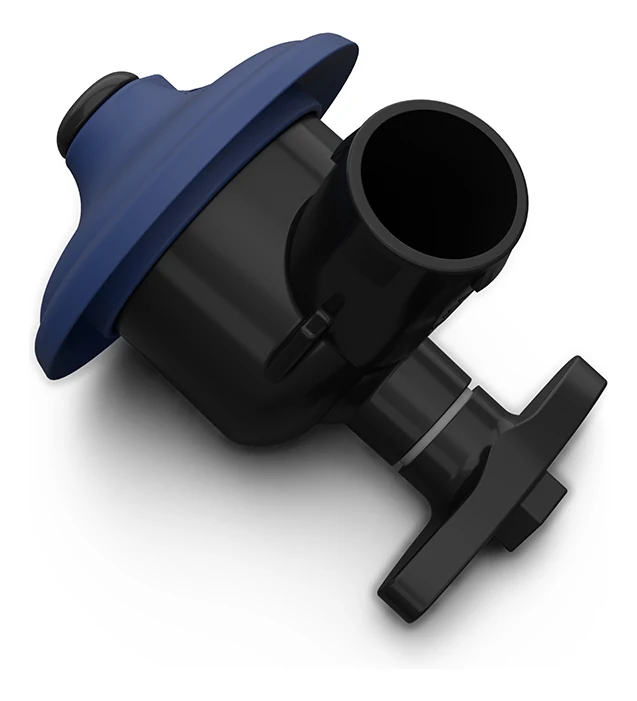
VBT bin aerator with a blue silicone membrane, a black three-way air collector and a T-handle.
The problem

Three ways to lose time on a ramp

The catalogue puts it briefly: the VBT solves bridging and rat-holing. Behind those two words lie the situations a driver knows: the hopper that will not empty, the hopper that empties halfway, and the load that simply takes too long.

Bridge over the outlet

Bridge over the outlet

The powder forms an arch across the opening and carries its own weight. The hopper is full, but nothing comes out, and the blower works without moving anything.

Rathole through the middle

Rathole through the middle

A narrow channel runs down through the centre while the rest stands still along the wall. The trailer leaves with a residue that has to come off somewhere else.

Load-out takes too long

Load-out takes too long

The material does come out, but more slowly than the schedule can carry. This is what the VBT is built for: the air is aimed at the outlet instead of spreading in every direction.

Walkthrough

Four steps through the product

Click through: from the hopper that will not empty to the number of units and where they go on your own trailer.

01 The problem

The same bulk trailer with and without bin aeratorsA dry bulk trailer seen from the side, split by a vertical line. Beneath the horizontal tank sit four hoppers, each with its own outlet. To the left of the line the powder has formed a bridge in every hopper, and below the bridge the space is empty: nothing comes out. To the right, aerators sit on the hopper walls, arrows show the air aimed down at the outlet, and the material falls freely out. The line can be dragged from side to side.Without aerationWith VBT

Without air the powder carries its own weight: the bridge stands and the hopper does not empty, however long the blower runs. With air the powder loses its internal cohesion and behaves once more like something that can flow. It is the same trailer on both sides of the line.

02 The technology

The aerator seen in the hopper wallA section through part of a sloping hopper wall. The silicone membrane sits inside the material as a parasol: a thickened rim resting against the inner face of the wall, a steep skirt rising towards the centre, and a small cap around the stem at the top. The rim is dimensioned as A, Ø104 mm. The Venturi cavity lies between the underside of the membrane and the wall. The stem passes out through the plate in a hole dimensioned as C, Ø38 mm, and outside sit the washer, the air collector and the T-handle. Three arrows show the air escaping under the rim and running down along the wall towards the outlet, while a single faint puff points the other way. A cloud of small dots shows the zone where the air loosens the material.A · Ø104 mmC · Ø38 mmThe material in the hopperAir from the blowerTowards the outletThe Venturi cavitySection

The membrane sits inside the material, the stem passes out through the 38 mm hole, and the air collector sits on the outside. Beneath the membrane lies the Venturi cavity that gives the air a preferred direction down towards the outlet. The rim rests against the wall and lifts by a few tenths when the air arrives — so it escapes all the way round rather than in a single jet.

  • White silicone · −40 to 170 °C
    VBT30 · VBT20 · VBT1L · VBT1R
  • Blue silicone · −40 to 170 °C
    VBT30 · VBT20 · VBT1L · VBT1R

03 The installation

The circuit on the trailerOne hopper beneath the trailer tank, seen in section. On the left the truck's blower with its impeller. From the blower an air line runs to the air collector, which runs horizontally across the hopper and chains the three units together. Two of the units are seen in the section; the third lies behind and is marked with a faint ellipse. Below the outlet the material falls into the discharge line, which runs up to the right. Five numbered points mark the parts.12345

The air comes from the truck's own blower, not from a compressed air plant with a filter and a control box. From the blower the line runs to the first air collector, and from there the three units in the hopper are chained together. There is neither a controller nor a solenoid valve in a VBT installation.

  1. The truck's blower The air comes from the trailer's own blower. The catalogue states continuous duty and says explicitly that the VBT is suitable to be used with a blower. The working pressure is 0.7 to 2 bar.
  2. The trailer's pipework The VBT suits a standard pneumatic bulk trailer circuit and works with all standard designs. No new system has to be built in order to retrofit.
  3. The unit in the hopper wall Three units per hopper, 120 degrees apart, in a Ø38 mm hole. The air collectors chain them together so they share a single air line.
  4. The outlet On the two hopper shapes above the outlet is Ø101.6 mm at a 45 degree taper and Ø120.7 mm at 37 degrees. Your own outlet may be another.
  5. Load-out This is where the time is won or lost. The more of the blower air that points at the outlet instead of up into the tank, the less time the truck stands still on the ramp.

04 The placement

Hopper angle
The hopper at a 45 degree taper, in sectionSection through a hopper with a 45 degree taper. The hopper diameter, the cone height and the outlet diameter are dimensioned, and two of the three aerators are seen on the cone wall.Ø669,9285,8Ø101,645° · to scaleThe three units seen from above at 45 degreesPlan view of the hopper at a 45 degree taper. Three units sit on a single circle, 120 degrees apart. The outlet is in the centre.120°Ø296,4Plan view · to scale
The hopper at a 37 degree taper, in sectionSection through a hopper with a 37 degree taper. The hopper diameter, the cone height and the outlet diameter are dimensioned, and two of the three aerators are seen on the cone wall.Ø762246Ø120,737° · to scaleThe three units seen from above at 37 degreesPlan view of the hopper at a 37 degree taper. Three units sit on a single circle, 120 degrees apart. The outlet is in the centre.120°Ø329,5Plan view · to scale

The two drawings are examples, not a sizing rule. If neither fits your hoppers, we work it out for your own geometry — the angle, the outlet and what you haul.

Here are two hopper shapes: one with a 45 degree taper and one with 37. Both carry three units 120 degrees apart on a single circle. Choose the one that resembles your hoppers and compare the figures with the ones you can measure yourself.

The technology

Tramontana®: air in one direction — at low pressure

An ordinary aeration nozzle blows air evenly in every direction. The underside of the Tramontana® disc is shaped as a Venturi cavity, which gives the air a preferred direction, down towards the hopper outlet. The material is loosened where it has to leave.

On a trailer the decisive figure is pressure. The VBT works from 0.7 to 2 bar. For comparison, the VBS silo version works up to 6 bar. The low pressure is not a limitation but the premise: the air comes from the truck's own blower, and the duty is continuous, precisely together with the blower.

The circuit is the trailer's own. The VBT suits a standard pneumatic bulk trailer circuit and works with all standard designs. No control box and no solenoid valve are supplied; the air collector on the outside of the hopper wall is the pipework, and it is part of the model.
Data

Technical specifications

ApplicationDry bulk tank trailers and dry bulk rail tankers
Material in the hopperDry, fine, granular powder
Problem solvingBridging and rat-holing
Duty cycleContinuous. Suitable to be used with a blower
Working pressure0.7 to 2 bar (10 to 29 psi)
Pneumatic circuitSuits a standard pneumatic bulk trailer circuit, works with all standard designs
Working temperature−40 to 170 °C (−40 to 338 °F)
TechnologyVibro-aeration
MembraneWhite silicone. Blue silicone is metal detectable and complies with FDA 177.2600
StemBlack polyarylamide, glass-fibre reinforced, to 10/2011/EC, FDA and UL94
Air collectorBlack polyarylamide, glass-fibre reinforced, to 10/2011/EC, FDA and UL94, or transparent polysulphone to ISO 10993, FDA 21 CFR 177.1655, NSF 51 and UL94
T-handleBlack polyarylamide, glass-fibre reinforced. Stainless steel threaded shaft
GasketsSilicone. EPDM as an option
Mounting holeØ38 mm (1 1/2 in) in the hopper wall
Units per hopperThree units, 120 degrees apart
OptionsHopper saver plate in AISI 304 stainless steel. EPDM gasket
Models

Four variants, one difference

The four models are the same aerator with a different air collector on each. The collector decides how three units in the same hopper chain onto a single air line: three-way in the middle, two-way along the way and one-way at the end, in a left-hand or right-hand version. Dimension A is the disc diameter, B the vertical spout that only the three-way has, and C the mounting hole.

Dimensions in millimetres
ModelAir collectorDrawingTemperatureABCD
VBT30Three-wayY1−40 to 170 °CØ104 mmØ50,8 mmØ38 mm6–7 mm
VBT20Two-wayY2−40 to 170 °CØ104 mmØ38 mm6–7 mm
VBT1LOne-way, left-handY3−40 to 170 °CØ104 mmØ38 mm6–7 mm
VBT1ROne-way, right-handY4−40 to 170 °CØ104 mmØ38 mm6–7 mm

How to read the model name: 30 is a three-way air collector, 20 two-way, 1L one-way left-hand and 1R one-way right-hand. The number is the number of ways out of the collector, not a size.

The membrane

White or blue

The colour is not cosmetic. It tells you which silicone the membrane is made from, and therefore what it may touch. Both cover the full temperature range from minus 40 to 170 degrees.

White silicone

−40 to 170 °C

The silicone membrane in its ordinary version. The whole VBT range is suitable for food and complies with UL94.

VBT30 · VBT20 · VBT1L · VBT1R

Blue silicone

−40 to 170 °C

Metal detectable and to FDA 177.2600. If a piece of the membrane comes loose, the metal detector at the receiving plant will catch it. A requirement in many food and feed plants.

VBT30 · VBT20 · VBT1L · VBT1R

Apart from the colour the two are identical: the same silicone, the same temperature range and the same dimensions. Choose the blue one where the receiving plant has a metal detector — otherwise it makes no difference in service.

Components

What sits on the hopper

A VBT is not one part. The membrane sits inside the hopper, the stem passes out through the hole, and the air collector and the T-handle sit on the outside. It is the collector that turns three units into one installation.

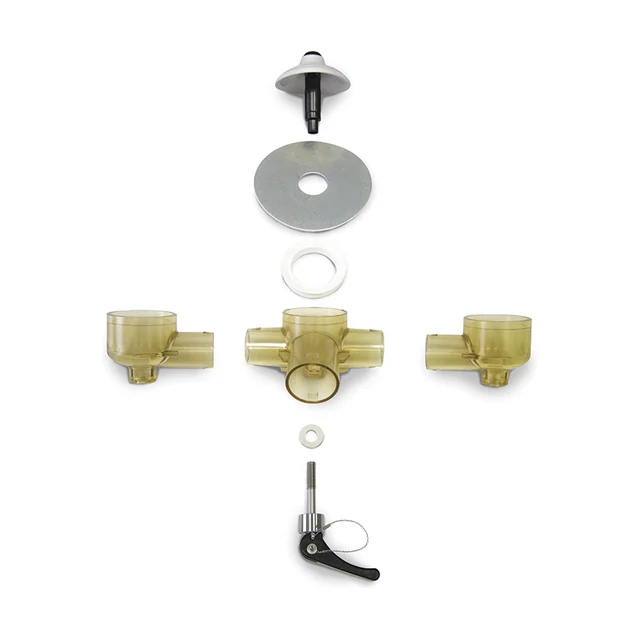
A VBT taken apart: membrane, gasket, washer, three air collectors in transparent polysulphone and the T-handle.

The air collectors C · D · E · F

Four models, one installation. The three-way collector sits where the air enters the hopper, the two-way carries it on, and the two one-way collectors close the row at either end. That is why the collector exists in a left-hand and a right-hand version.

Three-wayVBT30
Two-wayVBT20
One-way leftVBT1L
One-way rightVBT1R
MaterialBlack polyarylamide or transparent polysulphone
  1. Three units per hopper, 120 degrees apart.
  2. The mounting hole in the hopper wall is Ø38 mm.
  3. The collector has its own gasket, and the disc has its own.
  4. The T-handle locks the unit with a stainless steel threaded shaft.
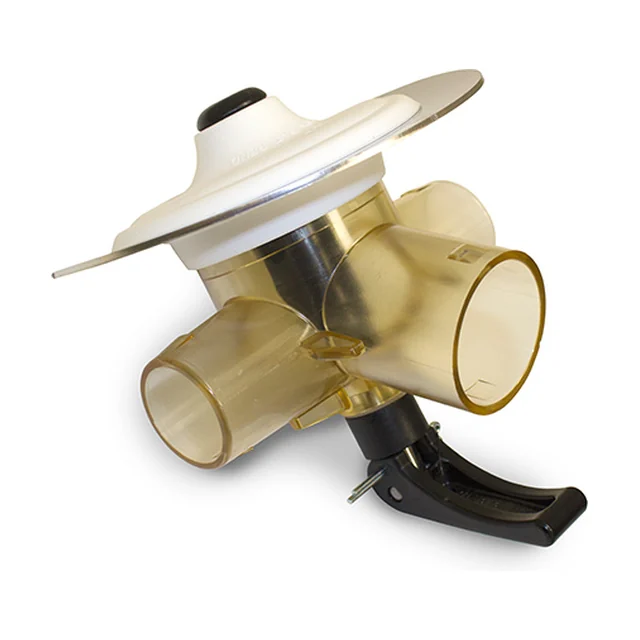
A VBT with a stainless steel hopper saver plate over the white membrane and a transparent air collector.

Hopper saver H

A stainless steel plate over the disc. It is used for highly abrasive materials, where the powder would otherwise work on the membrane itself. It is an option and is not included.

MaterialAISI 304 stainless steel
Intended forHighly abrasive materials
SuppliedAs an option
  1. The plate sits over the membrane and takes the wear.
  2. It is also known as a hopper saver disc.

If you need weights, air consumption, ATEX details or the user manual for a project, we obtain them from the factory. Call or write, and we will get what you are missing.

Application

Where it sits and what it works in

VehiclesDry bulk tank trailers and dry bulk rail tankers
MaterialsCement, lime, pigments, plastics, starch, flour, sugar and coffee
SectorsBuilding and construction, energy, feed and food, lines and machines, plastics and chemicals, heavy industry and environmental technology
SuitabilityThe entire range is suitable for food and complies with UL94. The polymer withstands both desert heat and arctic cold
Other vehiclesDump trucks, concrete pumps, salt spreaders and vacuum trucks are solved with vibrators, not with the VBT
Portrait of a technical adviser at Particulair.

Technical advice

What taper are your hoppers?

Tell us how many hoppers the trailer has, what angle they sit at and what you haul. We come back with a number, a combination of air collectors and a price — not with a catalogue.

Contact us Try the product selector