
Imagine a coffee pot tipping over on the kitchen counter. Coffee spills, you grab a cloth. No drama. Now imagine it is not coffee but maize starch, and instead of wiping it up you fetch a vacuum cleaner with a spark-generating motor inside. The probability of something happening is small, but it is not zero. And in an industry where hundreds of kilograms of such substances are handled every day, “small probability” is simply not good enough.
That is precisely the problem the ACD vacuum cleaner was designed to solve.
Dust that does not behave the way we expect
Most of us have an intuitive sense of what is dangerous: liquid nitrogen, strong acids, radioactive materials. We associate danger with things marked with skull-and-crossbones and neon warning tape.
Fine dust, we rarely think of as dangerous in itself. But that is exactly where intuition fails us. When a solid substance is ground down to particles smaller than 500 micrometres — thinner than a human hair — it starts to behave more like a gas than a solid. It can hang suspended in air, mix with oxygen, and at the slightest ignition source unfold as an explosion.
This does not happen with coarse gravel. It happens with lactose used as a tablet filler. With APIs, the active pharmaceutical ingredients in medicines. With starch, sugar, cocoa powder and flour. And it happens with a speed and force that is difficult to imagine if you have never witnessed it. Dust explosions have historically levelled factories and killed many people at once.
But the hazard does not have to come from an entire factory exploding. It can occur very locally, inside the vacuum cleaner itself, if the collected dust forms a combustible cloud inside the container and comes into contact with an electrical component that sparks.
Pharmaceutical and chemical industry: lactose, sucrose, maltodextrin, starch (maize, wheat, potato), cellulose, API powders in general, microcrystalline cellulose, titanium dioxide (TiO₂), aluminium oxide.
Food and nutrition industry: flour, cocoa powder, milk powder, coffee powder, spices, sugar, glucose, fructose, protein powders.
Chemicals and metals: aluminium powder, zinc powder, magnesium dust, epoxy powder coating, polypropylene granulate.
This list is not exhaustive. Any organic substance in fine powder form should be treated as potentially combustible until documented otherwise.
What is an ACD vacuum cleaner?
ACD is the official international designation for a vacuum cleaner intended for the collection of combustible dust. The full definition from IEC 60335-2-69, Annex AA, clause AA.3.208 reads: “appliance for pick-up of combustible dust.” This is not an informal label invented by manufacturers to add appeal to an expensive product. It is an internationally defined category with precise requirements for design, testing and documentation.
The standard — that is, the international norm IEC 60335-2-69, Edition 6.0, published 2021 — is the document that manufacturers and independent testing laboratories work from when certifying ACD equipment for the European market. A standard in this context is not advisory literature; it is a set of binding technical requirements that a product must satisfy before it can lawfully be sold for the intended purpose.
ACD vacuum cleaners are designed for environments that are not classified ATEX zones, but where combustible dust is nonetheless present in the process. That is precisely the situation in many pharmaceutical production rooms, packing areas, laboratories and cleanroom corridors. Dust is present, but in controlled quantities and controlled surroundings, so no persistent external explosive atmosphere arises. Inside the vacuum cleaner, however, the situation is different: the dust can very well form a combustible cloud there, and that is exactly what the ACD vacuum cleaner is built to handle.
What happens inside the vacuum cleaner?
To understand what an ACD vacuum cleaner must achieve, it helps to picture what actually takes place inside the machine during operation.
Dust is drawn in through the hose and arrives in the collection container. The air and dust swirl around, and a primary filter captures the majority of the particles. The air then flows on towards the suction motor. Here a secondary filter acts as the real protective barrier against even the smallest dust reaching the electrical components of the suction motor. The air finally passes through the motor and is discharged back into the room.
In an ordinary industrial vacuum cleaner, the suction motor is typically not separated from the air flow in any particular way. The motor actively uses the drawn-in air to cool itself — a design known as “through-flow.” It is efficient and inexpensive, but it means the air passing through the motor is the same air that collected the dust. For combustible dust this is a problem, because the motor is a focal point for electrical sparks and hot surfaces.
The ACD standard requires that this does not happen. IEC 60335-2-69 prohibits through-flow motors in ACD machines, per clause AA.22.204. Instead, bypass motors, side-channel blowers or other designs are used, where the cooling air for the suction motor is kept separate from the working air. The suction motor always sits on the clean side of the filtration — that is, after the dust has been captured.
Three dust classes, three levels of filtration
One of the most practically important details in IEC 60335-2-69 is the classification of vacuum cleaners into three dust classes based on how fine the dust is and how hazardous it is to people and plant. All ACD vacuum cleaners must be classified in one of these three classes.
Class L, “light hazard,” covers vacuum cleaners with a filter penetration of less than one per cent — suitable for dust types with a lower risk profile. Class M, “medium hazard,” requires less than 0.1 per cent filter penetration, typically relevant for pharmaceutical processes and dust types harmful to the respiratory system. Class H, “high hazard,” requires less than 0.005 per cent — the highest level, relevant for carcinogens, pathogens and highly potent pharmaceutical substances. Class H machines additionally require that the essential filter can only be removed with a tool, and that the machine stops operating if the filter is missing.
| Class L | Class M | Class H | |
|---|---|---|---|
| Filter penetration | below 1 % | below 0.1 % | below 0.005 % |
| Typical application | General combustible dust | Pharmaceutical processes, harmful dust | Carcinogens, pathogens, OEB 4–5 |
| Disposable container required | No | Yes | Yes |
| Filter locked with tool | No | No | Yes |
| Machine stops without filter | No | No | Yes |
| Notified body required | Yes | Yes | Yes |
Additional construction requirements
Beyond motor type and filtration, the standard imposes a number of further requirements on how an ACD vacuum cleaner is built.
All parts that come into contact with combustible dust must dissipate static electricity effectively. IEC 60335-2-69, clause AA.3.210, specifies that the electrostatic earth connection resistance must not exceed 1 MΩ — one megohm. The filter material must, according to clause AA.3.213, have a surface resistance of no more than 100 megohms. These are two separate requirements for two separate parts of the machine and must not be conflated.
Surfaces in contact with combustible dust must never exceed 135 degrees Celsius. That figure is not arbitrary. It derives directly from EN 1127-1, clause 6.4.2, which states that for Category 2 equipment in combustible dust atmospheres no surface may exceed two thirds of the dust’s minimum ignition temperature in a cloud. For the most relevant dust types this equates to 135 degrees, since the minimum ignition temperature for dust clouds is typically cited from 203 degrees upward — and two thirds of 203 is exactly 135. For surfaces where dust settles as a layer the limit differs: typically a minimum of 210 degrees for a 5 mm thick layer. ACD design must account for both scenarios.
The hose assembly and all accessories must have an end-to-end electrical resistance of less than 1 MΩ, per clause AA.22.220. This applies to the entire chain from nozzle to machine. Materials forming dust channels and the collection container must not contain more than 7.5 per cent magnesium, titanium or zirconium in total, because these metals can produce powerful sparks on impact, per clause AA.22.215.
The ACD earthing resistance requirements apply to the entire system, not only the vacuum cleaner. The hose, nozzle, brushes and tubes must also satisfy the requirements of IEC 60335-2-69, clause AA.22.220.
Particulair’s VACE range includes vacuum cleaner accessories in antistatic NBR compound with documented volume resistivity certified by the CERISIE laboratory (ISO 1853:2011), suitable for ATEX Zone 21 and Zone 22. VACE accessories are designed to complete an approved ACD or ATEX system with correct electrical properties all the way from nozzle to container.
For Class M and Class H machines, a disposable collection container — a Safebag — must be used, and the container change must be carried out without dispersing dust into the surroundings.
Unsure which class your situation requires?
We can help assess your dust type, risk scenario and documentation requirements — with no obligation.
Contact us for adviceWhat ATEX is, and why it differs
It is important to understand a distinction that many people underestimate: ACD and ATEX are not the same thing.
ATEX is the European regulatory framework for equipment used in classified explosive-hazard zones. The relevant European product standard for ATEX vacuum cleaners is EN 17348:2022, harmonised with ATEX Directive 2014/34/EU from March 2023, with the Machinery Directive 2006/42/EC, and with the new Machinery Regulation (EU) 2023/1230. An ATEX vacuum cleaner carries the EX mark and is designed to stand physically inside the classified ATEX zone.
ACD vacuum cleaners are intended for environments that are not ATEX-zone classified, but where combustible dust is nonetheless present. They are not ATEX-certified in the conventional sense, but they are internally designed and tested to withstand an internal Zone 20 — a situation where an explosive atmosphere is continuously present inside the container. It is precisely this combination that makes ACD a distinct and necessary category.
| ACD (1/-D) | ATEX Zone 22 (3D) | ATEX Zone 21 (2D) | |
|---|---|---|---|
| May stand in classified ATEX zone | No | Zone 22 | Zone 21 and 22 |
| Internal zone protection | Zone 20 | Zone 22 | Zone 21 |
| External ATEX zone rating | None | 3D | 2D |
| Notified body required | Yes | Yes | Yes |
| Applicable standard | IEC 60335-2-69 | EN 17348:2022 | EN 17348:2022 |
| Typical life science scenario | Packing area, lab, cleanroom corridor | Occasional dust presence | Periodic dust presence |
| Maintenance level | Moderate | Moderate | High |
The category marking, and what it actually means
When an ACD vacuum cleaner is correctly certified, it carries a specific marking set out in IEC 60335-2-69. At first glance the marking looks like something only an engineer would understand. But with a little guidance, anyone can read it.
Take this marking as an example: II 1/-D Ex h IIIC T135°C Da/-
“II” means the equipment is intended for surface installations — industry and production in general — as opposed to equipment designed for mines and underground installations, which carries the designation “I.” Virtually all equipment in pharmaceutical and life science environments belongs to Group II.
“1/-D” is the category notation and the most central element. “1” corresponds to Category 1D, the highest level of protection, suitable for internal Zone 20. The slash and hyphen mean there is no external ATEX zone rating, and that the machine must not be placed in a classified ATEX zone.
“Ex h” indicates the method of protection: construction safety, a non-electrical protection principle ensuring the machine itself is not a source of ignition.
“IIIC” indicates the dust group. Groups are divided into three levels: IIIA covers combustible flyings such as lint and wood shavings, IIIB covers non-conductive dust types such as most organic powders, and IIIC covers conductive dust types including metal dusts such as aluminium and magnesium. IIIC is the most demanding group, and a machine certified for IIIC is consequently also suitable for IIIA and IIIB.
“T135°C” confirms that none of the surfaces inside and on the vacuum cleaner that can come into contact with combustible material exceed 135 degrees Celsius. In practice a vacuum cleaner never reaches 135 degrees during normal operation. But the standard requires that it is tested for exactly that scenario: airflow completely blocked and the suction motor heating up over time to its extreme limit. It is an extreme scenario, but it has happened in the real world, and the limit is placed precisely there to ensure that even under the worst conceivable operating failure the surface temperature remains below the ignition point of the collected material.
“Da/-” is the Equipment Protection Level (EPL). “Da” is the highest level for dust equipment and corresponds to Zone 20. The hyphen reconfirms that there is no external ATEX zone rating.
The ACD label, and what the symbols mean
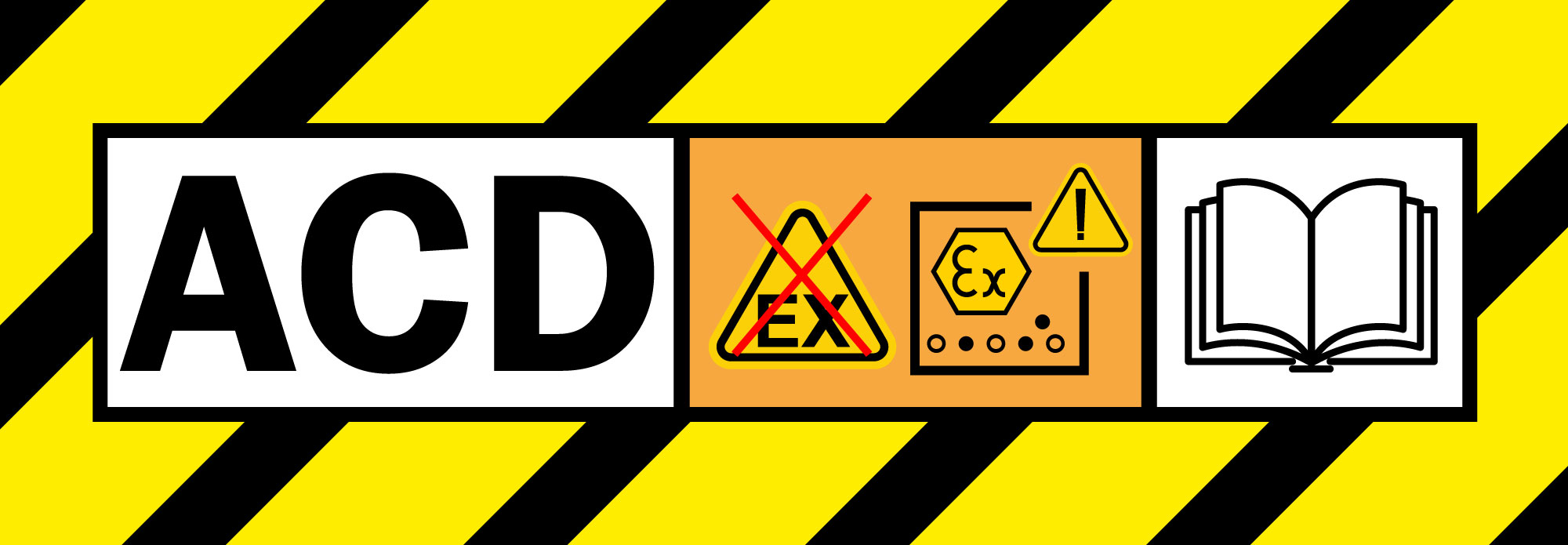
The official ACD label per IEC 60335-2-69, Figure AA.2. Yellow/black hazard striping, crossed-out EX (must not be placed in ATEX zone), EX with exclamation mark (internal Zone 20 protection) and book (read the manual).
The first thing you notice on the official ACD label is the yellow and black striped pattern — the international hazard colour combination for explosion risk, the same pattern used on road barriers and industrial warning markings.
In the white field on the left, “ACD” appears in large letters. This is the category designation itself, signalling that this machine is approved for collecting combustible dust in unclassified surroundings.
The orange central panel contains two symbols. The left one is an EX warning triangle crossed out in red — communicating clearly: this machine must not be used in an external ATEX zone, that is, it must not be placed in a classified explosive atmosphere. It is an active warning against confusing ACD with ATEX equipment. The right symbol is the EX mark with an exclamation point, signalling the internal ATEX protection — the internal Zone 20 certification — but only internally.
The white open book on the right is a reminder that the operating manual must be read and followed. IEC 60335-2-69 sets very specific requirements for what an ACD vacuum cleaner’s instructions must contain, including dust class, operating limits and safe emptying procedures.
When an ACD vacuum cleaner is not sufficient
With all that engineering and all those requirements, it might seem as though an ACD vacuum cleaner can handle almost anything. But the standard is very clear about what it does not cover.
An ACD vacuum cleaner must not be used in ATEX-zone-classified surroundings. If a room is classified as Zone 20, 21 or 22 because there is persistently, periodically or occasionally an external explosive dust atmosphere, the regulations require a fully ATEX-certified machine. This applies regardless of whether the vacuum cleaner itself is built for internal Zone 20.
An ACD vacuum cleaner is also not suitable for self-heating dust, for mixtures of combustible dust with flammable liquids, or as a general rule for magnesium dust, which reacts strongly with moisture and can self-ignite. And it does not cover situations where the vacuum cleaner is connected to a machine that generates sparks in the process itself.
Servicing — and why it is not a formality
An ACD vacuum cleaner is not a purchase-and-forget item. It is safety equipment, and like all safety equipment it loses its function if not properly maintained.
IEC 60335-2-69, clause AA.7.12, requires that the operating manual specifies the type and frequency of inspections and maintenance necessary for safe operation. For Class H machines the standard additionally requires that filtration efficiency is tested at least once a year, or that the essential filter is replaced with a new one. The alternative is not to skip the test — it is to change the filter.
Replacing the filter in a Class M or H machine is not the same as changing the bag in a domestic vacuum cleaner. It is a safety-critical action. The Safebag system is designed to limit dust dispersal during the container change, but it requires correct technique, appropriate gloves and correct waste handling — and the person carrying it out must be trained in what they are handling.
The earthing resistance is another critical parameter. Hoses and accessories wear over time, and a hose that meets the requirement on day one can easily have degraded conductivity after two years of use. Periodic measurement is the only way to know whether the system still meets the requirement it was certified against.
Is the EU type-examination certificate from a notified body available in the machine documentation? Is the dust class (L, M or H) clearly stated on the machine and in the documentation? Is the filter intact and within the manufacturer’s specified replacement period? Has the earthing resistance of hoses and accessories been tested recently? Has the responsible operator been trained in the correct emptying procedure? Are the correct replacement Safebags in stock?
If you cannot answer yes to all six questions, there is something that needs attention.
The grey zone in the market, and what you must demand
This is the most important section in this article.
ACD is not a protected designation. That means a manufacturer can technically label a machine “ACD” without having had it third-party tested and certified by a notified body.
And it happens. The market is flooded with vacuum cleaners calling themselves ACD-approved that have never been tested by an independent body. Some are correctly engineered in theory but skip the testing to save time and money. Others are simply ordinary industrial vacuum cleaners with an ACD logo attached. A third category comprises machines that are correctly built but certified only for very limited quantities and conditions — far more restrictive than what the marketing suggests.
What is the practical consequence? A non-certified ACD vacuum cleaner can have the right materials, the right filter construction and the right motor, and still fail on construction details only revealed under systematic testing: a filter material with too-high surface resistance, a hose coupling whose earthing resistance is ten times too high, a container that under complete airflow blockage heats its surface above 135 degrees. None of these faults are visible by inspection. All are revealed under the test the standard requires.
ATEX Directive 2014/34/EU is moreover unambiguous: Category 1D equipment — designed for internal Zone 20 — may not be self-certified. It always requires an EU type-examination by a notified body. Any manufacturer selling “ACD-approved” machines without this certificate is selling equipment that formally does not comply with the directive.
The decisive question is not whether “ACD” appears in the catalogue. The decisive question is whether the machine has been third-party certified for internal Zone 20 by a notified body, whether it is classified as dust class L, M or H, and whether the manufacturer can show you the EU type-examination certificate. If they cannot, the product is not what it claims to be.
At Particulair we use the designation ACD exclusively for products that have been certified by a notified body for internal Zone 20 in accordance with IEC 60335-2-69.
The right equipment for the right task
There is one mistake that is easy to make: defaulting to ATEX-certified equipment for everything, including situations where ACD would have been the correct and sufficient solution.
Intuition says: more safety is never a bad idea. But in practice it is more complicated. A fully ATEX-certified machine imposes requirements for maintenance, documentation, service intervals and operating procedures that are significantly more demanding than for ACD. That is correct and necessary when the machine is in a classified ATEX zone. When it is not, it adds complexity and cost without a corresponding increase in safety — and complexity is itself a risk factor. You do not wear safety boots in the office, not because injuries cannot happen there, but because the correct risk assessment leads to a different choice.
This is not about cutting corners on safety. It is about conducting the right risk assessment and choosing equipment that genuinely matches the specific need. A correctly selected ACD machine, certified to the relevant dust class and with proper documentation, is in the non-zone-classified scenario the professionally sounder choice than an over-specified ATEX machine.
Next steps if you are uncertain
The question “is our vacuum cleaner approved for what we use it for?” sounds simple. But answering it requires knowledge of your specific substances, the classification status of your space, your typical dust quantities and your working procedures.
The line between when ACD is sufficient and when ATEX is necessary is not always obvious in practice. An incorrect assessment can have consequences for the working environment, for insurance, and ultimately for the legality of your operations. Inspections by the national labour authority are not hypothetical, and insufficient documentation for the choice of cleaning equipment in an environment with combustible dust is a real risk during such a visit.
This is not something you should guess your way through. We offer a no-obligation technical review in which we examine your processes, dust types and current equipment and provide a concrete professional recommendation — not to sell you something you do not need, but to ensure you have what you actually need and that you can document that the choice is correct.
- IEC 60335-2-69:2021, Edition 6.0, International Electrotechnical Commission. Annex AA: Particular requirements for vacuum cleaners and dust extractors for the collection of hazardous dusts and combustible dusts.
- DS/EN 17348:2022, Requirements for design and testing of vacuum cleaners for use in potentially explosive atmospheres. European Committee for Standardization (CEN). Harmonised with ATEX Directive 2014/34/EU March 2023, Machinery Directive 2006/42/EC and Machinery Regulation (EU) 2023/1230.
- EN 1127-1:2019, Explosive atmospheres — Explosion prevention and protection — Part 1: Basic concepts and methodology. Clause 6.4.2 on temperature requirements for Category 2 equipment.
- Directive 2014/34/EU — ATEX Equipment Directive. Equipment and protective systems intended for use in potentially explosive atmospheres. eur-lex.europa.eu
- Regulation (EU) 2023/1230 of 14 June 2023 on machinery.
- Delfin Industrial Vacuum Solutions, ATEX/ACD — Industrial Vacuum Solutions for Combustible Dust, product brochure, 2024.
- Thomas Lyngskjøld. “ATEX ABC — Before there are sparks, there are choices.” Particulair Life Science Hub, 2026. life-science/en/articles/atex-abc.html
- Thomas Lyngskjøld. “The invisible weakest link.” Particulair Life Science Hub, 2026. life-science/en/articles