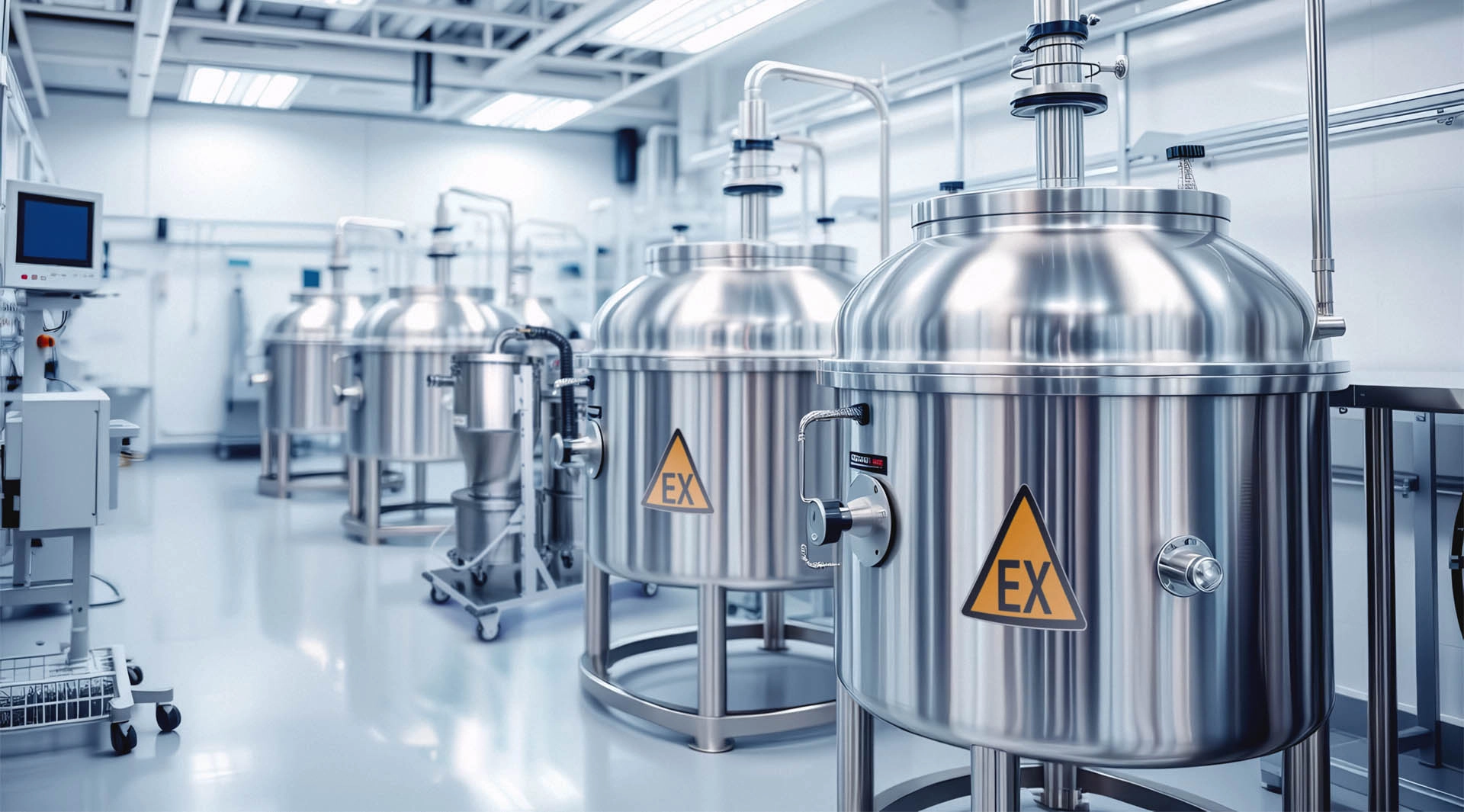
ATEX is not an abstract set of rules. It is a description of your working day, if you work with flammable substances, powders, gases or vapours. It is about what happens when three ordinary things meet at the wrong moment — and about the choices that can prevent it.
It starts with you
You are the one who selects the equipment. You are the one who needs to know whether a zone applies. You are the one who presses the start button. And you are also the one who becomes involved if something goes wrong — regardless of how many documents, manuals or CE markings may exist.
ATEX is therefore not just about complying with regulations, but about the choices you make every day. It is about whether you are using the right vacuum cleaner. Whether anyone knows where the dust settles. Whether cleaning is done frequently enough. And whether there is anyone at all who actually understands what Zone 22 means — not on paper, but in practice.
ATEX is not a responsibility that can be delegated to a single person or department. It concerns the attention and commitment of both management and employees. Although the ultimate legal responsibility for compliance rests with the employer, it is essential that everyone in the organisation understands the significance of ATEX and how their own actions can affect safety.
How bad can it get – and why zones alone do not protect you
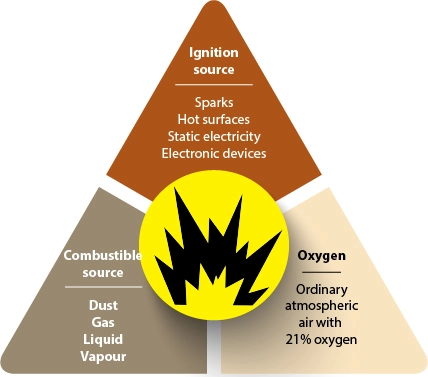
Three conditions must coincide for an explosion: flammable material, oxygen and an ignition source. Remove one — and the explosion cannot occur.
“Relax – it is only Zone 22.” That sentence has been said in many production halls. But Zone 22 is not reassurance. It is a warning.
Explosion risk does not only arise in extreme conditions. It arises when three entirely ordinary things come together:
- A flammable substance — such as fine flour dust, sugar, plastic powder or starch. It does not need to fill the entire room. A thin layer of less than 1 mm in a corner can be enough.
- Oxygen — nothing special here. Ordinary atmospheric air with 21 % oxygen is more than sufficient. Nothing extra needs to be added.
- An ignition source — which may be a hot surface, static electricity, a spark from a tool, a motor running hot, or something as mundane as a plug socket or a mobile phone.
Zones are a helpful tool — but they are not a guarantee. Many accidents occur precisely outside the official zones, or in zones that nobody has updated since the facility was built. ATEX zones are the result of a risk assessment and identify areas where an explosive atmosphere may occur. Their purpose is to illustrate the level of risk — they simply form the basis for taking the necessary safety measures. This is where your role becomes decisive.
The myths people still believe
Myths about ATEX can be just as dangerous as the sparks themselves. Here are the most common — and why they are hazardous.
ATEX is a field where half-truths have a long life. Not because anyone intends to mislead, but because the system is complex and day-to-day work demands quick decisions. Here are the most widespread myths:
“If it has CE marking, I can use it in the zone”
No. CE marking means the manufacturer declares conformity with a set of requirements — but it says nothing about whether the equipment is actually approved for a specific ATEX zone. That requires dedicated ATEX documentation and, in many cases, a notified body.
“Zone 22 is not dangerous – it is just dust”
Dust explodes. Especially organic dust: flour, sugar, grain, plastics, powder coatings, wood. And Zone 22 covers areas where an explosive atmosphere can occur — not where it does so constantly. It is the unpredictability that makes it dangerous.
“Our equipment is new – so it must be safe”
New equipment can easily be the wrong equipment. We have seen brand-new vacuum cleaners with plastic wheels and no earthing connection used in ATEX zones. And although some manufacturers apply an “ACD” label to the machine, this is not an official ATEX approval. ACD is an IEC classification indicating that the vacuum is designed to handle combustible dust in areas without zone classification. If you need documented Zone 20 safety, a full ATEX certificate from a Notified Body under EN 17348:2022 is required.
“That is something for the health and safety team to deal with”
You are part of the working environment. And ATEX responsibility cannot be outsourced if you are the one holding the hose or selecting the supplier. The myths persist — and that is why the same mistakes keep happening.
What an ATEX zone actually is – and how you can reduce it yourself
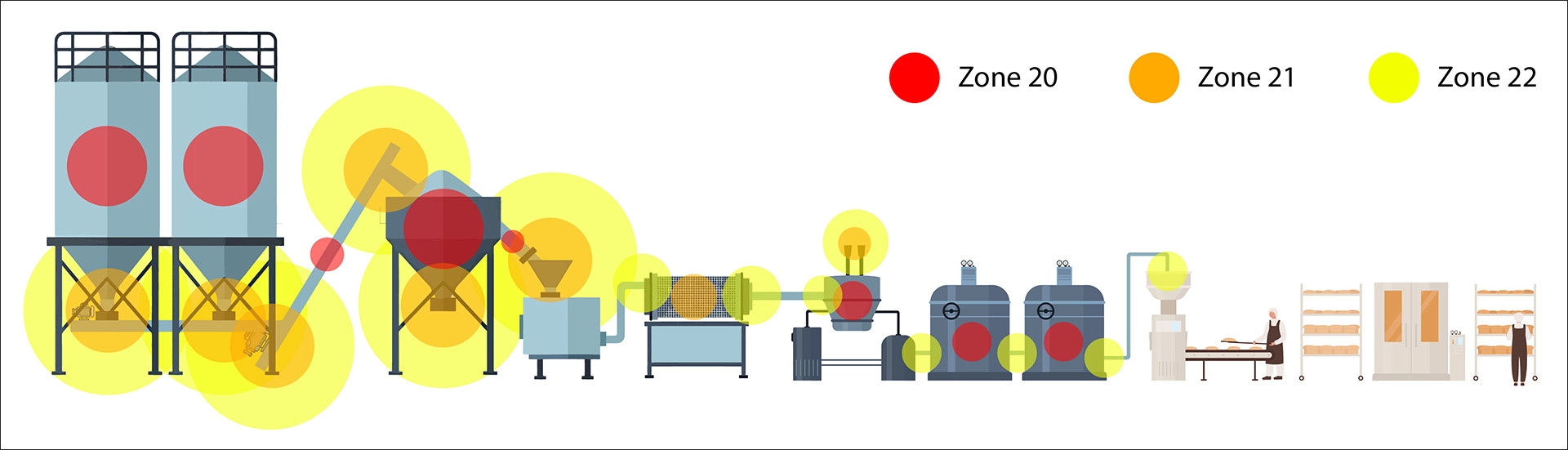
Zone 20, 21 and 22 in practice — example from a bakery with silos, conveyor screws and filling stations.
Many people believe an ATEX zone is a specific room. A space you walk into. But that is not correct. An ATEX zone is a risk area — not a fixed boundary on a drawing.
A zone is assessed to exist wherever — according to the risk assessment — an explosive atmosphere may occur. The size can vary considerably, and in practice it may be as small as one metre around an opening or ventilation point. Here are some of the most important ways you can make a difference yourself:
- Ventilation: Good extraction and air changes can remove explosive dust before it accumulates.
- Enclosed systems: If process equipment is encapsulated and sealed, nothing escapes — and the zone disappears.
- Housekeeping: Dust on shelves, beams and cable trays is often the most dangerous. Remove it, and you remove the fuel.
- Vacuum cleaners: Use equipment with the correct classification and conductivity. This reduces both the risk and the extent of the zone.
- Routine cleaning: Not just every Friday — but as an integrated part of operations.
- Behaviour: No grinding, sweeping, hot work or drilling in dusty areas — unless assessed and controlled.
- Static electricity: No mobile phones or other electrical equipment in zones containing combustible dust, unless ATEX/Ex-approved. That includes your footwear.
The good news? You can do all of this yourself. You do not need to bring in an external consultant to clean up, vacuum, ventilate or take responsibility. This personal accountability and daily decision-making is precisely what makes the difference.
Unsure about what your zone actually covers?
We help companies gain an overview of their zones, equipment and responsibilities — without drowning in directives.
Contact usHow to spot the wrong equipment – even when it carries CE marking
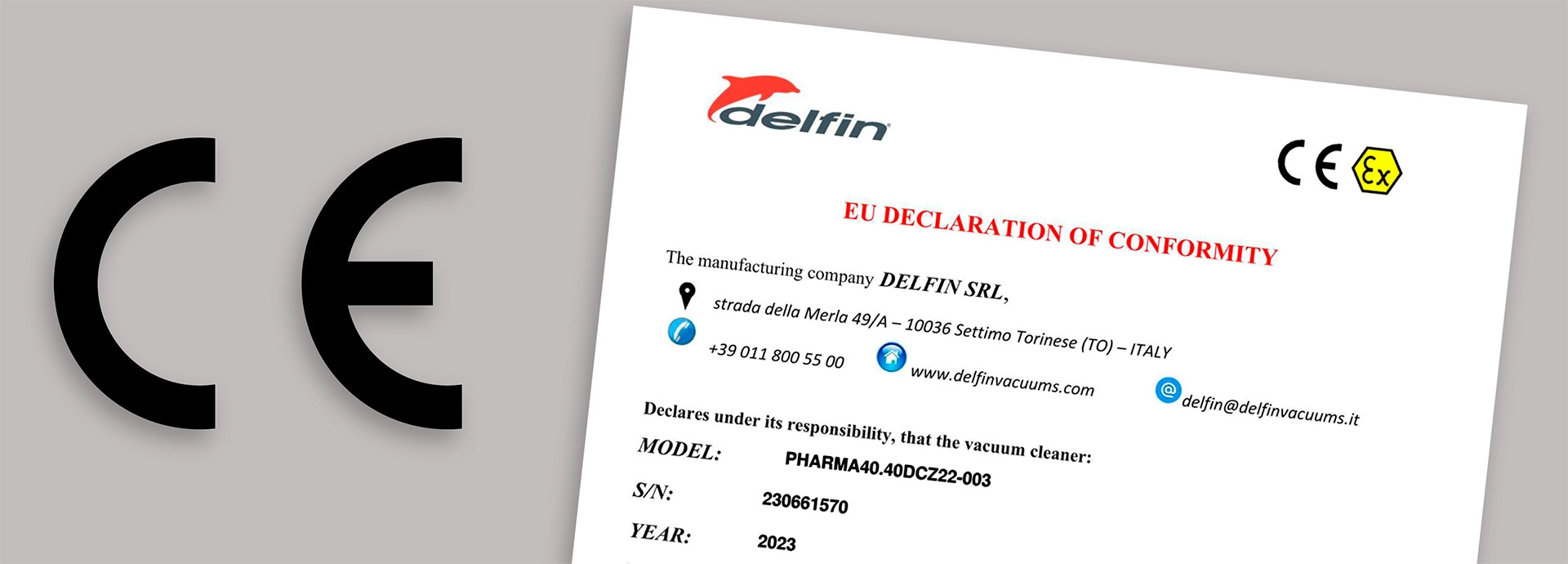
CE is not enough — look for the Ex marking and the NB number. A declaration of conformity should contain both.
A vacuum cleaner looks like a vacuum cleaner. And in many cases it is only when something goes wrong that it becomes apparent the equipment was never approved for use in an explosive environment. But you can actually learn to distinguish the right from the wrong — even without being an expert.
A CE marking only means that the manufacturer declares conformity with applicable directives. But it says nothing about which directives — or how conformity was achieved. ATEX equipment requires separate ATEX marking and documentation.
Read the ATEX marking – and understand it
A correctly ATEX-marked piece of equipment might carry a designation such as:
This means:
- CE 0051: CE marking with the Notified Body number. In this case 0051, which is IMQ (Italian certification body, typically used by Delfin). If the CE marking appears without an NB number, it is self-certification — which is only permitted for category 3 equipment (typically Zone 22).
- II: Non-mining equipment (Group II = industrial equipment above ground level)
- 2D: Approved for Zone 21 — D stands for Dust
- Ex h: Protection concept for non-electrical equipment (ISO 80079-36/-37). For electrical vacuum cleaners, Ex t (tb/tc) is normally used instead — protection by enclosure.
- IIIC: Suitable for conductive dust (e.g. graphite, aluminium)
- T135°C: Maximum surface temperature during operation
- Db: Equipment Protection Level (EPL) for Zone 21. Da = Zone 20, Db = Zone 21, Dc = Zone 22 — Da is the highest safety level.
The NB number confirms that an independent body was actively involved in the conformity assessment. Well-known numbers in the vacuum industry:
- 0051: IMQ (Italy) — typically used by Delfin
- 0081: LCIE Bureau Veritas (France) — typically used by Tiger-Vac
- 0080: INERIS (France) — used by certain Depureco models
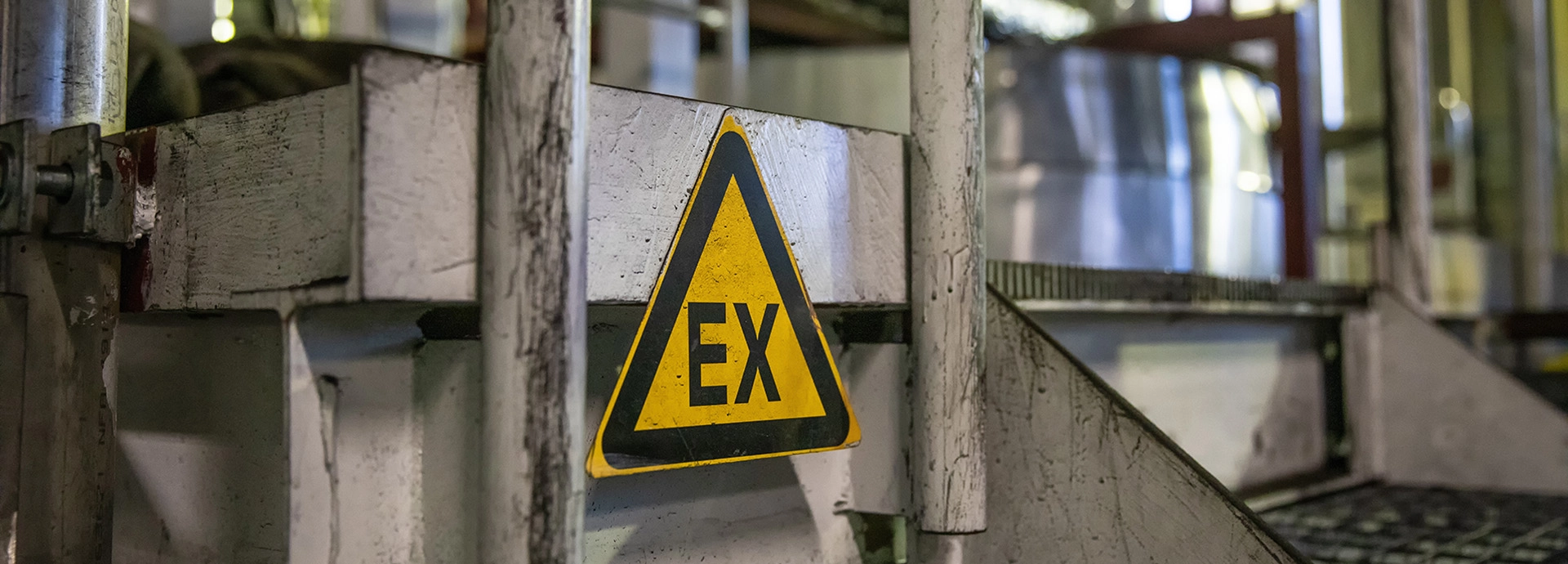
The EX marking is not merely a label — it is a declaration of the conditions under which the equipment may be used.
Has the equipment been tested by a notified body?

When a vacuum cleaner handles combustible dust, an internal Zone 20 is always created — regardless of where it is positioned externally.
When a vacuum cleaner handles combustible dust, an internal Zone 20 is always created — regardless of where the machine is positioned externally. Zone 20 typically occurs inside equipment such as silos, conveyor screws and vacuum cleaners, where an explosive dust atmosphere may be present continuously or frequently. This zone requires that both electrical and non-electrical equipment be type-approved by a notified body such as IMQ or TÜV.
This is where many mistakes occur:
- A vacuum cleaner may well be approved to operate in a Zone 22 environment externally.
- But: if it collects combustible dust, this creates an internal Zone 20 — and that requires notified body certification.
Many operators therefore use ACD vacuums in situations where equipment with documented Zone 20 certification is required. ACD is not an official ATEX approval and cannot replace a full ATEX certificate from a Notified Body when the requirements for internal Zone 20 safety must be documented.
Hoses and couplings – the overlooked weak points
Hoses and couplings can be critical if they do not dissipate static electricity. According to EN 17348:2022, the entire vacuum cleaner frame, motor housing and wheels must have a combined earth resistance of ≤ 106 Ω. Parts in direct contact with the dust stream — such as hoses, gaskets and filters — must have a resistance of < 108 Ω.
Hoses with excessive resistance, plastic couplings without dissipation, or metal parts without equipotential bonding can build up charge. These ignition sources are invisible — but potentially lethal.
In short: if you cannot document that the requirements are met, you have no proof that the equipment may be used in ATEX zones. And in that case, the responsibility is yours — not the supplier’s.
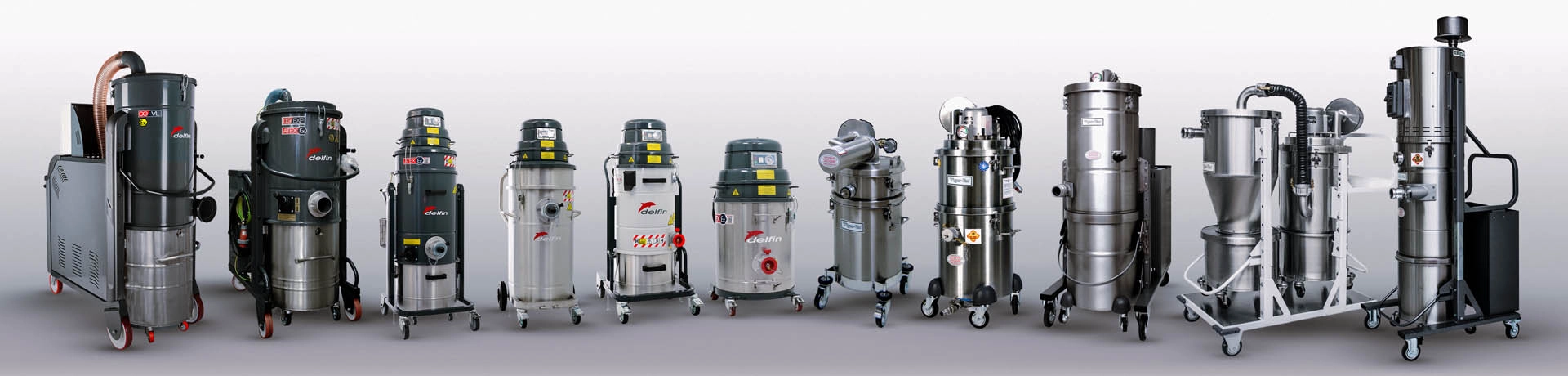
Equipment must be correctly tested, marked and documented — accessories included.
The responsibility nobody told you about
Many people working in industry have never received ATEX training. Directives and standards are demanding reading, and if they are not part of the daily routine, they are quickly forgotten. But whether you are holding the hose, pressing the button or ordering the next machine, the responsibility is still yours — even if nobody has said it out loud.
ATEX is not just a matter for health and safety officers and technical advisors. It is part of your daily work if you:
- work in areas with dust, vapours or powders
- select or use electrical and mechanical equipment
- have responsibility for operations, maintenance or procurement
- carry out cleaning, ventilation or service tasks
Many incidents occur because nobody felt responsible. But there is no “someone else”. There is you — and your choice in the moment. You do not need to be an expert. You just need to know when to stop and ask:
- Is this equipment permitted here?
- Do we have the documentation?
- Is there a risk of dust accumulation?
- Should we have this assessed — or simply clean it up?
Responsibility is not a burden. It is an opportunity to prevent mistakes before they become dangerous.
How to move forward – without drowning in directives
You are encouraged to take action yourself. Here is a practical 8-step guide to getting started.
ATEX can seem like a jungle of clauses, markings and standards. But you do not need to memorise the entire rulebook. You simply need to know where you stand — and what you can do yourself.
Start with the material. Look up the safety data sheet for the product you are working with. Does it state that it is flammable or potentially explosive? If in doubt — contact the manufacturer. And if they cannot answer, send us the data sheet.
Assess the quantity and frequency. How much dust do you see? How often does it arise? According to EN 60079-10-2:2015, Annex A, the zones can be illustrated with indicative hours: Zone 20 = > 1,000 hours/year, Zone 21 = 10–1,000 hours, Zone 22 = < 10 hours. These figures are indicative — not fixed thresholds.
Locate the dust physically. Walk around. Where does it settle? Where does it escape? Take photographs and notes — these will be important as documentation.
Find ways to limit the release. Can the process be enclosed? Can ventilation be improved? Be aware: incorrect or excessive ventilation can spread the dust and extend the zone. (EN 1127-1:2019, sections 6.4.2–6.4.3)
Hold off on cleaning — but plan it wisely. Do not use brooms, cloths or compressed air. These disperse the dust. Do not use ordinary vacuum cleaners in areas with explosive dust.
Make an initial assessment of the zone type based on material, quantity and frequency. This is not a definitive classification — but a sound starting point.
Select the correct equipment. Only once you know the zone does it make sense to select an ATEX vacuum cleaner. Use the classifications actively and be critical of CE markings that lack documentation.
Follow up regularly. ATEX zones are not static — they must be reassessed. Also bear in mind that a Zone 21 often gives rise to a Zone 22 in the surrounding area. Document the boundaries.
Would you like help getting started?
We help companies understand and define their zones, select the right equipment and avoid pitfalls around marking and common myths.
Contact us View ATEX productsDocumentation – what the law requires
Once you have understood the risk and begun to act, two final steps remain: documentation and visible behaviour.
In Denmark, ATEX conditions must be included in the company’s workplace risk assessment (APV). This can also take the form of a dedicated ATEX risk assessment. Where there is a risk of explosion, an explosion protection document (ESD) must be prepared, covering:
- Zone drawing
- Risk assessment
- Documentation for equipment used
There is no requirement to have this produced externally — the important thing is that the document exists and realistically covers the actual conditions. The legal basis is Executive Order No. 478 of 2003 (Danish Working Environment Authority) on work in connection with explosive atmospheres, and Executive Order No. 268 of 2010 (Danish Emergency Management Agency) on the classification of hazardous explosive areas. AT guidance C.0.9 describes how the requirements of EO 478 can be met in practice.
Make the zones visible – and safe
Once you have defined where the zones are, make them visible and understandable to everyone. This is not only about rules — it is about prevention:
- Mark the zones clearly on floors and walls (for example with colour coding, tape, signage or a QR link to your zone map)
- Put up signs — what is not permitted in the zone: no hot work, no spark-producing tools, no mobile phones, only approved footwear and equipment
- Inform colleagues and contractors: they need to know the zones — and what the rules are
It does not have to be expensive. But it demonstrates that you have grasped the seriousness — and created an environment where ATEX is not a hazard, but part of your culture.
- Directive 2014/34/EU — ATEX Equipment Directive. Equipment and protective systems intended for use in potentially explosive atmospheres. eur-lex.europa.eu
- Directive 1999/92/EC — ATEX Workplace Directive. Minimum requirements for improving the safety and health protection of workers potentially at risk from explosive atmospheres. eur-lex.europa.eu
- Executive Order No. 478 of 10 June 2003 (Danish Working Environment Authority) — Work in connection with explosive atmospheres. Implements ATEX Workplace Directive 1999/92/EC into Danish law. regler.at.dk
- Executive Order No. 268 of 2010 (Danish Emergency Management Agency) — Classification of hazardous explosive areas. brs.dk
- AT Guidance C.0.9 (August 2005) — Work in connection with explosive atmospheres. Guidance on how to comply with the requirements of EO 478 in practice. regler.at.dk
- EN 17348:2022 — Requirements for design and testing of vacuum cleaners for use in potentially explosive atmospheres. Includes requirements for earth resistance and electrical conductivity of hoses and accessories.
- EN 60079-10-2:2015 — Classification of areas with explosive dust atmospheres (Zone 20/21/22). Annex A provides indicative hours for zone classification.
- EN 1127-1:2019 — Explosive atmospheres — Explosion prevention and protection. Section 6.4 on ventilation and limitation of dust dispersal.
- EN ISO 80079-36 and -37 — Non-electrical equipment for use in potentially explosive atmospheres. Basis for the Ex h protection concept.
- EN 60079-32-1 — Electrostatic hazards, guidance. Background guidance on the management of static electricity in ATEX areas.
- Thomas Lyngskjold. “The invisible weakest link.” Particulair Life Science Hub, 2026. life-science/en/articles
- Thomas Lyngskjold. “Process dust requires proximity.” Particulair Life Science Hub, 2026. life-science/en/articles