
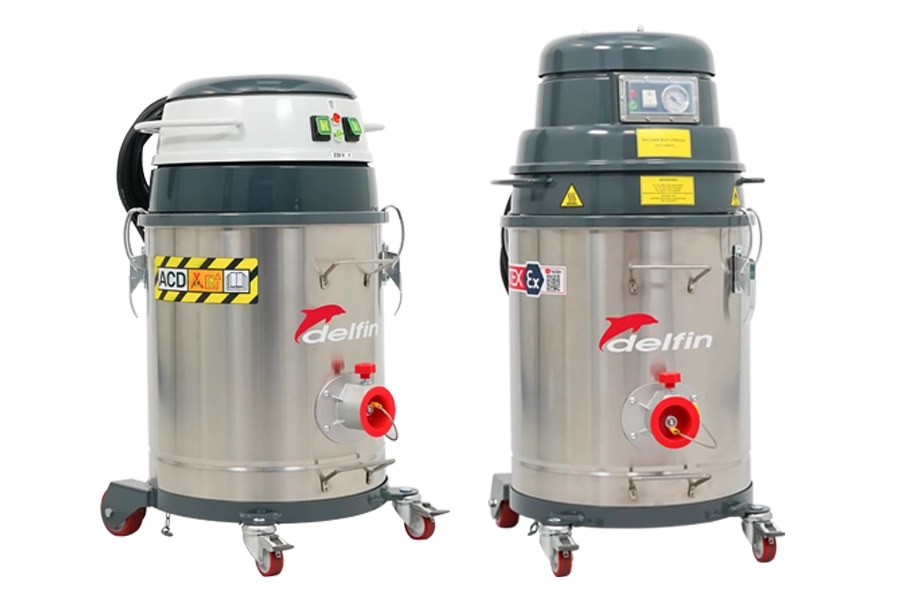
An ACD vacuum cleaner is certified under IEC 60335-2-69 Annex AA and designed for picking up combustible dust in non-classified locations. An ATEX vacuum cleaner is certified under the ATEX Directive 2014/34/EU and the harmonised EN 17348:2022 for use inside classified zones (Zones 20, 21, 22 for dust and 0, 1, 2 for gas). ACD protects against the combustible dust you vacuum in; ATEX protects against that and the explosive atmosphere you stand in.
Comparison at a glance
Lined up side by side, the two categories reveal their true distinctness. The table below is verified against the harmonised standards and the directive text itself.
| Criterion | ACD vacuum cleaner | ATEX vacuum cleaner |
|---|---|---|
| Underlying standard | IEC 60335-2-69:2021 Ed. 6.0, Annex AA | ATEX Directive 2014/34/EU + EN 17348:2022 |
| Area type | Non-ATEX-classified (ordinary location) | ATEX-classified zone — 20/21/22 or 0/1/2 |
| Risk addressed | Combustible dust cloud inside the bin | Explosive atmosphere inside AND around the machine |
| Third-party certification | Not required by the ACD standard — a manufacturer Declaration of Conformity per IEC 60335-2-69 is sufficient. Delfin voluntarily goes further and third-party-certifies the internal part as ATEX Category 1D. Depureco's ACD range (e.g. BL PRO ACD, BL 45 ACD) does NOT carry ATEX marking or an ATEX certificate on the interior — they are certified under the Machinery Directive and IEC 60335-2-69 | Mandatory — whole machine certified by notified body (IMQ, TÜV, CESI and others) |
| Typical marking | II 1/–D Ex h IIIC T80°C Da/– | II 1/2D Ex h tb IIIC T80°C Da/Db (example) |
| Internal EPL | Da (Zone 20 inside the bin) | Da (1D) or Db (2D) depending on category |
| External EPL | – (not classified) | Db (Zone 21), Dc (Zone 22), Gb/Gc for gas |
| Two-stage filtration | Main M + HEPA H14 (≥99.995%) | Main ISO 15E ≥95% + HEPA H ≥99.95% (per EN 17348) |
| Accessory requirement | Antistatic, continuous grounding | Surface resistance <10^8 Ω (EN 17348) |
| Typical brands | Delfin and Depureco (marked ACD). Tiger-Vac uses the term ORDLOC (Ordinary Locations) for the same use — US-rooted under NFPA 660. See ORDLOC section below | Delfin, Depureco and Tiger-Vac (all with ATEX-certified product ranges) |
| Lawful use in Zone 22 | No | Yes — requires at least 3D category |
| Lawful use in ordinary area | Yes | Yes (overspecified but permitted) |
The table points to the essential insight: the difference is not about the machine's quality. It is about the classification of the area. Choose wrongly and either safety falls short (ACD in a zone) or the purchase is needlessly expensive (ATEX in an ordinary room).
What is an ACD vacuum cleaner?
ACD stands for Appliance for pick-up of Combustible Dust. The category was formally introduced with the sixth edition of the international product standard IEC 60335-2-69, published in 2021, in its Annex AA, clause AA.3.208. The annex constitutes binding technical requirements — not guidance — that manufacturers and independent test laboratories use to certify ACD equipment for the European market.
The rationale is practical. Many pharmaceutical production rooms, packaging rooms, laboratories and food-processing lines are not ATEX-classified, because dust is well contained and the areas are kept clean. Yet inside a vacuum cleaner, the same lactose, starch or API powder can easily form a combustible cloud. That is precisely what the ACD vacuum is built for: internal Zone 20 protection in a non-classified world.
Typical technical baseline
- Motor head: spark-free, sealed, IP-tested for dust tightness.
- Two-stage filtration: primary class-M filter (dissipative, antistatic, ≥99.9 %) plus a secondary HEPA H14 filter (≥99.995 %) as a backup barrier.
- Full grounding: continuous electrical bonding between all parts, including hose and nozzles.
- AISI 304 stainless steel collection container (or 316 for harsher environments) with antistatic components throughout.
- Documentation of conformity with IEC 60335-2-69 Annex AA. The ACD standard itself does not mandate third-party certification — a manufacturer's Declaration of Conformity with supporting test documentation is sufficient. This makes it all the more important to study the manufacturer and the certification basis before buying.
Practice varies between manufacturers. Delfin voluntarily goes further than the ACD standard demands: they have a notified body third-party-certify the internal part as ATEX Category 1/–D, and describe it themselves as “more than applying the ACD label”. Depureco's ACD models (e.g. BL PRO ACD, BL 45 ACD) take a different route: they are certified under Machinery Directive 2006/42/EC and IEC 60335-2-69 (including Annex AA), but do not carry ATEX marking and do not have an ATEX certificate on the enclosure — as stated directly on their Declaration of Conformity. Both approaches are lawful and satisfy the ACD requirements; the difference is the weight of the documentation. For buyers where the extra documentation level matters in audits or insurance, this is a concrete choice to consider.
Typical marking
| II | Equipment Group 2 — surface industries (not mines) |
| 1/–D | Category 1 internal (Zone 20 inside the bin) / – external (no classified zone) |
| Ex h | Non-electrical explosion protection by constructional safety (per EN ISO 80079-36) |
| IIIC | Conductive dust subgroup (e.g. metal, carbon fibre) |
| T80°C | Maximum internal surface temperature |
| Da/– | EPL Da internal (highest level for dust), no external EPL |
ORDLOC — Tiger-Vac's parallel route
ACD is the European path. ORDLOC (Ordinary Locations) is the American one. Tiger-Vac uses the term for their vacuums designed to collect combustible dust in non-classified areas — same problem, different regulatory foundation.
The regulatory basis
Where ACD is anchored in the European product standard IEC 60335-2-69 Annex AA, ORDLOC references the American fire code framework: NFPA 660:2025 Vacuum Cleaning Method clause 8.4.2.2.1.8 (and NFPA 652:2019 clause 8.4.2.2.1.7 and NFPA 654:2020 clause 8.4.3.7), with additional OSHA workplace health and safety requirements. For Tiger-Vac's EU export models (the 2D-xx / 4D-xx ORDLOC Series), the certification is built on the Machinery Directive 2006/42/EC, the Low Voltage Directive 2014/35/EU and the EMC Directive 2014/30/EU — plus the supplementary ignition-prevention standards EN 1127-1:2019, IEC TS 60079-32-1:2013 (electrostatic hazards) and ISO 8031:2020 (conductive hose).
The seven minimum requirements in NFPA 660
NFPA 660:2025 lays down seven specific requirements for an ORDLOC vacuum, and Tiger-Vac's models are built to satisfy all of them:
- Construction materials must be conductive (per NFPA 660 clause 9.6.6.1)
- Suction hoses must be conductive or static-dissipative
- All conductive and static-dissipative components, including wands and attachments, must be bonded and grounded
- The fan or blower must sit on the clean side of the primary filtration media or wet separation chamber
- The vacuum must not be operated without filter media in place
- Electric motors must not be on the dirty side of the primary filter, unless listed for Class II/III Div. 1 or Zone 20/21
- Where liquids or wet materials are picked up, paper filter elements must not be used
Difference and similarity to ACD
| Criterion | ACD (EU) | ORDLOC (US + EU export) |
|---|---|---|
| Manufacturer examples | Delfin, Depureco | Tiger-Vac |
| Primary standard | IEC 60335-2-69 Annex AA (EU) | NFPA 660:2025 (US) |
| EU certification basis | IEC 60335-2-69 + Machinery Directive | EN 60335-2-2 + Machinery Directive + Low Voltage Directive |
| Ignition prevention | Internal construction per Annex AA | EN 1127-1 + IEC TS 60079-32-1 + ISO 8031 |
| Typical filtration | Class M + HEPA H14 | Dual HEPA H14 (MPPS per EN 1822) |
| Internal ATEX certificate on enclosure | Voluntary (Delfin does it; Depureco does not) | No — ORDLOC models are not ATEX-certified |
| Lawful in non-classified EU area with combustible dust | Yes | Yes |
| Lawful in ATEX zone | No | No |
For the buyer the consequence is bounded: both categories solve the same task in the same type of room. The choice often comes down to documentation culture (EU audits often prefer the IEC route), application specifics (e.g. cleanrooms, where HEPA and ESD emphasis may weigh more than the ACD mark itself), and supplier ecosystem (accessories, spare parts, service).
What is an ATEX vacuum cleaner?
An ATEX vacuum cleaner is designed, tested and certified for use in an area that is officially classified as explosive per the ATEX Directive 2014/34/EU (the Equipment Directive) and the harmonised design standard EN 17348:2022. It is not a variant of ACD. It is a distinct category where both the internal and external explosion protection is documented.
The difference from ACD is two-dimensional. ATEX covers both the internal environment (dust in the bin)
and the external (dust cloud or gas in the room). This is reflected in the two-digit marking
such as 1/2D — Category 1 internal, Category 2 external. For pneumatic and
combined units, gas categories come into play: for instance 3GD for Zone 2 (gas)
combined with Zone 22 (dust).
Core requirements in EN 17348:2022
- Ignition hazards assessment per EN 1127-1:2019 and EN ISO 80079-36:2016, for the whole machine including the internal dust environment.
- Conductive suction hose tested per EN ISO 8031:2020 for electrical resistance and conductivity.
- Measurement and disclosure of maximum internal surface temperature — the operator must know the number.
- Mechanically-generated sparks from picked-up solid objects are tested and characterised.
- Surface and through resistance <10^8 Ω on filters, bags, accessories and all non-metallic parts.
- The nameplate must state the collector type (DT, WT or LC — see below).
As Tiger-Vac put it in their September 2024 analysis: “An ATEX certification not covering compliance with EN 17348 is not enough to ensure that a vacuum cleaner is safe for the collection of combustible substances.” The point is worth remembering — because there are still machines on the market with older ATEX certificates that have not been upgraded to EN 17348.
Zones 20, 21, 22 — and 0, 1, 2
Zone classification comes from Directive 1999/92/EC (ATEX 137, the workplace dimension, implemented in Denmark in 2003) and appears in the company's explosion protection document. It describes how often an explosive atmosphere is expected to be present.
| Zone | Substance | Frequency | Equipment Category | EPL |
|---|---|---|---|---|
| Zone 20 | Dust | Continuous / long periods / frequent | 1D | Da |
| Zone 21 | Dust | Occasional during normal operation | 2D | Db |
| Zone 22 | Dust | Unlikely / short-term | 3D | Dc |
| Zone 0 | Gas | Continuous / long periods / frequent | 1G | Ga |
| Zone 1 | Gas | Occasional during normal operation | 2G | Gb |
| Zone 2 | Gas | Unlikely / short-term | 3G | Gc |
Important pitfall: the first digit of a marking such as 1/3D means
Category 1 internal — not Zone 1 (gas). Internal Zone 20
plus external Zone 22 gives the marking 1/3D — not 1/22.
The marking decoded, element by element
A real example from a Delfin BP single-phase vacuum cleaner:
| II | Equipment Group 2 — surface industries |
| 1/2D | Category 1 internal, Category 2 external; D = dust |
| Ex h | Non-electrical protection by constructional safety |
| tb | Electrical protection by enclosure (Ex t) at Db level |
| IIIC | Conductive dust — the finest and most hazardous subgroup |
| T80°C / T95°C | Maximum surface temperature, internal and external |
| Da/Db | EPL: highest internal dust protection (Da) / high external (Db) |
Enclosure protection Ex t (“t” for tight) means all electrical components are enclosed so that neither a dust layer nor a dust cloud can penetrate the casing. To achieve the IP 6X rating, the enclosure must pass three tests at an accredited institute: thermal and humidity endurance ageing, mechanical impact/tampering, and a dust-ingress test with the enclosure held under negative pressure.
The explosion pentagon — five elements, not three
Most people know the fire triangle: fuel, oxygen and an ignition source. A dust explosion needs two more conditions, because dust does not burn the way petrol does. It has to be dispersed in air as a cloud, and the explosion has to happen inside a confined space. Hence the explosion pentagon — five conditions that must all coincide.
The five conditions for a dust explosion
- Combustible dust — particles below about 500 µm that can ignite.
- Oxygen — typically the 21 % in air.
- Ignition source — sparks, hot surfaces, static electricity.
- Dispersion — the dust is airborne as a cloud, not deposited as a layer.
- Confinement — the explosion takes place in a closed space (e.g. inside a filter housing).
Remove one of the five and you remove the explosion. The ACD vacuum primarily targets no. 3 (no internal ignition source). The ATEX vacuum targets no. 3 both internally and externally, and addresses no. 5 through explosion-proof enclosures.
Two filtration barriers — a foundational principle
EN 17348:2022 introduces a clear concept of filtration barriers linked to the internal marking category for Zone 20. Understanding it matters because it sits at the core of both ACD and ATEX construction.
Level 1 — main filter, ISO 15E ≥ 95 %
A main filter sits inside the bin and prevents the bulk of the collected dust from reaching the motor head. The 95 % minimum efficiency (ISO 15E) is calibrated so that a Category 2D motor unit downstream can be legally certified.
Level 2 — HEPA after-filter, H class ≥ 99.95 %
The second level is the safety net: should the main filter fail or spring a leak, a HEPA-H filter (often H14, ISO 35H per EN 1822) captures the remainder. This is the level that allows a Category 3D motor unit to sit in the machine — by the time air reaches it, it has passed two barriers.
Filtration efficiency measurement follows ISO 29463:2018. Delfin documents each HEPA filter individually with a serial number and 100 % quality control (“individually tested HEPA filters as essential element for safety” is their own phrasing). Other manufacturers cover the same requirements but with different levels of documentation — it is always worth asking for a filter data sheet when purchasing critical units.
EN 17348:2022 and the three collector types
The harmonised standard defines vacuum cleaners by the substances they are intended to collect. The manufacturer must state the type on the nameplate, and the user must match the type to the application.
| Type | Abbreviation | Designed to collect | Examples |
|---|---|---|---|
| Dry Type | DT | Dry dust, combustible or non-combustible (not self-heating) | Lactose, flour, sugar, pharmaceutical APIs, cellulose, polymers |
| Wet Type | WT | Self-heating / reactive / conductive dust — submerged in an inerting liquid bath | Aluminium, titanium, magnesium, metal grinding dust |
| Liquid Collector | LC | Liquids, flammable or non-flammable | Swarf + coolant, solvents, liquid waste |
Note that EN 17348 applies to both electrical and non-electrical Category 2 and 3 vacuum cleaners for dust or liquid collection in both dust and gas atmospheres. It was harmonised under the ATEX Directive on 17 March 2023 and under the Machinery Directive in August 2023 — two dates that in practice mark a before and after in the life of the ATEX vacuum.
Decision framework — how to choose in practice
You only need to answer three questions before you can make a technically correct choice. They run in sequence — not in parallel.
Step 1
Is the area ATEX-classified?
Check the company's explosion protection document (EPD). If the area is listed as Zone 20, 21, 22, 0, 1 or 2, the answer is yes — you need an ATEX vacuum cleaner. If not, go to step 2.
Step 2
Do you handle combustible dust in the room?
Is the powder below about 500 µm and either organic or metallic (flour, sugar, starch, pharma APIs, milk, cocoa, wood, paper, textile, aluminium, etc.)? If yes, you need at minimum an ACD vacuum cleaner. If not (e.g. non-combustible ceramic, glass fibre, ordinary construction dust), a standard industrial vacuum is often enough.
Step 3
Is the dust reactive or conductive?
Aluminium, titanium, magnesium, carbon fibre, alkali metals or pyrophoric materials? Then you need a Wet Type (WT) collector (inert system with a liquid bath) regardless of whether the area is classified or not. For ordinary combustible powders a Dry Type (DT) is sufficient.
If the classification itself is in doubt, that is not a technical grey area — it is a risk management exercise. The right person to consult is the company's safety officer and the EPD, not the vacuum cleaner supplier.
Typical industries and dust types
A practical overview of where ACD and ATEX typically apply. Note that the same substance can appear in both columns — the room and the process decide, not the substance itself.
| Sector | Dust examples | Typical choice |
|---|---|---|
| Pharma and chemistry | Lactose, cellulose, APIs, titanium dioxide (TiO₂), aluminium oxide | ACD in production rooms; ATEX at milling, coating, blending |
| Food processing | Flour, sugar, cocoa, milk powder, coffee, spices, protein powder | ACD as a minimum; ATEX in silos and milling stations |
| Wood and furniture | Soft and hard wood dust from sanding, CNC | ACD at local extraction; ATEX in central filter systems |
| Metal and 3D printing | Aluminium, titanium, magnesium, carbon fibre (IIIC conductive) | ATEX 1/2D + Wet Type (WT) — inert system |
| Plastics and rubber | Polyethylene, polypropylene, EPDM granulate | ACD; ATEX in transport and separation |
| Oil, gas and energy | Coal, coke, bitumen dust, biomass | ATEX 2D or 1/2D; often combined with gas (GD marking) |
| Shooting ranges and ammunition | Gunpowder, lead, nitrocellulose | ATEX + Wet Type (self-heating) |
Common misconceptions
“We will buy an ATEX model to be safe.”
True in the sense that the machine is allowed in all zones. But if you buy an older ATEX vacuum without EN 17348 compliance, it is not sufficient for combustible dust. Check the production date and the certification version.
“ACD is just a cheaper ATEX.”
No. ACD is a different category with a different scope. An ACD vacuum is ATEX-certified internally for Zone 20 but is not approved for an external explosive atmosphere. Using ACD in a classified zone is a breach of workplace safety law.
“It is only flour, it is safe.”
Flour, along with sugar and starch, is one of the classic dust explosions — mill explosions have killed workers for centuries. Any organic powder below about 500 µm should be treated as potentially combustible until proven otherwise via a dust hazard analysis (MIE, MIT, Kst value).
“ESD and ATEX are the same thing.”
No. ESD (ElectroStatic Discharge) is about protecting sensitive electronics from static — semiconductor cleanrooms, not explosion protection. Some ATEX vacuums are also ESD-compatible, but they are two separate certifications.
“We do not need grounding, there are no sparks.”
Static sparks from an ungrounded metal nozzle can carry 5–10 mJ — enough to ignite aluminium dust (MIE < 10 mJ). EN 17348 requires continuous grounding and a conductive hose (EN ISO 8031:2020) — without them, the machine is not compliant.
Still unsure whether your area is classified?
We help clarify the zone, identify the right category and point to concrete models from Delfin and Depureco (ACD / ATEX) or Tiger-Vac (ORDLOC / ATEX). Call or email — we respond within one working day.
Frequently asked questions
Is ACD the same as ATEX?
When should I use an ACD vacuum cleaner?
When should I use an ATEX vacuum cleaner?
What does EN 17348:2022 mean for me as a user?
Can I use an ACD vacuum in a Zone 22?
Can I use an ATEX vacuum in an ordinary room?
What does T80°C on the nameplate mean?
Why is IIIC more important than IIIA/IIIB?
Do accessories (hoses, nozzles, brushes) also need to be ATEX-certified?
Is a HEPA H14 enough for certification?
How can I tell if my vacuum is correctly certified?
Can I get an inertised ACD vacuum cleaner?
What is ORDLOC? Is it the same as ACD?
Read more
- Can I use a regular vacuum for combustible dust? — in-depth article on ACD, IEC 60335-2-69 and the grey zone in the market.
- ATEX-certified is no longer enough — know EN 17348:2022 — why the new standard changes procurement.
- The ABC of ATEX — before there are sparks, there are choices — an introduction to ATEX as a regulatory framework.
- Inert vs. ATEX — when liquid is safer than enclosure — when Wet Type becomes necessary.
- Know your ohm — when surfaces must stay below 10^8 — about conductive hoses and accessories.
- Wiki: standards, terminology and regulations — reference desk for ATEX and ACD.
References
Directives and harmonised standards
- EU: ATEX Directive 2014/34/EU — Equipment and protective systems intended for use in potentially explosive atmospheres.
- EU: Directive 1999/92/EC (ATEX 137) — minimum requirements for improving the safety and health protection of workers potentially at risk from explosive atmospheres.
- CEN: EN 17348:2022 — Requirements for design and testing of vacuum cleaners for use in potentially explosive atmospheres. Harmonised under ATEX on 17 March 2023 and under the Machinery Directive in August 2023.
- CEN: EN 1127-1:2019 — Explosive atmospheres. Explosion prevention and protection. Part 1: Basic concepts and methodology.
- CEN: EN ISO 80079-36:2016 — Explosive atmospheres. Part 36: Non-electrical equipment. Basic method and requirements.
- IEC: IEC 60335-2-69:2021 Edition 6.0 — Household and similar electrical appliances. Safety. Part 2-69: Particular requirements for wet and dry vacuum cleaners, including power brush. Annex AA defines ACD.
- CEN: EN ISO 8031:2020 — Rubber and plastics hoses and hose assemblies. Determination of electrical resistance and conductivity.
- CEN: EN 1822:2019 (1–5) / ISO 29463 series — EPA, HEPA and ULPA filters.
- IEC: IEC TS 60079-32-1:2013 — Explosive atmospheres. Part 32-1: Electrostatic hazards, guidance.
ORDLOC — American reference standards
- NFPA: NFPA 660:2025 — Standard for Combustible Dusts and Particulate Solids, clause 8.4.2.2.1.8 on Vacuum Cleaning Method.
- NFPA: NFPA 652:2019 — Standard on the Fundamentals of Combustible Dust, clause 8.4.2.2.1.7.
- NFPA: NFPA 654:2020 — Standard for the Prevention of Fire and Dust Explosions from the Manufacturing, Processing, and Handling of Combustible Particulate Solids, clause 8.4.3.7.
- OSHA: Combustible Dust hazard communication and general-industry responsibilities under 29 CFR 1910.
Industry documentation
- Delfin Industrial Vacuums: ACD Industrial Vacuum Solutions for Combustible Dust — ATEX catalogue, Delfin Group, 2024.
- Depureco: ACD Industrial Vacuums for Combustible Dust in Non-Classified Zones — technical flyer, Volpiano (TO), 2025.
- Depureco: Don't Let Dust Threaten Your Production — ATEX Vacuum Catalogue, 2025.
- Tiger-Vac Inc.: EN 17348:2022 — A new machine safety standard regulating the use of vacuum cleaners in explosive atmospheres, September 2024.
- Tiger-Vac Inc.: Assessing the combustible properties of collected substances, October 2024.
- Tiger-Vac International Inc.: EU Declaration of Conformity for ORDLOC Series (2D-xx / 4D-xx), signed by Compliance Manager Stéphane Briquet, Laval, 27 May 2024.
- Tiger-Vac International Inc.: 2D-25L (DT) MFS HEPA ORDLOC Series (EU) — product brochure, Tiger-Vac Europa S.R.L., Ozzano Emilia, 2026.