
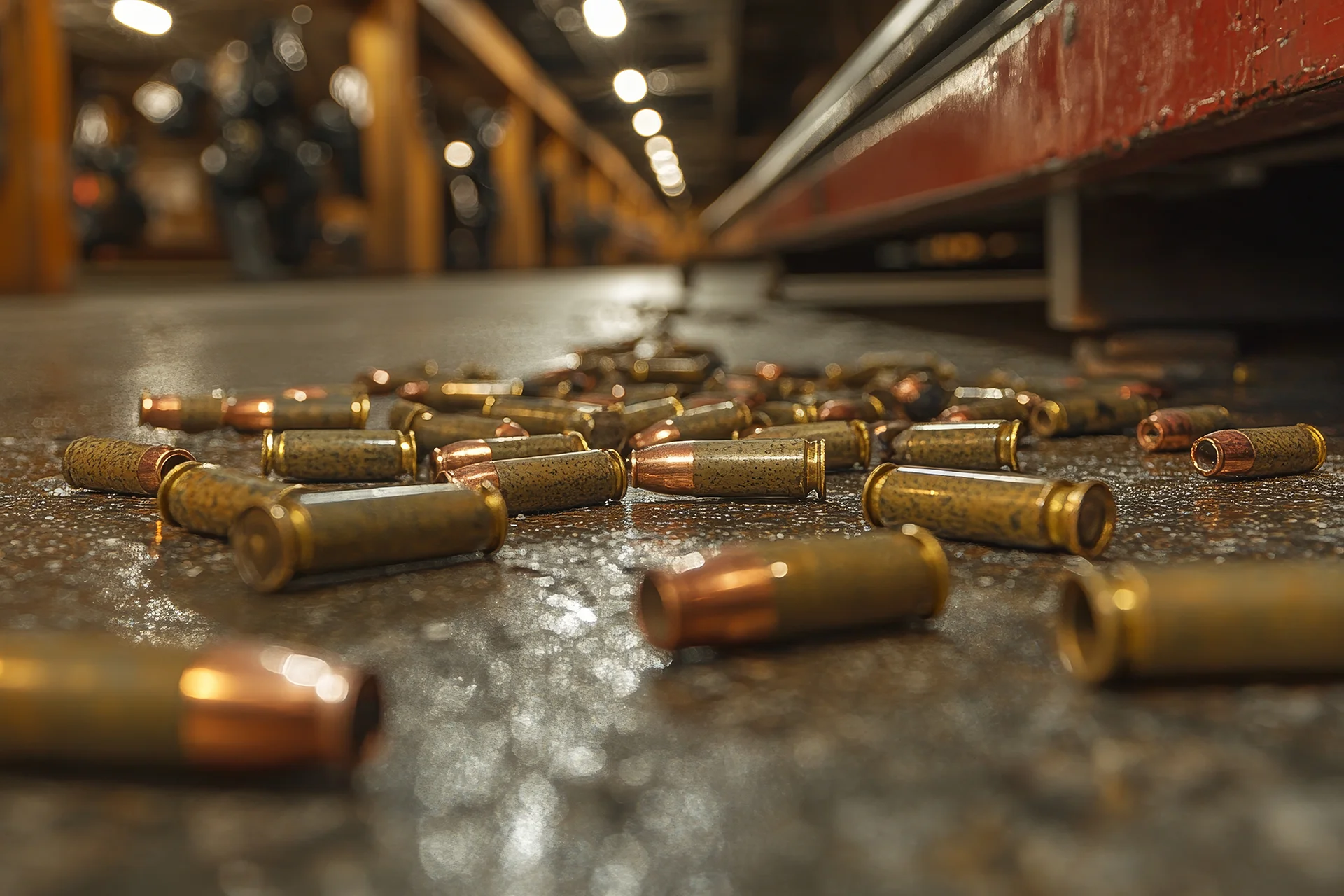
Why the challenge is bigger than ever
Indoor shooting ranges are under unprecedented pressure. New EU rules for both occupational health and explosion safety, combined with rising training activity and a lack of clear national guidance, mean that the responsibility for safe operation rests largely on the individual range.
That demands an overview — of health risks from lead and heavy metals, of explosion hazards from gunpowder residue, and of how standards such as EN 17348, EN 1822, IEC 60335-2-69 and EN IEC 62784 translate into practical day-to-day safety.
While the eye is on the target, the dust spreads
After the last shot has been fired, the silence feels heavy. The smell of powder lingers in the air, and the light catches an almost invisible layer of particles drifting across the floor, settling in corners, on shelves and in clothing. At military shooting ranges, police training facilities and private clubs across Europe thousands of rounds are fired every day, and the picture is the same in the United States and in Asia. Studies from all three regions show elevated blood-lead levels in indoor shooters even after only a few hours of weekly activity. Some researchers suggest the same may be true for outdoor shooters.
The hazardous particles also travel home as “take-home lead” on shoes, clothing and hair, where they can be released inside the house. They can then be inhaled or absorbed through skin and mouth, both by the shooter and by anyone else in the household. For children the risk is particularly serious: there is no known safe threshold for blood lead in children, and even low levels are linked to lasting cognitive and behavioural damage. In adults, lead can cause elevated blood pressure, kidney and nerve damage, and reduced fertility.
And once the facts are clear, the question becomes: will you carry on?
EU lead limits are routinely exceeded 20–30 times over
From 2024, the EU has introduced stricter limits for occupational lead exposure, reflecting the latest research on health effects.
The permitted airborne limit is now 0.03 mg per cubic metre of air, averaged over an eight-hour working day. This occupational exposure limit (OEL) applies to every EU workplace, including shooting ranges.
At the same time, the biological limit value for lead in blood has been set at 15 micrograms per 100 ml of blood. Because lead accumulates in the body over time, a transitional limit of 30 micrograms per 100 ml applies until 31 December 2028.
The background is straightforward: lead is toxic even in small amounts and damages the nervous system. Lead’s harmful effects have been known since antiquity, but systematic research into low-level exposure only began in the 1970s. Decades of subsequent studies have found no safe threshold, which has driven the current, very low limit values.
Measurements from European indoor ranges often sit 20–30 times above the limit. In Poland, readings up to around 23 times the limit have been recorded during operation, while in Germany “worst-case” values far higher have been measured during sweeping. The practical consequence is that even small layers of dust on floors, shelves and equipment can be enough to push a range over the limit, especially if the cleaning method spreads the dust rather than removing it. Sweeping, compressed air and conventional vacuum cleaners without correct HEPA filtration can send lead particles straight back into the air and make the situation worse.
Typical occupational limits for lead in blood
| Reference | Permissible blood-lead level |
|---|---|
| WHO (adults, occupational) | 10 µg/dL |
| EU occupational (BLV/BOELV) | 30 µg/dL (transitioning to 15 µg/dL from 2029) |
| Denmark | 20 µg/dL |
| Poland | 15 µg/dL |
| Finland | 15–20 µg/dL |
| Sweden | 20 µg/dL (people under 50 years of age) |
| Norway | 10.3 µg/dL (women), 31.0 µg/dL (other staff) |
Until the end of 2028 the EU signal is clear: far less lead is now permitted before a range can be considered medically defensible, which makes the method and equipment used for vacuuming a decisive control point.
The dual risk
Lead dust is toxic. Gunpowder dust is combustible. Both are dangerous, and both must be avoided, but in different ways. That gives indoor shooting ranges a dual risk: explosion and fire from powder residue, and a health hazard from lead and other metals.
ATEX is the body of rules covering equipment and work in places where combustible dust or gas can ignite. After a risk assessment, hazardous areas are classified into zones: Zone 21 (may occur during normal operation) and Zone 22 (may occur rarely and briefly). Inside closed equipment (for example inside the collection container of a vacuum cleaner) practice is to assume an “internal Zone 20”, because dust concentrations can be high and constantly present.
Not every part of a shooting range is an ATEX zone. Changing rooms, offices, corridors and classrooms are typically outside ATEX requirements, yet they can still be contaminated with lead dust. Here the focus must be on health: documented HEPA filtration (H14 as the final stage), leak-tight systems and good cleaning routines, so that dust is neither dispersed nor accumulated.
- Ignition can occur from about 170 °C and upwards. A small spark or even static electricity can trigger fire or explosion.
- Hazardous airborne dust level: a dust explosion can occur from 15 grams of dust per cubic metre of air. That corresponds to only 0.007 of a teaspoon of dust per litre of air.
- Explosive dust-layer thickness: even very thin layers of accumulated dust can explode, from a layer of just 1 mm.
- Real-world example: in 2023 a mobile police shooting range in California exploded because of accumulated powder residue and unsuitable equipment. One employee died and several others were injured.
In the firing hall itself, at the bullet trap, during filter emptying and during technical maintenance, ATEX scenarios can arise. Here equipment, accessories and working method must follow a zone classification based on a documented risk assessment.
Where unburned powder can be present, an inert/immersion solution (collection in oil) should be chosen, so that the dust is neutralised inside the container. Even if it later dries out, it has been impregnated and has lost its explosive potential.
Explosions do happen at shooting ranges
Real-world examples show that accidents occur when ordinary cleaning equipment is used on combustible dust.
In October 2023, two officers were training for a mandatory firearms qualification inside a mobile shooting range at Pitchess Detention Center north of Los Angeles. Suddenly a fatal explosion and fire broke out. Deputy Alfredo “Freddy” Flores, with 22 years of service behind him, sustained severe burns and was hospitalised with third-degree burns over most of his body. He died after nearly six months in hospital. The other officer was seriously injured but survived.
Flores’ family has sued the sheriff’s department for negligence and wrongful death. They argue that the accumulation of unburned powder, lead and other combustible material inside the trailer violated Cal/OSHA requirements for ongoing cleaning with approved equipment. Investigators concluded that the accumulated powder dust had been removed using non-explosion-protected vacuum equipment, and the report named static electricity, missing grounding and collection into unsuitable containers as central failures.
A study published in Forensic Science International describes a gunpowder dust explosion at an indoor shooting range in Istanbul, an incident with brutal consequences. The resulting fire was described as a “burn disaster”, distinct from ordinary burn injuries because the temperature and the toxic, hot gases created unusual burn patterns and an acute hazard for everyone present.
Fourteen people were evacuated from the site and seven were admitted to the hospital burn centre. Five of them died — two at the hospital and three at another centre. The injuries were not gunshot wounds but came from extreme heat and toxic particles in the explosion plume, a consequence of both ignited powder and the gases it released.
These events bring the essential problem into sharp relief: it does not take a hunting accident or a weapon malfunction to create a disaster. It only takes accumulated dust and a spark to ignite a dust cloud. Accidents happen in everyday operation when ordinary cleaning equipment is used on combustible dust: wrong equipment, missing grounding, static electricity and collection into unsuitable containers recur across incident reports.
That is why the choice of cleaning method and equipment is not cosmetic. Safe cleaning requires closed collection with equipment designed for combustible dust: an unbroken ESD discharge path through hoses and tools, correct grounding, documented tightness and filtration, and at the outer limit, systems where the dust is neutralised in a liquid bath.
Clear rules, but no one showing the way
Only 6 % of the EU’s 20,000 shooting ranges can continue to use lead ammunition if ECHA’s proposal is adopted. The remaining 94 % must invest between 5.5 and 6.2 billion euros — nearly six times higher than ECHA’s original estimate of 1.094 billion euros. The alternative is closure.
But that is not the only bomb ticking. While the debate over lead ammunition rages on, the risk of explosions from gunpowder dust remains almost completely unaddressed. And in the middle of this double crisis, European range operators are left without the one thing they need most: guidance showing how to comply.
The EU has the building blocks — the manual is missing
In December 2022, the first and still only document in Europe that combines protection against both lead poisoning and explosion hazards in a single coherent guide was published: the National Rifle Association’s Range Design and Safety Handbook. The irony is striking. It comes from the United Kingdom, which is no longer an EU member, yet builds on the EU’s own technical standards.
The 150-page handbook integrates the UK CLAW rules (Control of Lead at Work) with ATEX principles for explosion safety. It explains everything from ventilation design and H14 filtration to zone classification of hazardous areas and correct handling of powder residue. Chapters on “Control of Hazardous Substances in Indoor Ranges” and on bullet-trap maintenance translate standards into concrete, measurable operational requirements, not just theory.
The EU has the same building blocks: the ATEX Directive 2014/34/EU for equipment in explosive atmospheres, EN 17348 for dust collectors, EN 1822 for HEPA filtration, and from 2024 the tightened lead limits of 0.03 mg/m³ in air and 15 µg/dL in blood. Technically speaking, the EU framework is on a par with or ahead of the UK one. But whereas the UK has brought it together into a single workable manual, the EU member states are left with fragments scattered across occupational health, environmental and safety authorities.
- EN 17348 — Harmonised standard under the ATEX Directive (2014/34/EU) for transportable dust collectors in explosive atmospheres. Sets requirements for construction, materials, ESD dissipation, grounding, control of ignition sources and filtration.
- (EN) IEC 60335-2-69 — Base standard for commercial and industrial vacuum cleaners.
- (EN) IEC 62784 — Specific requirements for dust collectors for combustible dust (EPL Dc) as a supplement to 60335-2-69.
- EN 1822 / ISO 29463 — Classification and testing of fine filters (EPA/HEPA/ULPA). H14 = 99.995 % at MPPS is typically used as a final stage to capture the finest particles such as lead dust.
The national void, documented across Europe
In Denmark, the Working Environment Authority publishes general pages on lead and explosive atmospheres. The Danish Emergency Management Agency publishes ATEX guidance. The public health portal Sundhed.dk mentions indoor shooting ranges as a source of lead exposure. But no Danish authority has issued a consolidated guide for range operators showing how to combine H14 filtration, zone classification and lead reduction in daily operation.
Poland has its “Wzorcowy regulamin strzelnic”, a national model code focused on conduct and weapon safety. But it is not a technical operating manual for lead hygiene, ATEX cleaning or specification of filter classes.
Germany is arguably the most problematic. The Federal Ministry of the Interior’s 2012 Schießstandrichtlinien are built on the explosives act, not on ATEX or modern dust classification. The accompanying information sheets still permit methods such as dry sweeping, which by today’s standards can create both a health hazard and an explosion risk. Instead of clarity, the document creates confusion for operators trying to comply with both German and EU rules.
The pattern repeats in Sweden, Norway and Finland. All have implemented the EU directives in national law with varying blood-lead limits. But none has produced a consolidated, authority-issued guide specifically for shooting range operations.
The result: operators must navigate more than 100 pages of directives and standards, interpret technical language such as “EPL Dc”, “MPPS”, “H14” and “Zone 20/21/22” on their own. Measurements show lead concentrations 20–30 times above the new EU limits, but how many ranges are actually measuring? And even when they do, what is the solution?
Why is no one acting?
A 2024 survey by ESSF found that the cost of upgrading European shooting ranges is between 5.5 and 6.2 billion euros, not ECHA’s original estimate of around 1.1 billion. For many small, volunteer-run ranges, even a fraction of that is financially out of reach.
But economics is only one barrier. There is also a structural one: shooting ranges fall between the cracks of national government. Is it the occupational health authorities’ responsibility to protect shooters against lead? Or the environmental authorities’ task to prevent contamination? Should safety authorities handle ATEX classifications? In practice, responsibility is spread so thin that no one takes ownership.
On top of that comes political prioritisation. Shooting ranges are a small sector compared with industrial production, transport or construction. With limited resources in specialised agencies and a cross-pressure of tasks, ranges end up low on the priority list.
There is a fundamental mismatch between the complexity of the rules and the support provided for implementation. EU directives assume that national authorities will guide and support compliance, but that link is often absent in practice. The result is not anyone’s bad faith, but a structural void: rules without guidance, requirements without tools, responsibility without capacity.
What happens while we wait
While authorities deliberate and the industry navigates without a map, the problems accumulate out of sight.
Take a typical volunteer-run shooting range in Poland or Denmark. The Range Conducting Officer knows that the vacuum cleaner’s filter must be “good enough” for lead dust. But what does good enough mean? H13? H14? EPA? And does the hose have to be antistatic if only .22 LR is being fired? The manufacturer answers “it depends on your zone classification.” But who does the classification, and what does it cost?
While the questions pile up, operation continues. The dust is swept together, perhaps with the wrong equipment. Lead accumulates in corners, on shelves and in the clothes people wear home. Powder residue forms layers in ventilation ducts that no one has classified as Zone 22.
Measurements show lead concentrations 20–30 times above the new EU limits, but how many ranges are actually measuring? And even when they are, what is the solution without financial support for upgrades?
This is not malice or indifference. It is a regulatory vacuum, where responsibility has been assigned but the means and the guidance have not. And while we wait for someone to take the initiative, both lead exposure and explosion risk remain real threats, documented through accidents in California in 2023 and in Istanbul, and through decades of research on “take-home lead” affecting families and children.
Who takes the lead, and who pays the bill?
The United Kingdom has shown that it is possible to translate EU technical standards into workable practice. The NRA’s 2022 handbook is the proof. But it does not solve the cost problem. It only clarifies what needs to be done.
And that raises the next question. If upgrading European shooting ranges costs 5.5 to 6.2 billion euros, who is going to pay? The UK guide helps operators understand the requirements for ventilation, H14 filtration, ATEX zone classification and cleaning routines. But it provides no grants to install the equipment.
For small, volunteer-run clubs, the guidance therefore becomes paradoxical: now they know exactly what they cannot afford to do.
That points to a fundamental problem in the entire debate. When ECHA proposes restrictions on lead ammunition with exceptions for ranges that implement “risk management measures”, the proposal rests on two assumptions:
- That operators understand what is required (here guidelines are missing)
- That they have the means to implement it (here funding is missing)
The UK model addresses only the first. The second remains unresolved, both in the UK and in the rest of Europe.
So what is needed?
First: guidance. The EU member states, or the EU itself, could develop a standardised guide in cooperation with ESSF, AFEMS and national organisations. The UK has shown the prototype; it can be adapted.
Second: transition support. Without funding programmes, technical assistance or realistic transition periods, even the best guide becomes an unrealistic catalogue of requirements. Other industrial sectors have been given decades for equivalent adjustments. Shooting ranges typically get 18 months to five years, at costs many cannot bear.
Third: prioritisation. If the goal is to protect health and prevent explosions, closing 94 % of the infrastructure does not help. A pragmatic approach would be to focus first on high-risk areas (indoor ranges with high activity), extend transition periods for low-risk ranges and offer practical support rather than requirements alone.
50 years of knowledge, the same open questions
Lead risks at shooting ranges have been documented since the 1970s. The ATEX framework has existed since the 1990s and was revised in 2014. Activity at the ranges is rising. EU requirements are tightening. And still the operators wait for someone to show them the way.
The question is no longer whether the rules are good enough. The question is when someone will take responsibility for making them usable. Because right now, 94 % of Europe’s ranges are trapped between standards they cannot interpret and requirements they cannot afford.
When the experts disagree, whom do you trust?
It sounds like an easy task: buy a vacuum cleaner and the problem is solved. But not even the manufacturers of industrial vacuum cleaners can agree on what is “good enough” for a shooting range. Some argue ATEX everywhere, others say ordinary industrial vacuums are fine outside the risk zones. Some highlight special techniques for unburned powder. And almost every manufacturer ends up saying the same thing: it is your responsibility to define the need — we just supply the equipment. It is almost too easy to be a supplier that way.
The safest course is naturally to bring in independent expert help, so you can lean back and let others do the work. But even if someone else defines the responsibility, the responsibility itself is still yours.
So even with outside help, a lot of work remains on your side. A good recommendation is therefore to start yourself and see how far you can get. You can always call in occupational-health advisors, ATEX specialists and accredited laboratories afterwards.
Is your vacuum solution fit for shooting ranges?
| Area of the range | Standard vacuum with H14 filter | Professional ATEX solution | Notes |
|---|---|---|---|
| Office and communal areas | Sufficient if the area is kept dust-free and does not receive direct traffic from the range. Requires an H14 filter and regular filter changes. | Not required, but HEPA filtration and antistatic accessories are recommended for optimal safety. | Primary focus is on preventing health risks. No ATEX requirement as no explosion hazard is expected. |
| Changing rooms and storage | Only if the area is not ATEX-classified (no risk of combustible dust). Use H14 filtration and antistatic equipment to remove lead dust from clothing and shoes. | Not required unless heavy contamination or dust accumulation occurs. | Non-zone area. Stops take-home lead at the exit without ATEX obligations. |
| Firing hall and bullet trap | Not permitted — high explosion risk even with small quantities of unburned powder. Standard equipment can create sparks and ignition sources. | Required: ATEX Zone 21-certified industrial vacuum with immersion separator, HEPA H14 as the final stage and a complete ESD and grounding chain. | High-risk area. Inert collection in a liquid bath is critical to neutralise powder and reactive dust. |
| Ventilation systems | Unsuitable — risk of re-circulating contaminated air, sparking and secondary contamination of other areas. | Required: ATEX Zone 21-certified industrial vacuum with immersion separator, HEPA H14 as the final stage and a complete ESD and grounding chain. | Accumulated dust can dry out and become reactive. Inert collection is strongly recommended. |
| Waste handling and containers | Risky to use non-explosion-protected equipment. Critical for safe emptying and handling of contaminated waste. | Required: ATEX Zone 21-certified industrial vacuum with immersion separator, HEPA H14 as the final stage and a complete ESD and grounding chain. | Manual handling should be avoided. Inert liquid is strongly recommended to neutralise explosive materials. |
| Technical rooms and plant rooms | Often possible if the room is dry and not ATEX-classified. Focus must be on correct dust classes and filtration. | ATEX equipment required if an explosive dust atmosphere can form or if contaminated material is handled. | Check electrical equipment and grounding. Inert collection may be necessary for unknown dust. |
| Weapons-cleaning rooms and benches | Acceptable only with documented low lead levels and good ventilation. Local extraction at the workstation is required. | ATEX equipment required if weapon cleaning can release gunpowder dust or create static-electricity risks. | Always use local extraction. Z21/inert industrial vacuum recommended where gunpowder dust can be released. |
| Break rooms and canteens | Permitted with H14 filter and frequent filter changes. Important to maintain a high hygiene standard and avoid cross-contamination. | ATEX not required, but hygiene is critical to protect non-exposed people. | Primary risk is “take-home lead” from contaminated clothing and equipment. |
| Entrances, airlocks and corridors | H14 filter as a minimum. Zone separation should be considered to control spread between clean and contaminated areas. | ATEX only required if these areas border directly on ATEX zones or receive direct contamination. | Critical for spread control. Zone integration and airlock function are important. |
| Toilets and changing facilities | Permitted if not contaminated. Hygiene area must be separated from working areas, with clear procedures for changing clothes. | ATEX not required, but increased focus on routines and hygiene requirements. | Important for “take-home lead” control. No inert requirement. |
| Workshops and repair rooms | H14 filter for low-risk activities. ATEX requirements apply when processing or repairing ammunition and weapons. | ATEX required if work involves explosive or lead-containing material, or if spark formation is a risk. | Individual risk assessment needed. Inert collection recommended where powder or mixed dust can occur. |
| External and outdoor areas | Typically not relevant for vacuum equipment, but disposal and transport of contaminated material must be controlled. | ATEX may be required for bulk handling of residue or contaminated waste in larger quantities. | Z21/inert industrial vacuum recommended for larger volumes of unknown dust, for example in indoor containers. |
| Sand or earth traps outside the bullet catcher | Requirements depend on lead content and zone classification. Dry handling significantly increases risk compared to wet methods. | ATEX required if there is a risk of accumulated powder dust or explosive mixtures. Z21/inert industrial vacuum strongly recommended for dry operation. | Separate risk assessment required, based on ammunition type and operating pattern. |
| Rental and loan department | Ordinary industrial vacuum with HEPA filter recommended. Increased cleaning frequency needed because of many users. | ATEX not required under normal circumstances, but stricter hygiene and cleaning frequency are critical. | Many different users create an increased risk of cross-contamination. |
Have you recognised your own situation in the table?
You may be unsure where the line runs between ordinary cleaning equipment and ATEX requirements. You may be unsure whether your solution actually meets the authorities’ expectations. Or you may simply want to be certain before anyone starts asking.
Then let us have a conversation
We offer a free, non-binding review of your shooting-range facility, helping you assess risks, cleaning routines and equipment. So you can be certain that your solution holds up.
Do you want peace of mind? Then let us look at it together.
Are you ready for the EU’s tightened lead and ATEX requirements for shooting ranges?
We review your existing solution area by area and give you a concrete assessment of what must be upgraded and what can continue to be used.
Contact us- Blood-lead contamination in indoor shooters (DK).
- International review of lead at shooting ranges.
- Chemical Analysis of Gunpowder Residues.
- Interpol Review of Gunshot Residue 2019–2021.
- Lead exposure in shooters (Nature, 2023).
- Risk analysis for shooters (DK).
- Lead exposure at firing ranges — a review.
- Lead in indoor shooters, Korea 2025 (JKMS).
- Public report: lead among sports shooters.
- Heavy metals in shooting-range air.
- Long-term indoor gunshot exposure.
- Occupational Exposure to Metals in Shooting Ranges.
- Ammunition composition and health risks.
- AP News: Explosion at mobile police shooting range, Los Angeles 2023.
- Forensic Science International: Istanbul indoor range explosion, “burn disaster” case.
- Case: Proactive lead reduction at a shooting range (Sysco Env.).
- Gun culture & lead report (VPC, USA).
- UK military standard for shooting ranges (JSP 403).
- OSHA: Lead risk management.
- NIOSH: Lead & cleaning (CDC).
- NIOSH: Occupational lead exposure.
- Sundhed.dk: Lead (DK).
- Danish Emergency Management Agency: ATEX guidance.
- Danish Working Environment Authority: Lead and lead-containing materials.
- ATEX Directive 2014/34/EU.
- ATEX Workers Directive 1999/92/EC.
- EN 17348:2022 — ATEX vacuum cleaners and dust collectors.
- EN 1822 / ISO 29463 — Classification and testing of HEPA/EPA/ULPA filters.
- IEC 60335-2-69:2021 — Safety requirements for vacuum cleaners.
- EN IEC 62784:2018 — Specific requirements for dust collectors for combustible dust (EPL Dc).
- EN ISO 80079-36:2016 — Non-electrical Ex equipment.
- EN ISO 80079-37:2016 — Protection methods for mechanical Ex equipment.
- EN ISO 8031:2020 — Electrical properties of hoses.
- Thomas Lyngskjold. “Inert vs ATEX.” ex-vac/en/articles
- Thomas Lyngskjold. “Fuel handling in the defence sector with Tiger-Vac.” ex-vac/en/articles
- Thomas Lyngskjold. “ATEX approval is no longer enough — get to know EN 17348:2022.” ex-vac/en/articles