High-temperature · up to +300 °C
CP ARAMID 461 PROTECT
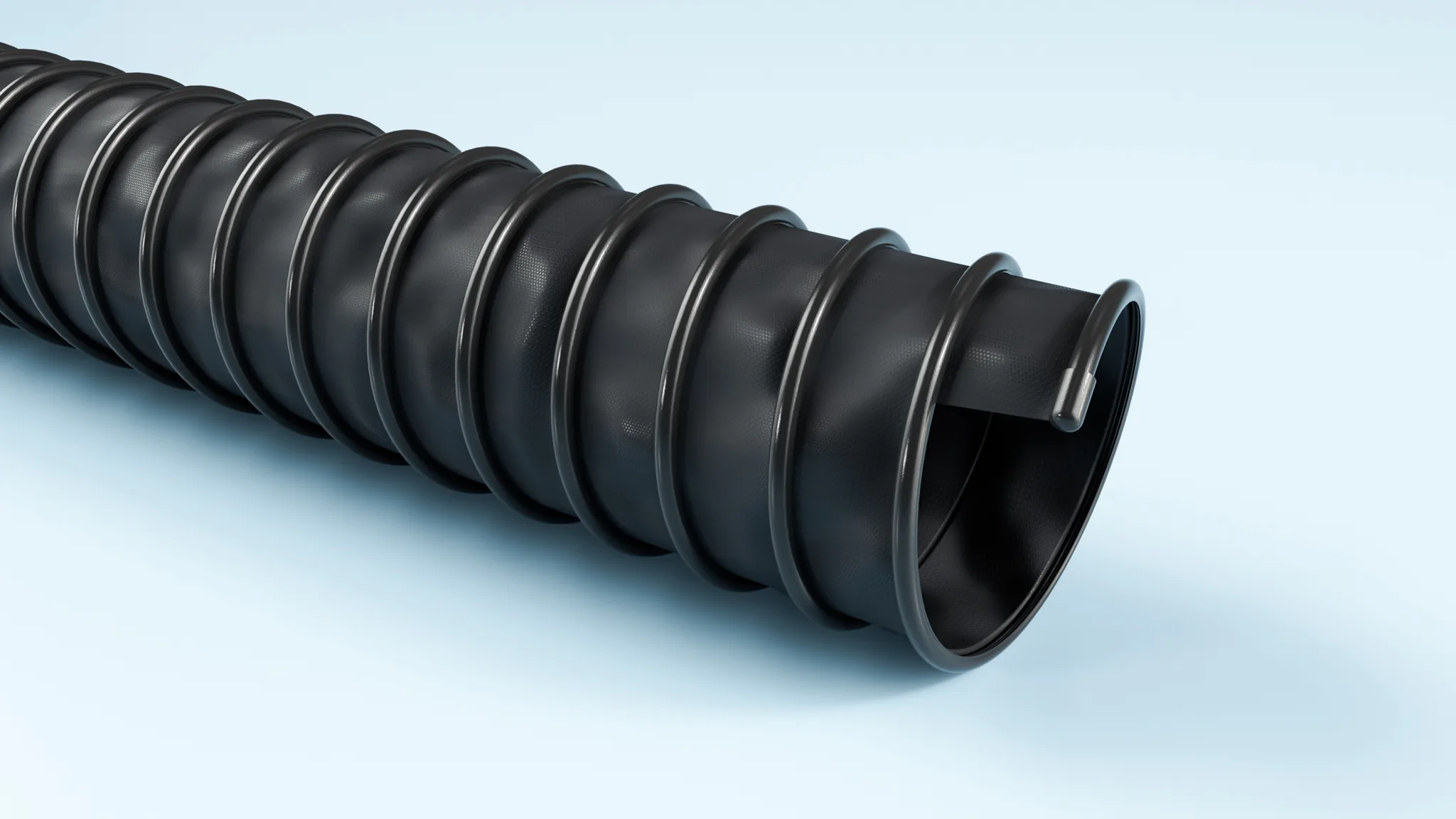
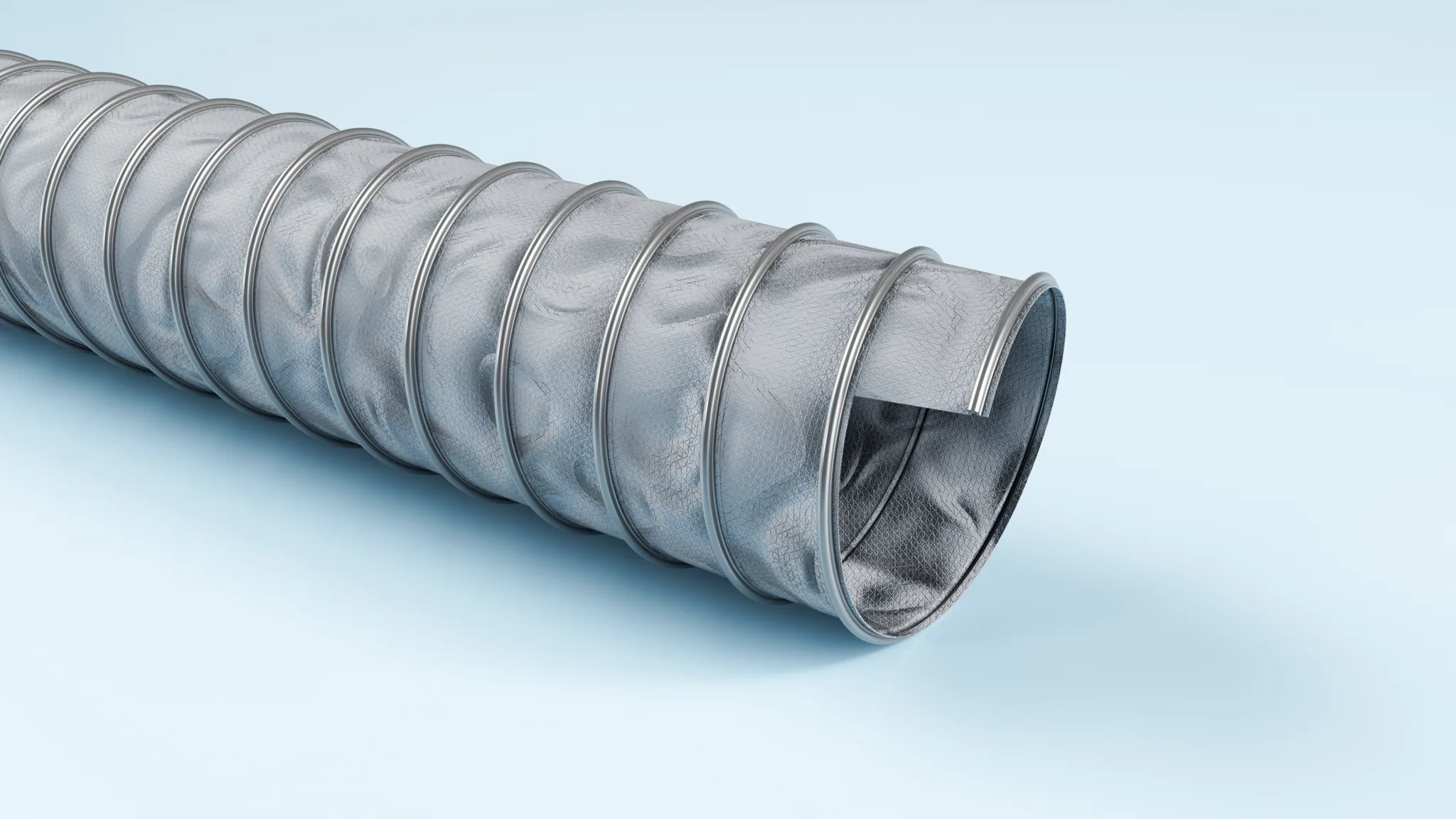
Highly flexible exhaust hose with external protection profile — designed for extracting engine exhaust gases up to +300 °C. The aramid wall has M1 fire class per UNE 23.727-90 and is highly vibration-resistant. The protection profile is firmly clamped from elasticised high-temperature plastic that absorbs impact and abrasion. Designed for workshop pits, exhaust extraction, exhaust removal on dynamometers and engine test benches.
- Up to +300 °C
- M1 fire class
- Aramid wall
- Shock-absorbing
- Highly flexible
- Cut to length
Why this hose?
CP ARAMID 461 PROTECT is specialised for a specific task: extracting hot engine exhaust gases where temperature can reach +300 °C and where the hose is simultaneously subjected to vibrations from the engine. The aramid wall is chosen because aramid fibres have one of the highest melting temperatures among synthetic fibres — typically above +400 °C.
The external protection profile is the visible main feature. The profile is made of elasticised high-temperature plastic and firmly clamped around the hose in a spiral. It absorbs both impact (when the hose hits edges or falls) and abrasion (when the hose is dragged across floors or edges). This extends hose lifetime significantly in workshop environments.
The M1 classification per UNE 23.727-90 means the material is non-combustible in the European fire class scale — the highest fire resistance for flexible plastic materials. It's a critical parameter when the hose sits close to hot exhaust pipes where a spark could ignite ordinary hose materials.
Where it is used
The classic application is vehicle workshops with pits or lift-bridges, where a flexible extraction hose runs from the exhaust pipe up to a central extraction unit. The aramid + protection profile combination is what lasts longest in daily workshop use.
On dynamometers and engine test benches the hose sits as a form-stable connection between the engine and the emission measurement unit. Vibrations from the engine are constant and strong — the hose's flexibility and vibration resistance is what makes it suitable.
In emissions test facilities it's often used in combinations where multiple hoses are parallel (e.g. on multiple vehicles tested simultaneously) — the external profile ensures the hoses don't abrade against each other.
In everyday talk we call it an "exhaust hose with profile" or "workshop exhaust hose" — the visible protection profile is the first thing you recognise.
Technical specifications
Technical specifications for CP ARAMID 461 PROTECT.
| Material | Aramid + fabric reinforcement, external high-temperature plastic profile |
|---|---|
| Spiral | Galvanised steel |
| Inner diameter | 75.6–250 mm |
| Temperature | 0 to +300 °C (peak) |
| Fire class | M1 (UNE 23.727-90) |
| Vibration resistance | High |
| Protection profile | Shock-absorbing, anti-abrasion |
| Conformity | UNE 23.727-90 (M1), REACH, RoHS |
| Cut to length | Yes |
| Manufacturer SKU group | 4617500 |
Dimensions and ordering
Standard dimensions for CP ARAMID 461 PROTECT from Ø 75.6 mm to Ø 250 mm. The hose is primarily designed for medium to large extraction applications.
| Inner Ø |
Outer Ø |
Working pressure |
Vacuum |
Bend radius |
Max. length |
Weight |
Article no. |
|---|---|---|---|---|---|---|---|
| 75.6 | 87.6 | 0.42 | 0.23 | 48 | 10 | 0.85 | 46100757500 |
| 80 | 92 | 0.405 | 0.2 | 49 | 10 | 0.89 | 46100807500 |
| 101.5 | 113.5 | 0.25 | 0.12 | 58 | 15 | 0.86 | 46101007500 |
| 101.5 | 113.5 | 0.25 | 0.12 | 58 | 15 | 0.86 | 46101027500 |
| 120 | 132 | 0.22 | 0.085 | 63 | 15 | 1.01 | 46101207500 |
| 126.5 | 138.5 | 0.22 | 0.085 | 70 | 15 | 1.06 | 46101257500 |
| 151.5 | 163.5 | 0.14 | 0.05 | 81 | 15 | 1.04 | 46101507500 |
| 160 | 172 | 0.125 | 0.04 | 86 | 15 | 1 | 46101607500 |
| 180 | 192 | 0.115 | 0.03 | — | 15 | 1.12 | 46101807500 |
| 202.3 | 214.3 | 0.115 | 0.03 | 103 | 15 | 1.26 | 46102007500 |
| 250 | 262 | 0.08 | 0.025 | 125 | 15 | 1.54 | 46102507500 |
Fields without a value (—) are not specified in the manufacturer's factsheet. Overpressure and underpressure values are recommended operating limits; the product can be subjected to higher loads on request. Bend radius is measured along the inside of the hose bend.

Standards and compliance
CP ARAMID 461 PROTECT is tested and compliant with the following:
- UNE 23.727-90 M1. Spanish fire class standard; M1 corresponds to "non-combustible" — the highest class for flexible plastic materials. Standard in industrial and test facilities with high-temperature media.
- REACH (EC 1907/2006). The manufacturer's REACH declaration is available for download.
- RoHS. Directive 2011/65/EU on the restriction of hazardous substances.
Documentation and downloads
Additional documents about this hose, its compliance and installation. Click to download as PDF in a new tab.
Help with material selection
Although this hose isn't ATEX-relevant, these two articles provide useful background on electrical resistance and industrial safety — important if you later combine the hose with electrical equipment or work in mixed environments:
The invisible weakest link
Why a conductive or antistatic hose isn't sufficient on its own — and what grounding means for the complete system.
Know your ohm
The difference between antistatic and conductive, which resistance limits apply where, and how to measure them correctly.
Industries that use it
CP ARAMID 461 PROTECT is used in specific high-temperature extraction applications:
Vehicle workshops are the largest user group. Here the combination of +300 °C peak, vibration resistance and the robust protection profile is precisely what makes the hose practically usable in a busy workshop environment.
At emissions test facilities and dynamometers the hose is often permanently installed. Here the long-term stable aramid wall and the M1 fire classification are important for both operation and authority approvals.
In the chemical industry it's used for hot process gas extraction. When the process generates vapours above +200 °C, aramid is the right material — ordinary PVC and PU hoses would melt at these temperatures.
Custom lengths and assemblies
The hose is delivered on 10 m and 15 m rolls. We cut to length and fit couplings or flange solutions as a finished assembly.
For workshop installations we can establish standard configurations that are repeatable across deliveries.

Frequently asked questions
Does it tolerate +300 °C continuously?
No — +300 °C is the peak temperature, not continuous service. For long-term stability, continuous service should be below +200 °C. For continuous service above +300 °C choose a metal hose — for example METAL HOSE INOX 376 which tolerates +600 °C.
What is M1 fire class?
M1 is the Spanish fire class standard (UNE 23.727-90) corresponding to "non-combustible". It's the highest class for flexible plastic materials and is commonly accepted across the EU as documentation that the material doesn't itself contribute to fire.
What's the difference between CP ARAMID 461 and CP ARAMID 461 PROTECT?
Standard CP ARAMID 461 has the same aramid wall but without the external protection profile. The PROTECT variant adds the firmly clamped profile that absorbs impact and abrasion — important in workshop environments where the hose is handled daily.
How long is the lifetime in a car workshop?
It depends greatly on use — number of cars per day, how often the hose is handled, and how hot the exhaust is. Typically it lasts 2-5 years in daily workshop use. The protection profile is what typically wears first, which is a good indicator for replacement before the hose itself is compromised.
Can I get it with specific couplings for my exhaust nozzles?
Yes. We cut to length and typically fit a flange or standard exhaust nozzle connection at one end, and a standard suction-side coupling at the other. Tell us which flange system your extraction unit has.
Is it ATEX-approved?
No. The hose is insulating and is neither conductive nor antistatic. In car workshops ATEX is typically not a requirement, but in emissions test facilities with specific gas types it may be. For ATEX zones choose a conductive variant — contact us for assessment.