Smooth interior hoses
Hoses where the inner wall is smooth rather than corrugated. That means lower pressure drop, fewer places for material to settle, and a wall that can actually be cleaned properly.
Most spiral hoses have an inner wall that follows the spiral and is therefore ribbed. That is cheap and flexible, but every rib is a small obstruction: it slows the air stream, creates turbulence and gives material somewhere to collect. A hose with a smooth interior has an inner lining or a construction that lays the wall flat across the spiral.
The difference matters most in three places. In pneumatic conveying, where the pressure drop across a long run costs blower capacity directly. In food and pharmaceutical production, where a smooth wall can be cleaned and documented while a ribbed wall retains residue. And with abrasive media, where the particles otherwise strike hardest on the rib crests.
This page gathers the hoses in the range that have a smooth interior. The filters on the left can combine the property with the other requirements your process imposes, such as food approval or electrical dissipation.
Products
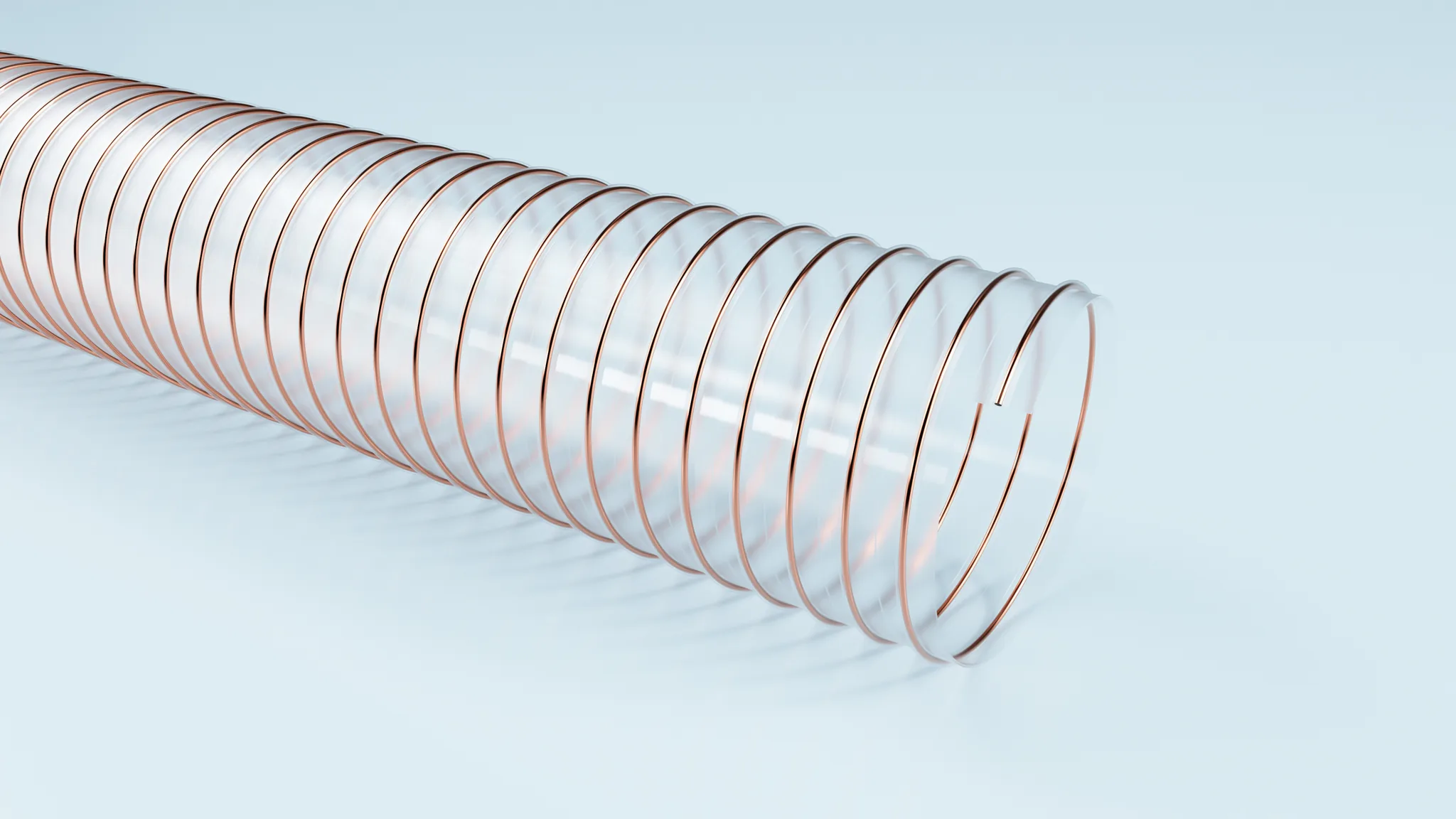
AIRDUC® PUR 350 FOOD-AS (MD)
Food-grade antistatic polyurethane hose for pneumatic conveying of flour, grain and pharmaceutical products
- Inner Ø: 25.1-500 mm
- Temp: −40°C to +90°C
- Standards: EU 1935/2004, EU 10/2011

AIRDUC® PUR 352 SE (MD)
Flame-retardant polyurethane hose for ventilation, heating and plumbing in rail vehicles and ships
- Inner Ø: 20-450 mm
- Temp: −40°C to +90°C

AIRDUC® PUR 356 EC (XHD)
Conductive extra-heavy-duty polyurethane hose for extremely abrasive media in ATEX zones
- Inner Ø: 32-100 mm
- Temp: −40°C to +90°C
- Standards: ATEX 2014/34/EU, TRGS 727

AIRDUC® PUR 357 VAC-TRUCK
Extremely abrasion-resistant vacuum truck hose with very high pressure, vacuum and compression resistance
- Inner Ø: 100-250 mm
- Temp: −40°C to +90°C

AIRDUC® PUR 350 AS (MD)
Lightweight antistatic PUR hose for pneumatic transport in ATEX zones
- Inner Ø: 25.1-500 mm
- Temp: −40°C to +90°C
- Standards: ATEX 2014/34/EU, TRGS 727, DIN 26057

AIRDUC® PUR 351 EC (MD)
Electrically conductive polyurethane hose for ATEX zones
- Inner Ø: 25.1-315 mm
- Temp: −40°C to +90°C
- Standards: ATEX 2014/34/EU, TRGS 727, DIN 26057

AIRDUC® PUR 355 AS (HD)
Antistatic heavy-duty polyurethane hose for abrasive media in ATEX zones
- Inner Ø: 13-500 mm
- Standards: ATEX 2014/34/EU, TRGS 727, DIN 26057

AIRDUC® PUR 355 EC (HD)
Conductive heavy-duty polyurethane hose for abrasive media in ATEX zones
- Inner Ø: 20-110 mm
- Temp: −40°C to +90°C
- Standards: ATEX 2014/34/EU, TRGS 727, DIN 26057

AIRDUC® PUR 355 FISH (HD)
Heavy-duty PUR hose specifically for aquaculture and fish farming
- Inner Ø: 101.5-500 mm
- Temp: −40°C to +90°C
AIRDUC® PUR 355 FOOD (HD)
Heavy-duty food-grade PUR hose for abrasive media
- Inner Ø: 13-400 mm
- Standards: EU 1935/2004, EU 10/2011, FDA 21 CFR

AIRDUC® PUR 355 HT (HD)
Heavy-duty PUR hose for abrasive media at elevated temperatures
- Inner Ø: 25.1-400 mm
- Temp: −40°C to +100°C
- Standards: DIN 26057

AIRDUC® PUR 356 AS (XHD)
Antistatic extra heavy-duty PUR hose for the toughest media in ATEX zones
- Inner Ø: 32-300 mm
- Temp: −40°C to +90°C
- Standards: ATEX 2014/34/EU, TRGS 727, DIN 26057
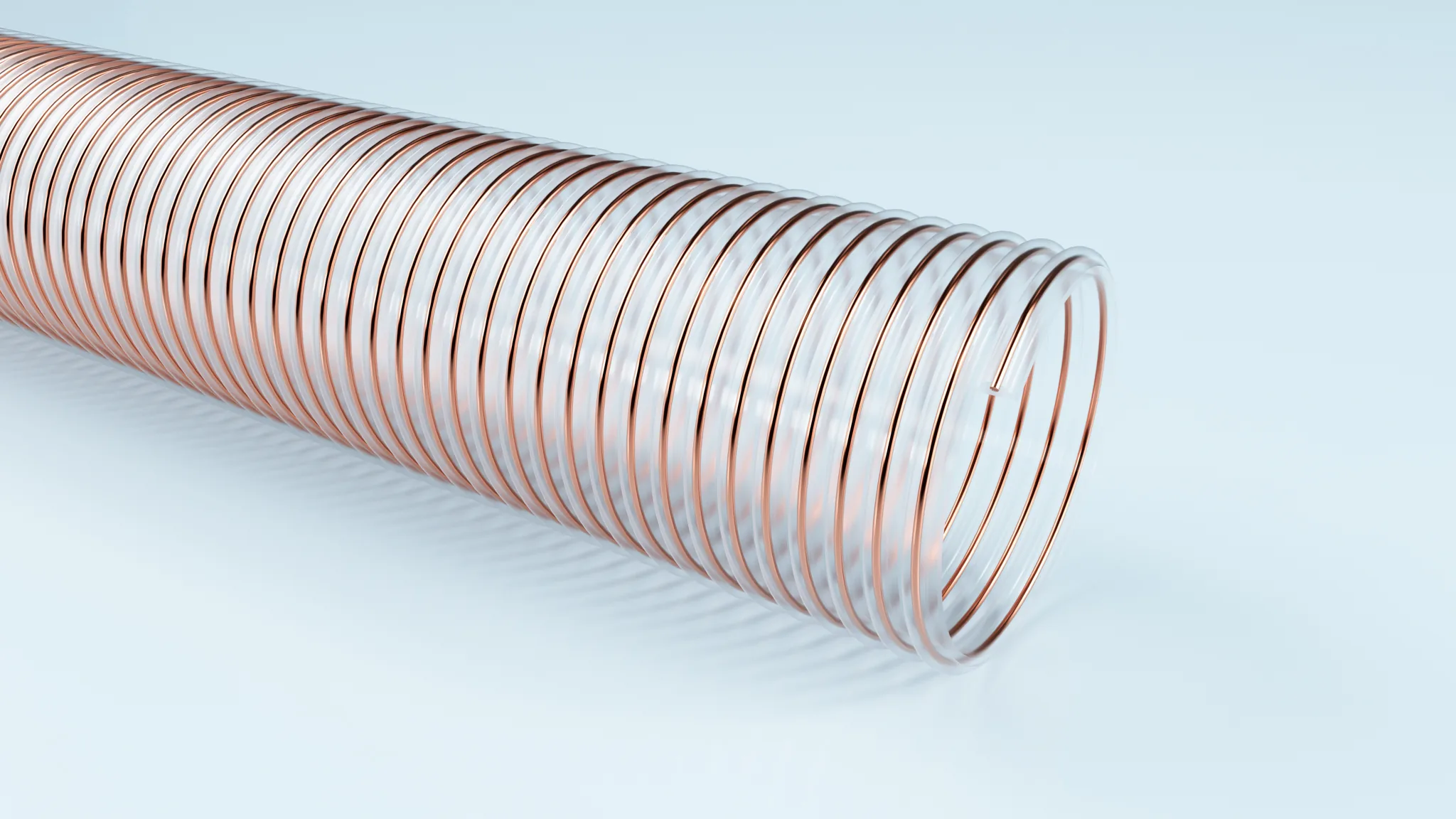
AIRDUC® PUR 356 FOOD (XHD)
Extra heavy-duty food-grade PUR hose for high throughputs of abrasive food media
- Inner Ø: 32-152 mm
- Temp: −40°C to +90°C
- Standards: EU 1935/2004, EU 10/2011, FDA 21 CFR

AIRDUC® PUR-INOX 355 FOOD-AS (HD)
Antistatic food-grade heavy-duty PUR hose with stainless steel spiral
- Inner Ø: 25.1-202.3 mm
- Temp: −40°C to +90°C
- Standards: EU 1935/2004, EU 10/2011, FDA 21 CFR

BARDUC® PUR-INOX 382 FOOD-AS (XHD)
Food-grade antistatic extra-heavy-duty bulk hose with stainless steel spiral
- Inner Ø: 32-100 mm
- Temp: −40°C to +90°C
- Standards: EU 1935/2004, EU 10/2011

CORROSIV®/EN
Chemical-resistant EPDM hose for acids and alkalis at high concentration
- Inner Ø: 19-50 mm
- Standards: REACH, RoHS

CORROSIV®/SP/EN
Premium chemical-resistant EPDM hose for the most aggressive media
- Inner Ø: 25-100 mm
- Temp: −40°C to +90°C
- Standards: REACH, RoHS

CP VITON® 459 EC
Conductive Viton®-lined hose for extreme chemicals at high temperatures
- Inner Ø: 38-712 mm
- Temp: −40°C to +200°C
- Standards: REACH, RoHS

EUROLON
PVC lay-flat hose for water supply, drainage and irrigation
- Inner Ø: 25-203 mm
- Temp: −20°C to +60°C

LAVAFORM
Thermoplastic water hose for washing machines and cold-water applications
- Inner Ø: 10-13 mm
- Temp: −20°C to +60°C

LAVAFORM/EXTRA
Thermoplastic water hose for hot-water applications in washing machines and pumps
- Inner Ø: 10-13 mm
- Temp: −20°C to +95°C

NORFLEX® PUR 401 FOOD
Highly flexible food-grade PUR hose for tight installations
- Inner Ø: 2-19 mm
- Temp: −40°C to +90°C
- Standards: EU 1935/2004, EU 10/2011, FDA 21 CFR

PETROL-OIL
Specialised hose for oil and fuel transfer at tank trucks and terminals
- Inner Ø: 6-25 mm
- Temp: −40°C to +90°C
- Standards: REACH, RoHS

RADIACORD
EPDM cooling water hose with antifreeze resistance for closed cooling circuits
- Inner Ø: 10-110 mm
- Temp: −30°C to +100°C

SUPERCHEM®/UPE/EN
Extremely flexible suction and pressure hose for aggressive chemicals
- Inner Ø: 19-100 mm
- Temp: −30°C to +100°C
- Standards: REACH, RoHS

TEMPERFORM/BLUE
Extremely flexible EPDM cooling hose for temperature control up to 100 C
- Inner Ø: 9.5-12.7 mm
- Temp: −20°C to +100°C

TEMPERFORM/RED
Extremely flexible EPDM cooling hose (red) for temperature control up to 100 C
- Inner Ø: 9.5-12.7 mm
- Temp: −20°C to +100°C
The interior decides more than you would expect
The inner wall is the surface the medium actually meets. A corrugated wall behaves like a series of small steps: the flow separates at every crest, forms eddies in the trough and loses energy the whole way through. Over a few metres it makes no difference. Over a long conveying run, or in an installation with several bends, it becomes a measurable loss of capacity.
Pressure drop and flow
As a rule of thumb, a corrugated inner wall costs appreciably more pressure drop than a smooth wall at the same inner diameter and the same air velocity, and the difference grows with length. In practice that means either spending more blower energy to hold the same conveying velocity, or selecting a larger dimension to compensate. If you were going to size up anyway, a smooth hose in the original dimension is often the cheaper answer.
Deposits and cleaning
The troughs are also where material settles. With moist or sticky media that turns into deposits which reduce the free cross-section and can in time become a hygiene problem. A smooth wall has no pockets to hold material, can be flushed through and can be inspected. That is why a smooth interior is in practice a requirement in most food and pharmaceutical applications where the hose forms part of a cleaning regime.
Questions we hear often
What is the difference between a smooth and a corrugated interior?
A corrugated inner wall follows the spiral and is therefore ribbed. A smooth interior lays the wall flat across the spiral so the medium meets an even surface. From the outside the two hoses can look identical; the difference is stated in the product datasheet.
How much does it matter for pressure drop?
Enough to count when sizing long runs. The ribs create turbulence and cost energy at every single winding, and the loss grows with length and with air velocity. Over short sections the difference is negligible; over long conveying runs it is not.
Is a smooth interior a requirement in food production?
Not as a clause in its own right, but in practice it follows from the cleaning requirement. If the hose is to form part of a documented cleaning regime, the inner wall has to be cleanable effectively, and that is difficult to document for a ribbed wall. Food approval itself concerns the material and is governed by EU 1935/2004 and EU 10/2011.
Does a smooth interior wear differently?
Yes. In a corrugated hose the particles strike mainly on the rib crests, so wear concentrates in a pattern and breaks through there first. A smooth wall spreads the impact evenly, which normally gives a longer service life with abrasive media, provided the material is otherwise abrasion-resistant.
Can I have a smooth interior and high flexibility at the same time?
Yes, but it is a trade-off. The inner lining that makes the wall smooth typically also makes the construction slightly stiffer. Several hoses in the range carry both properties; use the filters to narrow down to those and compare the bending radius.
See also
- Food & Pharma hoses: where a smooth interior is usually a precondition for the cleaning regime.
- Highly flexible hoses: when the hose also has to bend tightly.
- All products: the full range with every filter available.