Delfin • Cyclones • Pre-separator for food contact
Delfin ESD.SEP-0685
Filter-free cyclone pre-separator built for processes with food contact requirements. Chamber, container, lid and frame are all stainless steel. The cyclone separates more than 98 % of the material before the air reaches the vacuum unit’s filter. 20 L collection, 20 kg.
- Separates more than 98 % of the material before the vacuum unit’s filter
- Meets the requirements for materials in contact with food (MOCA)
- Chamber, container, lid and frame in stainless steel — the whole unit
- Only 20 kg with a 45 × 40 cm footprint — easy to move
- Substantially extends filter life on the vacuum unit it connects to
- No filter and no motor — connects to an existing vacuum unit
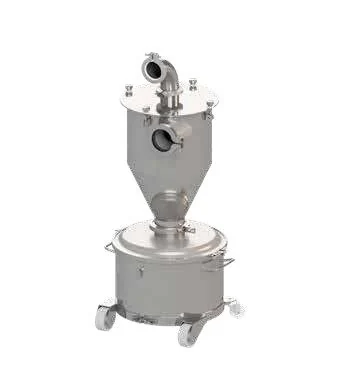
What is the Delfin ESD.SEP-0685?
The ESD.SEP-0685 is a cyclone pre-separator without a filter. It is fitted between the suction point and the vacuum unit and removes the bulk of the material before the air reaches the filter. It is a simple machine with a single purpose: to keep the material out of the filter.
What sets it apart from Delfin’s other pre-separators is the construction. Chamber, container, lid and frame are all stainless steel, and the unit is built to meet the requirements for materials in contact with food. That makes it relevant in food production, nutritional supplements and other processes where contact materials are regulated.
How it works
Material-laden air enters the ø280 mm cyclone chamber through the 3″ connection. Inside the chamber the air is forced into a spiral, and centrifugal force throws the particles out against the wall, where they lose speed and fall into the 20 L collection container. The cleaned air leaves the cyclone through the 2½″ clamp connection and continues to the vacuum unit.
Separation depends on the velocity of the air through the cyclone. If the air flow drops too low, the particles lose the centrifugal force that drives separation and the material carries on to the filter. The vacuum unit therefore has to be sized to work in the right range — not simply to be powerful enough.
Technical specifications
| Parameter | Value |
|---|---|
| Type | Cyclone pre-separator, filter-free |
| Cyclone efficiency | >98 % |
| Cyclone chamber | ø280 mm |
| Collection capacity | 20 L |
| Inlet | 3″ |
| Outlet | Clamp 2½″ |
| Construction | Stainless steel — chamber, container, lid and frame |
| Food contact | Meets MOCA requirements for contact materials |
| Motor | None — connects to a vacuum unit |
| Filter | None — filtration takes place in the vacuum unit |
| Dimensions | 45 × 40 × 90h cm |
| Weight | 20 kg |
CE marking based on: Machinery Directive 2006/42/EC • IEC 60335-2-69
What it connects to
The ESD.SEP-0685 has neither motor nor filter and therefore always works together with a vacuum unit. The outlet is a 2½″ clamp connection, and the unit is sized according to the air flow in the installation it forms part of. We help select the right vacuum unit and the right hoses and couplings.
Questions and answers
Should the ESD.SEP-0685 fit into your installation?
We help select the right vacuum unit, hoses and couplings so the cyclone works in the right range. Advice is free and without obligation.