Food/Pharma · FDA + EU 1935/2004
AIRDUC® PUR-INOX 355 FOOD-AS (HD)
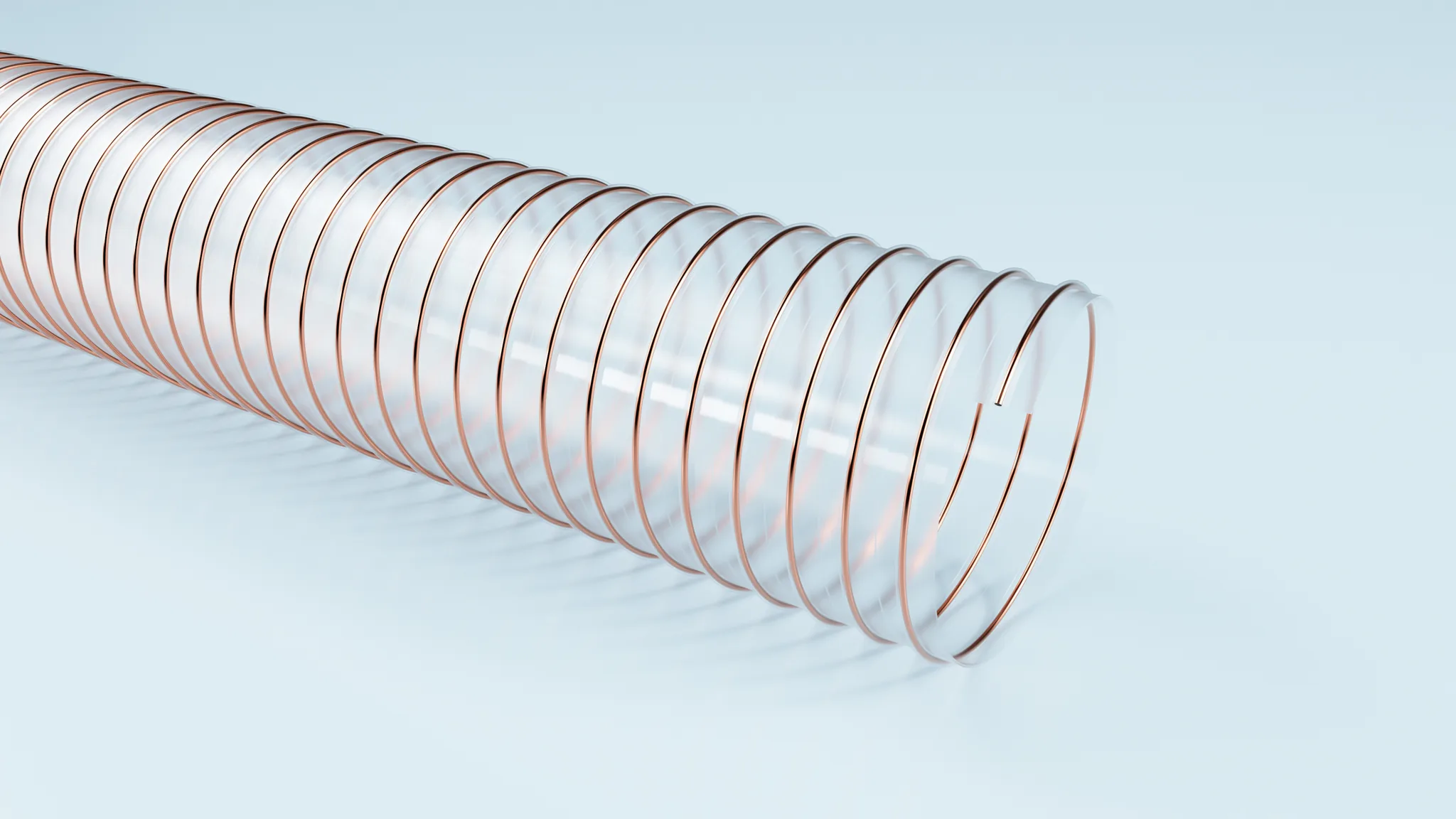
Heavy-duty food-grade PUR hose with stainless steel spiral (INOX) for areas where galvanised steel is not permitted. Antistatic surface makes it ATEX-suitable for zone 22, and the stainless spiral resists CIP/SIP cleaning and humid environments. Suitable for dairies, beverage production and pharma processes.
- Food-grade
- EU 1935/2004 + FDA
- Abrasion-resistant PUR wall
- Highly flexible
- Gas, dust, liquid, granulate
- Cut to length
Why this hose?
AIRDUC® PUR-INOX 355 FOOD-AS (HD) is the specialised variant of the 355 FOOD family where the spiral is stainless steel (INOX) instead of galvanised. It is a concrete material change with concrete practical consequences: in food production, galvanised steel is often not permitted for hygiene or contamination reasons, because zinc can migrate under aggressive cleaning or contact with acidic media.
The hose is antistatic (<109 Ω), ATEX-approved for Zone 0/1/2 (gas) and Zone 20/21/22 (dust), and food-approved per EU 10/2011 (category E — dry food), EC 1935/2004 and FDA 21 CFR 177.2600. It covers LFGB and is manufactured under GMP EC 2023/2006. The HD wall is Type 3 to DIN 26057.
The INOX spiral is the practical answer to a specific limitation in many food applications: if the choice between 355 FOOD-AS (HD) and 355 FOOD (HD) exists on the basis of ATEX requirements, and if food production simultaneously rules out galvanised steel, the choice falls on the INOX variant. For pharma at even higher bulk volumes, BARDUC® PUR-INOX 382 FOOD-AS (XHD) in bulk class is available.
Food approval concerns the whole system, not just the hose. The hose materials are tested for food contact (EU 1935/2004, EU 10/2011, FDA 21 CFR 177.2600), but couplings, gaskets and assemblies must also be food-grade for the complete installation to be compliant.
CIP/SIP cleaning requires that both hose and couplings tolerate the specified temperatures and chemicals. Always verify full system compatibility before installation.
Where it is used
The hose is used in food and pharma industry to transport dry and wet media — from flour and sugar to milk, juice and bakery products. The smooth inner wall prevents residue buildup, and cleaning between media changes is quick.
Typical systems are filling and packaging machines, transport between silo and mixing machine, and ingredient transfer in bakeries and dairies. The hose is CIP-cleanable for variants that specify it.
In food industry, beverage industry, dairy industry many different media are often handled. The broad food approval — categories A, B, C, D2 and E — makes the hose suitable for multi-purpose installations where the same system handles multiple products.
The formal name is AIRDUC® PUR-INOX 355 FOOD-AS (HD). In daily use it is referred to as "the INOX food hose" or "the stainless food hose" — it is selected where a galvanised steel spiral is not permitted or desirable (typically in dairies, food production or pharmaceutical installations).
Technical specifications
Specifications are valid as of 2026-04-15. Fields without a value are not specified in source data.
| Material | Food-grade PUR, antistatic surface |
|---|---|
| Colour | Transparent |
| Wall construction | Heavy-duty PUR wall with embedded stainless steel spiral (INOX) |
| Conveyed media | Gas, dust, liquid, granulates and particles |
| Temperature range | −40 °C to +90 °C |
| Short-term peak | +125 °C |
| Smooth surface | Smooth interior |
| Electrical resistance | Antistatic wall with surface and electrical resistance <109 Ω. Method: EN 60079-32-1, < 10⁹ Ω |
| ATEX marking | II 3D (zone 22) — antistatic, food-grade per TRGS 727 |
| Food-grade | Yes — EU 1935/2004, EU 10/2011, FDA 21 CFR 177.2600 |
| Cut to length | Yes — Particulair cuts the hose to your dimensions |
The hose is approved for internal transport of combustible dust in zone 22. Correct grounding is a prerequisite for the antistatic or conductive property to function in practice. We always recommend a continuity resistance measurement after installation.
Dimensions and ordering
AIRDUC® PUR-INOX 355 FOOD-AS (HD) is supplied in 18 standard sizes from inner Ø 25.1 mm to 202.3 mm. Each size has its own article number at the manufacturer. Standard roll length is typically 10 m, and the hose can be cut to length.
| Inner Ø |
Outer Ø |
Wall thickness |
Working pressure |
Vacuum |
Bend radius |
Max. length |
Weight |
Roll |
Article no. |
|---|---|---|---|---|---|---|---|---|---|
| 25.1 | 32.1 | 1.2 | 3.565 | 1 | 20 | 25 | 0.28 | 10 | 35500251018 |
| 32 | 42 | 1.5 | 3.49 | 1 | 26 | 25 | 0.43 | 10 | 35500321018 |
| 38 | 48 | 1.5 | 2.975 | 0.985 | 29 | 25 | 0.49 | 10 | 35500381018 |
| 40 | 50 | 1.5 | 2.835 | 0.935 | 30 | 30 | 0.52 | 10 | 35500401018 |
| 50.5 | 60.5 | 1.5 | 2.3 | 0.75 | 35 | 30 | 0.64 | 5, 10 | 35500501018 |
| 55 | 65 | 1.5 | 2.1 | 0.68 | 38 | 30 | 0.69 | 10 | 35500551018 |
| 60 | 70 | 1.5 | 1.93 | 0.625 | 40 | 30 | 0.75 | 10 | 35500601018 |
| 64.5 | 74.5 | 1.5 | 1.79 | 0.575 | 43 | 30 | 0.8 | 10 | 35500651018 |
| 70 | 81 | 1.5 | 1.665 | 0.505 | 62 | 25 | 0.94 | 10 | 35500701018 |
| 75 | 85 | 1.5 | 1.56 | 0.475 | 66 | 25 | 1 | 5, 10 | 35500751018 |
| 80 | 91 | 1.5 | 1.465 | 0.45 | 69 | 25 | 1.06 | 10 | 35500801018 |
| 90 | 100 | 1.5 | 1.305 | 0.395 | 76 | 25 | 1.18 | 10 | 35500901018 |
| 101.5 | 112.5 | 1.5 | 1.18 | 0.385 | 83 | 25 | 1.44 | 5, 10 | 35501001018 |
| 126.5 | 137.5 | 1.5 | 0.95 | 0.305 | 101 | 25 | 1.77 | 10 | 35501251018 |
| 151.5 | 163.5 | 1.5 | 0.795 | 0.285 | 118 | 20 | 2.33 | 10 | 35501501018 |
| 160 | 172 | 1.5 | 0.745 | 0.265 | 125 | 20 | 2.46 | 10 | 35501601018 |
| 180 | 192 | 1.5 | 0.665 | 0.235 | 139 | 20 | 2.75 | — | 35501801018 |
| 202.3 | 215.3 | 1.5 | 0.6 | 0.145 | 156 | 15 | 3.02 | — | 35502001018 |
Note: Fields without a value (—) are not specified in the manufacturer's factsheet. Overpressure and underpressure are recommended operating limits; the product can be subjected to higher loads on request. Bend radius is measured along the inside of the hose. Contact us for full specifications or special variants.

Standards and compliance
The hose is tested and certified to the following standards:
- ATEX 2014/34/EU (1999/92/EC). European directive for equipment and protective systems intended for use in potentially explosive atmospheres. The hose is certified under this legislation and may be used in the zones specified by the ATEX marking.
- TRGS 727. German technical rules for hazardous substances, avoidance of ignition sources when handling combustible dusts and liquids. The hose's electrical conduction meets TRGS 727's limit values.
- DIN 26057 Type 2. German industrial standard for hoses used in pneumatic transport. Defines types, dimensions, pressure and vacuum requirements, and test procedures for industrial pneumatic hoses.
- EU 1935/2004. European framework regulation for materials in contact with food. The hose's components are tested to meet the general requirements for food contact.
- EU 10/2011. Plastics Implementation Measure — specific requirements for plastic materials in food contact. The hose is tested for categories A (aqueous), B (acidic pH<4.5), C (alcohol <20 %), D2 (dairy) and E (dry foods).
- FDA 21 CFR 177.2600. US Food and Drug Administration requirements for polyurethanes in food contact. The hose's food-grade approval is tested and documented in compliance with this regulation.
- REACH (EC 1907/2006). EU regulation on registration, evaluation, authorisation and restriction of chemicals. The hose's materials are REACH-compliant; manufacturer's declaration is available for download.
- RoHS (Directive 2011/65/EU). Restriction of Hazardous Substances — restriction on the use of certain hazardous substances in electronic products. The hose's components comply with RoHS limit values.
Documentation and downloads
Additional documents about this hose, its compliance and installation. Click to download as PDF in a new tab.
Industries that use it
The hose is used across a wide range of industries — below is an overview of the most typical industries where AIRDUC® PUR-INOX 355 FOOD-AS (HD) is used:
In the dairy and milk industries, the INOX spiral is often a hygiene requirement — galvanised steel is commonly excluded because of zinc migration during aggressive CIP/SIP cleaning or contact with acidic dairy products. The hose is specifically approved for these environments.
In food production, it is used in bulk transfer of dry foodstuffs where the process simultaneously requires ATEX properties. In the pharmaceutical industry, it sits on powder transfer installations and tablet presses where the INOX spiral is a quality standard.
In aquaculture, it is used for fish-feed transport where saltwater exposure would corrode a galvanised spiral. In grain industries and animal-feed, it features in bulk pneumatics. What unites these applications is that the spiral material is the dictating selection criterion — rarely service life against wear or the dimension itself, but compatibility with hygiene rules or a corrosive environment.
Custom lengths and assemblies
AIRDUC® PUR-INOX 355 FOOD-AS (HD) can be cut to length and assembled with couplings, cuffs and threads to fit your installation precisely. We produce complete hose assemblies with crimped ferrules, clamp collars or threaded connections, depending on what the process requires.
For ATEX installations it is particularly important that couplings and assemblies preserve the hose's electrical continuity. It's about the whole system conducting static electricity away, not just the hose itself.


Frequently asked questions
What's the difference between FOOD (HD) and FOOD (MD)?
The HD wall construction is more robust and wear-resistant than MD, ideal for high throughputs of abrasive food. MD is lighter and more flexible, suitable for smaller loads and tight installations.
Which food categories can the hose handle?
The hose is tested for all EU 10/2011 categories: A (aqueous foods), B (acidic foods pH<4.5), C (alcoholic beverages <20 %), D2 (dairy products) and E (dry foods such as grain and powder).
Can the hose be cleaned with CIP/SIP?
Yes, as long as cleaning medium and temperature are within specified limits. Steam cleaning up to +130 °C is typically acceptable short-term. Verify against the factsheet when in doubt.
Is the hose ATEX-approved?
Standard FOOD variants are NOT ATEX-approved — they are insulating. The AS variant (with antistatic surface) is ATEX-suitable for Zone 22, and the EC variant is fully conductive.
How long until the hose should be replaced?
Under normal food operation (non-abrasive media) the hose typically lasts 3-5 years. Visual inspection at each cleaning and functional testing during CIP cycles is recommended to catch early signs of wear or cracking.