 DA · EN
Dust collectors
Catch the dust where it starts.
Mobile and stationary dust collectors for production, food, pharma and ATEX zones. We choose the machine from your task, not from one brand.
DA · EN
Mobile and stationary dust collectors for production, food, pharma and ATEX zones. We choose the machine from your task, not from one brand.
Tell us what needs to be caught and where the machine will stand. You get a suggestion of which dust collectors fit, and why. You don't need to answer everything.
Click the options that match your task.
Click your answers on the left. The list narrows with every click.
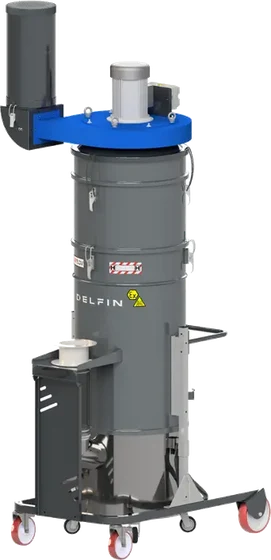
A few models from the range
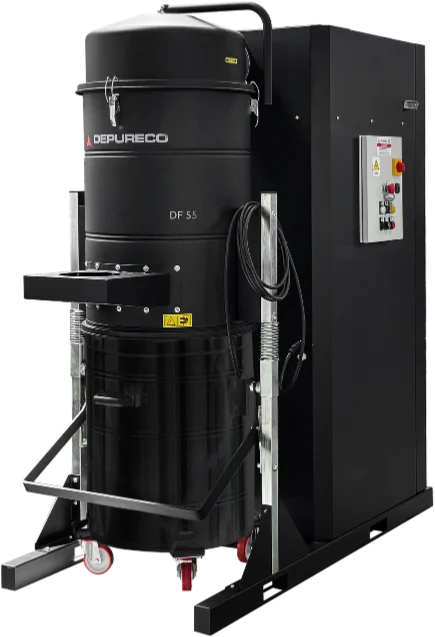
The selector gives a first suggestion based on the manufacturers' own data. It is indicative and does not replace an assessment of your process, your zone classification or a dimensioning. Ask us before you choose a machine.
Start from your dust and your area. Every model page shows airflow at the inlet, the filter, the ATEX marking and where the data comes from.
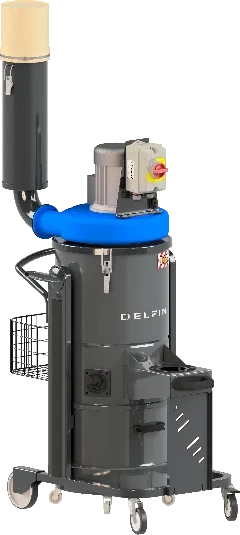
Mobile units, fixed filter plants and stationary units with automatic filter cleaning.
Explore Standard →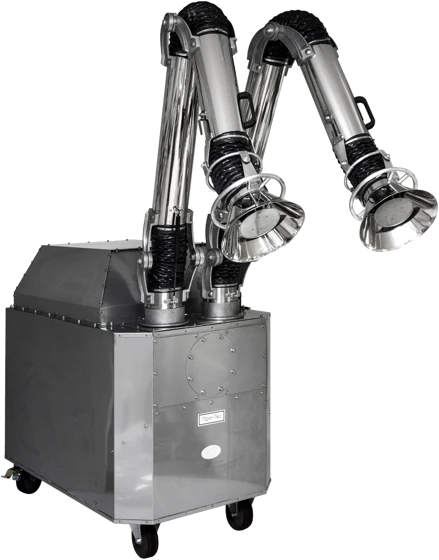
For combustible dust. Each model with its full ATEX marking and the zones it may stand in.
Explore ATEX →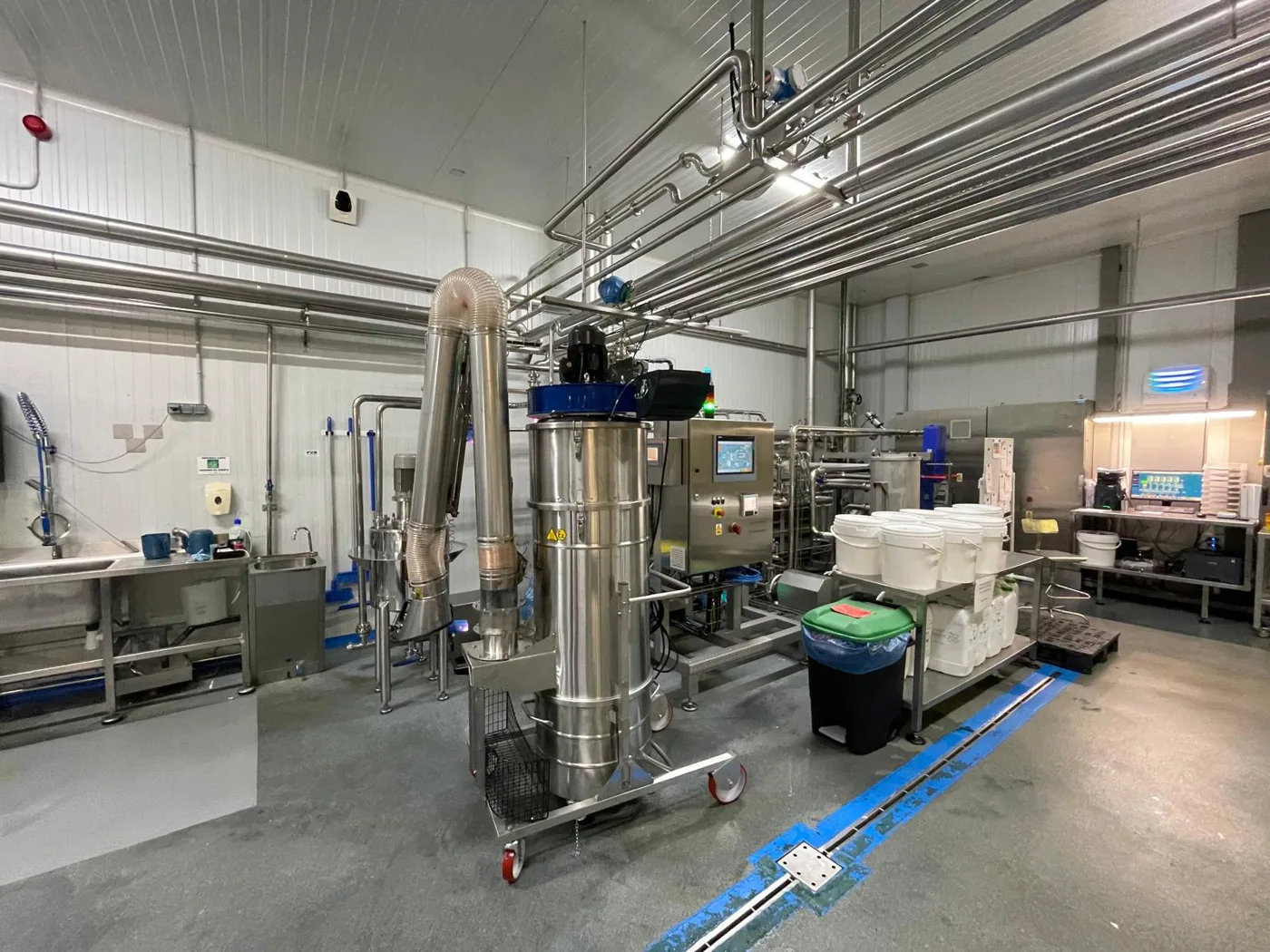
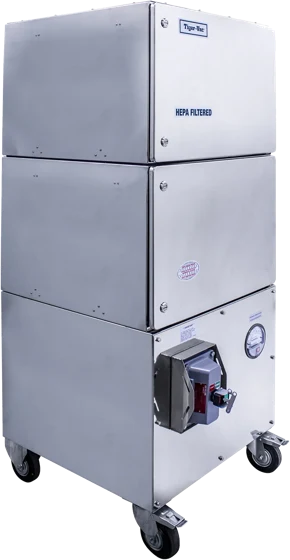
Machines where material and filter are documented: stainless steel AISI 304 and HEPA filters.
Explore Food & Pharma →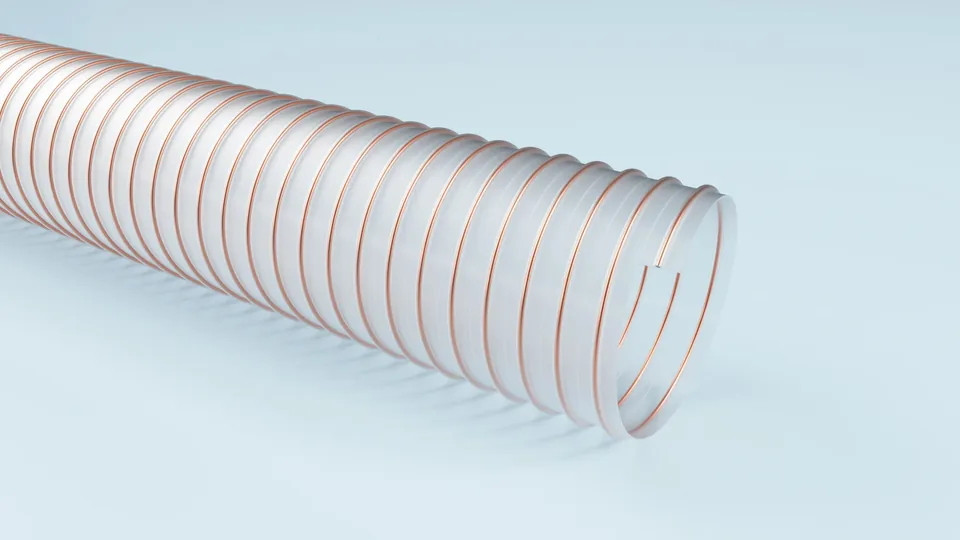
CP hoses for extraction arms and dust collectors with a fan. AIRDUC hoses for industrial vacuums.
Explore Hoses →Food & Pharma: the manufacturers' data says nothing about food or pharma approval of the machines, so we show material and filter only. Food-contact approval is documented on the hoses.
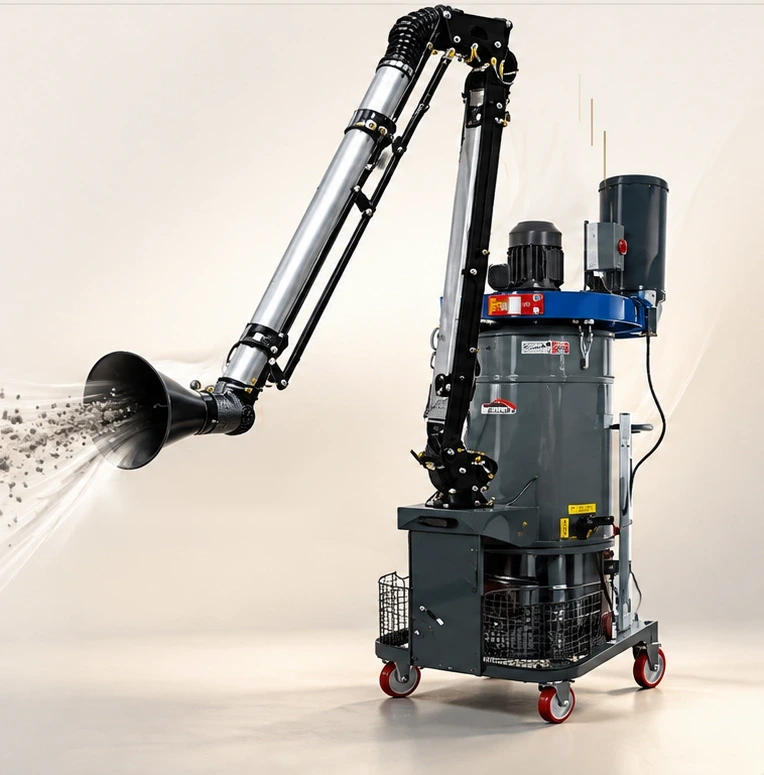
How close must the suction opening be, and how much air is needed? Choose a hood, move the values and see whether the dust is caught.
The hood at the end of the arm gathers suction in front of it and stops air from behind. The arm makes it easy to move the hood close to the source, and distance matters most.
At the same airflow, a larger opening gives slower air in front of it. A larger hood needs more air.
Beyond about 1.5 times the opening diameter, the result is only a rough estimate.
Enter the estimated airflow available at the hood opening, not just the manufacturer's maximum airflow rating. Actual airflow depends on ductwork, filters and system resistance.
For example bag filling or welding. Recommended capture velocity: 0.51–1.02 m/s.
Open doors, ventilation and fans typically give a draught of 0.1–1 m/s.
The calculator gives a first estimate. It uses common formulas for local exhaust and assumes the air around the source is otherwise still. It does not know your process, and the result is no guarantee. The particle animation is illustrative, not a prediction of capture efficiency. Ask us before you choose a solution.
Q = airflow, V = capture velocity, x = distance, A = area of the opening.
Plain round opening Q = V(10x² + A). With flange Q = 0.75·V(10x² + A). Source: ACGIH, Industrial Ventilation: A Manual of Recommended Practice for Design, 30th edition, equations 6.4 and 6.5.
The formulas are reliable close to the opening. Beyond about 1.5 times the opening diameter, the result is only a rough estimate (ACGIH, 30th edition, section 6.6.8).
Extraction arm with hood: calculated as a round opening with flange, where A is the hood opening. This is a simplification.
Capture velocities: 0.38–0.51 · 0.51–1.02 · 1.02–2.54 · 2.54–10.2 m/s (ACGIH, 30th edition, table 6-2).
Two typical solutions, told simply. The customers are anonymous.
“Prompt and professional.”The customer about our first reply
More projects, and how we approach tasks that are still on the drawing board.
See selected projects →Three typical tasks and how we solve them.
Building chemicals
A dust extractor behind a screen, with two fixed extraction arms at the weighing station.
Bags are filled by hand at a scale, and dust hangs in the air around the weighing station. The existing vacuum cleaner did not remove it, because it is built for dust on surfaces, not dust in the air.
The solution is a dust extractor behind a screen, fixed pipes and two fixed extraction arms at the weighing station. The air can be returned to the room through a HEPA filter, so no exhaust over the roof is needed.
Food production
Two extraction arms, at the lid opening and at the spill area, adjusted on site at commissioning.
Cooked crab shells are ground in a bowl cutter. Even with the lid closed, fine particles and mist escape and can cause respiratory problems for the staff.
We advised against building the extraction into the machine. Instead we use two extraction arms, one at the lid opening and one at the spill area, adjusted on site at commissioning, and offered two machine alternatives.
Pharma
A stainless steel Depureco dust collector with HEPA H13 and an extraction arm.
Quality assurance required that no dust escapes during filter cleaning, and that the HEPA filter is integrity tested every time it is changed.
We compared several machines with the customer and let them see the machine before choosing. The solution: a Depureco dust collector in stainless steel with HEPA H13 and an extraction arm. The manufacturer integrity tests the HEPA filter before the machine is shipped.
Customers are anonymous.
The machines are easy to service, so you can do it yourself. We send service reminders based on the manufacturer's recommended maintenance intervals.
How the filter works
Illustrative animation, not to scale. The cleaning system differs between machines. Follow the manual for your machine.

Vacuum solutions for pharma, cleanrooms and life science.
particulair.eu/life-science
Accessories for vacuum cleaners in ATEX zones and food environments.
particulair.eu/vace
ATEX and ACD vacuum cleaners for explosion-classified zones and combustible dust.
particulair.eu/ex-vac
Technical hoses for critical environments.
particulair.eu/flexcore
Vibrators, air cannons and fluidisation that make powder flow out of silos and hoppers.
particulair.eu/flow-aid
We're ready to advise on selection and sizing.