
Tiger-Vac CD-230V EX CFB HEPA
Stationary single-phase TEFC ATEX combined vacuum for internal Zone 20 / external Zone 21 dust + Zone 0/1 gas -- 50 L tank, 1.5 kW, Conductive Filter Bag (CFB) for sealed disposal
- Stationary connection to process extraction in pharma and chemical production
- Active API powders and toxic substances requiring sealed disposal
- Life-science cleanrooms with internal Zone 20 and external Zone 21
- Zone 0/1 gas environments where operator exposure must be minimised
- Pigment and dye handling where dust must be encapsulated immediately
- ATEX Directive 2014/34/EU -- II 1/2GD Ex db h IIB T4 Gb / Ex h tb IIIC T135°C Db IP65 -- Intern: Ex h IIC T6 Ga / Ex h IIIC T50°C Da -- LCIE 03 ATEX 6295 X -- IECEx LCI 10.0040X -- EN 17348
- EN 17348:2022 (harmonized March 2023)
- IEC 60335-2-69 (industrial vacuums)
Tiger-Vac CD-230V EX CFB HEPA
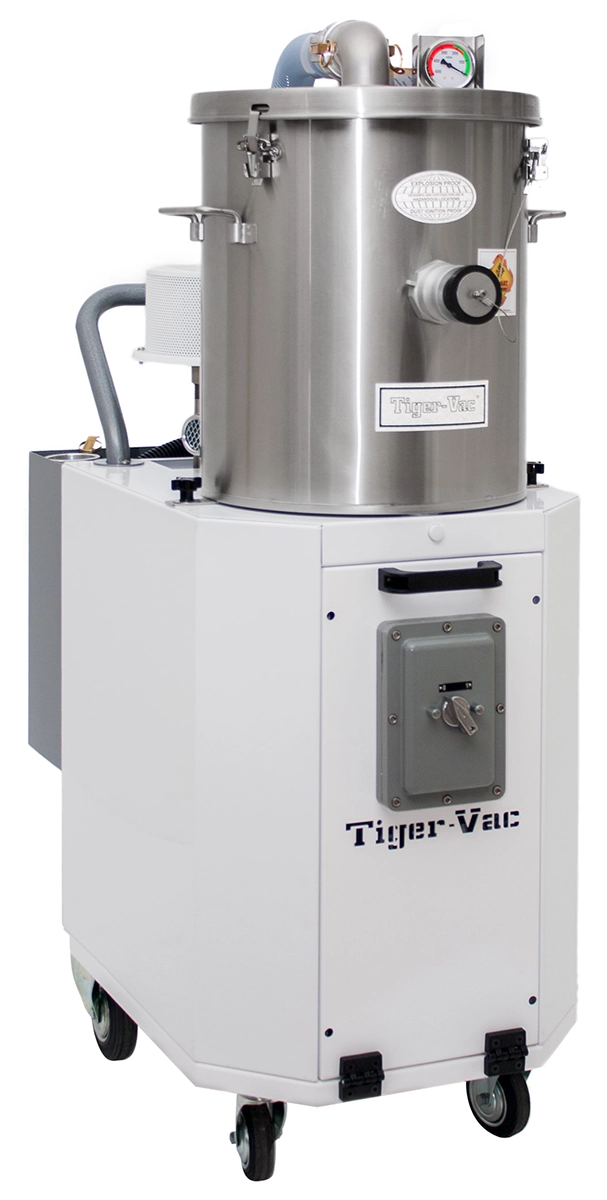
The Tiger-Vac CD-230V EX CFB HEPA is the sibling to the MRPFT variant and shares the same II 1/2GD certification to EN 17348 -- category 1/2 for dust (internal Zone 20, external Zone 21) and category 2 for gas (internal Zone 0, external Zone 1). The difference lies in the filter strategy: here a static-dissipative filter bag (Conductive Filter Bag, CFB) continuously collects the dust and can be sealed and disposed of without direct dust contact. This suits environments where the recovered material must be handled in sealed units -- active API powders, toxic pigments and any substance where operator exposure must be minimised. A 1.5 kW TEFC motor delivers 212 m3/h at 2540 mmH2O vacuum, HEPA H14 final filter is standard, and the whole construction is AISI 304 stainless steel with IP65 protection.
Applications
- Stationary connection to process extraction in pharma and chemical production
- Active API powders and toxic substances requiring sealed disposal
- Life-science cleanrooms with internal Zone 20 and external Zone 21
- Zone 0/1 gas environments where operator exposure must be minimised
- Pigment and dye handling where dust must be encapsulated immediately
Technical specifications
| ATEX marking | II 1/2GD Ex db h IIB T4 Gb / Ex h tb IIIC T135°C Db IP65 -- Intern: Ex h IIC T6 Ga / Ex h IIIC T50°C Da -- LCIE 03 ATEX 6295 X -- IECEx LCI 10.0040X -- EN 17348 |
|---|---|
| Internal / external zone | 20 / 21 |
| Motor type | 1-faset TEFC-motor, eksplosionssikret (Ex d IIA T4 Gb / Ex t IIIC T135°C Db), 1,5 kW / 12,3 A |
| Duty cycle | Continuous |
| Airflow | 212 m³/h |
| Vacuum | 249 mbar (2540 mmH₂O) |
| Container | 50 L |
| Sound pressure | 68 dB(A) |
| Filter class | H class |
| Filter type | HEPA H14 (EN 1822-5, 99,995 % @ 0,3 µm MPPS), 211027B |
| Primary filter | Main filter assembly SD epitropic polyester med PTFE, for ATEX 22E (215393TA-SD) + rustfri stålbur (218390) + statisk ledende samlepose CFB (212994A-SD64) |
| Cleaning system | Ingen (manuel) -- statisk ledende filterpose skiftes når fuld |
| Collection system | Detachable container |
| Material | AISI 304 rustfri stål |
| IP class | IP65 |
| Power | 1.5 kW |
| Current | 12.3 A |
| Voltage | 230 V / 50 Hz / 1~ |
| Inlet | Ø 50 mm |
| Dimensions (L × W × H) | 640 x 480 x 1510 mm |
| Weight | 97 kg |
Questions and answers
What is the advantage of the Conductive Filter Bag (CFB) over MRPFT?
CFB ensures collected dust never contacts the operator's skin or breathing zone -- the bag is sealed and disposed of as a sealed unit. This is critical for API powders, hormones and other highly potent substances. MRPFT, by contrast, requires manual emptying of the container, which can involve brief dust contact. CFB does carry an ongoing operating cost for filter bags and more frequent filter service than MRPFT, where the same filter tubes are reused. Choose CFB when operator exposure is the deciding factor; choose MRPFT when operating cost and large volumes are.
Is the filter bag really static-dissipative?
Yes. The collection bag (212994A-SD64) is made of conductive material -- resistance below 10 ohms -- so it cannot build electrostatic charge during filling or disposal. This is essential for ATEX hygiene: without a conductive bag, collected combustible dust could develop sparks on contact, and the disposal process itself becomes a combustion risk. Always maintain the same ESD chain across bag, hose, accessories and earth.
Can I upgrade from CFB to MRPFT or vice versa?
Not a simple retrofit. The filter housing construction differs -- MRPFT has fixed filter tubes with cleaning handle, CFB has an open cage with replaceable conductive collection bag. If the need shifts from operator safety (CFB) to large volume / low operating cost (MRPFT) or vice versa, it is usually better to buy the other variant and use both in parallel. Contact Particulair for a specific conversion estimate.
How often should the filter bag be changed?
It depends entirely on dust density and volume. For fine, light powders (pigments, lactose, aerosol recoveries) the bag is typically changed when 60-80 % full -- the change interval is most often determined by the VRV setting: the machine has a VRV setting of 1780 mmH2O, and when vacuum drops below this, it is time to change. For heavier, coarser dust the interval can be days or weeks. Always follow local SOP for API or active-substance handling.
Is it suitable for life-science / GMP production?
Yes. AISI 304 stainless steel throughout and smooth exterior surfaces make it cleanroom compatible, and IP65 ensures exterior wash-down does not damage electrics. HEPA H14 final filter meets ISO 14644 class 5 air quality on the exhaust. For formal GMP validation, however, an IQ/OQ package is typically also required -- Particulair can supply this on request.
Why 50 mm inlet and only 10 m cord?
The 50 mm inlet reflects the expected process extraction hose -- most fixed installations use 50 mm pipe. The 10 m cord is consistent with stationary use, where the machine is connected to a nearby outlet and not moved far. If longer reach is needed, an earthed extension cord with ESD spec can be used, but this must be assessed from an ATEX practical standpoint.