
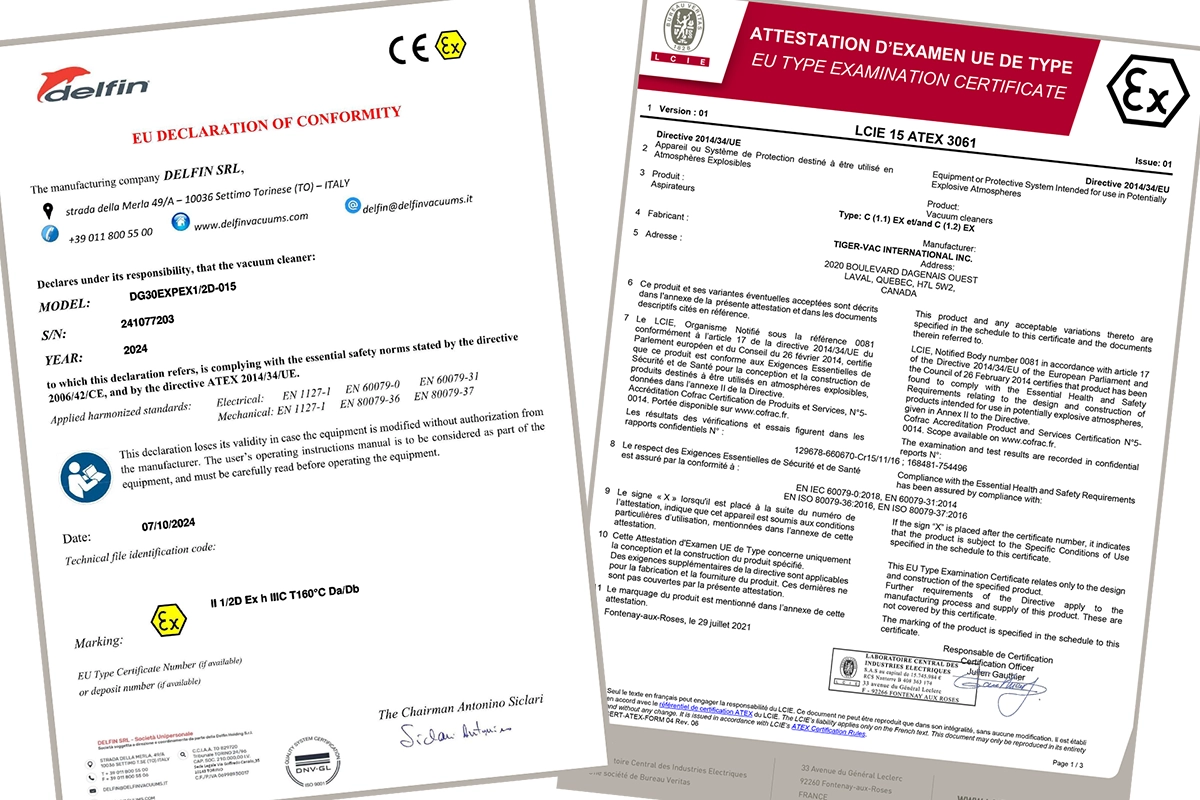
All three suppliers use European notified bodies (designated conformity assessment bodies) to third-party certify their vacuum cleaners under ATEX 2014/34/EU and the harmonised EN 17348:2022. Delfin works with IMQ S.p.A. (NB 0051) in Milan. Depureco splits the task between TÜV NORD CERT (NB 0044) in Essen for design and RINA Services (NB 0474) in Genoa for production surveillance — a classic Module B plus Module D arrangement. Tiger-Vac uses LCIE (NB 0081) in Fontenay-aux-Roses, a member of the Bureau Veritas group, which issues both their EU-Type Examinations and their parallel IECEx certificates. ACD vacuum cleaners are certified to IEC 60335-2-69 Annex AA and form a separate category for non-classified locations handling combustible dust.
Why certification matters
An ATEX certification is not a marketing badge. It is the legal requirement that lets a vacuum cleaner be used in an explosive atmosphere on the single market. Without a valid EU-Type Examination certificate from a notified body the machine may not be sold for use in Zone 20, 21 or 22 (for dust) or Zone 0, 1 or 2 (for gas) within the EU. The rule stems directly from Directive 2014/34/EU and is implemented across Member States in national legislation covering explosive atmospheres.
A certificate is layered documentation. It contains a binding description of the construction, the tests performed, the standards used, a verbatim marking the machine must bear, and often Specific Conditions of Use — conditions the operator must observe for the certificate to remain valid. Without knowing these conditions you do not have legally defensible documentation of safe operation. That is why Particulair always delivers the actual type examination alongside every ATEX or ACD model we sell.
The second reason certification matters is what does not meet the eye: production quality. A certification for a serially produced machine requires not only an approved design — it also requires ongoing production surveillance by a notified body, typically through Module D or Module E of the directive. A fine design without monitored production is, from the regulator’s point of view, a compromised certificate. That is where third-party involvement genuinely earns its keep.
If you want the regulatory background at a higher level, our article ATEX ABC — the foundations every engineer should know covers the directive, the zones, categories and the EPL system. For the practical choice between ACD and ATEX in a real purchasing situation, read ACD vs ATEX — the difference explained by specialists.
How to read the marking
Every certified vacuum cleaner from the three suppliers carries a marking that follows a fixed pattern. If you learn to read the line, you understand ninety per cent of what the certificate says in a few seconds. Here is a typical marking from Delfin’s single-phase motor head range:
| II | Equipment group 2 — surface industries (not mining) |
| 1/2D | Category 1 internal (Zone 20 inside the machine) / category 2 external (Zone 21 around the machine) for dust (D) |
| Ex h | Non-electrical explosion protection by constructional safety (EN ISO 80079-36 and 80079-37) |
| tb | Dust protection by enclosure at EPL Db level (EN 60079-31) |
| IIIC | Sub-group for conductive dust (metal, carbon fibre, graphite dust) — strictest dust group |
| T80°C | Maximum surface temperature internally — must not exceed 80°C under any operating condition |
| T95°C | Maximum surface temperature externally |
| Da/Db | Equipment Protection Level — Da internally (highest for dust), Db externally |
All four fields (category, Ex method, dust group, temperature, EPL)
must match the environment you have classified. If your explosion
protection document records the room as Zone 21 with conductive
dust, the machine must be at least II 2D IIIC externally.
If you have Zone 22 with non-conductive dust you can get by with
II 3D IIIB — but a IIIC machine is always
overspecified rather than under-specified. That is the right direction
to choose.
Still finding temperature classes and gas zones confusing? See our
article Inert versus
ATEX — three routes through reactive powders and
Know your ohm — ESD
on ATEX accessories, which shows how delicate the
<10^8 Ω requirement is in practice.
The three suppliers
Although the three companies end up with comparable products on the market, they take different paths through the EU certificate system. The differences are not arbitrary. They reflect each company’s history, geography, ownership and relationship with individual notified bodies. Below are the three in the order established in our internal CLAUDE.md:
Tiger-Vac — LCIE (NB 0081)
France · Bureau Veritas groupTiger-Vac’s certificate programme is unusually detailed. They work with a single notified body — LCIE, part of the Bureau Veritas group — which issues both their EU-Type Examination certificates and their IECEx Certificates of Conformity, with parallel tests and reports. That makes their documentation uncommonly coherent and traceable. All certificates are signed by Julien Gauthier, Certification Officer at LCIE.
For Particulair, Tiger-Vac’s strength is also the sheer volume of documentation available. We can currently source around 25 different type examinations for their active models — from combined gas-and-dust certificates for the CD series to pneumatic Venturi certificates for the SS series. The list below shows examples from the certificate programme; it is not exhaustive.
Examples from the EU-Type Examination certificates
| Certificate | Series / type | Marking | Issued |
|---|---|---|---|
LCIE 15 ATEX 3061 Issue 01 |
C (1.1) EX and C (1.2) EX — single-phase with brush or brushless motor | II 1/3 D · External Ex h tc IIIC T85°C/T200°C Dc IP6X · Internal Ex h IIIC T85°C/T200°C Da | 29 July 2021 |
LCIE 03 ATEX 6295 X Issue 06 |
CD-xx EX, CD-IT xx EX, CD/EUR xx EX, CDPU xx EX — three-phase, also in gas-and-dust combi variant | II 1/2 GD or II 1/2 D or II 1/2 G · External Ex db h IIB T4 Gb / Ex h tb IIIC T135°C Db IP65 · Internal Ex h IIC T6 Ga / Ex h IIIC T50°C Da | 16 December 2024 |
LCIE 03 ATEX 6310 X Issue 01 |
SS and SSAT — pneumatic Venturi vacuum cleaners with no electrical parts | II 2 GD · Ex h IIC T6 Gb · Ex h IIIC T85°C Db | 2 February 2018 |
LCIE 03 ATEX 6297 / 03 |
EXP1-10, EXP1-15, EXP1-25, EXP1-55 with variants IT/HRS/AC/DT/4W/TC | II 2GD Ex d IIA T3/T4 Gb · Ex t IIIC T200°C/T120°C Db IP6X/IP65 | 19 July 2012 (still valid per art. 41 of 2014/34/EU) |
Parallel IECEx certificates
For global export Tiger-Vac complements each EU certification with
a corresponding IECEx Certificate of Conformity — issued by the
same notified body, but under the IECEx scheme rules rather than
the EU directive. Examples include IECEx LCIE 15.0048
(C series, Issue 2, 29 July 2021), IECEx LCI 10.0040X
(CD series, Issue 4, 16 December 2024) and
IECEx LCIE 17.0076X (SS/SSAT pneumatic Venturi,
14 December 2018).
Standards applied across the programme
- EN IEC 60079-0:2018 and IEC 60079-0:2017 — general requirements for Ex equipment
- EN 60079-1:2014 and IEC 60079-1:2014 — flameproof enclosure “d” (three-phase CD series only)
- EN 60079-31:2014 and IEC 60079-31:2013 — dust protection by enclosure “t”
- EN ISO 80079-36:2016 and ISO 80079-36:2016 — basic methods and requirements for non-electrical equipment
- EN ISO 80079-37:2016 and ISO 80079-37:2016 — non-electrical protection “c”, “b”, “k”
The CD series carries Specific Conditions of Use (hence the X suffix): only manufacturer-approved accessories; specific quality requirements for replacement screws in flameproof parts (class 8.8 and 4.8); and flamepaths conforming to the tables in EN 60079-1.
Delfin — IMQ S.p.A. (NB 0051)
ItalyDelfin works with IMQ — Italy’s national certification and quality organisation — as its principal notified body under the ATEX Directive. IMQ is one of the most experienced certification bodies in the vacuum technology field, and the geographical proximity (Delfin in the Turin region, IMQ in Milan) means that testing and follow-up can happen close at hand.
Delfin’s 2024 strategy — third-party only
In their own ATEX Vacuums Presentation 2024 Delfin has explicitly moved away from self-certification: “The strategy for 2024 is to offer only third-party certified machines for the internal Category 1”. Until 2024 Delfin had both self-certified and dual-certified machines in its range. From 2024 onwards all machines with internal Category 1 (Zone 20 inside) are third-party certified by IMQ — and for customers who previously chose self-certified solutions on price grounds, Delfin is simultaneously introducing an extended ACD line as an affordable alternative for non-ATEX areas.
“Innovative Protection Method” — Delfin’s Ex t dust tight
For the Ex t protection method (dust protection by enclosure per EN 60079-31) Delfin’s testing partners run three sequential laboratory tests on every enclosure or motor head before third-party certification is issued:
- Accelerated aging: 14 days in a climate chamber at 95 per cent relative humidity and a defined temperature (e.g. 95 °C), followed by 14 days at 0 per cent humidity at the same temperature, and one day at the minimum operating temperature minus margin (e.g. −30 °C). The temperature set-point is tied directly to the “t” protection level the machine must achieve (Ex ta, tb or tc).
- Mechanical stress (impact): a 1 kg weight is dropped from 70 cm onto the sensitive parts of the enclosure or motor head — simulating everyday knocks and misuse during service.
- Ingress protection (IP): the enclosure is placed under negative pressure in a chamber filled with very fine dust for 2–8 hours, depending on the enclosure’s specifications. Only if the dust does not penetrate can the enclosure be marked IP 6X.
The three tests map directly onto the ATEX zone: Ex ta for Zone 0/20, Ex tb for Zone 1/21 and Ex tc for Zone 2/22. Delfin uses the method particularly on their internal Zone 20 motor heads — which is why they are first to market with single-phase Category 1 solutions.
The most important component certifications
- BP/BL series (single-phase motor head, brush or brushless):
in Delfin’s own words, “the first manufacturer to have
designed, tested and obtained third-party ATEX certification for
single-phase motor heads for both ATEX Zone 21 and 22”. The
official dust ignition protection marking is
Ex tb, ATEX
          category 2D, IECEx EPL Db
. The operational distinction is practical: the BP motor (carbon brush) delivers slightly higher suction (2,500 mmH₂O) with an expected service life of 800–1,200 hours, while the BL motor (brushless) delivers slightly higher airflow (215 m³/h) with a service life of 8,000–12,000 hours. At 8 hours’ daily use this equates to 5–7 years of service from BL versus 6–8 months from BP. Both have their place: BP gives better performance on heavy or electrostatically charged dust residues; BL handles larger dust volumes better. - HD series (side channel blowers):
third-party certified from 2024 onwards, power range 0.4 to
25 kW. Marking
Ex tc, category 3Dfor ATEX Zone 22. Options also available for category 2D or gas zones. - ATEX Switch Box (three-phase): Delfin’s own
control box for three-phase suction systems in Zone 21 and 22.
Marking
Ex tb, category 2D.
Delfin consciously chooses to third-party certify many of its
ATEX components even where the standard does not require it. The
same mindset applies to the ACD products: Delfin has a notified
body third-party certify the internal part of its ACD models as
ATEX Category 1/–D, describing this in the catalogue as
“more than applying the ACD label”. The typical internal ACD
marking is therefore
II 1/–D Ex h IIIC T80°C Da/–.
Typical markings
| Category | Marking (Delfin’s own wording) |
|---|---|
| ATEX Zone 20/22 (newer 1/3D models) | II 1/3D Ex h IIIC T160°C Da/Dc |
| ATEX Zone 21 / 22 (dual-dust 1/2D) | II 1/2D Ex h tb IIIC T80°C (internal) / T95°C (external) Da/Db |
| ACD (non-classified location) | II 1/–D Ex h IIIC T80°C (internal) Da/– |
| Combi (dust + gas) | 1/2D + 2/2G category — Zone 1, 2, 21, 22 |
Note that the T-class varies: older models and enclosed units typically carry T80/T95°C, while newer models with more thermally loaded motors (e.g. HD side channel blowers) are certified up to T160°C. Both figures are lawful — what matters is whether the actual T-class matches the maximum surface temperature the ignition temperature of your dust requires.
Standards applied
- EN 17348:2022 — harmonised March 2023 (ATEX) and August 2023 (Machinery Directive)
- EN IEC 60079-0:2018 (clauses 26.10, 26.8, 26.9 for sealing of electrical controls)
- IEC 60335-2-69:2021 Edition 6.0 Annex AA for ACD marking
- ISO 29463:2018 for filtration efficiency measurement
- EN ISO 11688-1:2009 for noise reduction by design
- EN ISO 20643:2008 for hand-transmitted vibration
- Antistatic components: surface and transverse resistance below
10^8 Ωper EN 17348
Delfin does not publish individual certificate numbers in its public catalogue — a level of disclosure that differs from Tiger-Vac’s very transparent practice. If you need the actual type examination for a specific model, contact us at sales@particulair.com.
Depureco — TÜV NORD CERT (NB 0044) + RINA Services (NB 0474)
Germany + ItalyDepureco has chosen a division of the certification task that is in fact the classic interpretation of the ATEX Directive’s modular structure: TÜV NORD CERT handles the design approval (EU-Type Examination Certificate, Module B), and RINA Services monitors that production continuously meets the approved design (Production Quality Assurance, Module D). Both are active ATEX notified bodies on the European Commission’s NANDO list.
The advantage for the buyer is that design scrutiny comes from one of the world’s most respected German technical authorities, while ongoing production surveillance is performed by an Italian organisation well positioned for on-site audits close to Depureco’s factory in Volpiano. The result is a robust two-stage quality assurance, reflected in the detailed markings of each model family.
Typical markings (from Depureco’s ATEX catalogue, p. 17)
| Model family | Marking (1/3D) | Marking (1/2D) |
|---|---|---|
| BL PRO DEX, BL 20 JC DEX, BL 45 DEX, BL 45 JC DEX, BL 45 DEX INERT | II 1/3D Ex h IIIC T140 Da/Dc | II 1/2D Ex h IIIC T140 Da/Db |
| ECOBULL XM M DEX, ECOBULL XM T DEX | II 1/3D Ex h IIIC T160 Da/Dc | II 1/2D Ex h IIIC T160 Da/Db |
| ECOBULL M/T/PLUS DEX | II 1/3D Ex h IIIC T160 Da/Dc | II 1/2D Ex h IIIC T160 Da/Db |
| FOX (3/5,5/7,5/10) DEX | II 1/3D Ex htc IIIC T140°C Da/Dc | II 1/2D Ex htc IIIC T140°C Da/Db |
| PUMA (10/15/20/25/30 P/S) DEX | II 1/3D Ex htc IIIC T140°C Da/Dc | II 1/2D Ex htc IIIC T140°C Da/Db |
| DF (075/22/40) DEX | II 1/3D Ex h IIIC T140 Da/Dc | 3/3G variant: II 3/3G Ex h IIIC T140 Gc/Gc |
| ECOBULL M/T/PLUS DEX 3/3G | II 3/3 G Ex h IIB+H2 T4 Gc/Gc (combi with hydrogen gas) | |
Filter classes under EN 60335-2-69
Depureco has unusually detailed filter class documentation per EN 60335-2-69 IFA|BGIA M-PES. All DEX models ship with an Antistatic Polyester primary filter at class M and a secondary HEPA filter at class H14 (fibreglass). INERT variants (BL 45 DEX INERT, ECOBULL DEX INERT) use class H13 as primary filter in a liquid-bath system.
ACD line
The Depureco ACD series (M PRO ACD, BL 45 ACD, TX ACD, MINIBULL ACD, ECOBULL ACD, PUMA ACD and more) is certified to the Machinery Directive 2006/42/EC and IEC 60335-2-69 with dedicated focus on non-classified locations handling combustible dust. Unlike Delfin, Depureco does not take the extra step of third-party certifying the internal enclosure as ATEX category 1/–D. They rely on end-to-end grounding, spark-free motors and antistatic filtration — all three requirements of IEC 60335-2-69 Annex AA. Both approaches are legal; the choice depends on the depth of documentation you need for audits and insurance purposes.
The regulatory framework — seen through the standards
Same product, different angle. Below we walk through the regulatory frameworks that the three suppliers operate within. For each framework we show how Delfin, Depureco and Tiger-Vac position themselves — with concrete evidence from their documentation.
ATEX Directive 2014/34/EU
ATEX 2014/34/EU (the so-called “Equipment Directive”, to distinguish it from ATEX 1999/92/EC “Workplace Directive” / ATEX 137) is the EU regulation governing equipment and protective systems intended for use in potentially explosive atmospheres. It entered into force on 20 April 2016 and replaced the earlier 94/9/EC. The directive defines equipment groups (I for mining, II for surface industries), categories (1, 2, 3 by protection level) and requirements for market access through EU-Type Examination by a notified body.
For a serially produced vacuum cleaner the practical implication is:
- Module B — the notified body examines the design and issues an EU-Type Examination Certificate.
- Module D or Module E — the notified body monitors production. Module D covers a production quality assurance system. Module E covers product quality assurance at final inspection.
- EU Declaration of Conformity — the manufacturer declares that the produced equipment conforms to the EU-Type Examination and applies the CE and Ex markings.
Tiger-Vac, Delfin and Depureco are all in the directive’s scope. Tiger-Vac combines Module B and Module D at the same notified body (LCIE). Depureco splits them (TÜV NORD on Module B, RINA on Module D). Delfin combines them at IMQ. None of the approaches is more correct than the others — the choice is the manufacturer’s, as long as both notified bodies are on the NANDO list.
When a certificate has the X suffix (e.g. LCIE 03 ATEX 6295 X),
it signals that the machine is subject to Specific Conditions of Use.
This is not a disqualification — it is a nuance. The conditions
could for example require the use of only manufacturer-approved
accessories, or specify that certain replacement parts must meet a
defined quality standard. The notified body sets these out in the
annex to the certificate, and the operator must observe them for the
certificate to remain legally effective.
IECEx — the international scheme
IECEx (International Electrotechnical Commission System for Certification to Standards relating to Equipment for use in Explosive Atmospheres) is a voluntary international scheme accepted by national authorities in more than 30 countries outside the EU. Within the EU IECEx complements ATEX — it does not replace it. A machine sold in the EU must have an EU-Type Examination; the IECEx certificate is an export optimisation that gives access to the rest of the world without repeating the testing process.
Tiger-Vac is the strongest IECEx profile of the three. All their EU-ATEX certificates have a parallel IECEx Certificate of Conformity issued by the same LCIE (NB 0081), with the same battery of tests. That lets a customer who exports to, say, Canada, Brazil or Australia get the same machine approved without further type testing. For Particulair this matters because several of our customers in defence and offshore operate across multiple jurisdictions.
ACD — IEC 60335-2-69 Annex AA
ACD (Appliance for pick-up of Combustible Dust) was formally introduced in 2021 with the 6th edition of IEC 60335-2-69, specifically its Annex AA, clause AA.3.208. It is an international product standard in the IEC 60335 series (safety for household and similar appliances). Annex AA describes requirements for vacuum cleaners used to pick up combustible dust in non-classified locations — i.e. outside ATEX zones.
The point is subtle but important. Many industries handle combustible dust (lactose, milk powder, flour, sugar, pharmaceutical powders) in rooms that are not formally ATEX classified, because the dust is well contained during operation. But the moment the vacuum cleaner draws the dust in, a combustible cloud forms inside the machine — and that is exactly what the ACD construction is designed to contain safely.
Delfin voluntarily subjects its ACD models to third-party certification as ATEX Category 1/–D. Depureco stops at a Declaration of Conformity based on the Machinery Directive and IEC 60335-2-69. Tiger-Vac uses its own designation ORDLOC (Ordinary Locations) for the same application — with the American regulatory framework (NFPA 660) as backdrop. For a deeper comparison of the three routes see ACD vs ATEX — the difference explained, and for ACD as a technology and a standard in general The ACD vacuum cleaner — the invisible dust rider from 2021.
EN 17348:2022 — the harmonised standard
EN 17348:2022 is the central European standard all three suppliers actively reference. It was harmonised under the ATEX Directive on 17 March 2023 and under the Machinery Directive in August 2023 — which gives it legal precedence as the preferred basis for complying with the two directives. The standard effectively replaces the older EN 62784:2018, which is now only used as historical reference.
The standard defines three collector types, which must appear on the nameplate:
- Dry Type (DT) — dry dust, both combustible and non-combustible.
- Wet Type (WT) — combustible or self-heating dust in a liquid bath (typically oil) to neutralise ignition sources. Used for reactive metal powders.
- Liquid Collector (LC) — liquids, combustible or non-combustible.
EN 17348 also introduces the dual-filtration system you see on all modern ATEX vacuum cleaners: a primary filter (at least ISO 15E, 95 per cent efficiency per ISO 29463:2018) as the main barrier, and a secondary HEPA filter of at least class H (99.95 per cent) as backup. The secondary filter is not just a quality boost — it is what allows a category 3D powerhead to be used downstream, because it removes the residual risk that a primary-filter failure could let a dust cloud pass into the motor.
We have a dedicated article that goes in depth on EN 17348: Know EN 17348:2022 — the standard that changed the rules of the game. And for the consequences on equipment selection and purchasing specifications: Process dust requires proximity — why extraction at the source matters.
Supporting standards
EN 17348 does not stand alone. It refers to a battery of more specific standards that each cover a technical dimension of explosion protection. Here is the overview:
| Standard | Covers | Typically cited in |
|---|---|---|
EN IEC 60079-0:2018 | General requirements for equipment in explosive atmospheres | All three suppliers |
EN 60079-1:2014 | Flameproof enclosure “d” | Tiger-Vac CD series (three-phase) |
EN 60079-31:2014 | Dust protection by enclosure “t” | All three suppliers for electrical parts |
EN ISO 80079-36:2016 | Non-electrical equipment — basic methods and requirements | All three (central for Ex h marking) |
EN ISO 80079-37:2016 | Non-electrical protection “c”, “b”, “k” | All three |
ISO 29463:2018 | Measurement of filtration efficiency (HEPA) | Delfin (p. 9 in catalogue) |
EN ISO 11688-1:2009 | Noise reduction by design | Delfin (p. 13) |
EN ISO 20643:2008 | Hand-transmitted vibration | Delfin (p. 13) |
EN 60079-32-1:2013 | Static electricity — guidance and resistance limits | Basis for <10^8 Ω requirement in EN 17348 |
EN ISO 8031:2020 | Conductive suction hose — electrical resistance | Accessory requirement in EN 17348 |
EN 1127-1:2019 | Fundamental concepts and methodology for ignition prevention | Ignition Hazard Assessment per EN 17348 |
For an approach built up from the electrostatic standpoint, see Know your ohm — ESD on ATEX accessories, which translates the numbers in EN 17348 into everyday terms. And for the general history of why invisible dust is the most dangerous, read The invisible weakest link — why dust slips through.
Notified bodies and modules — what do they actually do?
The term notified body — in EU parlance a designated conformity assessment body — covers an organisation notified by an EU Member State to carry out conformity assessment under a specific directive. All notified bodies appear on the European Commission’s NANDO list (New Approach Notified and Designated Organisations) with a four-digit identification number. That is the number you see first in a certificate.
Under ATEX 2014/34/EU there are eight modules available for conformity assessment. For serially produced vacuum cleaners these are the most important:
EU-Type Examination
The notified body examines the design, performs tests and issues an EU-Type Examination Certificate. Applies to category 1 and 2 equipment. This is the certificate you see as LCIE 15 ATEX 3061, LCIE 03 ATEX 6295 X and so on.
Production Quality Assurance
The notified body audits the manufacturer’s quality management system in production and performs ongoing surveillance. This is the module RINA Services performs for Depureco.
Product Quality Assurance
An alternative to Module D — focused on final inspection of finished products rather than process control. Less commonly used for ATEX vacuum cleaners.
Under IECEx the framework is slightly different, but the principle
is the same: a combined Type Examination (ExTR, Test Report) and
Quality Assessment Report (QAR) form the basis for the Certificate of
Conformity. Tiger-Vac’s IECEx certificates have visible references
to FR/LCIE/ExTR-*.00 (Test Report) and
FR/LCI/QAR10.0008/* (Quality Assessment Report) — the
numbers you find on page 2 of the certificate.
How to read a certificate — step by step
An EU-Type Examination Certificate is straightforward once you know
what to look for. Here is a guide written with Tiger-Vac’s
LCIE 15 ATEX 3061 Issue 01 as the concrete example:
- Directive reference (points 1-2): “Directive 2014/34/EU — Equipment or Protective System Intended for use in Potentially Explosive Atmospheres”. If 94/9/EC appears instead, the certificate is old but still valid per Article 41 of 2014/34/EU.
- Product and type (point 3): “Vacuum cleaners — Type C (1.1) EX and C (1.2) EX”. If your specific model variant is not mentioned here or in the annex, the certificate is not legally effective for that variant.
- Manufacturer and address (points 4-5): must match the machine’s nameplate. Discrepancies are red flags.
- Notified body (point 7): “LCIE, Notified Body number 0081 in accordance with article 17 of the Directive 2014/34/EU...”. This confirms the issuer is accredited to perform the conformity assessment.
- Test reports (point 7): the confidential report numbers documenting the test work itself. E.g. “129678-660670 Cr15/11/16; 168481-754496”. You can request excerpts from us (not whole reports, since they are the manufacturer’s property).
- Standards (point 8): the list of harmonised standards the machine has been tested against — EN IEC 60079-0:2018, EN 60079-31:2014, EN ISO 80079-36:2016 and so on. Here you can see whether EN 17348:2022 is included.
- Specific Conditions of Use (point 9): if the certificate number has the X suffix, the conditions appear here or in the annex. They must be read and observed.
- Marking (point 11 / annex section 12): the verbatim marking the machine must bear. If the product’s nameplate deviates, that too is a red flag.
- Description of Product (annex section 12): technical description that effectively defines the scope of the certificate. Read it — you often find nuances there that are not on the front page.
- Issue version (front page, upper right): e.g. “Issue 06”. When a manufacturer updates the design or the underlying standard, the notified body issues a new Issue of the same certificate number. Older Issues can still be valid for older production years — that is why it is important to match the Issue version against the machine’s year of manufacture.
If you have a specific certificate you would like walked through, that is one of the things we are happy to help with. Send a PDF to sales@particulair.com and we will read it with reference to this guide.

We’ll send you the certificate — typically the same day
Need the current EU-Type Examination or IECEx Certificate of Conformity for a specific model? We gladly share it, including any Issue updates and Specific Conditions of Use. Tell us the model name and the documentation is on its way.
Frequently asked questions
What does it mean that an industrial vacuum cleaner is ATEX certified?
Who is a notified body — and what are IMQ, TÜV NORD, RINA and LCIE?
Why does Depureco use two different notified bodies?
What is the difference between ATEX and IECEx?
Why do some ATEX certificates have an X suffix after the number?
What is EN 17348:2022 and why is it always mentioned?
How do the three suppliers differ in their certification strategy?
How do I read the marking II 1/3D Ex h IIIC T140°C Da/Dc?
What does Tiger-Vac’s dual II 1/2 GD marking mean?
What do Ex h, Ex tb, Ex tc, Ex db and Ex d mean?
Is an ACD vacuum cleaner also third-party certified?
What are EN ISO 80079-36 and EN ISO 80079-37?
Where do I find the actual certificate for a specific model?
Why is an old ATEX certificate under Directive 94/9/EC still valid?
What is the difference between Dry Type, Wet Type and Liquid Collector under EN 17348?
What does IIIC dust group mean when Delfin or Depureco uses it?
What about UKEX and UKCA after Brexit?
What does IECEx cover that ATEX does not?
- European Parliament and Council: Directive 2014/34/EU of 26 February 2014 on the harmonisation of the laws of the Member States relating to equipment and protective systems intended for use in potentially explosive atmospheres (recast). EUR-Lex
- European Commission: NANDO list of notified bodies — up-to-date register of ATEX-accredited bodies.
- European Parliament and Council: Directive 1999/92/EC of 16 December 1999 on minimum requirements for improving the safety and health protection of workers potentially at risk from explosive atmospheres (ATEX 137).
- EN 17348:2022 — Requirements for the design and testing of vacuum cleaners and vacuum systems for use in potentially explosive atmospheres.
- IEC 60335-2-69:2021 Ed. 6.0 — Particular requirements for wet and dry vacuum cleaners, including industrial machines, with Annex AA for ACD.
- EN IEC 60079-0:2018 — Explosive atmospheres, Part 0: Equipment — General requirements.
- EN 60079-1:2014 — Flameproof enclosures “d”.
- EN 60079-31:2014 — Dust protection by enclosure “t”.
- EN ISO 80079-36:2016 — Non-electrical equipment — basic methods and requirements.
- EN ISO 80079-37:2016 — Non-electrical protection “c”, “b”, “k”.
- ISO 29463:2018 — Measurement of filtration efficiency for HEPA filters.
- Tiger-Vac International Inc.: EU-Type Examination Certificates LCIE 15 ATEX 3061 (Issue 01), LCIE 03 ATEX 6295 X (Issue 06), LCIE 03 ATEX 6310 X (Issue 01), LCIE 03 ATEX 6297 / 03. IECEx Certificates of Conformity IECEx LCIE 15.0048 (Issue 2), IECEx LCI 10.0040X (Issue 4), IECEx LCIE 17.0076X. Signed by Julien Gauthier, Certification Officer, LCIE.
- Delfin Srl: Atex / ACD — Industrial Vacuum Solutions for Combustible Dust. Catalogue, Settimo Torinese, 2024.
- Depureco Industrial Vacuums Srl: New ATEX Vacuum Catalogue (2025) and ACD Industrial Vacuums Flyer (2024). Volpiano.
- ACD vs ATEX — the difference explained by specialists
- ATEX ABC — the foundations every engineer should know
- The ACD vacuum cleaner — the invisible dust rider from 2021
- Know EN 17348:2022 — the standard that changed the rules
- Know your ohm — ESD on ATEX accessories
- Inert vs ATEX — three routes through reactive powders
- The invisible weakest link — why dust slips through
- Process dust requires proximity
- Fuel handling in defence
- Shooting ranges facing closure
- Wiki — laws, standards, guidance and terminology