
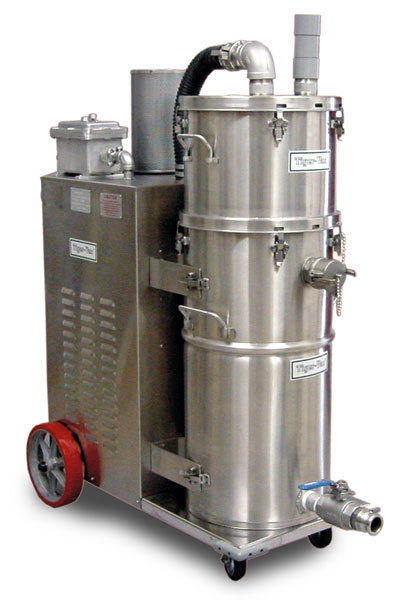
Tiger-Vac CD-3 EX ULPA (W & D) Z1-2-21-22
Three-phase TEFC ATEX II 1/2GD pharma wet/dry vacuum -- 56.8 L dust tank + 64.4 L liquid, ULPA U15 + HEPA H14 standard, ISO Class 4 cleanroom-compatible, AISI 304/316
- Pharma manufacturing in ISO Class 4 cleanrooms with combined zone marking
- Bio-pharma and pharmaceutical pilot production with solvent vapour
- Pharma CMR substances (cytostatics, hormones, beta-lactam antibiotics) wet or dry
- Semiconductor and electronics fabs where 99.999 % filtration is required in ATEX zones
- Research and pilot plants where cross-contamination must be minimised in combined zones
- ATEX Directive 2014/34/EU -- II 1/2GD External: Ex db h IIB T4 Gb -- Ex h tb IIIC T135 C Db IP65 -- Internal: Ex h IIC T6 Ga -- Ex h IIIC T50 C Da -- -5 C <= Ta <= +37 C -- EN 17348 DT/LC -- LCIE 03 ATEX 6295 X -- IECEx LCI 10.0040X -- ATEX 3rd party -- ISO Class 4 cleanroom-compatible -- mindre end 10 ohm modstand
- EN 17348:2022 (harmonized March 2023)
- IEC 60335-2-69 (industrial vacuums)
Tiger-Vac CD-3 EX ULPA (W & D) Z1-2-21-22
The Tiger-Vac CD-3 EX ULPA (W & D) Z1-2-21-22 is Tiger-Vac's pharma-oriented ATEX II 1/2GD wet/dry vacuum with the highest filtration in the range. 3rd party certified per LCIE 03 ATEX 6295 X and IECEx LCI 10.0040X. A 400 V TEFC induction motor (4 kW, 8.7 A) delivers 299 m3/h at 3380 mmH2O -- about 41 % more flow and 33 % higher vacuum than the CD-63L. ULPA U15 (99.999 % MPPS 0.12 micron) is standard plus HEPA H14 -- giving ISO Class 4 cleanroom compatibility for pharma applications. The entire construction is AISI 304/316 stainless steel with less than 10 ohm resistance to ground (grounded for safe discharge of static electricity). 56.8 L dust tank + 64.4 L liquid capacity. The 82 dB(A) sound level is higher than the CD-63L, but that is the price of the 4 kW motor that makes the unit a pharma workhorse. Note: the higher noise level requires hearing protection for continuous use.
Applications
- Pharma manufacturing in ISO Class 4 cleanrooms with combined zone marking
- Bio-pharma and pharmaceutical pilot production with solvent vapour
- Pharma CMR substances (cytostatics, hormones, beta-lactam antibiotics) wet or dry
- Semiconductor and electronics fabs where 99.999 % filtration is required in ATEX zones
- Research and pilot plants where cross-contamination must be minimised in combined zones
Technical specifications
| ATEX marking | II 1/2GD External: Ex db h IIB T4 Gb -- Ex h tb IIIC T135 C Db IP65 -- Internal: Ex h IIC T6 Ga -- Ex h IIIC T50 C Da -- -5 C <= Ta <= +37 C -- EN 17348 DT/LC -- LCIE 03 ATEX 6295 X -- IECEx LCI 10.0040X -- ATEX 3rd party -- ISO Class 4 cleanroom-compatible -- mindre end 10 ohm modstand |
|---|---|
| Internal / external zone | 20 / 21 |
| Motor type | Three-phase TEFC induction motor, explosion-protected (Ex db h IIB T4 Gb / Ex h tb IIIC T135 C Db IP65) -- 3rd party certified |
| Duty cycle | |
| Airflow | 299 m³/h |
| Vacuum | 331 mbar (3380 mmH₂O) |
| Container | 56.8 L |
| Sound pressure | 82 dB(A) |
| Filter class | H class |
| Filter type | HEPA H14 (EN 1822, 99.995 % MPPS) included as standard + ULPA U15 (99.999 % MPPS 0.12 micron) -- aerosol leak-tested, OSHA-compliant |
| Primary filter | Main filter SD* static dissipative with pre-filter SD* and liquid filter (separate for liquid pick-up) |
| Cleaning system | Ingen aktivt filterrens-system -- skiftes ved mætning |
| Collection system | Detachable container |
| Material | AISI 304 and 316 stainless steel construction -- less than 10 ohm resistance to earth |
| IP class | IP65 |
| Power | 4.0 kW |
| Current | 8.7 A |
| Voltage | 400 V / 50 Hz / 3~ |
| Inlet | Ø 50 mm |
| Dimensions (L × W × H) | 1100 x 510 x 1310 mm |
| Weight | 160 kg |
Questions and answers
What is the difference between CD-3 EX (W&D) and CD-3 EX (MRAC)?
Drive specs are identical (4 kW, 299 m3/h, 3380 mmH2O, 82 dB(A), 56.8 L dust + 64.4 L liquid, 160 kg, AISI 304/316). The difference is the filter stack: the standard W&D version has HEPA H14 + ULPA U15 absolute filters. The MRAC version adds a Middle Ring with Activated Carbon -- a cartridge with 8 kg activated carbon that adsorbs toxic and odorous vapours (VOC, acid vapours, mercury vapours depending on carbon type). Choose W&D for standard pharma applications; choose MRAC when the recovered substances also emit harmful vapours.
Why 82 dB(A)?
The CD-3 EX uses a 4 kW TEFC motor with high flow (299 m3/h), giving a higher noise level than smaller machines. 82 dB(A) is above the occupational health limit of 80 dB(A) for daily exposure without hearing protection. For continuous use the operator must wear hearing protection (SNR >= 25 dB recommended). If lower noise is critical, see the CD-63L EX (W&D) which is 72 dB(A) but with lower flow.
What does "less than 10 ohm resistance" mean?
The whole machine (body, cart, wheels, tools) has less than 10 ohm resistance to ground -- measured per EN 60079-32-1. This is necessary for safe discharge of static electricity that can otherwise build up from the collected dust and liquid. ESD ignition (with arc) can ignite combustible dust or vapour at relatively low energy (less than 1 mJ for IIIC dust) -- therefore ESD grounding is mandatory on ATEX vacuums. The CD-3 EX's low resistance is specifically designed to meet this requirement.
Can it handle combustible powder?
Yes -- combustible powder per the ATEX directive is part of the certificate's coverage. Specifically: II 1/2GD with IIIC marking covers conductive and non-conductive combustible powder. For metallic powders (aluminium, iron, magnesium, lithium) the optional conductive metal dust motor (Class II Group E in North America / Group IIIC in Europe) plus a liquid bath immersion system must be used to neutralise self-ignition risk.
What activated carbon types are available for the MRAC version?
Tiger-Vac offers four carbon types in 8 kg cartridges: Regular activated carbon (212200B) for general VOC removal, MERSORB (212200C) for mercury vapours, KOGC3/KINA3 (212200K) for acid vapours and chlorides, and A-3 (212200L) for ammonia and arsine/phosphine. Choose the cartridge based on the specific gas/vapour spectrum in your application. Cartridge life is typically 6-12 months depending on concentration and air volume.