
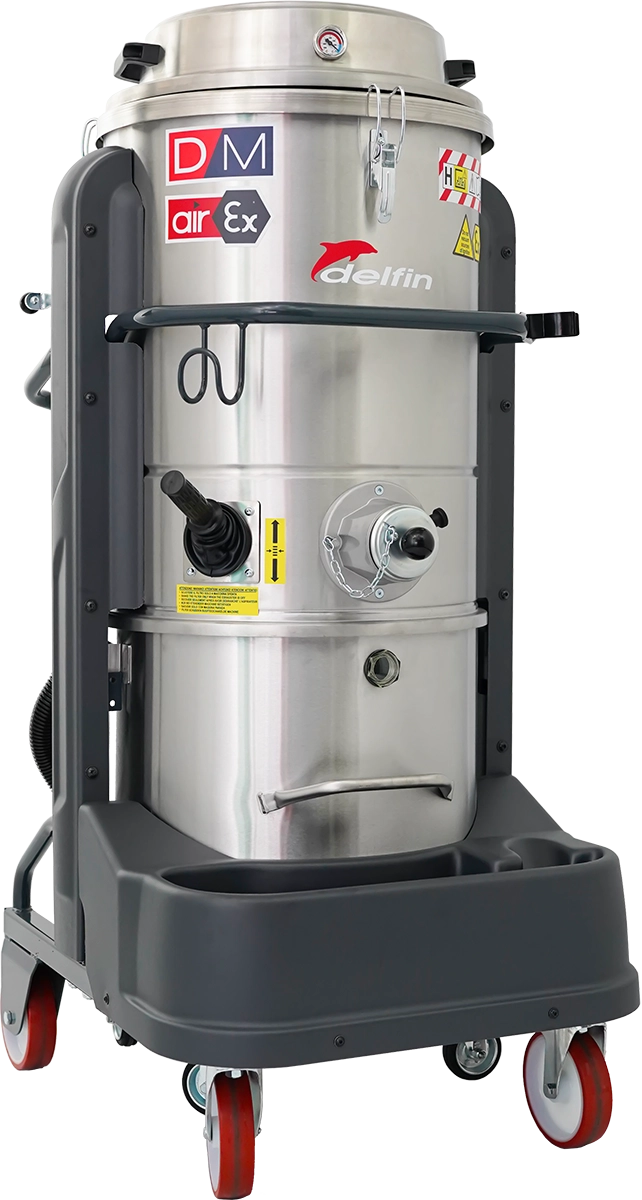
Delfin DM AIREX 19V 1/2D - 2/2G
Pneumatic ATEX combi vacuum for gas Zone 1 and dust Zone 21 -- 19 venturi, 100 L tank, AISI 304 stainless construction, gas group IIC
- Refineries and chemical plants with hydrogen or acetylene atmospheres (gas group IIC)
- Pharmaceutical factories with volatile organic substances and powder
- Process plants where both gas and dust must be handled in one task
- Central suction at large facilities with combi-zones and high dust volume
- Special applications requiring absolute spark-freedom in IIC gas group
- ATEX Directive 2014/34/EU -- II 1/2D Ex h IIIC T85°C Da/Db -- II 2/2G Ex h IIC T6 Gb/Gb
- EN 17348:2022 (harmonized March 2023)
- IEC 60335-2-69 (industrial vacuums)
Delfin DM AIREX 19V 1/2D - 2/2G
The Delfin DM AIREX 19V 1/2D-2/2G is the large combi-certified AIREX model -- double certificate (II 1/2D Ex h for dust and II 2/2G Ex h IIC for gas, including gas group IIC which covers hydrogen and acetylene), 100-litre tank and full AISI 304 stainless construction (tank, filter chamber and motor head). 19 venturi units deliver 465 m³/h airflow and 5000 mmH₂O vacuum. Notified-body certified by IMQ and built for the toughest combi tasks -- explosion-hazardous areas with hydrogen or acetylene atmospheres and simultaneous combustible dust.
Applications
- Refineries and chemical plants with hydrogen or acetylene atmospheres (gas group IIC)
- Pharmaceutical factories with volatile organic substances and powder
- Process plants where both gas and dust must be handled in one task
- Central suction at large facilities with combi-zones and high dust volume
- Special applications requiring absolute spark-freedom in IIC gas group
Technical specifications
| ATEX marking | II 1/2D Ex h IIIC T85°C Da/Db -- II 2/2G Ex h IIC T6 Gb/Gb |
|---|---|
| Internal / external zone | 20 / 21 |
| Motor type | 19 venturi-enheder, pneumatisk drift (trykluft) |
| Duty cycle | Continuous |
| Airflow | 465 m³/h |
| Vacuum | 490 mbar (5000 mmH₂O) |
| Container | 100 L |
| Sound pressure | 74 dB(A) |
| Filter class | H class |
| Filter type | HEPA H14 (EN 1822-5), 99,995 % ved MPPS, 26.000 cm² filterflade |
| Primary filter | Antistatisk polyester klasse ANT M PTFE (star/lommefilter, 30.000 cm², diameter 500 mm). |
| Cleaning system | Manuel ryste-rensning af lommefilter |
| Collection system | Plastic bag |
| Material | AISI 304 rustfrit stål (helkonstruktion inkl. beholder, filterkammer og hoved) |
| Air consumption | 1530 nl/min |
| Supply pressure | 6 bar |
| Air supply hose | Ø 12 mm |
| Venturi units | 19 pcs |
| Inlet | Ø 80 mm |
| Dimensions (L × W × H) | 620 x 620 x 1600 mm |
| Weight | 80 kg |
Questions and answers
Why pneumatic venturi drive instead of an electric motor?
Venturi units have no moving parts, no brushes and no motor windings. That eliminates two things at once: a potential ignition source in an explosive atmosphere, and the maintenance burden of motor, bearings and cooling. The vacuum can run continuously for as long as compressed air is supplied, and there are no electrical components to certify or inspect. The trade-off is air consumption -- venturi makes most sense where compressed air is already available (production plants, refineries, pharmaceutical facilities).
Why is the 1/2D-2/2G model categorised as ATEX Combi?
This model is double-certified: "II 1/2D" covers dust (internal Zone 20, external Zone 21), and "II 2/2G" covers gas (Zone 1 both inside and outside). Since it can operate safely in areas where dust and gas atmospheres may occur simultaneously, it belongs in the ATEX Combi category in our catalogue. Equivalent to IEC notation II 1/2GD. Typical use: refineries, chemical plants, drying processes and fuel handling where both atmospheres can occur.
What compressed-air installation is required?
The unit requires clean, dry compressed air at 6 bar with a 12 mm ID supply hose. Air consumption at full load is 1530 nl/min, which corresponds to a mid-range industrial compressor, so the installation must be able to sustain this. Always fit an air filter upstream to protect the venturi nozzles.
What is gas group IIC, and why does it matter?
Gas group indicates which type of gas the machine is certified for. IIA covers propane, butane and most hydrocarbons. IIB covers ethylene and broader hydrocarbons. IIC is the most stringent class and covers hydrogen and acetylene -- gases with the lowest ignition energy. The DM AIREX 19V 1/2D-2/2G is certified IIC, so it can be used across the full spectrum. The smaller 802 WD combi models are only certified IIB, so they cannot be used in hydrogen or acetylene atmospheres.
Who has certified the model?
The AIREX series is certified by IMQ (Istituto Italiano del Marchio di Qualità) as notified body under ATEX Directive 2014/34/EU, and the IECEx certificate is issued through IMQ as well. Both certificates underpin the CE marking shown on the machine's nameplate. Document numbers available upon request.
How is the dust collected?
Dust is collected in a 100-litre tank lined with a plastic bag. When full, the bag is closed and disposed of without the operator coming into direct contact with the dust. After the primary filter sits an HEPA H14 filter (99.995 % efficiency at MPPS per EN 1822-5) as the final stage, so the exhaust is clean even for fine or health-hazardous particles.