
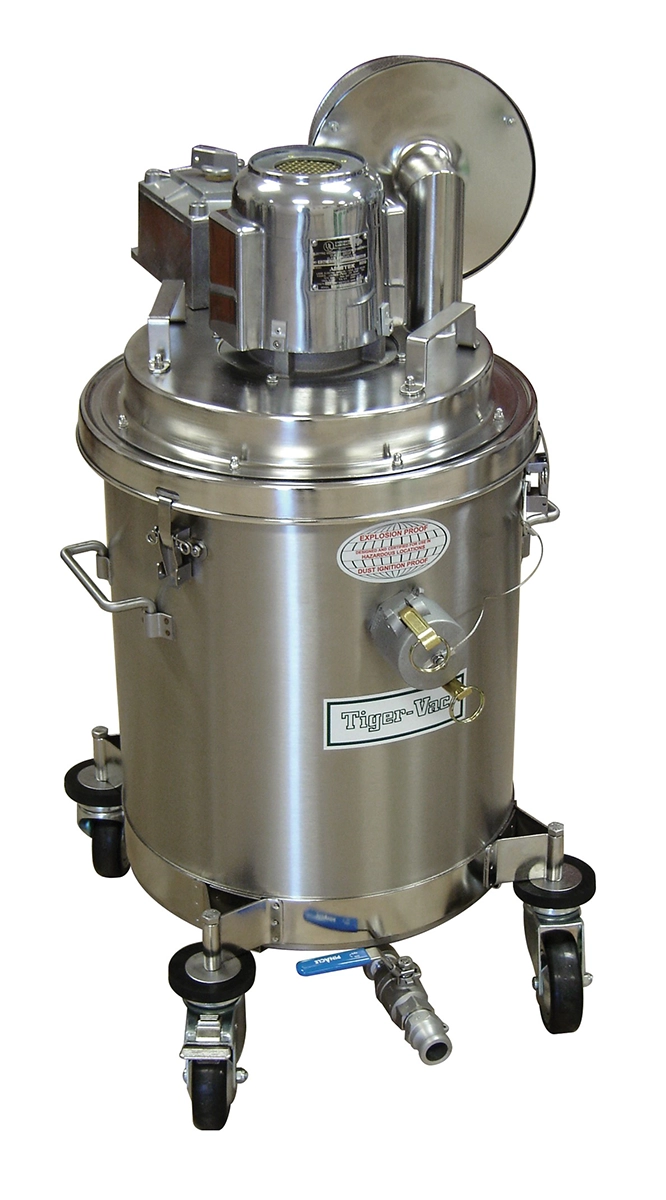
Tiger-Vac EXP1-10/15 (4W) RE
Single-phase TEFC ATEX combined vacuum for Zone 1 gas + Zone 21 dust -- wet and dry recovery, HEPA H14 standard, available with 22.7 L or 38 L container
- Pharmaceutical production with both powder recovery and water-based cleaning in one workflow
- Chemical filling lines with solvent vapours, product powders and non-flammable spills
- Cleanroom class 4 environments where AISI 304 and static dissipation are mandatory
- Filling and post-processing with both dry and wet waste
- Maintenance teams wanting to avoid running two separate machines in the same ATEX zone
- ATEX Directive 2014/34/EU -- II 2GD Ex d IIA T3 Gb / Ex t IIIC T200°C Db IP6X -- LCIE 03 ATEX 6297 -- EN 17348
- EN 17348:2022 (harmonized March 2023)
- IEC 60335-2-69 (industrial vacuums)
Tiger-Vac EXP1-10/15 (4W) RE
The Tiger-Vac EXP1-10/15 (4W) RE is the versatile workhorse of the EXP1 line -- certified II 2GD to EN 17348 DT/LC for both dry recovery of combustible dust and wet recovery of non-flammable liquids. Available in two container sizes: EXP1-10 with 22.7 L dust / 28.5 L liquid, and EXP1-15 with 38 L dust / 47.3 L liquid -- all other specifications are identical, so the choice is purely one of capacity and height (84 cm vs 97 cm). H14 HEPA filter and ISO Class 4 cleanroom compatibility are standard on both.
Applications
- Pharmaceutical production with both powder recovery and water-based cleaning in one workflow
- Chemical filling lines with solvent vapours, product powders and non-flammable spills
- Cleanroom class 4 environments where AISI 304 and static dissipation are mandatory
- Filling and post-processing with both dry and wet waste
- Maintenance teams wanting to avoid running two separate machines in the same ATEX zone
Technical specifications
| ATEX marking | II 2GD Ex d IIA T3 Gb / Ex t IIIC T200°C Db IP6X -- LCIE 03 ATEX 6297 -- EN 17348 |
|---|---|
| Internal / external zone | -- / 21 |
| Motor type | 1-faset TEFC-motor, eksplosionssikret (Ex d IIA T3 Gb / Ex t IIIC T200°C Db), 1.0 kW / 4.5 A |
| Duty cycle | Continuous |
| Airflow | 224 m³/h |
| Vacuum | 152 mbar (1550 mmH₂O) |
| Container | 22.7 L |
| Sound pressure | 78 dB(A) |
| Filter class | H class |
| Filter type | HEPA H14 (EN 1822-5, 99.995 % @ 0.3 µm MPPS), 211027B |
| Primary filter | Statisk ledende klud-hovedfilter 211013 + forfilter 212008 + væskefilter 211010 |
| Cleaning system | Ingen (manuel) |
| Collection system | Detachable container |
| Material | AISI 304 rustfri stål |
| IP class | IP6X |
| Power | 1.0 kW |
| Current | 4.5 A |
| Voltage | 230 V / 50 Hz / 1~ |
| Inlet | Ø 38 mm |
| Dimensions (L × W × H) | 480 x 460 x 840 (EXP1-10) / 480 x 460 x 970 (EXP1-15) mm |
| Weight | 31 kg |
Questions and answers
What does II 2GD mean in the ATEX marking?
II 2GD means category 2 for both gas and dust. The unit may be used in areas where explosive atmospheres OCCASIONALLY occur during normal operation -- that is external Zone 1 for gas and Zone 21 for dust. Category 2 does NOT cover the interior of the equipment (Zone 0/20) -- that requires category 1. EN 17348:2022 is the harmonised standard that specifies test requirements for vacuums in this category.
What is the difference between EXP1-10 and EXP1-15?
All specs are identical -- motor, vacuum, airflow, filter class, ATEX marking -- except tank size and therefore height. EXP1-10: 22.7 L dust / 28.5 L liquid, 84 cm tall, 31 kg. EXP1-15: 38 L dust / 47.3 L liquid, 97 cm tall, 37 kg. The choice is purely capacity and available headroom/floor footprint.
Which liquids may I pick up?
EN 17348 DT/LC on this model covers NON-flammable liquids. That is water, aqueous solutions and non-ignitable process liquids. Flammable or solvent-based liquids require the MRAC variant (EXP1-10 (4W) RE HEPA (MRAC), DT/LC flammable) or a consultation with Particulair.
Is the HEPA filter standard or optional?
HEPA H14 to EN 1822-5 (99.995 % MPPS at 0.3 µm) is standard on this model. ULPA filter can be specified if the application requires a higher class.
How is the collected material handled safely?
The conductive poly liner (212100A / 212100B) is placed in the container before use. When the dust has been collected, the liner is sealed and disposed of without direct contact -- critical for both occupational safety and ATEX hygiene, because the liner is static-dissipative and cannot build electrostatic charge during disposal. Always keep the same ESD chain on bags, hoses and accessories, and always ground the unit during operation.
Can I switch between dry and wet during the same task?
Yes -- but swap the liquid filter 211010 to the correct configuration before wet recovery, and empty the tank fully before returning to dry recovery. Primary filter 211013 and pre-filter 212008 must be in good condition and dry during dry recovery to preserve HEPA efficiency.