
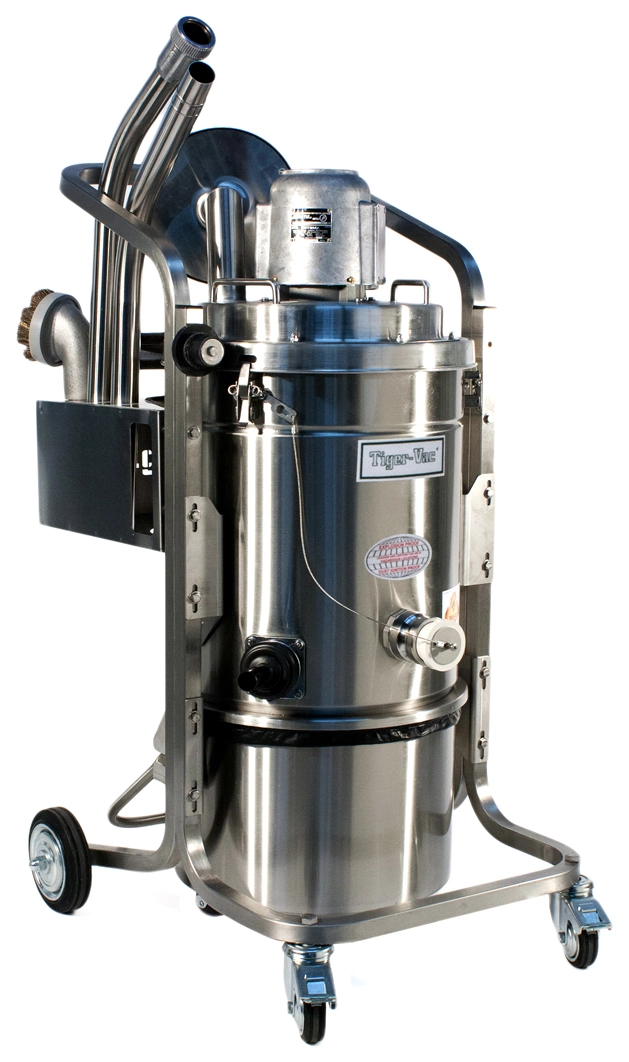
Tiger-Vac EXP1-10 (25L) DT RE HEPA MFS (SS-FOD CART)
Single-phase TEFC ATEX combined vacuum for Zone 1 gas + Zone 21 dust -- 25 L detachable tank (DT), Manual Filter Shaker (MFS), stainless FOD tool basket, ISO Class 4 cleanroom compatible
- Pharmaceutical tablet compression with daily cleaning of press areas
- Laboratories and pilot lines where a detachable tank provides fast emptying
- Aerospace and precision manufacturing where FOD control is critical
- ISO Class 4 cleanrooms with external Zone 21 dust
- Chemical QC labs where solvents are vacuumed alongside powder dust
- ATEX Directive 2014/34/EU -- II 2GD Ex d IIA T3 Gb / Ex t IIIC T200°C Db IP6X -- LCIE 03 ATEX 6297 -- EN 17348
- EN 17348:2022 (harmonized March 2023)
- IEC 60335-2-69 (industrial vacuums)
Tiger-Vac EXP1-10 (25L) DT RE HEPA MFS (SS-FOD CART)
The Tiger-Vac EXP1-10 (25L) DT RE HEPA MFS (SS-FOD CART) is a compact ATEX combined vacuum certified II 2GD to EN 17348 for simultaneous Zone 1 gas and Zone 21 dust. It combines a 25 litre detachable recovery tank with a Manual Filter Shaker (MFS) system and a star-shaped SD main filter, so the filter cake can be released without opening the machine. The FOD stainless steel tool basket (Foreign Object Debris) keeps accessories on the unit and prevents contamination -- important in pharma and aerospace. A 1.0 kW TEFC motor delivers 224 m3/h at 1550 mmH2O, and ISO Class 4 cleanroom compatibility makes it suitable for pharmaceutical production. HEPA H14 final filter (EN 1822-5) and a static-dissipative poly liner are standard.
Applications
- Pharmaceutical tablet compression with daily cleaning of press areas
- Laboratories and pilot lines where a detachable tank provides fast emptying
- Aerospace and precision manufacturing where FOD control is critical
- ISO Class 4 cleanrooms with external Zone 21 dust
- Chemical QC labs where solvents are vacuumed alongside powder dust
Technical specifications
| ATEX marking | II 2GD Ex d IIA T3 Gb / Ex t IIIC T200°C Db IP6X -- LCIE 03 ATEX 6297 -- EN 17348 |
|---|---|
| Internal / external zone | -- / 21 |
| Motor type | Single-phase TEFC motor, explosion-proof (Ex d IIA T3 Gb / Ex t IIIC T200°C Db), 1.0 kW / 4.5 A |
| Duty cycle | Continuous |
| Airflow | 224 m³/h |
| Vacuum | 152 mbar (1550 mmH₂O) |
| Container | 25 L |
| Sound pressure | 78 dB(A) |
| Filter class | H class |
| Filter type | HEPA H14 (EN 1822-5, 99,995 % @ 0,3 µm MPPS), 211027B |
| Primary filter | SD star-shaped main filter with PTFE lamination, filter support ring and steel cage (218424AT) |
| Cleaning system | Manual Filter Shaker (MFS) -- manuel mekanisk filterrys |
| Collection system | Detachable container |
| Material | AISI 304 stainless steel |
| IP class | IP6X |
| Power | 1.0 kW |
| Current | 4.5 A |
| Voltage | 230 V / 50 Hz / 1~ |
| Inlet | Ø 50 mm |
| Dimensions (L × W × H) | 660 x 660 x 1090 mm |
| Weight | 45 kg |
Questions and answers
What is the difference between MFS and MRP filter cleaning?
MFS (Manual Filter Shaker) uses a lever that mechanically shakes the main filter, causing the dust cake to fall into the container. It is simple, nothing changes in motor or airflow, and it is ATEX-safe because no valves or electrics are involved. MRP (Manual Reverse Purge) instead uses a reverse airflow through the filter to release the dust. MRP is effective for fine sticky powders, MFS is effective for coarser dust that falls easily.
What does FOD basket mean and why is it relevant?
FOD stands for Foreign Object Debris -- a term from aerospace covering any foreign object that can contaminate a production area. A stainless steel FOD basket keeps accessories (hose, nozzles, brush) on the machine itself rather than on the floor, so the operator does not risk leaving screws, hardware or plastic parts in a cleanroom or aircraft production line. In pharma and medical devices, it is a simple but real quality control.
What does ISO Class 4 cleanroom (formerly Class 10) mean?
ISO 14644-1 Class 4 permits a maximum of 10,000 particles at 0.1 µm or larger per cubic metre of air -- one of the cleanest levels used regularly in pharmaceutical and semiconductor production. The former US Federal Standard 209E called the same level "Class 10" (10 particles at 0.5 µm per cubic foot). AISI 304 construction with smooth surfaces and HEPA H14 exhaust makes the EXP1-10 (25L) compatible with these requirements -- though the installation itself must be validated locally.
Can it pick up liquids?
No. The EXP1-10 (25L) DT RE HEPA MFS is dry recovery only (EN 17348 DT). For both dry and wet within the same II 2GD envelope, choose the EXP1-15/25 (TC) RE HEPA (DT/LC), which is EN 17348 DT/LC for combined dry + non-flammable liquids.
How compact is the unit really?
L × W × H = 660 × 660 × 1090 mm, weight 45 kg, container 25 L. It is mid-sized -- smaller than the EXP1-35L MRP (64 × 64 × 142 cm, 54 kg) but larger than the EXP1-5 (4W) (53 × 61 × 75 cm, 27 kg). It fits under a lab bench with 110 cm ceiling height, and the FOD basket adds about 5 cm in one dimension.
What is the difference between this and the EXP1-35L DT MRP?
Both have a detachable tank (DT) and the same motor, but they differ on three points: container size (25 L vs 35 L), filter cleaning (MFS mechanical shake vs MRP reverse pulse) and FOD basket (only on the 25L). Choose the 25L MFS if the operator wants to keep accessories on the machine and the dust is easy to shake down; choose the 35L MRP if you handle finer, sticky dust and need the extra volume.