
Tiger-Vac EXP1-10 (4W) RE HEPA (MRAC)
Single-phase TEFC ATEX combined vacuum for Zone 1 gas + Zone 21 dust -- with activated carbon Middle Ring (MRAC) for toxic vapour absorption, flammable liquids, 22.7 L dust / 28.5 L liquid
- Mercury remediation in laboratories and dental clinics with MERSORB carbon variant
- Chlorine production and halogen chemistry with KOGC3/KINA3 carbon for chloride vapours
- Semiconductor and LED manufacturing with arsine and phosphine exposure (A-3 carbon)
- Pharmaceutical production with volatile toxic intermediates
- Research and incident response where unknown toxic vapours may be present
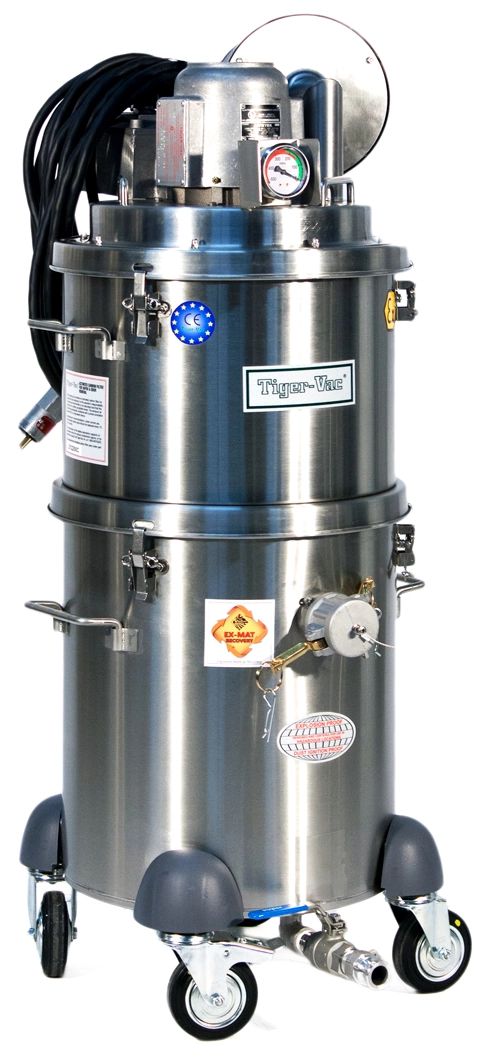
- ATEX Directive 2014/34/EU -- II 2GD Ex d IIA T3 Gb / Ex t IIIC T200°C Db IP6X -- LCIE 03 ATEX 6297 -- EN 17348
- EN 17348:2022 (harmonized March 2023)
- IEC 60335-2-69 (industrial vacuums)
Tiger-Vac EXP1-10 (4W) RE HEPA (MRAC)
The Tiger-Vac EXP1-10 (4W) RE HEPA (MRAC) is the specialist in the line -- built with a Middle Ring Activated Carbon module between container and motor head that absorbs toxic and corrosive vapours in the work air before HEPA filtration. Certified II 2GD to EN 17348 DT/LC for both combustible dust and flammable liquids in Zone 1/21. The Middle Ring ships with 3 mm regular carbon (212200B) as standard and can be specified for mercury vapours (MERSORB, 212200C), chloride vapours (KOGC3/KINA3, 212200K) or arsine/phosphine (A-3, 212200L).
Applications
- Mercury remediation in laboratories and dental clinics with MERSORB carbon variant
- Chlorine production and halogen chemistry with KOGC3/KINA3 carbon for chloride vapours
- Semiconductor and LED manufacturing with arsine and phosphine exposure (A-3 carbon)
- Pharmaceutical production with volatile toxic intermediates
- Research and incident response where unknown toxic vapours may be present
Technical specifications
| ATEX marking | II 2GD Ex d IIA T3 Gb / Ex t IIIC T200°C Db IP6X -- LCIE 03 ATEX 6297 -- EN 17348 |
|---|---|
| Internal / external zone | -- / 21 |
| Motor type | Single-phase TEFC motor, explosion-proof (Ex d IIA T3 Gb / Ex t IIIC T200°C Db), 1.0 kW / 4.5 A |
| Duty cycle | Continuous |
| Airflow | 224 m³/h |
| Vacuum | 152 mbar (1550 mmH₂O) |
| Container | 22.7 L |
| Sound pressure | 78 dB(A) |
| Filter class | H class |
| Filter type | HEPA H14 (EN 1822-5, 99.995 % @ 0.3 µm MPPS), 211027B, 6,500 cm² filter area |
| Primary filter | Static conductive cloth main filter 211013 (3,480 cm²) + pre-filter 212008 + liquid filter 211010 |
| Cleaning system | Ingen (manuel) |
| Collection system | Detachable container |
| Material | AISI 304 stainless steel |
| IP class | IP6X |
| Power | 1.0 kW |
| Current | 4.5 A |
| Voltage | 230 V / 50 Hz / 1~ |
| Inlet | Ø 38 mm |
| Dimensions (L × W × H) | 480 x 460 x 1190 mm |
| Weight | 37 kg |
Questions and answers
What does II 2GD mean in the ATEX marking?
II 2GD means category 2 for both gas and dust. The unit may be used in areas where explosive atmospheres OCCASIONALLY occur during normal operation -- that is external Zone 1 for gas and Zone 21 for dust. Category 2 does NOT cover the interior of the equipment (Zone 0/20) -- that requires category 1. EN 17348:2022 is the harmonised standard that specifies test requirements for vacuums in this category.
Which carbon variant should I choose?
The Middle Ring Activated Carbon (MRAC) is available in four variants matched to the contaminant type. Regular (212200B) is standard and covers general VOCs and light solvents. MERSORB (212200C) is sulphur-impregnated for mercury vapours -- used in dental clinics, laboratories and mercury remediation. KOGC3/KINA3 (212200K) is impregnated for acid vapours and chlorides -- used in halogen chemistry and chlorine production. A-3 (212200L) covers ammonia, arsine and phosphine -- used in semiconductor and LED production. See our wiki article on MRAC carbon variants for the full overview.
How often must the carbon charge be replaced?
It depends entirely on the contaminant type and concentration. Regular 212200B can last several months in routine VOC collection; MERSORB in mercury remediation can saturate in weeks. Tiger-Vac recommends monitoring via downstream sampling before the carbon section, or -- for high-risk substances -- a scheduled replacement programme. Contact Particulair for a proposal.
Is the HEPA filter standard or optional?
HEPA H14 to EN 1822-5 (99.995 % MPPS at 0.3 µm) is standard on this model. ULPA filter can be specified if the application requires a higher class.
How is the collected material handled safely?
The conductive poly liner (212100A) is placed in the container before use. When the dust has been collected, the liner is sealed and disposed of without direct contact -- critical for both occupational safety and ATEX hygiene, because the liner is static-dissipative and cannot build electrostatic charge during disposal. Always keep the same ESD chain on bags, hoses and accessories, and always ground the unit during operation.
Can I pick up flammable liquids?
Yes -- this is the only EXP1 model certified EN 17348 DT/LC for FLAMMABLE liquids. The carbon filter absorbs vapours from the liquid before the HEPA section, reducing explosion risk in the exhaust. A float valve closes the suction inlet at maximum liquid level. Note: always verify the specific liquid's compatibility with the carbon variant before use.