Mobile single-phase TEFC immersion separator for combustible metal powder -- collection straight into a water bath, CFE coalescing filter of HEPA grade, SS304 tank and four-wheel dolly. Certified II 2GD to EN 17348 WT
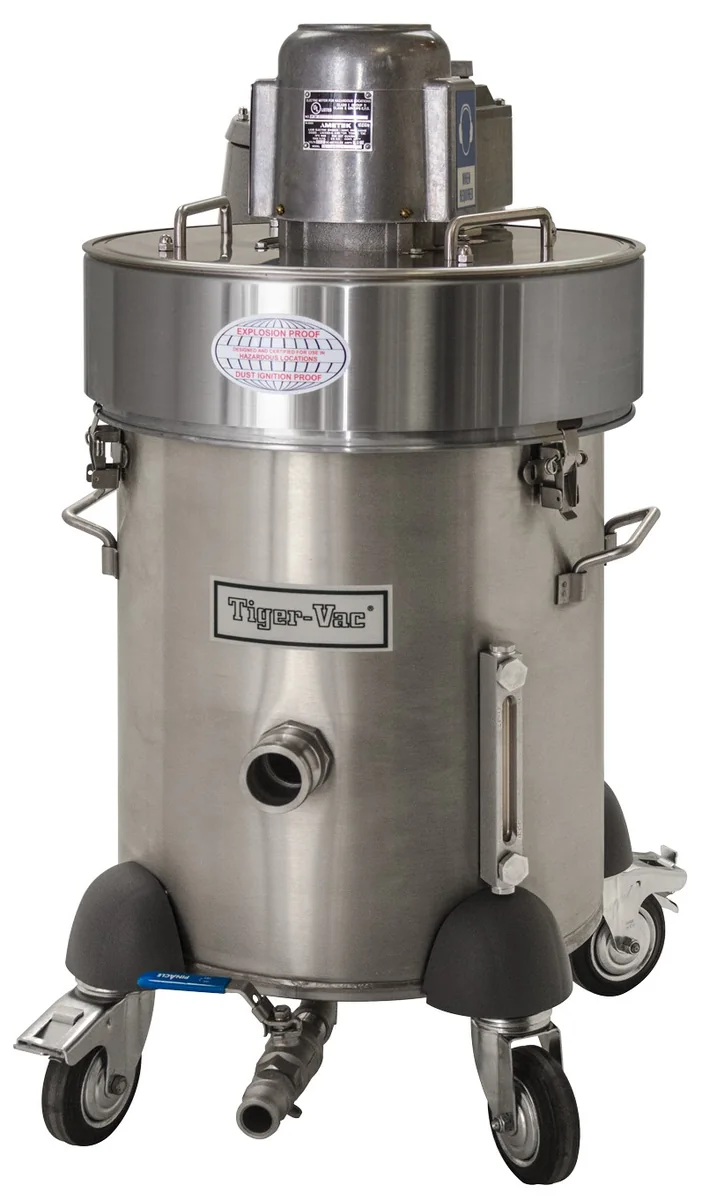
The Tiger-Vac EXP1-10 (IT-40L) EX (CFE) HEPA W/3D TOOL KIT is a mobile immersion separator -- a vacuum where the recovered powder does not land in a dry container but is drawn straight down into a liquid bath. Tiger-Vac describes the principle as recovery and inertisation of combustible dust into a liquid immersion bath: as long as the particles stay wetted they cannot form a dust cloud, which removes one of the five conditions a dust explosion needs. That is the essential difference between this machine and a conventional ATEX vacuum with a bag filter. This model is intended for water (not oil) and needs 12.3 L of water in the recovery tank before use. Collection itself happens in a conductive disposable wet bag rated at 3 L, which can be sealed and removed without the powder ever being dry. A degassing vent releases gas from the unit automatically, and a liquid level indicator lets you check the bath without opening the tank. CFE stands for Coalescing Filter Element -- a coalescing filter that strips moisture from the outgoing air and filters at HEPA grade, which Tiger-Vac states as 99.97 % at 0.3 micron. The motor is a single-phase 1 kW TEFC unit (Ex d IIA T3 Gb) delivering 224 m3/h at 1550 mmH2O. The tank is AISI 304 stainless steel and the machine stands on a four-wheel dolly. A complete static-dissipative (SD) accessory set is included, together with a dedicated 3D tool kit for print chambers and powder handling.
| ATEX marking | II 2GD Ex d IIA T3 Gb -- Ex t IIIC T200°C Db IP6X -- 0 °C <= Ta <= +40 °C -- LCIE 03 ATEX 6297 -- EN 17348 WT |
|---|---|
| Internal / external zone | -- / 21 |
| Motor type | 1-faset TEFC-motor, eksplosionssikret (Ex d IIA T3 Gb / Ex t IIIC T200°C Db IP6X), 1 kW / 4,5 A |
| Duty cycle | Continuous |
| Airflow | 224 m³/h |
| Vacuum | 152 mbar (1550 mmH₂O) |
| Container | 3 L |
| Sound pressure | 79 dB(A) |
| Filter class | H class |
| Filter type | CFE koalescensfilter i HEPA-grad -- Tiger-Vac angiver 99,97 % ved 0,3 mikrometer |
| Primary filter | Væskebad (immersion) -- pulveret opsamles vådt i en ledende engangspose |
| Cleaning system | Væskebad -- ingen tør filterrensning; badet skiftes sammen med vådposen |
| Collection system | Detachable container |
| Material | AISI 304 rustfrit stål |
| IP class | IP6X |
| Power | 1.0 kW |
| Current | 4.5 A |
| Voltage | 230 V / 50 Hz / 1~ |
| Inlet | Ø 38 mm |
| Dimensions (L × W × H) | 480 x 460 x 860 mm |
| Weight | 31.8 kg |
Because dry metal powder in air is among the most dangerous combustible dusts there is. Aluminium, titanium and magnesium have low minimum ignition energy, and a dry container full of fine metal powder is effectively an explosive chamber waiting for an ignition source. In an immersion separator the powder is drawn straight into a liquid bath. The particles are wetted and cannot form a dust cloud -- and without a dust cloud there is no dust explosion. Tiger-Vac calls the principle inertisation in a liquid bath. Note that the method places demands on the liquid: some reactive metals react with water, and there you need a model that can run with oil instead. If you are unsure what your powder tolerates, talk to us before choosing a model.
EN 17348:2022 is the product standard for vacuum cleaners used in explosive atmospheres. It classifies machines by how the collected dust is handled. DT means dry type -- dry collection in a container or bag. WT means wet type -- wet collection, where the dust is held in a liquid. This model is WT, and that is not a detail: the classification says the machine is designed and tested specifically to keep combustible dust wet, not to collect it dry. A DT machine must therefore not be substituted for reactive metal powder, even if it carries the same ATEX marking.
The two models share the same motor, the same airflow and the same ATEX marking. The difference is tank and liquid. This model, the EXP1-10 (IT-40L) EX (CFE), sits on a four-wheel dolly, runs on water only and has a 3 L wet bag. The enhanced version, EXP1-10 (IT-40L) EX DT (CFE), has a detachable tank (DT) so the tank can be wheeled away and swapped without downtime, runs on either water or oil, and has a 4.5 L wet bag. Choose the DT version if your powder does not tolerate water, or if you empty often enough that a detachable tank saves real time.
The marking is II 2GD, that is ATEX category 2 for both gas and dust externally. Specifically the unit may be placed in Zone 1, where an explosive gas atmosphere is likely to occur in normal operation, and in Zone 21, where the same applies to explosive dust. Ambient temperature must be between 0 °C and +40 °C. The machine does not carry a separate internal Zone 0/20 marking; internal safety rests on the liquid bath, not on a zone certification of the internal space. If your print room is not zone classified at all, an ACD machine to IEC 60335-2-69 Annex AA may be enough -- but not for reactive metal powder.
Beyond the standard static-dissipative accessories, the machine ships with a set of tools intended for the printer environment: nozzles and brushes that reach into the build chamber, into corners and around the surfaces of the powder station without improvising. Every accessory in the chain is static dissipative, and that is not optional -- all the way from the nozzle tip to the machine earth, resistance must be low enough for static electricity to drain away. Never mix standard accessories into the set.
